North Texas Water Is Hard. Here Is What It Does to Your Whole Pool.

Austin Andrews
Founder, True Texan Pools
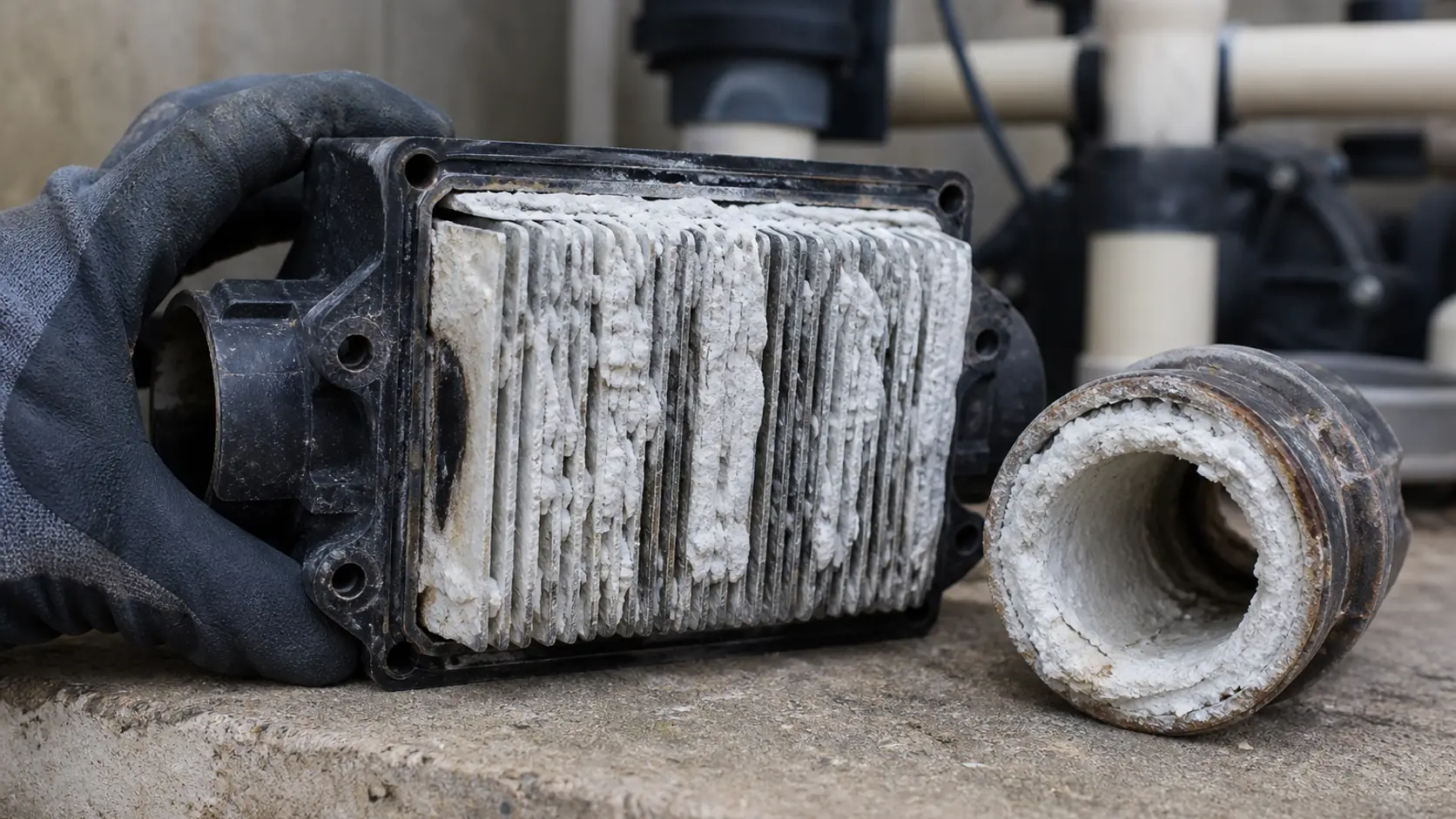
The white band on your tile is the visible part of a problem that starts at the hose. North Texas fill water arrives moderately hard, and nothing in normal pool maintenance takes calcium back out again, so the number has only one direction available to it. It climbs year after year, and it does not stop at the tile: it goes after the heater, the salt cell, the filter, and eventually the plaster. Here is the whole system, and the one decision that actually resets it.
Almost every article about hard water and pools is really about the tile, and almost every one of them treats it as a cleaning problem. Getting the scale off the tile is genuinely covered elsewhere, in our guide to calcium on pool tile, and that is the right article if you are standing at the pool with a pumice stone in your hand right now. This one is about why the band came back.
Where the calcium actually comes from
Not from your chemicals, in most cases. It comes out of the tap. The North Texas Municipal Water District, which supplies Plano, Frisco, McKinney, Allen, and much of the surrounding area, describes its treated water as moderately hard, and its own reports put total hardness roughly in the 105 to 202 ppm range.
Hold that against the Pool & Hot Tub Alliance recommended range for calcium hardness in a concrete or plaster pool, which is 200 to 400 ppm, with 150 ppm as the floor for any pool. Read carelessly, that looks reassuring: our fill water arrives near or below the bottom of the band rather than above it.
The trap is that it does not stay there. Fill water is a starting point, and it is the only input. Nothing in normal pool maintenance removes calcium, so the number has exactly one direction available to it, and a pool that is topped off all summer walks up through the band and out of the top of it. That is why scale is a problem of years here rather than a problem of the hose, and why a three year old pool and a fifteen year old pool on the same street can have completely different hardness. Our water chemistry guide carries the full target ranges.
Two ways of counting the same thing
Municipal reports often quote hardness in grains per gallon, while pool test kits report ppm as calcium carbonate. One grain per gallon is about 17.1 ppm. So water described as 8 to 10 grains per gallon is roughly 140 to 170 ppm, which is why a homeowner comparing a city water report to a pool test kit sometimes concludes the two disagree when they do not.
Then evaporation does the rest
Water evaporates. Calcium does not. Every gallon that leaves your pool as vapor leaves its mineral content behind, and every gallon you add to replace it brings more in. In a North Texas summer a 15 by 30 pool loses close to a thousand gallons a week to evaporation with nothing wrong, which is roughly a thousand gallons a week of fresh calcium delivery.
This is why calcium hardness is the one number on a pool test that only ever goes up. pH drifts both ways. Alkalinity can be raised or lowered. Chlorine is consumed. Calcium accumulates, permanently, until somebody removes water.
What high calcium actually does, component by component
Scale forms where calcium comes out of solution, and it comes out of solution preferentially where water is hottest, most agitated, or where pH is locally highest. That points at specific parts of your system rather than at the pool generally.
| Where | What it looks like | Why it happens there | What it costs |
|---|---|---|---|
| Waterline tile | A chalky white or grey band | Splash and evaporation at the surface concentrate minerals | Cosmetic, then abrasive removal |
| Gas heater exchanger | Nothing visible, then reduced heat and eventual failure | The hottest water in the system is inside it | The most expensive item on this list |
| Salt cell plates | White crust between the plates | High local pH is generated right at the plate surface | Lower output, shorter cell life |
| Filter media | Rising pressure that a cleaning does not fix | Deposits bind into cartridges and sand | Premature media replacement |
| Plaster and steps | A rough, gritty feel underfoot | Surface-wide precipitation once the index goes positive | Eventually a resurface |
| Automatic cleaner and jets | Stiff wheels, crusted fittings | Small passages concentrate deposits fastest | Parts and irritation |
The heater is the one that deserves emphasis, because it is silent. Scale on the inside of a copper heat exchanger insulates the tube from the water it is supposed to be heating, so the flame keeps working against a surface that cannot shed its heat. Efficiency falls first, then the tube fails. There is a reason local specialists write specifically about Collin County hard water and heat exchangers, and it is not marketing.
The number that actually governs scaling
Calcium hardness on its own does not tell you whether water will scale. What matters is the balance between calcium, pH, total alkalinity, and temperature, expressed as a saturation index. The principle is simple even if the arithmetic is not.
- Index positive: the water is oversaturated and wants to deposit calcium. You get scale.
- Index negative: the water is undersaturated and wants to dissolve calcium. It takes it from your plaster and grout instead.
- Index near zero: balanced, which is the whole objective.
Two consequences follow, and they are the two most useful facts in this article.
First, you can offset high calcium with pH and alkalinity. A pool sitting at 400 ppm calcium can be held out of scaling territory by keeping pH at the low end of range and alkalinity at the low end of range. It is not a permanent solution and it does narrow your margin for error, but it is the reason two pools with identical hardness can look completely different.
Second, heat pushes water toward scaling. A heated spa attached to your pool will scale long before the pool does, and an August pool at 90 degrees is closer to precipitating than the same pool in February. Our water chemistry guide covers the targets for each of the four inputs.
Chasing pH down is not a strategy on its own
Owners with hard water often end up pouring acid weekly, which drives alkalinity down along with pH and leaves the water with no buffering capacity at all. The result is a pool whose pH swings violently between doses, which is worse for plaster than the scale was. If you are adding acid every week, the actual problem is upstream, and the answer is usually dilution rather than more acid.
Sequestrants: useful, and frequently misunderstood
A sequestering or chelating agent binds minerals so they stay dissolved instead of depositing. They genuinely work, and on a pool with high hardness and a heater they are reasonable ongoing maintenance.
What they do not do is remove calcium. Your test will read exactly the same number after dosing. They also break down over time and need re-dosing, typically monthly, and they are consumed faster by high chlorine. Treat a sequestrant as a way of buying time until the water exchange rather than as an alternative to it.
The only real fix, and how to do it safely here
Since nothing consumes calcium, lowering it means replacing water with water that has less calcium in it. Dilution is linear: replacing a third of the volume lowers hardness by about a third, less whatever the fill water brings back in. Since our fill water is already hard, that last clause matters, and it is why local pools tend to stabilize at a higher hardness than the textbook target rather than at it.
Do it in stages. Lower the water a foot or two with a submersible pump, refill, let it circulate for a day, retest, and repeat. Then rebalance the fresh water in order: total alkalinity, then pH, then calcium, then chlorine.
Do not empty a pool in Collin County
This is the local rule that overrides most general advice. Our expansive clay holds groundwater that exerts real upward pressure on an empty shell, and a plaster pool sitting empty can lift or crack. That is a structural repair rather than a resurface. Exposed wet plaster also crazes within hours in real heat. Never drain after heavy rain, and if the pool genuinely needs a full exchange, that is a job with a hydrostatic relief valve and somebody watching it. Clay soil and your pool covers the wider picture.
The alternative that keeps your water
Mobile reverse osmosis treatment filters the pool’s existing water on site, stripping calcium and total dissolved solids and returning it. It is more expensive than a hose and it avoids both the structural risk and the water bill of a large exchange, which makes it worth pricing on a big pool with very high hardness, especially during a drought year when filling is restricted anyway.
Living with it, which is what most people actually do
A realistic North Texas hard water routine looks like this.
- Test calcium hardness quarterly rather than weekly. It moves slowly and predictably.
- Hold pH at the lower end of range rather than the middle, and keep alkalinity from drifting up.
- Brush the waterline tile every single visit. Scale that never gets a chance to bond is scale you never have to grind off.
- Run a sequestrant on a schedule if you have a heater or a salt cell.
- Plan a staged partial exchange when hardness climbs well past target, ideally in late winter when nobody wants to swim and evaporation is slow.
- Keep an eye on the heater. Falling heat output with no other symptom is a scale symptom.
Where this becomes our job
The point where most owners hand this over is not the tile. It is the moment they realize the tile is a symptom, the heater has been quietly losing efficiency for two seasons, and nobody has tested calcium hardness in three years. A full chemistry panel including hardness, stabilizer, and alkalinity, plus an honest look at the heater and cell, is what an equipment inspection is for, and chemical balancing is where the ongoing management lives.
Staged partial exchanges we will do. We will also tell you plainly when the honest answer is to leave the hardness where it is and manage the index instead. On a pool with no heater and clean tile, that is frequently the cheaper and safer call.
The thing to hold onto is that hardness here only ever moves in one direction. You are not deciding whether the number goes up. You are deciding whether you bring it down deliberately, in a cold February when nobody wants to swim, or whether you let the heater decide for you.
Frequently Asked Questions
How hard is the water in North Texas for a pool?
Moderately hard, and the number that matters is not the tap. NTMWD's own reports put total hardness roughly in the 105 to 202 ppm range, against a Pool and Hot Tub Alliance recommended range of 200 to 400 ppm for a concrete or plaster pool. So fill water arrives near or below the bottom of the band. The trap is that it is a one-way input: nothing removes calcium, so the pool walks up through the band and out of the top of it over the years.
Why does calcium hardness only ever go up in my pool?
Because water evaporates and calcium does not. Every gallon that leaves as vapor leaves its mineral content behind, and every gallon added to replace it brings more in. In a North Texas summer a 15 by 30 pool loses close to a thousand gallons a week, which is a thousand gallons a week of fresh calcium delivery. Nothing in normal pool maintenance removes it.
What does hard water damage in a pool besides the tile?
The gas heater's heat exchanger, silently, because the hottest water in the system is inside it and scale insulates the tube from the water it is heating until the tube fails. Salt cell plates, because generation raises pH right at the plate surface. Filter media, which binds and stops filtering. And eventually the plaster itself, which goes gritty underfoot once the saturation index turns positive.
Can I offset high calcium hardness with pH and alkalinity?
To a degree, and it is the most useful practical fact here. What governs scaling is the saturation index, which combines calcium, pH, alkalinity, and temperature, not calcium alone. A pool at 400 ppm calcium can be held out of scaling territory by keeping pH and alkalinity at the low end of range. It narrows your margin for error and it explains why two pools with identical hardness look completely different.
Do sequestrants lower calcium hardness?
No. They bind minerals so they stay dissolved rather than depositing, which genuinely works and is reasonable ongoing maintenance on a pool with a heater or a salt cell. Your test will read exactly the same number after dosing. They also break down over time and need re-dosing, typically monthly, so treat one as a way of buying time until a water exchange rather than as an alternative to it.
How do I lower calcium hardness in a pool in Collin County?
By replacing water, in stages, never by draining. Lower the level a foot or two with a submersible pump, refill, circulate for a day, retest, and repeat, then rebalance alkalinity, pH, calcium, and chlorine on the fresh water. Never fully drain, because our expansive clay holds groundwater that can lift or crack an empty shell. Mobile reverse osmosis treatment is the alternative that keeps your water.
Ready to stop thinking about your pool?
True Texan Pools keeps your water swim-ready year-round across Plano and all of DFW. Clear pricing, no contracts, and a photo report after every visit. Austin handles every job personally.
Keep reading
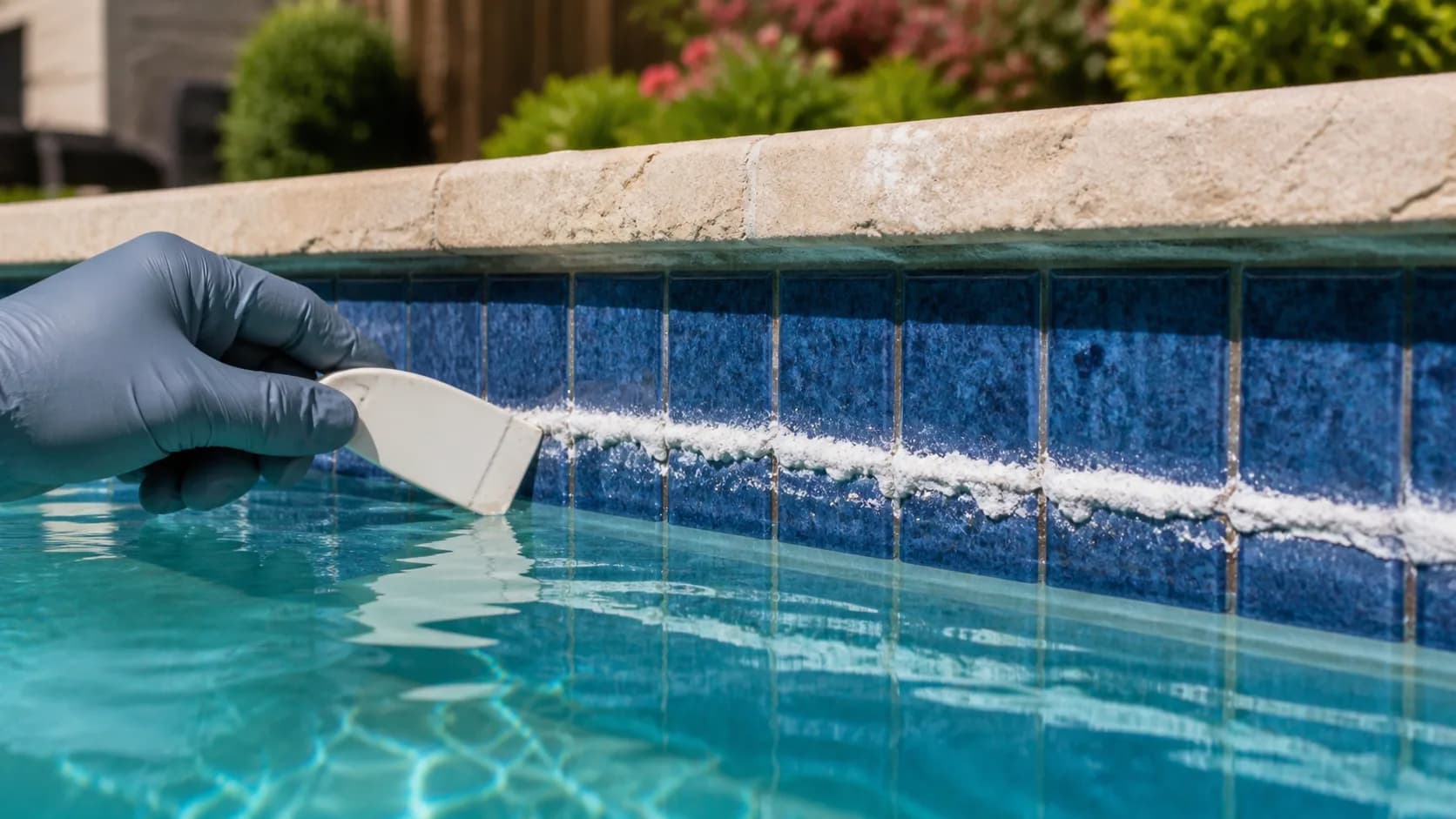
Calcium Scale on Pool Tile: Why It Keeps Coming Back
You can scrub the tile, and you should, but unless you deal with what put the scale there it comes back before the season is out. In DFW, that means understanding why your calcium hardness only ever goes up.
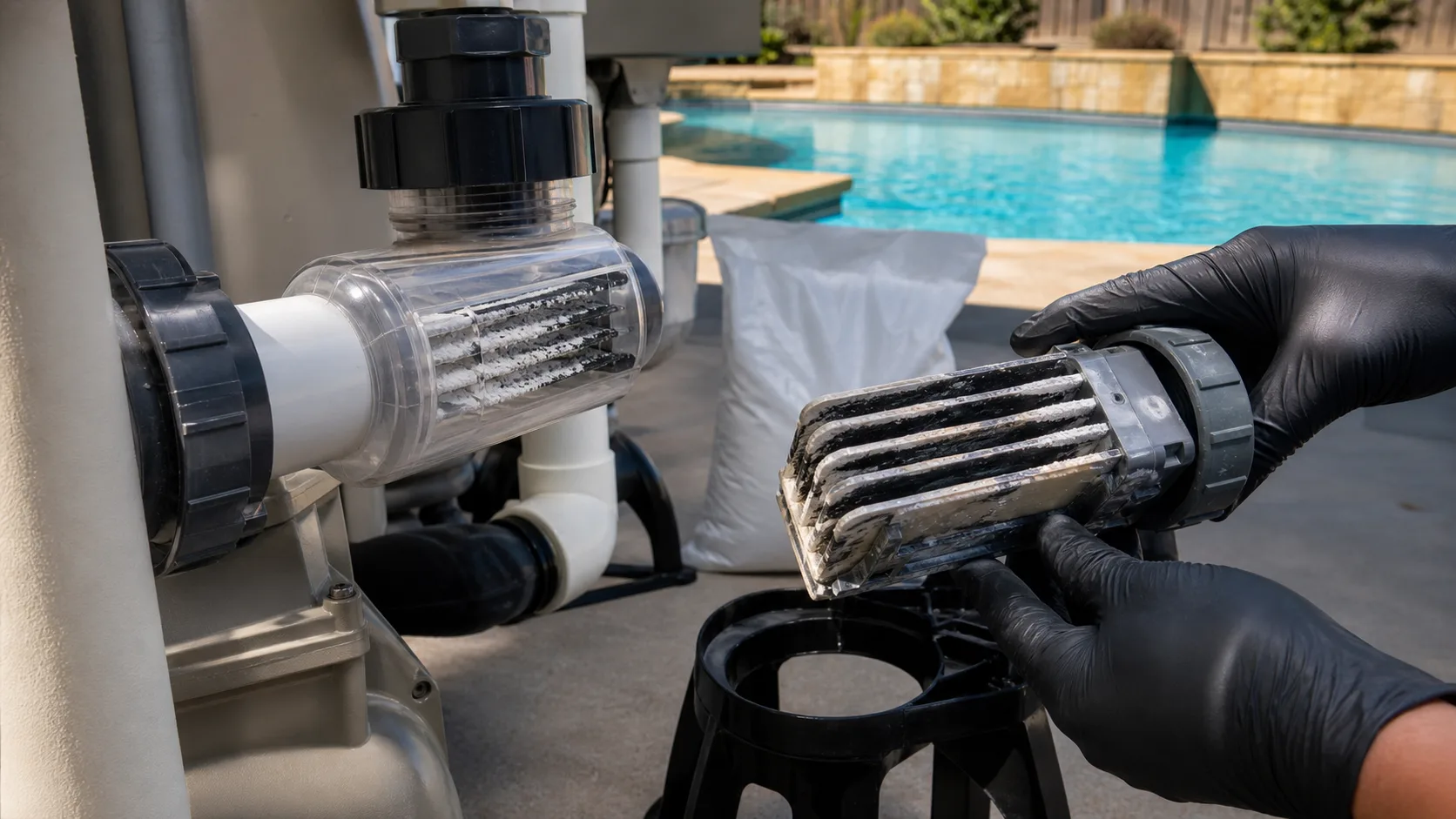
Salt Water Pool Maintenance in North Texas: What Nobody Tells You
Salt pools are not chlorine-free and not lower maintenance. They trade weekly chemical handling for a standing requirement to control pH and keep the cell clean, which is harder here than most places.