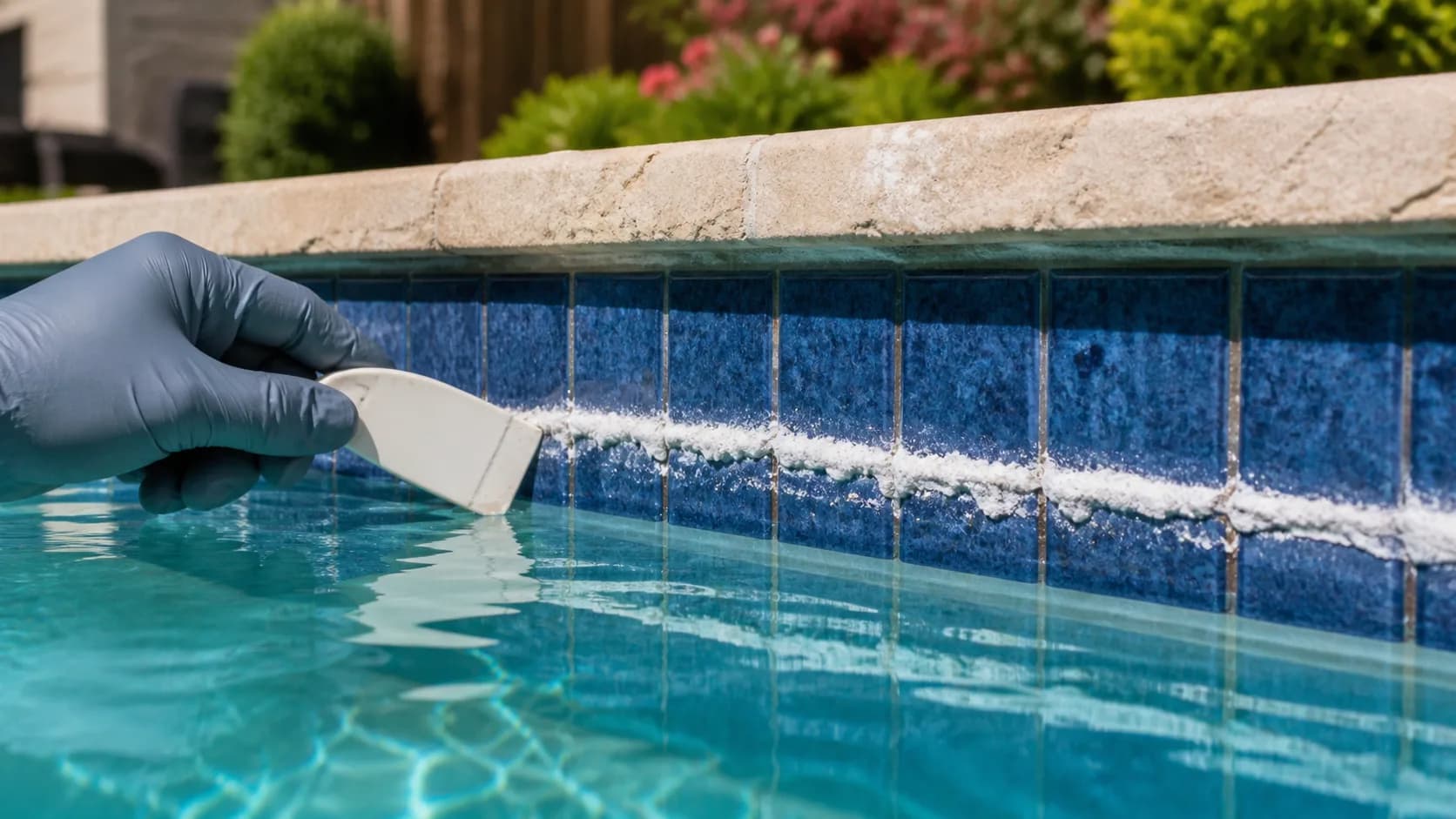
The white crust at your waterline is calcium, and in North Texas it isn’t really a cleaning problem. It’s your water telling you that its chemistry has been slightly out of balance for a while, and that the mineral load in it has been climbing every summer since the pool was filled. You can scrub the tile, and you should, but unless you deal with what put it there, it comes back before the season is out.
Why North Texas pools scale in the first place
The North Texas Municipal Water District describes its treated water as moderately hard, attributing it to the minerals in Lavon Lake. That means the water coming out of your hose already carries dissolved calcium. It’s the starting point, not the problem.
The problem is what a Texas summer does to it. Water evaporates; calcium doesn’t. Every gallon that leaves your pool as vapor leaves its minerals behind, and every gallon you add to make up the difference brings more in. A pool losing half an inch a day in July is concentrating its own mineral content continuously, and nothing in normal pool maintenance removes any of it. Calcium hardness on a DFW pool climbs year after year unless somebody deliberately dilutes it.
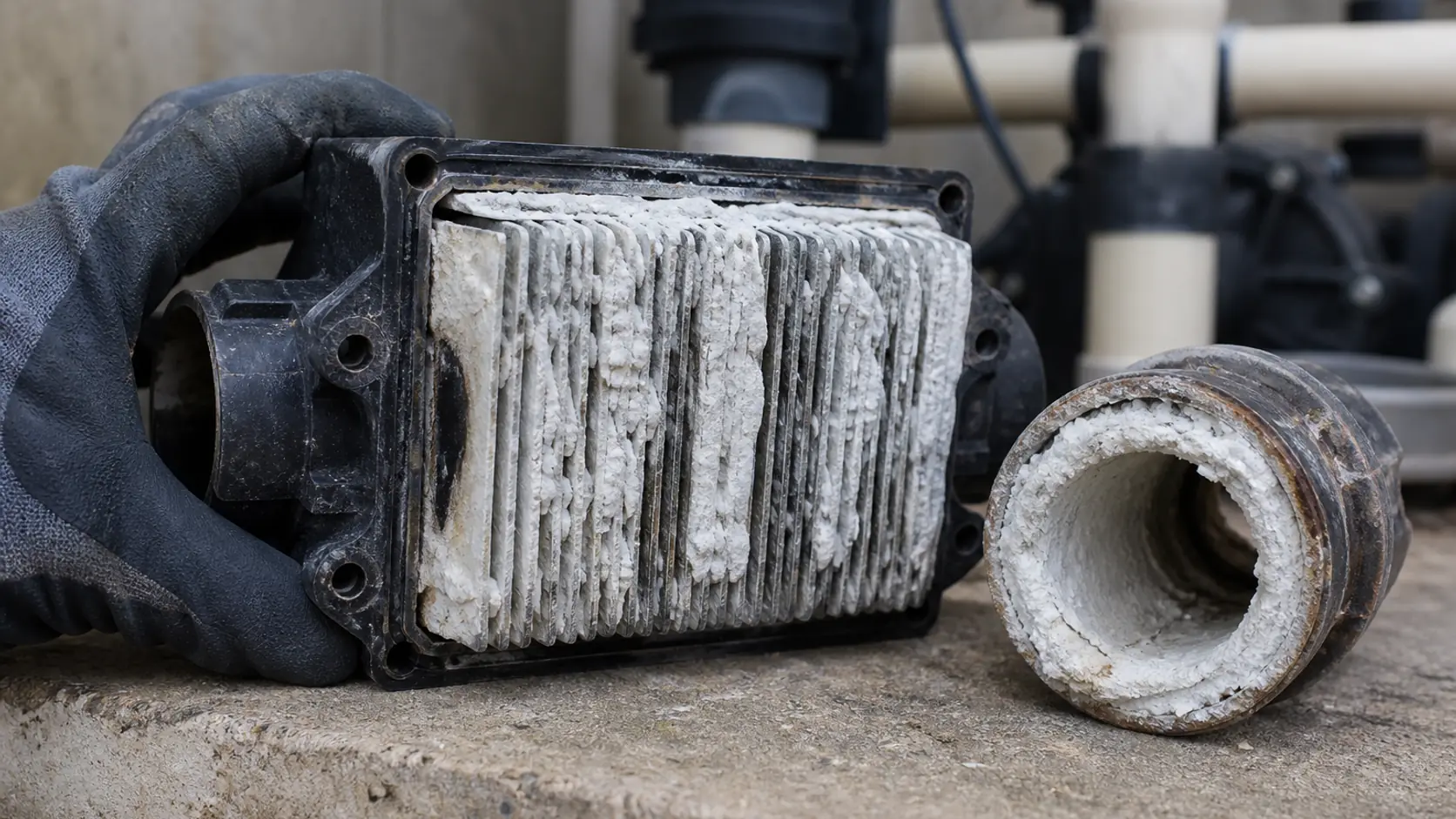
At some point that rising calcium meets a pH that has drifted up, or an alkalinity that is running high, or simply water that is 90 degrees, and the calcium stops staying dissolved. Where it comes out determines what you see: suspended in the water it is cloudiness, on the tile it is scale, and on a salt cell or inside a heat exchanger it is an expensive equipment problem.
Scale, cloudy water, and a dying salt cell are one problem
They look like three separate complaints and get treated as three separate jobs, but they’re the same chemistry showing up in three places. That’s why fixing the tile without fixing the balance is temporary, and why a pool that scales its tile is usually also shortening the life of the most expensive equipment on the pad.
Which kind of scale do you have?
This matters, because the two types respond to completely different treatments and one of them can’t be dissolved at all.
| Calcium carbonate | Calcium silicate | |
|---|---|---|
| Appearance | White, flaky, crusty, sometimes crystalline | Gray-white, smooth, dense, often with a slight sheen |
| How fast it forms | Weeks to months | Months to years, slowly |
| Reacts to acid? | Yes, visibly fizzes | No reaction at all |
| Comes off with | Acid-based scale remover, pumice, scrubbing | Mechanical removal, usually bead or glass blasting |
| Usually caused by | High pH, high alkalinity, high calcium | Long-term neglect plus silicates in the water |
The test takes ten seconds. Put a drop of a household acid, or a diluted acid-based tile cleaner, on the deposit and watch. Fizzing means carbonate, which is the common case and the tractable one. Nothing at all means silicate, which is the harder case and, in practice, means calling somebody with a blasting rig rather than buying another bottle of cleaner.
Getting it off the tile
For carbonate scale, in increasing order of aggression:
- An acid-based tile and scale cleaner. Start here. Gels stay on a vertical surface long enough to work, which matters at a waterline. Follow the label, wear gloves and splash goggles, and don’t use it in an enclosed space. The general chemical handling rules apply in full.
- A pumice stone, on tile or plaster only. This works, and it works on deposits nothing else touches, but it’s abrasive. Keep both the stone and the surface wet the entire time, work gently, and stop if you see the stone loading up rather than cutting. Never use pumice on vinyl, fiberglass, or acrylic, and be careful on glass tile, which scratches more easily than ceramic.
- Professional blasting. Bead, glass bead, or soda blasting removes both carbonate and silicate scale from a whole waterline in a session, and it’s the only practical answer for silicate. It requires dropping the water level below the tile, so it is a scheduled job rather than a Saturday one.
Do not pour acid down the waterline
It’s tempting to treat a whole waterline by pouring acid along it. Do not. You’ll get an uneven result, you risk etching plaster and softening grout, and pouring acid at the water surface near a skimmer with a chlorine tablet in it is one of the ways people end up breathing chlorine gas. Use a product formulated for the job, applied to the surface, not decanted into the pool.
Keeping it from coming back
Removal is the visible half. This is the half that decides whether you’re doing it again next summer.
Hold pH down, and alkalinity toward the bottom of range
pH is the lever with the most authority here. Kept at 7.4 to 7.6, calcium is far more willing to stay dissolved even at elevated hardness. Let it sit at 8.0 through a hot month and it won’t.
The related move is to keep total alkalinity toward the lower end of its acceptable range rather than the middle. Alkalinity resists pH change, which is useful, but a high alkalinity on a pool that already drifts upward means you’re constantly adding acid to fight a buffer you set too strong. That’s especially true on salt pools, where the hydrogen coming off the cell aerates the water and drives pH up continuously. Our salt pool guide covers why that drift is structural rather than something you did wrong.
Know your actual calcium hardness
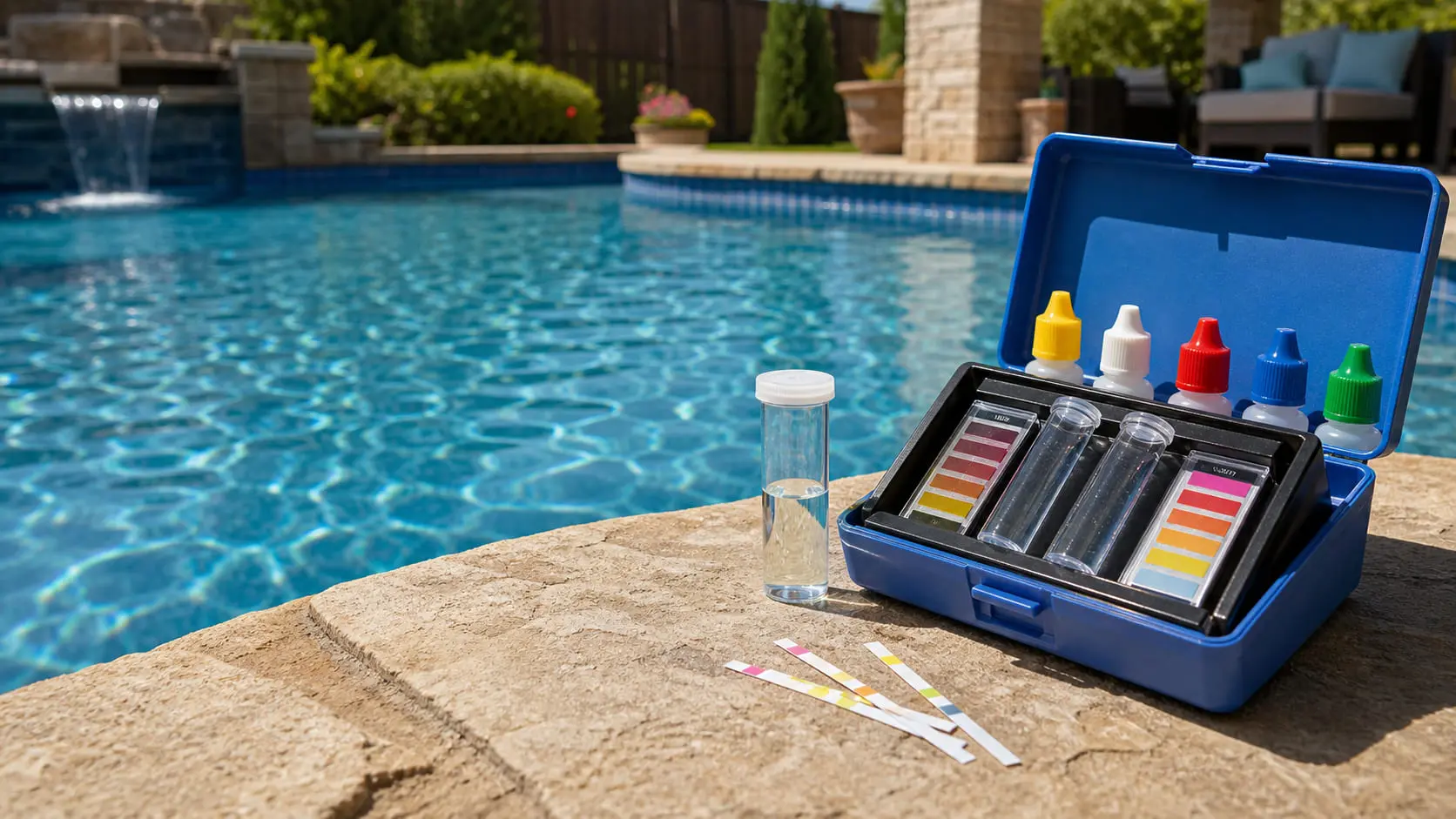
Most homeowners have never measured it, because the strips people buy focus on chlorine and pH. If your pool is more than a few years old and has never had water exchanged, the number is probably higher than you would guess. It’s worth a proper test, and it’s one of the panels included in our chemical balancing service. The full set of target ranges is in our water chemistry guide.
Use a sequestrant, particularly after a big fill
A sequestrant binds dissolved minerals and keeps them in solution rather than letting them deposit. It doesn’t remove calcium, and it isn’t a substitute for balance, but it buys real margin on a pool that runs hard water. It also breaks down over time, so it’s a recurring dose rather than a one-off. The moment it earns its keep most is right after adding a large volume of fresh water, which is exactly when a slug of new minerals arrives all at once.
Brush the tile weekly, before there is anything to see
Scale starts as a film you can still feel before you can see it. A weekly pass along the waterline with a brush keeps that film from consolidating into a crust, which is the difference between a thirty-second habit and a paid restoration. It’s one of the small things a consistent weekly service is genuinely good at, because it happens whether or not anyone remembered.
The one real way to lower calcium hardness
There’s no chemical that removes calcium from pool water. The only way the number comes down is dilution: taking some water out and replacing it with lower-hardness water. That makes partial water exchange a legitimate maintenance operation on an older DFW pool rather than a sign that something went badly wrong. Check your city’s drought stage first, though: a severe stage in this area restricts draining and refilling a pool, even while it still allows topping off for evaporation.
The alternative, on a pool where hardness has gone very high, is mobile reverse osmosis treatment. A truck filters the existing water and returns it with the minerals removed, so you keep your water instead of sending it down the street. It isn’t cheap, but on a large pool under watering restrictions it can compare favorably to draining and refilling twenty thousand gallons.
Never fully drain a pool in North Texas
Our expansive clay soil holds water and moves with it, and the water in the ground under your pool exerts real upward pressure. An empty shell can lift, crack, or in the worst case pop out of the ground, and that’s a catastrophic, uninsured-feeling repair. Plaster also doesn’t like drying out. Partial exchange, done in stages, is the safe version, and it shouldn’t be attempted at all after heavy rain or during a period when the ground is saturated. If a full drain is unavoidable, it’s a job for someone who will check the hydrostatic relief valve first.
What we would do with a scaled pool
The order matters, and it isn’t the order most people choose.
- Test first, including calcium hardness and alkalinity. Cleaning tile before knowing the numbers is cleaning a symptom.
- Correct pH and alkalinity, and hold them for a few weeks. If they’re not stable, new scale starts forming on freshly cleaned tile immediately.
- Plan the dilution if hardness demands it. Partial exchange staged over time, or RO service on a large pool.
- Then clean the tile. Last, so the result lasts.
- Add a sequestrant and start brushing the waterline weekly. This is what keeps you out of the cycle.
If your tile has a white line and you would rather someone else worked out why, that’s exactly what our inspection and balancing work is for. We’ll tell you which type of scale you have, what your hardness actually is, and whether this is a brushing problem or a water problem, before anyone quotes you for a restoration.
It also helps to know which side of a large number you are on. Cleaning tile is a maintenance job. Restoring a plaster surface that scale has taken hold of is a capital one, and what resurfacing costs in DFW is worth reading before you accept that a surface is finished, because a surface that only needs cleaning gets quoted as one that is.