Your test strip says three parts per million of free chlorine. The pool is hazy, the walls feel slick, and by Thursday it has a green cast to it. Somebody at the pool store told you the chlorine is locked and sold you a bottle to unlock it. There’s no lock, there’s no unlocking chemical, and what is actually happening is both simpler and more annoying than that.
What cyanuric acid does
Cyanuric acid, sold as stabilizer or conditioner, is the reason an outdoor pool in Texas is possible at all. Unprotected chlorine in direct July sun has a half-life measured in minutes. Add stabilizer and the chlorine survives the afternoon. Our water chemistry guide covers where it sits among the five numbers that matter; this article is about what happens when this one number gets away from you, because it’s the failure we’re called out for most often in August.
The mechanism is worth understanding, because it explains everything that follows. When cyanuric acid is in the water, most of your chlorine isn’t free-floating hypochlorous acid doing the sanitizing. It’s chemically bound to the stabilizer, sitting in reserve, shielded from UV. Only a small fraction is unbound and working at any given moment. As that working fraction gets consumed, the reserve releases more to replace it.
Here is the part nobody explains at the counter: a standard test doesn’t distinguish between the two. Your free chlorine reading is the total of the working chlorine and the reserve. It reports the whole tank, not the fuel reaching the engine. At 30 ppm of cyanuric acid, a 3 ppm reading means plenty is working. At 120 ppm, the same 3 ppm reading means very little is, because the reserve is enormous and the release rate is slow.
“Chlorine lock” is a description, not a diagnosis
The phrase gets used for the symptom, which is real: chlorine is present and nothing is happening. But it implies a state that can be broken, and there’s no product that breaks it. High CYA isn’t a lock. It’s a ratio problem. You fix a ratio by changing one of the two numbers, and there are only two ways to do that: raise the chlorine to match the stabilizer, or remove water to lower the stabilizer.
The number to look at instead
Stop reading free chlorine as an absolute. Read it as a percentage of your cyanuric acid. The widely used figure is a floor of 7.5 percent of CYA on a chlorine pool, or about 5 percent behind a salt cell, which earns the lower number because it makes chlorine continuously. Below that, algae starts winning. That single ratio explains almost every mysterious green pool we get called to.
The percentage itself is a practitioner convention rather than a published standard, set out in the Trouble Free Pool account of the free chlorine and cyanuric acid relationship, and it is worth being straight about that. The direction behind it isn’t convention at all. The CDC recommends at least 1 ppm of free chlorine in a pool, and at least 2 ppm once cyanuric acid is in the water. The official floor doubles the moment stabilizer is present, at any level of it. A pool sitting at 100 ppm of CYA is a long way past the point where even that doubled figure is enough.
| Cyanuric acid | Floor on a chlorine pool (7.5%) | Floor on a salt pool (5%) | Verdict |
|---|---|---|---|
| 30 ppm | 2.3 ppm | 1.5 ppm | Easy to hold. Ideal for a chlorine pool here. |
| 50 ppm | 3.8 ppm | 2.5 ppm | Still comfortable. Upper end of ideal. |
| 70 ppm | 5.3 ppm | 3.5 ppm | Workable for salt pools, demanding for tablets. |
| 100 ppm | 7.5 ppm | 5 ppm | Most owners never carry this. Algae has an opening. |
| 150 ppm | 11.3 ppm | 7.5 ppm | Impractical. Dilute the water. |
Both columns are floors, not targets. Comfortable maintenance sits above either one, at 10 to 15 percent of the stabilizer reading, which is the band our chemical calculator works to.
Read the bottom two rows again with your own habits in mind. If your stabilizer is at 100 and you have been happily maintaining 3 ppm all summer because that’s what the strip bottle calls ideal, you have been running at well under half the floor for weeks, on either sanitizer. The pool didn’t fail suddenly. It was always going to fail, on the first hot, still, high-bather-load weekend.
Why salt pools land here more often
Salt systems are usually run at a higher stabilizer level on purpose, commonly 60 to 80 ppm. A cell produces chlorine at a slow steady trickle rather than in a slug, so it needs the UV protection to keep up during the day. That’s legitimate. The trouble is that it puts the pool much closer to the edge, so a bit of drift and one hot week is enough to cross it. More on the specifics in our salt water pool guide.
How it got high in the first place
Cyanuric acid doesn’t leave. It isn’t consumed by sanitizing, it doesn’t evaporate, sun doesn’t degrade it, and heat doesn’t burn it off. The only routes out of your pool are splash-out, backwashing, and deliberate draining. Meanwhile there are several routes in:
- Trichlor tablets. The single biggest cause. Every three-inch tablet is roughly half stabilizer by weight. As a rule of thumb, adding 10 ppm of chlorine via trichlor adds about 6 ppm of CYA that never leaves. Run tablets all season in a floater or an inline feeder and the number climbs relentlessly.
- Dichlor shock. Same problem, faster. Shocking with dichlor rather than cal-hypo or liquid chlorine adds a slug of stabilizer at exactly the moment you’re trying to fix a water problem.
- Refilling a leak. Not a direct source, but a compounding one. A pool that is losing water and being topped up keeps its stabilizer while diluting nothing, and the fill water brings its own minerals in.
- Overcorrecting once. Granular stabilizer takes days to fully dissolve and register. Owners add a dose, test too early, see no change, and add again. Both doses then show up together.
Test strips are unreliable exactly where it matters
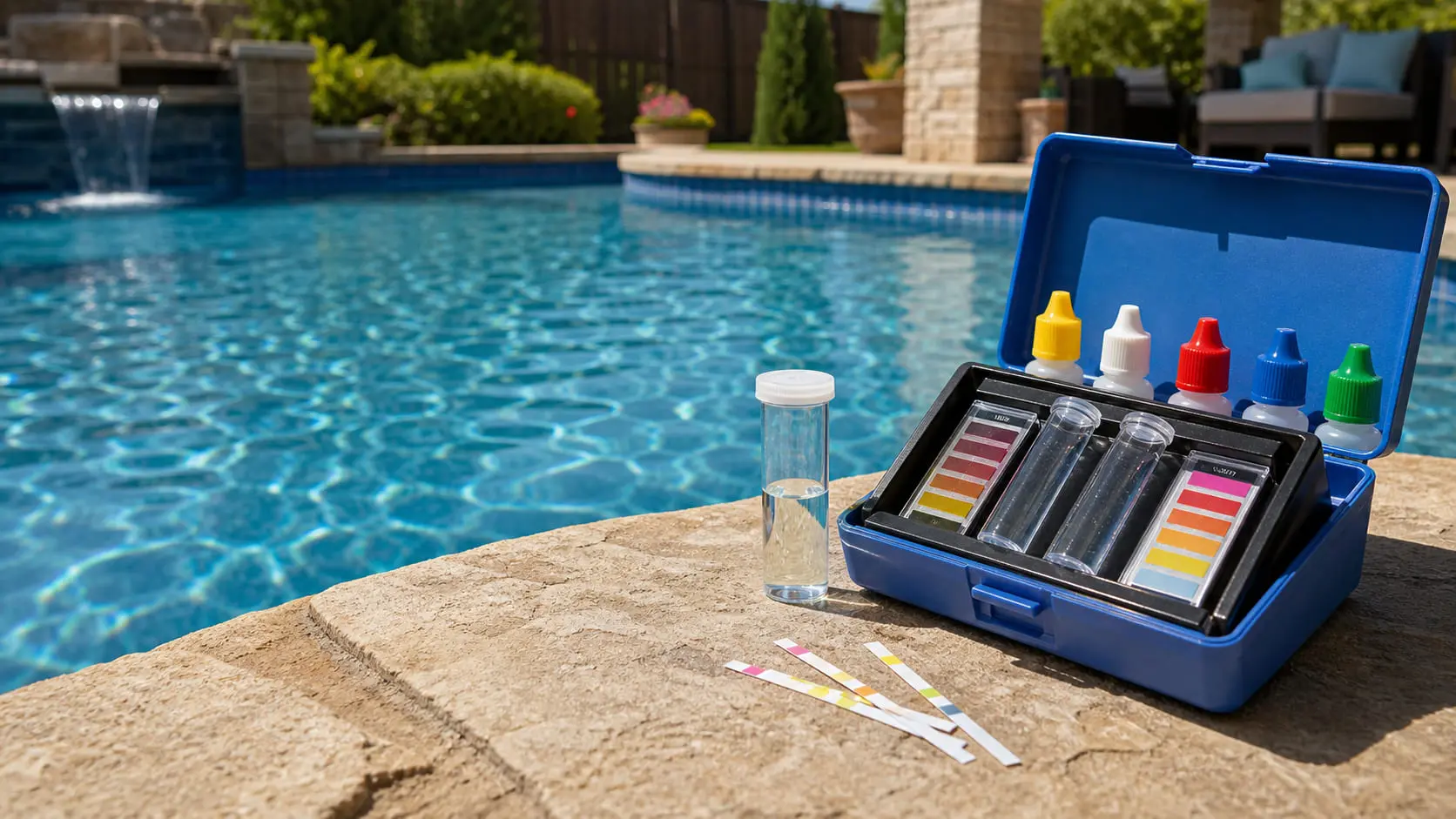
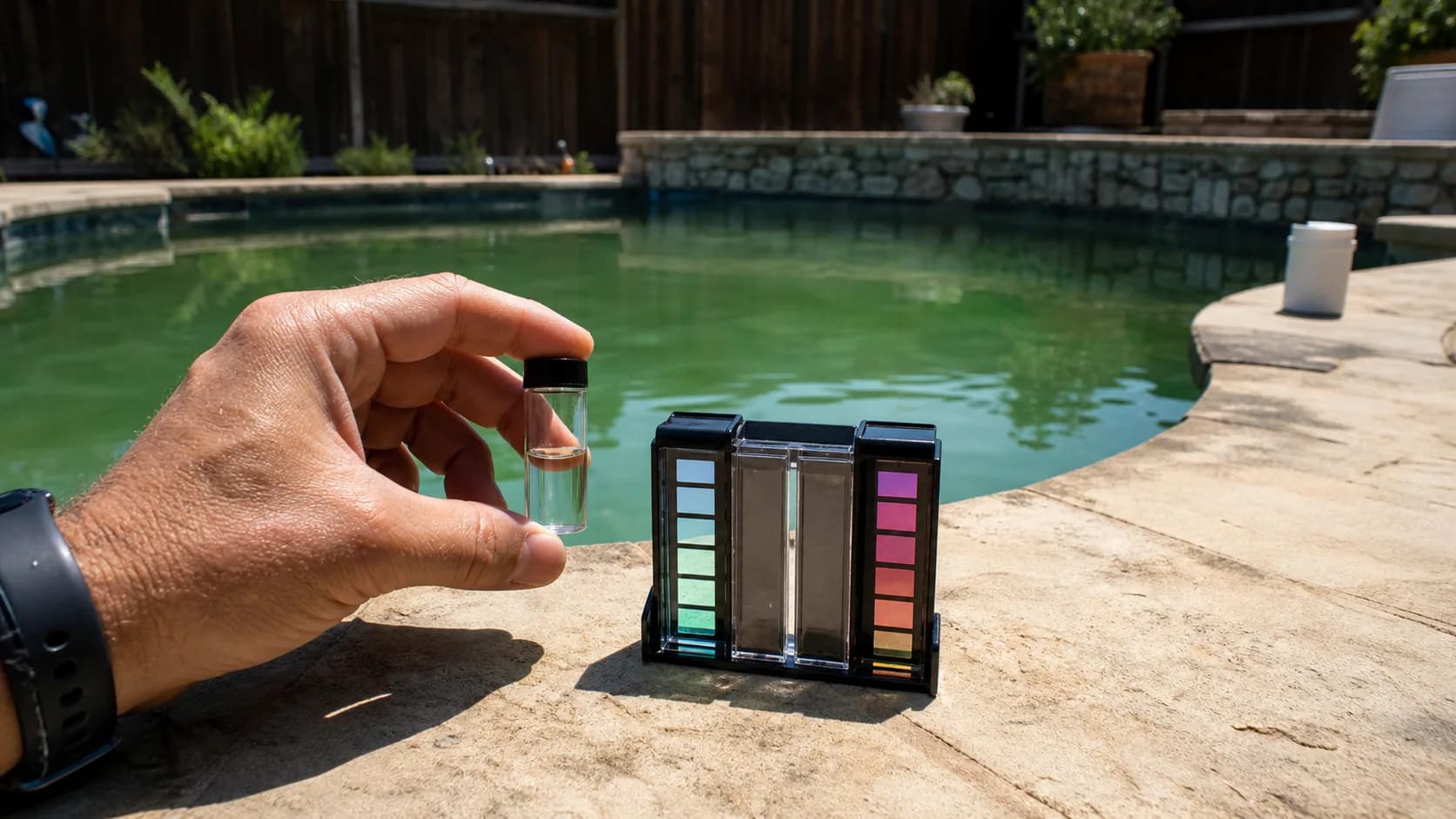
Strip pads for cyanuric acid are coarse and tend to read low at the high end, which is the end you need accuracy at. The turbidity test, where you fill a tube until a black dot disappears, is better but still an eyeball judgment. If your reading is anywhere near 80, get a proper liquid test or take a sample somewhere that runs one before you decide to drain anything. Draining is expensive to do twice.
The only fix, and how to do it properly
There’s no chemical that removes cyanuric acid at any price worth paying. Products that claim to are either enzymes with slow, unpredictable results or they simply do nothing. The fix is dilution: take water out, put fresh water in. That’s the whole method, and the skill is in doing it without wrecking the plaster or the surrounding soil.
- Get an accurate CYA number first. Everything below is arithmetic on that number, so a bad reading means a wasted drain.
- Check your city’s current drought stage before you start.This is the step nobody mentions. A severe drought stage in this area prohibits draining and refilling a pool while still permitting top-offs for evaporation, which makes a staged exchange the exact activity that gets restricted. Allen’s plan is explicit about it and its neighbors run comparable plans, so confirm your own before you buy a pump hose.
- Calculate the fraction to replace. Dilution is linear. Removing and replacing a third of the water cuts CYA by about a third. From 120 ppm to a target of 40 ppm you need to replace roughly two-thirds of the volume.
- Do it in stages, not in one drop. Drain a foot or two, refill, let it circulate for a day, then retest before starting the next stage. Slower, far safer than emptying the pool, and it stops you overshooting the target. Two or three partial exchanges reach the same place as one big one.
- Work in inches, because that’s what you can see. Draining a foot off a pool with a roughly uniform surface area removes a predictable fraction of the volume, and the pool wall is a more reliable gauge than a pump running time. Note the level, drain to a mark, refill to the original mark.
- Rebalance in order afterward. Fresh North Texas fill water is hard and alkaline. Test alkalinity, then pH, then calcium, then chlorine, then re-add a measured amount of stabilizer to land at 30 to 50 ppm rather than guessing.
- Change what caused it. Going back to a tablet floater afterward puts you right back here next August. Switch the routine sanitizer to liquid chlorine or cal-hypo, and keep tablets for vacations and short absences only.
A worked example
Take a common case: an 18,000-gallon pool that has been on tablets for three seasons and tests at 120 ppm of cyanuric acid. You want to land at 40 ppm.
- Fraction to replace: you want the CYA to end at one third of what it is, so two thirds of the water has to go. Done as a single exchange that is 12,000 gallons.
- In stages: replacing a third at a time takes CYA from 120 to 80, then to roughly 53, then to roughly 36. That’s three exchanges of about 6,000 gallons each, and the third slightly overshoots, which is fine because you’ll be adding stabilizer back to hit 40. Note that staging costs more water, not less: 18,000 gallons rather than 12,000, because each stage is diluting water you have already partly diluted. You’re buying safety and control with that extra 6,000 gallons, and on a plaster pool in Texas clay it is worth it.
- What that is in inches: on a pool with 450 square feet of surface, 6,000 gallons is about 21 inches of water. Call it two feet down and back up per stage, or split each stage into two shallower passes if you would rather never take the level far below the skimmer. The chemistry doesn’t care how you slice it, only about the total fraction replaced.
- What it costs: 18,000 gallons of municipal water in this area is a noticeable but not alarming line on one bill, and far below the cost of losing a season to repeated algae blooms or damaging a shell with a full drain.
The arithmetic only works if you know your volume, and a surprising number of owners don’t. If you’re guessing, our pool volume calculator will get you a real number from length, width, and the two depths, which you need for dosing anyway.
Never fully drain a plaster pool in a Texas summer
Two separate reasons, both expensive. First, an empty shell in our expansive clay can float, especially after a wet spring, because the groundwater under it pushes up and there is no longer any water weight holding it down. That’s a structural repair, not a resurface. Second, wet plaster left exposed to a 100-degree afternoon dries and crazes within hours. If a pool has to come all the way down, it happens on a cool day, with the groundwater checked first, and it gets refilled immediately. That’s a job to hand to somebody who does it for a living.
What about doing nothing?
It’s a real option in one narrow case: if your CYA is at 70 or 80 and you’re genuinely willing to carry 5 to 6 ppm of free chlorine consistently, the pool will be fine. It’s safe to swim in, and it costs more chlorine per week. What doesn’t work is being at 80 and maintaining 3 ppm because a bottle label said 3 was ideal. Pick one: match the chlorine to the stabilizer, or lower the stabilizer. The pool doesn’t accept a compromise between them.
Getting green water back while CYA is still high
If you have already crossed the line and the pool has bloomed, the dilution is the long-term fix but it doesn’t clear the water today. The short-term work is the same green-to-clean process as always, with one important adjustment: the shock level scales with CYA too. Killing an algae bloom takes roughly 40 percent of your CYA level in free chlorine, held there until the water clears. At 100 ppm CYA that is about 40 ppm of free chlorine, which is a serious quantity of liquid chlorine, and it’s a large part of why an over-stabilized pool is so much more expensive to recover than a normal one.
The practical sequence when both problems are live at once is to dilute first and shock second. Replace a third of the water, which drops both the stabilizer and the algae count, then shock the diluted pool at a level you can actually reach. Doing it in that order has saved our customers real money more than once.
Where this becomes our job
Testing, calculating a replacement fraction, and running a staged partial drain with a submersible pump are all within reach of an owner who is careful and unhurried. Where people get hurt is the full drain, the hydrostatic question, and the rebalance on fresh hard fill water, which is finicky and easy to chase in circles.
Our chemical balancing service covers the testing and the rebalance, and green-to-clean covers the recovery when it has already gone too far. If you’re on weekly service, this is one of the things being watched for: CYA is checked on a schedule specifically so the number gets caught at 70 on the way up rather than at 130 on the way to a drain.
And if you take one thing from this: the stabilizer number is the one chemistry value in your pool that is effectively permanent. Treat every tablet you drop in as a small deposit into an account you can only close by draining. That framing alone keeps most pools out of trouble.