Rust and Blue-Green Stains: Metal in Your Pool Water

Austin Andrews
Founder, True Texan Pools
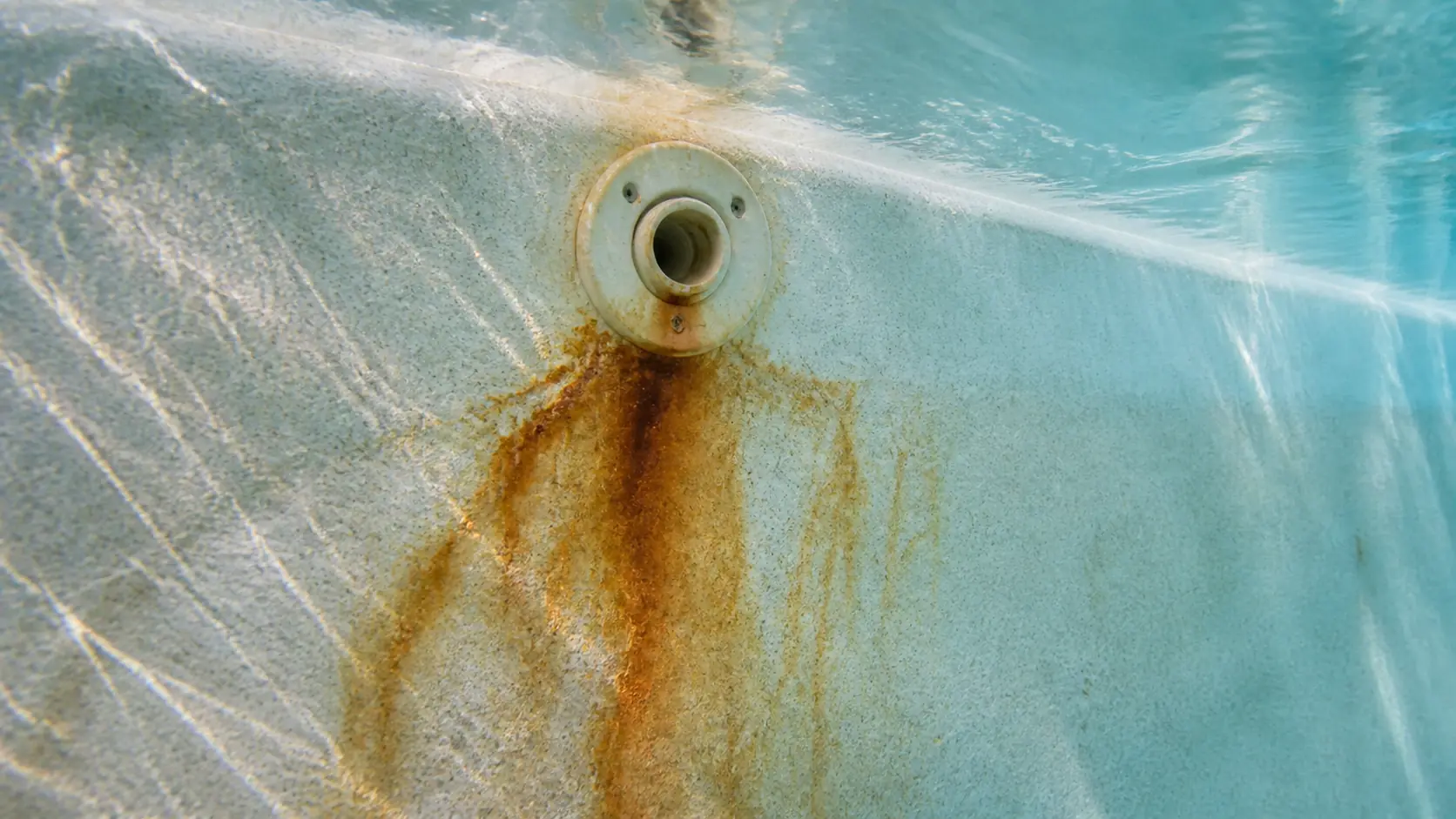
A brown streak under a return. A blue-green shadow spreading from the light. A grey blotch on the steps that appeared over one winter. These are metal stains, they are not damaged plaster, and the treatment depends entirely on which metal you have. Get the identification right and most of them lift off in a weekend. Get it wrong and you can set the stain permanently into the surface, which is the one outcome nobody recovers from.
Metal stains get diagnosed as dead plaster constantly. A homeowner sees rust-colored discoloration spreading across a white wall, assumes the finish is finished, and gets a five figure resurfacing quote for a problem that a bottle of ascorbic acid would have solved. Before anybody talks about resurfacing, it’s worth establishing what you’re actually looking at.
Is it a metal stain at all?
Two families of stain exist and they behave in opposite ways. Organic stains come from leaves, algae, acorns, worms, and anything else that decayed against the surface. Metal stains come from dissolved metal in the water that oxidized and plated onto the plaster. The remedy for one does nothing for the other.
| Organic | Metal | |
|---|---|---|
| Common shape | Leaf-shaped, blotchy, follows where debris sat | Streaks below fittings, rings, broad even patches |
| Common color | Brown, green, reddish brown | Rust brown, teal, purple, grey |
| Responds to chlorine | Yes, lightens or lifts | No, usually darkens |
| Responds to ascorbic acid | Barely | Lifts, often visibly within a minute |
| Where it appears first | Floor, corners, under the steps | Below returns, around the light, at the waterline |
The vitamin C test
Take a plain vitamin C tablet, ascorbic acid, and hold it against the stain underwater for thirty to sixty seconds. If a clean spot appears in the shape of the tablet, it’s a metal stain and ascorbic acid is going to be part of the answer. If nothing happens, try the chlorine version: hold a trichlor tablet against the stain the same way, with gloves on. If that lightens it, the stain is organic and your problem is a shock and brush job rather than a metal one.
Do this at the shallow end wall where a small test patch will not be conspicuous, not in the middle of the most visible stain on the pool.
Reading the color
Once you know it’s metal, the color narrows it to one of three, and the source of each is different enough that the fix diverges from here.
| Color | Metal | Usual source | Notes |
|---|---|---|---|
| Rust brown, orange, tan | Iron | Well water fill, corroding steel, iron-rich fill | By far the most common here. Often appears after a big refill. |
| Blue-green, teal, aqua | Copper | Heater heat exchanger, copper algaecide, corroding plumbing | Almost always generated by your own pool rather than delivered to it. |
| Purple, black, dark brown-grey | Manganese | Well water, some municipal sources | Less common, stubborn, and often mistaken for a dark organic stain. |
| Blue-black waterline smudge | Copper plus scale | Copper in hard water at high pH | Two problems layered, and the scale has to come off first. |
Do not shock a pool with metal in the water
This is the mistake that turns a light stain into a heavy one. Chlorine is an oxidizer. Dissolved metal sitting invisibly in your water is oxidized by a shock dose and comes out of solution onto the nearest surface, which is your plaster. Every person who has ever refilled from a well, shocked the pool the same day, and found the whole shallow end brown the next morning has run this experiment. Sequester first, shock later.
Where the metal came from
Iron, and why fill water matters
Most iron arrives dissolved in the water you added. Plenty of properties on the outskirts of Collin County, out toward Celina, Prosper, Lucas, and Parker, run on wells or have a well for irrigation that gets used for the pool because it isn’t metered. Well water in this region can carry meaningful iron and manganese, and it goes into the pool completely clear. You will not see it until it oxidizes.
That’s why iron staining so often shows up right after something that involved a lot of water: a partial drain and refill, a leak that ran for weeks with the autofill compensating, or a first fill on a new pool. If you top off from a well, you’re adding iron every time, and the fix is a hose filter and a sequestrant routine rather than a stain treatment every spring.
There is a useful number for how little it takes. The EPA’s secondary drinking water standards are not health limits at all, they are nuisance limits, and they exist largely because of staining. Iron is listed at 0.3 mg/L and manganese at 0.05 mg/L, the concentrations at which each begins to stain fixtures and laundry. They are also secondary standards, meaning federal rules do not require a system to treat for them at all, and a private well is under no obligation to anybody. A third of a milligram per liter is a level you cannot see, taste, or notice in a glass of water. Now put twenty thousand gallons of it in a pool and oxidize all of it onto one wall.
Copper, and the salt pool chain
Copper is different: it’s usually manufactured inside your own equipment. The three sources, in order of how often we find them:
- A gas heater’s heat exchanger. The exchanger is copper. Aggressive water passing through it dissolves it, and the pool gets both a stain and, in time, a failed heater. Water that is corroding the exchanger is the same water described in why your heater is not heating.
- Copper-based algaecide. It works, and it deposits copper in your pool permanently. Used once on a green recovery it’s often fine. Used routinely as a maintenance product it accumulates and eventually plates out.
- A mineral or ionizer system. These deliberately put copper in the water. Staining is a known tradeoff, not a malfunction.
The chain worth knowing by name goes like this: a salt pool generates chlorine continuously, salt cells push pH up, the owner adds acid to hold it down, someone overshoots, the water sits acidic and low in alkalinity for weeks, the heater’s copper exchanger dissolves into the water, and the first sign anybody notices is a teal stain spreading under the returns. Nothing in that chain is exotic. It’s the ordinary result of running a salt pool without watching alkalinity, and it’s covered from the other end in salt water pool maintenance.
Removing the stain
The sequence below is the standard ascorbic acid treatment. It is genuinely effective on iron, usually effective on copper, and hit or miss on manganese. Read all of it before starting, because the order is what makes it work.
- Test and record everything first. Free chlorine, pH, alkalinity, calcium, cyanuric acid, and a metals test if you can get one. Write it down. You’re going to be putting the pool back afterward.
- Get chlorine to near zero. Ascorbic acid and chlorine consume each other, so a pool at 5 ppm will simply eat the treatment. Stop chlorinating and let the sun bring it down over a day or two, or use a neutralizer.
- Bring pH down toward 7.2. Metal lifts more readily from a slightly acidic surface.
- Turn off any salt cell and the heater. A cell running through this treatment is making chlorine you’re trying to remove, and the heater has copper you are actively trying not to dissolve more of.
- Add ascorbic acid with the pump running. Broadcast it across the surface. On iron staining the change is often visible within thirty minutes.
- Circulate and brush. Give it several hours, brushing the stained areas. Repeat the dose if some remains.
- Add sequestrant immediately. This is the step people skip and it is the one that decides whether the stain stays gone. The metal is now dissolved in your water rather than on your wall, and it will plate straight back out the moment chlorine returns unless it’s bound up first.
- Bring the pool back slowly. Restore pH and alkalinity, then bring chlorine up over several days rather than in one dose. A shock at this point undoes the whole job.
- Keep dosing sequestrant on a schedule. It degrades. Most products want a monthly maintenance dose, and if you fill from a well, treat every refill.
What sequestrant does and does not do
A sequestrant chemically binds dissolved metal so chlorine cannot oxidize it out of solution. It does not remove the metal from the pool. The metal is still there, held in suspension, which is why the dosing continues and why a pool with a lot of accumulated metal eventually needs the water partly replaced or treated by reverse osmosis rather than managed forever with a bottle.
Stopping it from coming back
- Filter the fill. A hose-end filter for pool fills is inexpensive and catches iron before it enters. If you fill from a well, this is the highest value thing on the list by a distance.
- Hold alkalinity where it belongs. Copper staining is nearly always downstream of water that spent time aggressive. The targets and the reasoning are in the water chemistry guide.
- Stop using copper algaecide as routine maintenance. If algae is a recurring problem, the cause is sanitizer and circulation, and it’s worth reading the algae types guide rather than adding metal to the water every month.
- Fix the reason for the big refills. A pool that needs a lot of new water is often a pool with a leak, and every new gallon brings more iron. Work through leak or evaporation if you’re unsure which you have.
- Watch the heater. A heat exchanger that has started shedding copper is telling you about the water it’s sitting in, and it’s a repair on a clock.
When it will not come off
Some stains have been there long enough, or through enough shock cycles, that they’ve become part of the surface. Manganese in particular resists ascorbic acid more often than iron does. Two honest outcomes exist at that point.
The first is living with it. A faded metal stain on a pool that is otherwise sound is a cosmetic issue, and it will fade further under ordinary use. The second is an acid wash, which strips a layer of plaster and takes the stain with it. That works, and it spends part of the remaining life of your finish to do it, which is a trade worth making deliberately rather than on a whim. If the surface is already thin, the honest answer is that you are looking at a resurface sooner rather than a stain treatment now.
Austin’s Tip
Photograph the stain from a fixed spot on the deck, at the same time of day, before you start and every day through the treatment. Metal stains lift gradually and it is genuinely difficult to tell whether anything is happening by eye. Two photos a day apart settle it, and they also tell you whether it is creeping back three weeks later while there is still time to dose sequestrant rather than repeat the whole treatment.
What we would do with a stained pool
Identify before treating, because the remedies for the two stain families are opposites and one of them sets the other permanently. Vitamin C tablet for metal, chlorine tablet for organic, then read the color to name the metal. Lift it with ascorbic acid at low chlorine and slightly low pH, and sequester in the same visit, so what came off the wall does not plate straight back onto it. Then go and find the source, because iron arriving in a well fill and copper leaving a dissolving heat exchanger will both keep producing the same stain until somebody interrupts them.
The work we would rather be doing is duller than any of that. A metals test on a pool that gets topped up from a well, and an alkalinity reading held where it belongs on a pool with a gas heater, are five-minute jobs that prevent this entire article. That is what weekly service is actually for, and it costs a great deal less than a weekend of ascorbic acid and a pool you have to rebuild the chemistry on afterwards.
Frequently Asked Questions
How do I know if a pool stain is metal or organic?
Hold a plain vitamin C tablet against it underwater for about a minute. If a clean spot appears in the shape of the tablet, it is a metal stain. If nothing happens, try a chlorine tablet with gloves on; if that lightens it, the stain is organic and needs shocking and brushing instead. Test on a shallow end wall rather than the most visible stain in the pool.
What causes rust colored stains in a pool?
Iron, and it usually arrives dissolved in the fill water. Well water in the outer parts of Collin County can carry meaningful iron, and it enters the pool completely clear, so the stain appears only when chlorine oxidizes it onto the plaster. That is why iron staining so often shows up right after a big refill, a partial drain, or a leak that ran for weeks with the autofill compensating.
What causes blue-green stains in a pool?
Copper, and unlike iron it is usually generated inside your own equipment rather than delivered to the pool. The three sources are a gas heater’s copper heat exchanger being dissolved by aggressive water, copper-based algaecide used as routine maintenance, and mineral or ionizer systems that put copper in deliberately. On salt pools the usual chain is overshot acid dosing corroding the heat exchanger.
Will shocking the pool remove a metal stain?
No, it makes it worse. Chlorine is an oxidizer, so a shock dose pulls dissolved metal out of solution and deposits it on the nearest surface, which is your plaster. Anyone who has refilled from a well, shocked the same day, and found the shallow end brown the next morning has run this experiment. Sequester first and shock later.
Does sequestrant remove metal from pool water?
No. It chemically binds the metal so chlorine cannot oxidize it out of solution and onto the wall. The metal is still in the pool, held in suspension, which is why the dosing has to continue on a schedule and why a pool with a lot of accumulated metal eventually needs the water partly replaced or treated by reverse osmosis rather than managed with a bottle forever.
Do I need to resurface my pool because of stains?
Usually not. Metal stains get mistaken for dead plaster constantly, and a rust-brown blotch on a white wall reads as damage when it is a deposit that lifts off. Resurfacing is for a surface that is rough, chalky, worn through to the aggregate, or delaminating. If the plaster underneath is sound, the honest options are treating the stain, living with a faded one, or an acid wash that spends part of the surface’s remaining life.
Work it out for your pool
All toolsFree, instant, and no email needed to see the answer.
Ready to stop thinking about your pool?
True Texan Pools keeps your water swim-ready all year, across Plano and the rest of DFW. Clear pricing, a photo report after every visit, and Austin doing every job himself.
Keep reading
Chlorine Reads Fine and the Pool Still Went Green
Three parts per million of free chlorine, and the walls still feel slick. The problem isn’t the chlorine number, it’s the number you’re reading it against.
Is My Pool Leaking or Just Evaporating? The Bucket Test
There’s a definitive test for this, it costs nothing, and it takes 24 hours. Here is how to run it, and how the pattern of the loss tells you which part of the system to suspect.