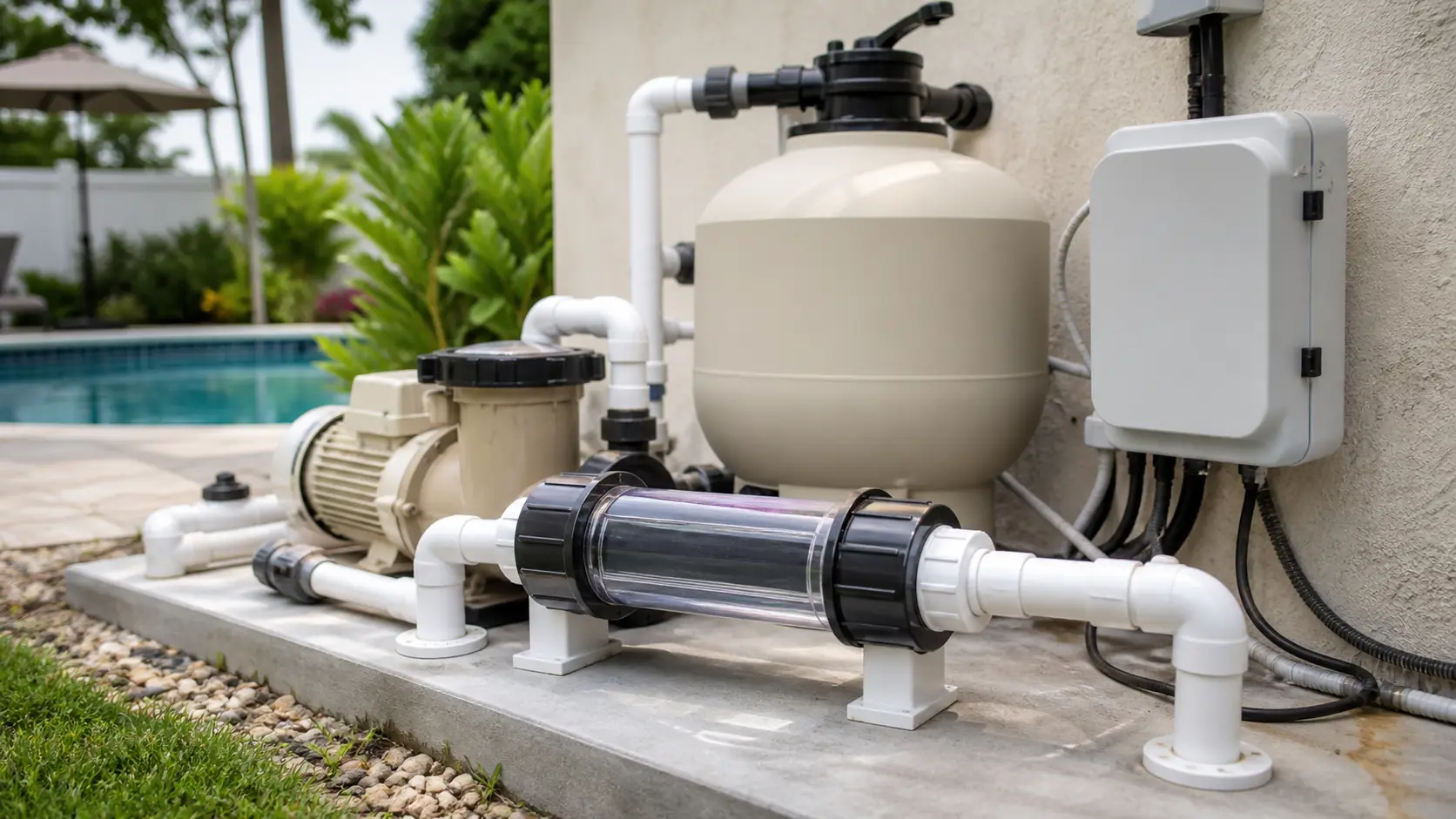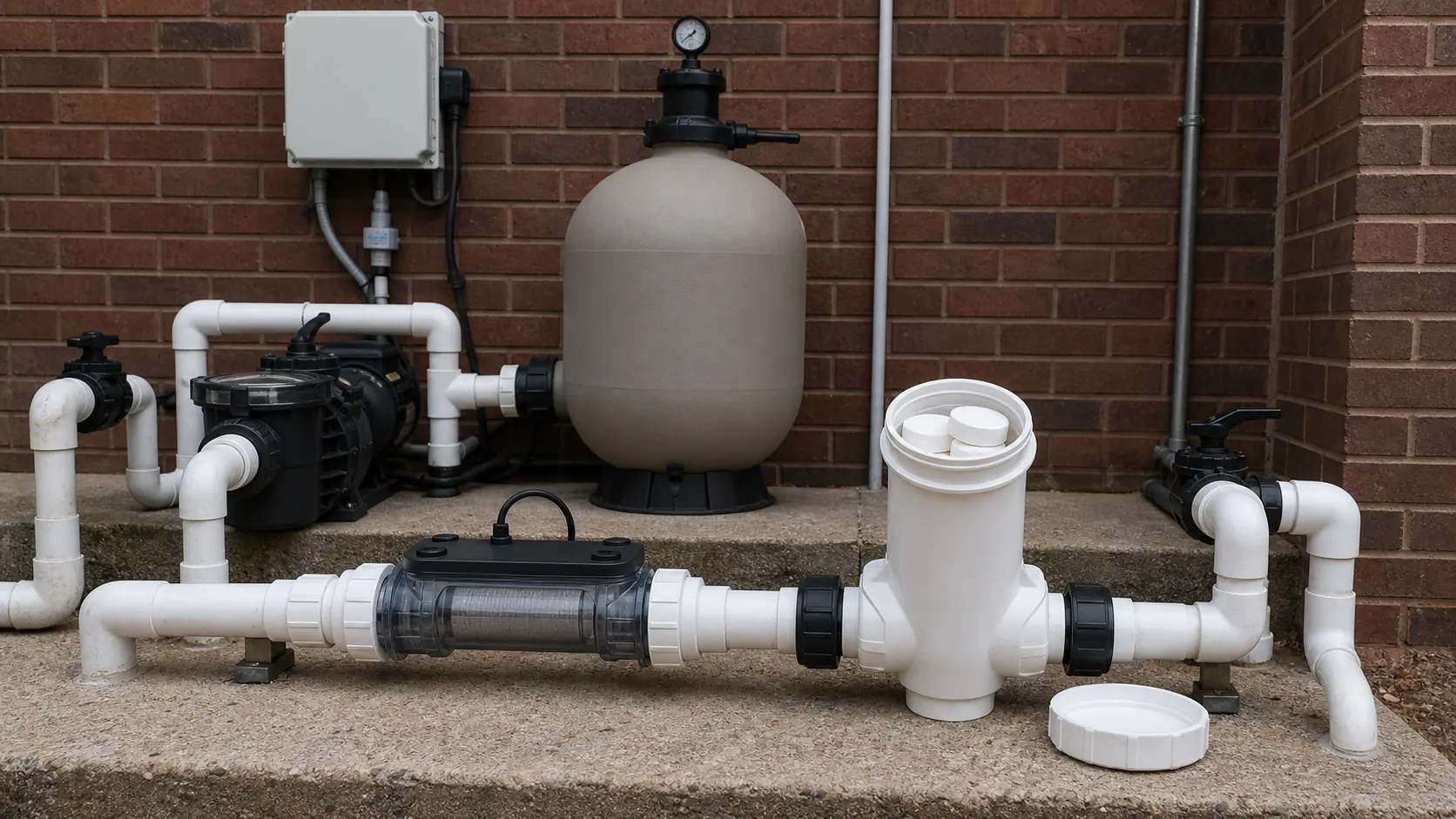
Salt pools got popular in DFW for a good reason: the water feels better and you aren’t hauling jugs of chlorine every week. But the marketing around them created a myth that costs owners real money, and it’s this. A salt pool is a chlorine pool. It makes its own chlorine instead of you buying it, and everything chlorine needs, it still needs.
How a salt pool works
You dissolve salt in the water. Water passes through a cell containing metal plates carrying a low-voltage current, and electrolysis splits the salt to produce chlorine directly in the plumbing. That chlorine sanitizes your pool, gets consumed doing it, and eventually reverts to salt, which is why you top off salt occasionally rather than constantly.
So the sanitizer in a salt pool is the same sanitizer as in a traditional pool. What changed is the delivery mechanism. This isn’t a technicality, because it means every chemistry rule from our water chemistry guide still applies: pH, alkalinity, calcium, and stabilizer all matter exactly as much as before.
The three myths that cost the most
“Salt pools are chemical-free.” They aren’t. They generate chlorine on site.
“Turning the output up makes more chlorine, faster.”Only up to a point. The cell has a fixed production capacity, and the percentage setting controls how much of the pump’s run time it generates for, not how hard it works. At 100 percent it is making everything it can, so past that the only lever left is more run time. And if you find yourself needing a high setting year round, something upstream is wrong rather than under-dialed.
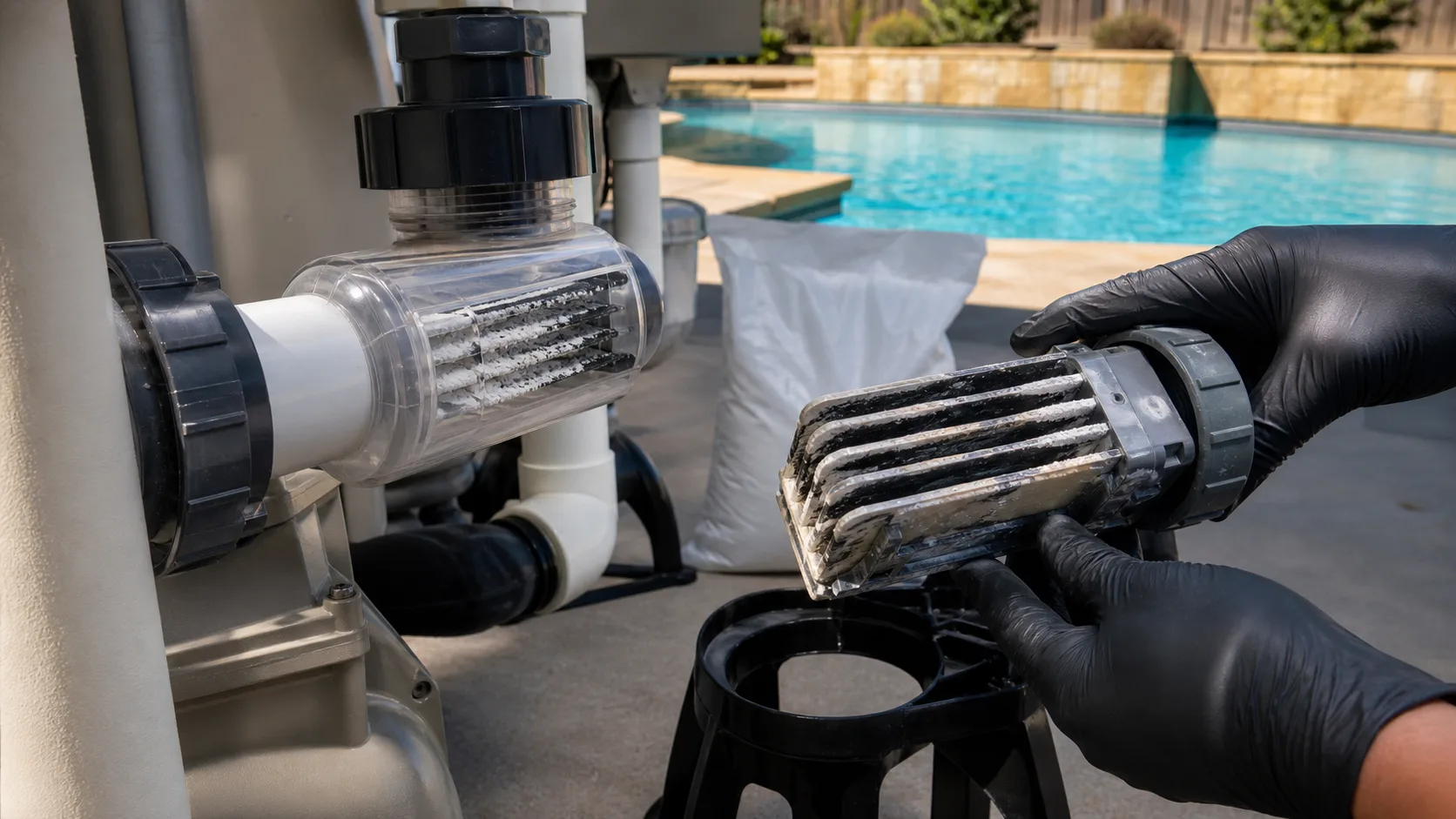
“The cell takes care of itself.” Scale buildup on the plates is the number one reason cells die early, and cells are the expensive part.
Why North Texas is harder on salt cells
Salt pools have a reputation for climbing pH, and the reputation is earned, but the usual explanation is wrong. The electrolysis reaction itself is close to pH-neutral: what it makes is chlorine and hydrogen gas, and the chlorine consumed by sanitizing gives back roughly what was taken. The rise comes from the hydrogen bubbles streaming off the cell aerating the water, which drives dissolved carbon dioxide out of it, and losing CO2 is what pushes pH up. That’s why the cure isn’t endless acid: it’s keeping total alkalinity toward the lower end of its range, because a pool carrying less alkalinity has less CO2 to outgas in the first place.
The consequence is the same either way. High pH plus dissolved calcium is exactly the condition where calcium carbonate falls out of solution as scale, and in a salt pool the first place it lands is the cell plates, because that’s where the local chemistry is most extreme.
Now add our situation. Fill water in much of Collin County is described by the North Texas Municipal Water District as moderately hard, and every summer top-off after evaporation leaves its calcium behind while the water leaves. Calcium hardness climbs season over season. Combine a rising calcium level with a process that continuously pushes pH up, and you have a machine for making scale.
This is why salt pools here need more chemistry attention than traditional pools, not less. The pH wants watching constantly, because letting it drift is what quietly kills the cell.
The maintenance that keeps a cell alive
1. Hold pH down
This is the whole game. Target the same 7.4 to 7.6 band as any pool, and expect to add acid more regularly than a neighbor with a traditional chlorine pool. A salt pool that sits at 8.0 for a month is a salt pool that is scaling its own cell. The opposite mistake matters too: overshooting the acid and leaving the water aggressive for weeks is how a heater’s copper heat exchanger ends up dissolved into the pool, which shows up as the teal staining described in metal stains in pool water.
2. Inspect and clean the cell
Pull the cell and look at the plates. Clean, they look like clean metal. Scaled, you will see white crusty deposits bridging the gaps. Many cells can be rinsed clear with a hose if you catch it early; heavier scale needs an acid soak.
Two cautions. Follow your manufacturer’s cleaning instructions and dilution, because the plate coating is what produces your chlorine and aggressive or too-frequent acid soaking strips it. And clean it only when it needs it, not on a schedule for its own sake. Some units have a self-cleaning reverse-polarity cycle, which reduces the frequency but doesn’t eliminate the need to look.
3. Get the salt level right, from your own unit
Every generator model has its own target range and its own low-salt alarm threshold. Running below range makes the cell underperform or shut down; running above it wastes salt and can, on some units, accelerate wear.
Read the label, not the blog
We’re deliberately not printing a universal ppm figure here, because there isn’t one. The correct number is printed on your generator or in its manual, and it differs between manufacturers and even between models from the same manufacturer. If you do not know yours, that’s worth five minutes with a flashlight at the equipment pad.
4. Do not skip stabilizer
Cyanuric acid protects chlorine from being destroyed by sunlight, and a salt pool in a Plano July is under exactly the same sun as everyone else’s. Without stabilizer in range, your generator produces chlorine all day and UV destroys it about as fast, and you’ll conclude the cell is failing when the chemistry is the problem.
5. Watch for the salt-specific wear
Salt water is more corrosive to some materials than fresh. Keep an eye on metal fixtures, ladders, rails, and any natural stone coping where splash-out lands and dries. This isn’t a reason to avoid a salt pool, but it’s a reason to notice things early.
When the panel says low salt, it usually isn’t
The most misread signal on a salt pool is the low-salt warning, and the reason is that your generator doesn’t actually measure salt. It measures how well the water conducts electricity and infers salinity from that. Several things other than a genuine salt shortage will drag that reading down, and pouring in bags of salt to chase the light is how pools end up oversalted.
Cold water is the seasonal one. Conductivity falls as temperature drops, so a pool that read fine in September can show low salt in January at exactly the same salinity, and most units also reduce or stop production entirely once the water drops into the low 50s. That’s normal winter behavior in North Texas, not a fault. A scaled cell produces the same complaint year-round, because deposits on the plates interfere with the current the unit is reading. So does a cell that has simply reached the end of its life.
The order to work through it is: test the salt independently with a strip or a meter rather than trusting the panel, note the water temperature, then pull and inspect the cell. Only add salt if an independent test agrees the pool is low. Salt does not evaporate, and there’s no easy way to remove it short of draining and refilling water, which in our clay soil isn’t a step to take casually.
When the cell is genuinely done
Cells wear out even when everything is done right, because the coating on the plates is consumed in normal operation. The signs that you have reached that point rather than a cleaning problem: chlorine production stays low after a proper cleaning, the cell reads low salt against an independent test that says otherwise, or the unit logs hours well into the range its manufacturer publishes. What replacement costs and how long you should expect a cell to last here is covered in salt cell lifespan and cost.
Stop and get someone out when the pool won’t hold chlorine after you have confirmed salt, stabilizer, and pH are all in range, or when the cell shows heavy scale that a manufacturer-specified soak doesn’t clear. Both of those are past the point where more homeowner troubleshooting helps, and continuing to run a struggling cell hard is a good way to turn a cleaning into a replacement.
Salt versus traditional chlorine, honestly
| Salt system | Traditional chlorine | |
|---|---|---|
| Sanitizer | Chlorine, generated on site | Chlorine, added manually |
| Water feel | Softer, less harsh | Can feel harsher |
| Weekly chemical handling | Much less | More |
| pH management | More demanding, pH rises constantly | Depends on chlorine type |
| Big-ticket wear item | The cell | None comparable |
| Upfront cost | Higher | Lower |
If you are weighing this before you own a salt system rather than after, the install price, the cell fund, and the two situations where converting is the wrong move are in what a salt conversion costs.
Our take: a salt pool is nicer to swim in and less hassle week to week, and it’s a good choice for a lot of DFW families. It isn’t a lower-maintenance pool. It trades weekly chemical handling for a standing requirement to keep pH controlled and a cell healthy, and if that requirement isn’t met the savings evaporate the first time you replace a cell early.
That trade is a good one when someone is actually watching the chemistry every week. It’s a bad one when the pool is left to itself, which is the scenario where we usually meet a scaled cell for the first time. Keeping the pH controlled and the cell clean is part of what we do on weekly service, and it’s a specific focus of our chemical balancing work on newer Frisco and Prosper builds where salt systems are close to standard.