Why Is My Pool Green? A Plano Owner’s Green-to-Clean Guide

Austin Andrews
Founder, True Texan Pools
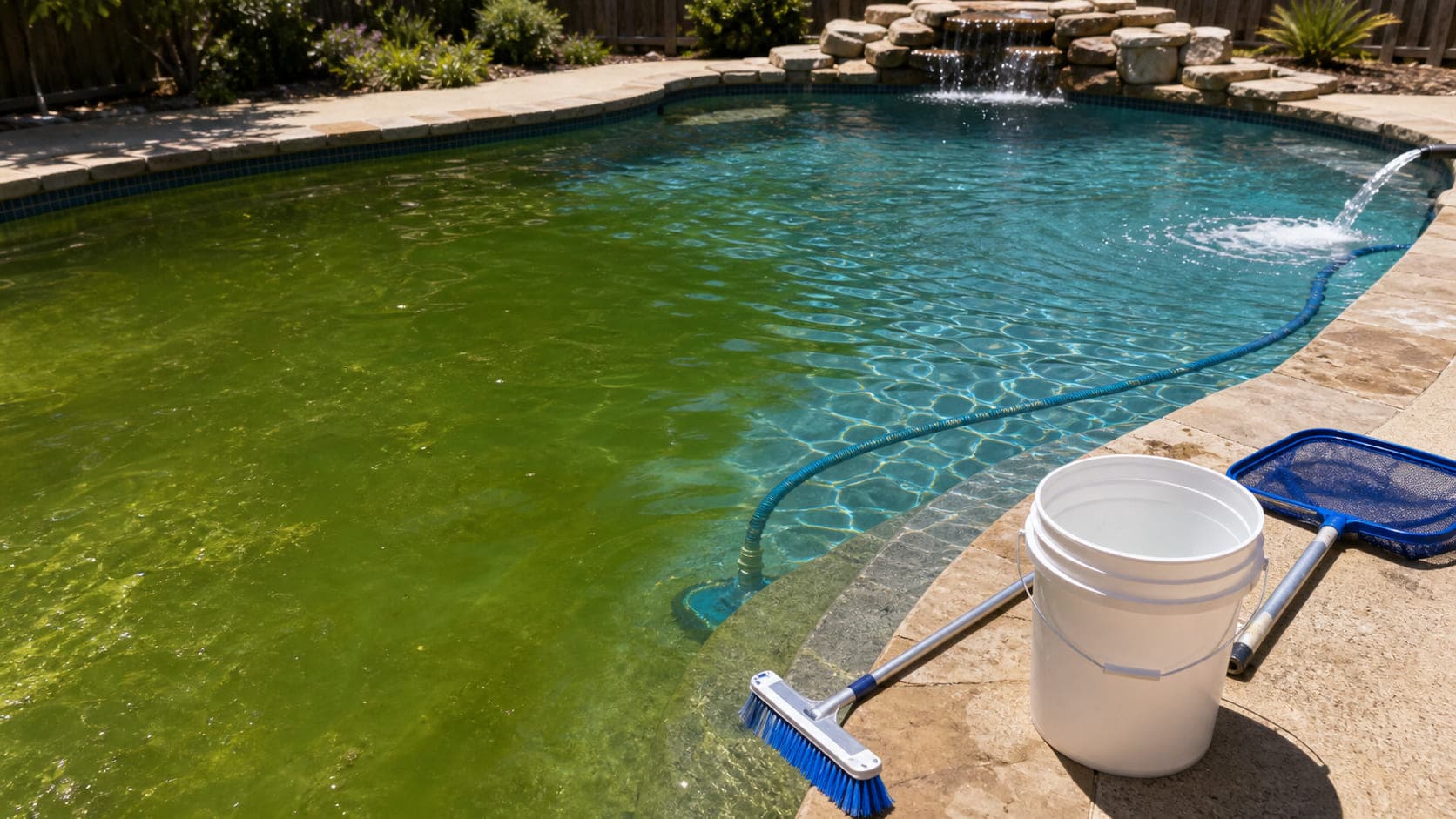
You walked out back this morning and the water that was crystal clear last week is now somewhere between lime green and pea soup. It feels like it happened overnight, and in a Plano summer it nearly can. A green pool isn’t a mystery and it isn’t a disaster. It’s algae, and algae follows rules. Once you understand those rules, you can clear the water back up and keep it from happening again.
Why pools turn green so fast in North Texas
Algae spores are always in your pool. They blow in on the wind, ride in on swimsuits and pool toys, and wash in with rain. They stay invisible as long as your chlorine is doing its job. The CDC recommends keeping free chlorine at a minimum of 1 ppm, or at least 2 ppm in a stabilized pool, which is most pools here, and testing chlorine and pH at least twice a day, more often when a lot of people are swimming. That cadence exists precisely because the margin disappears so quickly. The moment chlorine drops below the level it needs to hold, those spores multiply, and in our climate they multiply fast. Three things make North Texas especially friendly to algae:
- Heat. Algae thrives in warm water. Our pools sit in the 80s and 90s for months, which is prime growing temperature.
- Sunlight. Long, intense summer sun burns chlorine out of the water quickly and feeds algae through photosynthesis at the same time.
- Rain and storms. A summer downpour dilutes your chlorine, drops organic debris in the water, and shifts the chemistry, often right before a bloom.
Put those together and you get the classic Plano scenario: a hot week, a missed chemical check or a storm, and a pool that goes from clear to green in a day or two. If you’re in the middle of a run of triple-digit days right now, our guide to pool care through a Texas heat wave covers what to change in the routine before it gets to this point.
Do not swim in a green pool
Green water means the sanitizer is depleted, which often means bacteria are present alongside the algae. Reduced visibility is also a real drowning hazard, especially for kids. Keep everyone out until the water is clear and the chemistry is back in range.
Reading the shade of green
How green the water is tells you roughly how much work it will take to recover. This is the same scale we use to quote a recovery clean:
| What you see | What it means | Effort to clear |
|---|---|---|
| Slightly cloudy, faint green tint | Early bloom, chlorine just ran low | Often clears in 24 to 48 hours |
| Clearly green, water still see-through | Established algae bloom | Two to three days of shock and filtering |
| Deep green, can’t see past a foot deep | Heavy bloom | Three to five days, repeated shocking |
| Black or swampy, can’t see the steps | Severe, possibly with debris and stains | May need a partial drain or acid wash |
The green-to-clean recovery, step by step
Here is the exact sequence that clears a green pool. The order matters. Skipping a step is the most common reason a pool goes cloudy gray and stalls instead of clearing.
Step 1: Clear out the debris
Skim off as much surface debris as you can and empty the skimmer and pump baskets. The cleaner you start, the less organic material is fighting your chlorine.
Step 2: Test and balance the basics
Test your water and get the pH into range, around 7.4 to 7.6. Chlorine works far more effectively at the right pH, so this small step makes every dose of shock that follows do more. If you aren’t sure what your numbers should be, our pool water chemistry guide lays out every target level.
Step 3: Shock the pool, hard
Shocking means raising chlorine high enough to kill the algae and oxidize the organic load. A light bloom might clear with a single strong shock, but a deep green pool usually needs a much larger dose and often more than one round. This is the step people underdose most. A timid amount of shock just feeds you false hope.
Step 4: Brush every surface
Right after shocking, brush the walls, steps, floor, and any corners where algae clings. Brushing breaks up the colonies so the chlorine can reach them and so the dead algae lifts off the surfaces into the water where the filter can grab it.
Step 5: Run the filter around the clock
This is the step that actually clears the water, and the one homeowners cut short. Run the pump continuously, 24 hours a day, until the water clears. All that dead algae has to be filtered out. Backwash or clean the filter as the pressure climbs, because a clogged filter stops doing its job.
Step 6: Repeat and then vacuum
Re-test, re-shock if the water is still holding green, and keep brushing. As the algae dies it settles to the bottom as a gray or tan dust. Vacuum that out, ideally to waste if your system allows it, so it doesn’t just recirculate.
The cloudy-blue stage is good news
Green water almost always passes through a cloudy, milky-blue stage on its way to clear. That isn’t a setback, it’s the dead algae suspended in the water waiting to be filtered out. Keep that filter running and it will polish out. Patience at this stage beats dumping in more chemicals.
How long it takes
For a typical Plano pool, here is what to expect once you start treating it correctly:
- Light green: clear in 24 to 48 hours.
- Solid green: two to three days of shocking, brushing, and constant filtration.
- Deep green to swamp: three to five days, sometimes longer, and the point where a drain and refill or acid wash can be the faster, cheaper path.
The point to stop is when the water isn’t moving through those stages. If you have held a shock level for two full days, brushed, and filtered continuously, and the pool is still the same green it was on day one, something is holding your chlorine down rather than the algae winning. Nine times out of ten that is cyanuric acid sitting high enough that the chlorine you’re adding can’t reach an effective level at any realistic dose. Get a full panel run, including CYA, before you buy another case of shock. Adding more chlorine to a pool that can’t use it is the most expensive way to make no progress.
A full drain isn’t a DIY shortcut in North Texas
If someone suggests emptying the pool to deal with a swamp, understand what that involves here. Our expansive clay holds groundwater that pushes up on an empty shell, which can lift or crack it, and exposed plaster dries and crazes fast in summer heat. A full drain is sometimes the right call on a severe pool, but it’s a job for someone who will check the hydrostatic relief valve first and refill immediately, not a Saturday project. Partial exchange, staged over a few days, is the safe version and usually enough.
Keeping it from happening again
Clearing a green pool is satisfying, but the real win is never seeing green again. Three habits prevent almost every bloom:
- Hold your chlorine steady. Consistent sanitizer is the entire game. The pools that turn green are almost always the ones that ran low on chlorine for a few days.
- Keep cyanuric acid (stabilizer) in range. Too little and the sun burns your chlorine off by noon. Too much and you have to hold chlorine so high to keep it effective that the level becomes impractical, and algae slips in through the gap. Both ends of that range end in the same place.
- Check the pool weekly, especially after storms. A summer storm is the most common trigger for a bloom. A quick test and a small chlorine bump afterward heads it off.
This is exactly why most North Texas pools do best on weekly service through the summer. A week is about the longest a pool can coast in our heat before chemistry drifts far enough to invite algae back.
Staring at a green pool right now?
If you would rather not spend your week mixing chemicals and babysitting the filter, this is one of the most common calls we get. We bring the pool back to swim-ready with a condition-priced green-to-clean recovery, then keep it that way. Reach out through our contact form or call and we’ll get you on the schedule.
Frequently Asked Questions
How long does it take to clear a green pool?
A lightly green pool can often clear in 24 to 48 hours after a proper shock and filtration cycle. A deep green or swamp pool can take three to five days of repeated shocking, brushing, and running the filter around the clock. Severe cases sometimes need a partial drain or acid wash.
Will shock alone fix a green pool?
Shock kills the algae, but it doesn’t remove it. After shocking you still need to brush the surfaces, run the filter continuously, and vacuum out the dead algae. Skipping the filtration and brushing is the most common reason a pool turns cloudy gray instead of clearing up.
Can I swim in a green pool?
No. Green water means algae is present and the sanitizer is depleted, which often means bacteria are present too. Visibility is also reduced, which is a drowning hazard. Wait until the water is clear and chemistry is balanced before swimming.
Why is my pool still green after shocking it?
Usually one of three things: the shock dose was too small for the pool volume, the cyanuric acid level is high enough to blunt the chlorine, or nobody brushed and filtered afterward. Shock kills algae but doesn’t remove it, so the water often turns cloudy gray and stalls there without filtration.
Why did my pool turn green so suddenly?
Because algae growth is exponential, not gradual. A bloom doubles rather than creeps, so a pool can look faintly dull on Friday and be fully green by Sunday once chlorine hits zero in warm water. That’s why the trigger is nearly always a few days of low sanitizer rather than anything dramatic.
Work it out for your pool
All toolsFree, instant, and no email needed to see the answer.
Ready to stop thinking about your pool?
True Texan Pools keeps your water swim-ready all year, across Plano and the rest of DFW. Clear pricing, a photo report after every visit, and Austin doing every job himself.
Keep reading
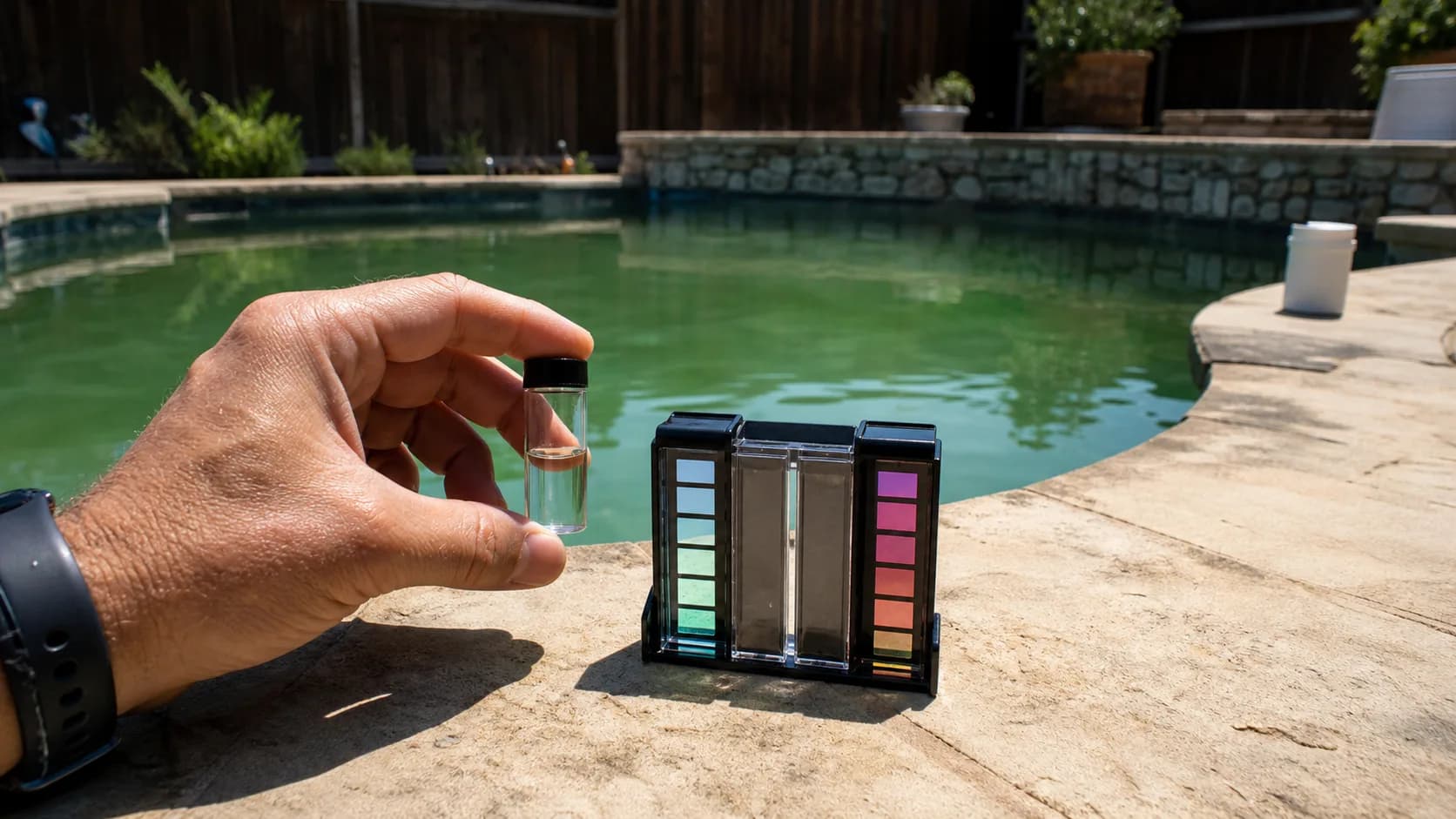
Chlorine Reads Fine and the Pool Still Went Green
Three parts per million of free chlorine, and the walls still feel slick. The problem isn’t the chlorine number, it’s the number you’re reading it against.
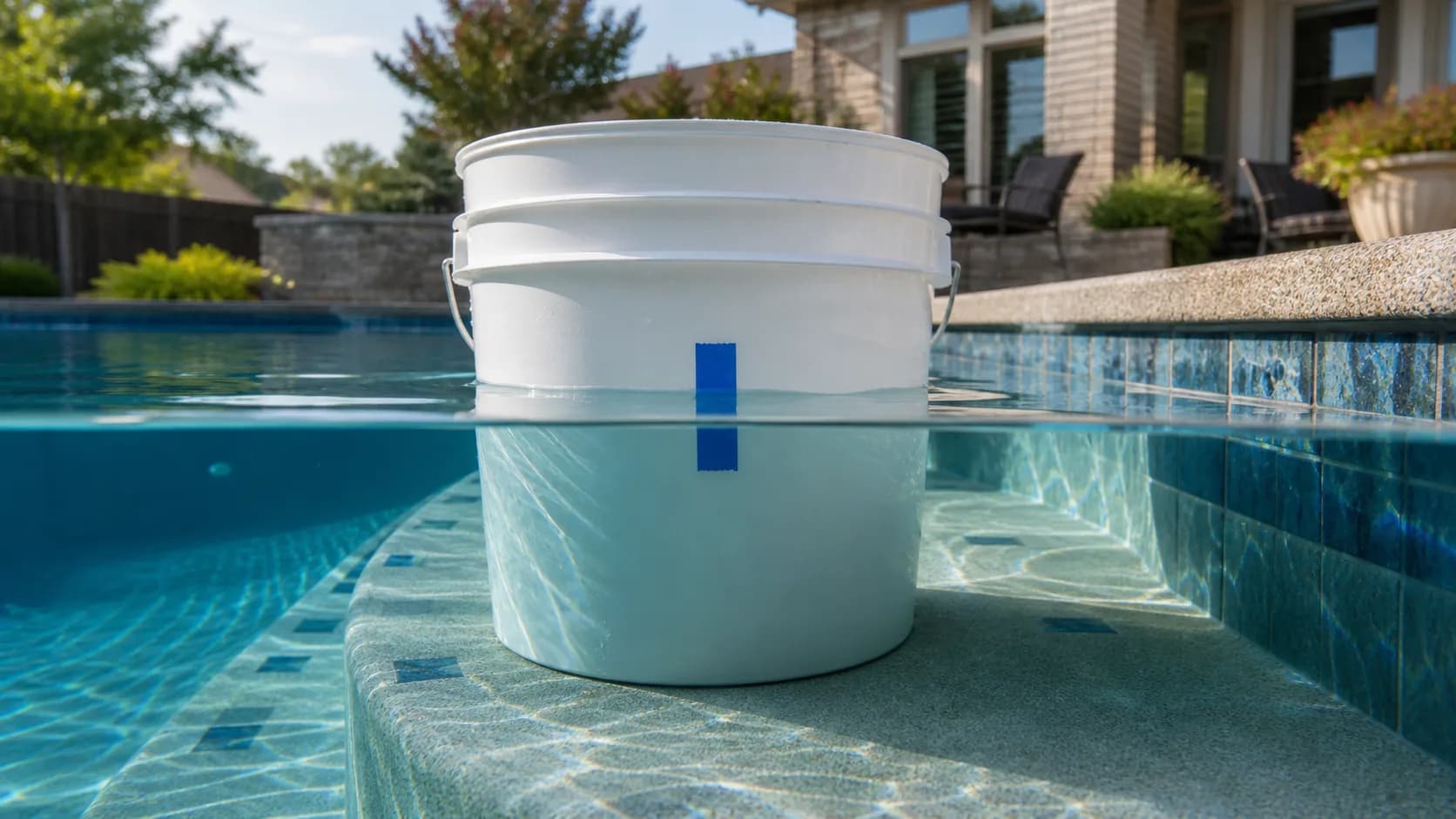
Is My Pool Leaking or Just Evaporating? The Bucket Test
There’s a definitive test for this, it costs nothing, and it takes 24 hours. Here is how to run it, and how the pattern of the loss tells you which part of the system to suspect.