Almost every pool company in this market says it is licensed and insured. Very few of them say which license, and there is a reason for that: Texas does not license swimming pool contractors at all. There is no state pool board, no pool builder license, and nothing to hold for routine cleaning. The credentials that do exist are real, narrow, and searchable in about ten minutes, and this is how to check them.
This is an awkward article for a pool company to publish, because the honest version of it removes a claim the whole category leans on. We think that is the point. If you are about to hand somebody a gate code and a monthly charge, you should be able to verify what they told you, and most of what gets said about licensing in this industry cannot be verified because it does not refer to anything.
There is no Texas pool contractor license
Some states license pool builders and pool servicers as a trade. Texas does not. There is no state swimming pool contractor license, no state pool board, and no competency exam a person has to pass before cleaning your pool for money. The practical effect is that the barrier to entering this business is a truck and a pole, which is exactly why the market has the churn it has and why companies vanish mid-season often enough to be a genre of complaint.
What the state regulates is narrower and more specific: the electrical work inside a pool, the plumbing, and the operation of public pools. Your backyard is not a public pool. An apartment or HOA pool is, and the rules there are a different article.
What this post does not do
This is a buyer’s verification guide, not a page about our own paperwork. Nothing here is a claim about True Texan Pools. If a credential matters to you, ask us for it directly and check it the same way you would check anybody else, using the searches this article names.
The licenses that do exist
Three separate authorities cover the work that happens around a pool, and they do not overlap. Knowing which one applies to the job in front of you is most of the skill here.
| Credential | Issued by | What it authorizes |
|---|---|---|
| Residential Appliance Installation Contractor | TDLR | The business-level electrical license, numbered with a TICL prefix. It lets a company do pool equipment electrical work on the load side of the control center. |
| Residential Appliance Installer | TDLR | The individual version, numbered RAIL. Install and replace underwater lights, GFCI devices, pumps, motors, heaters, and automation. |
| Electrical Contractor and Master Electrician | TDLR | Full electrical scope, numbered TECL. Required for any new or upgraded line-side circuit, panel work, or new service. |
| Plumbing licenses | TSBPE | A separate board entirely. Pool water lines and valve work fall under plumbing, not electrical. |
| Certified Pool Operator | PHTA, a trade body | A certification, not a state license. It is the recognized credential for supervising a public pool and it is voluntary for residential work. |
The three TDLR license types are listed on the department’s own electricians program page, which is worth a minute of reading if you are about to have equipment replaced. The distinction that catches people out is the one dividing the three TDLR licenses from each other, and it has a name.
Load side, line side, and where your money goes
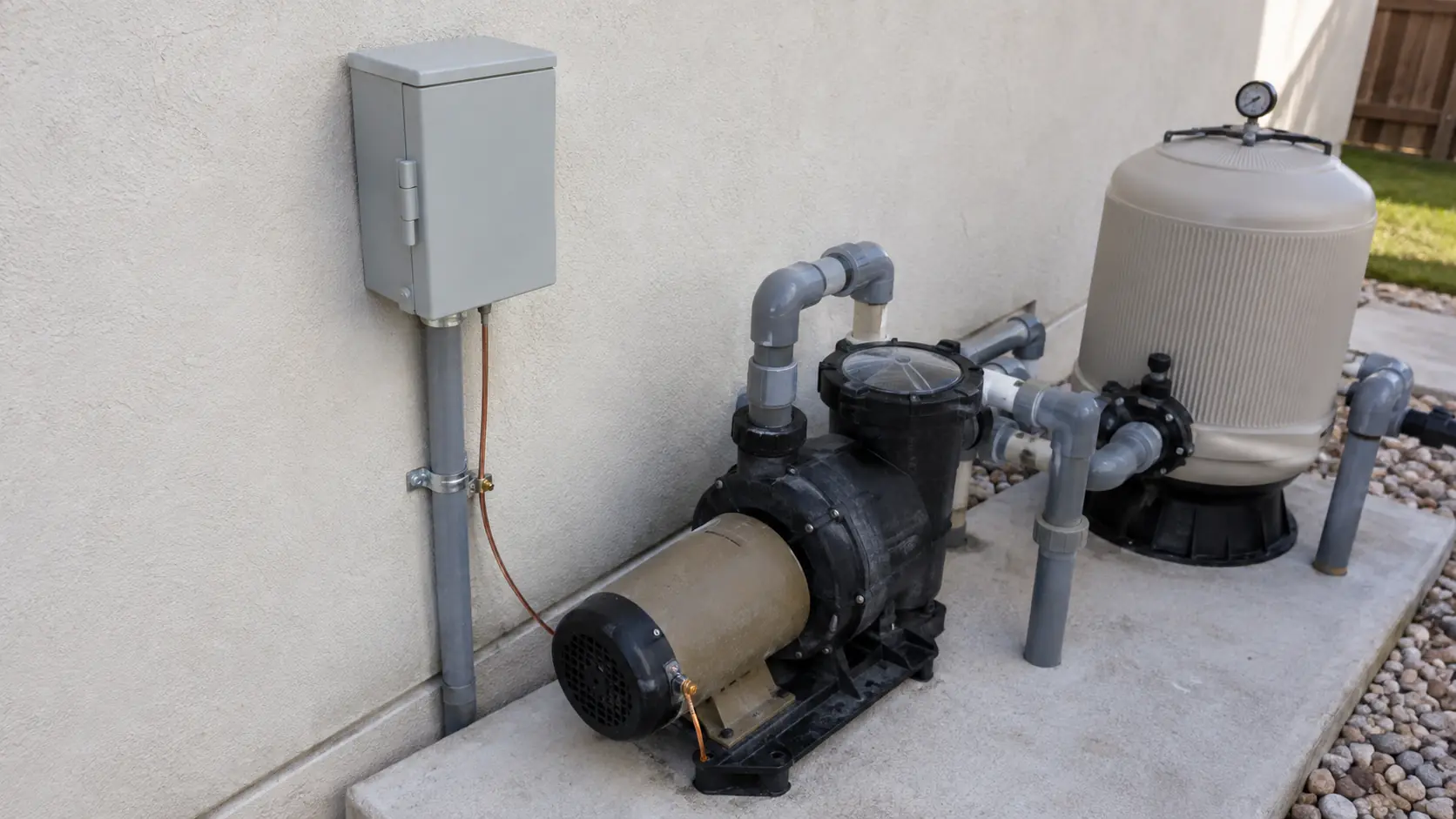
The control center is the panel or subpanel that feeds the equipment pad. Everything downstream of it is the load side: the pump, the heater, the salt system, the light, the automation. A company holding the residential appliance licenses can work there.
Everything upstream is the line side, and that needs an electrical contractor with a master electrician. If your equipment upgrade involves a new circuit, a bigger breaker, or a panel that was never sized for what you are adding, the person who can legally do that part is not necessarily the person who sold you the pump. A variable speed pump swap usually stays on the load side. A brand new heater on a pad that has no spare capacity often does not.
The question that separates the two
Ask: does this job touch the breaker panel, or only the equipment on the pad? If the answer involves the panel and the company holds only the residential appliance licenses, they need to bring in a licensed electrical contractor. A company that waves that away is telling you something about how they work generally, not just about this job.
What insured means, and the number behind it
Insured is the vaguer half of the phrase, because it is not a status the state confers. It is a policy somebody bought, in some amount, that was in force on some date. All three of those variables matter and none of them is implied by the word.
One hard number exists in Texas, and it applies only to the TDLR electrical licenses. Under 16 TAC 73.40, a TDLR electrical license holder has to carry general liability of at least $300,000 per occurrence for bodily injury and property damage combined, $600,000 aggregate, and $300,000 for products and completed operations, with a certificate filed with the department at licensing and again at each renewal. That is the floor for holding the license, not a figure anybody chose as adequate.
For comparison, the general liability limits that cities, HOAs, and commercial property managers commonly require are $1 million per occurrence and $2 million aggregate. A residential customer is under no obligation to require anything at all, which is why the number is almost never discussed on a driveway.
Workers’ compensation, which is the one nobody asks about
Workers’ compensation works differently here than most people assume. The Texas Department of Insurance states it plainly on its employer page: private employers in Texas can choose to carry coverage, but it is not required in most cases. An employer that opts out is called a non-subscriber, and it is not breaking any law by opting out.
There is one checkable consequence worth knowing. A non-subscriber has to report to the state that it does not have coverage, and has to report work-related injuries that cost more than a day of lost time. So this is not a matter of taking somebody’s word for it in either direction: a company either registered as a non-subscriber or it carries a policy, and either answer is a fact rather than an opinion.
For you, this is the question with the largest number attached. If a technician is injured on your property working for a company with no workers’ comp, the path to recovery for that injury can run toward your homeowner’s policy. It is a low probability event and a very large one, and it takes one sentence to ask about. Most small pool routes in this market are owner-operated or one or two people, and a sole proprietor with no employees has nobody to cover, which is a perfectly honest answer to the question.
CPO, and when it matters
The Certified Pool Operator certification comes from the Pool & Hot Tub Alliance. It is a real course with a real exam, it lasts five years, and it teaches the chemistry and the code that public pool operation requires.
It is also not a license, and Texas does not require it for residential work. Where it genuinely matters is public pools: the state health department regulates public swimming pools and spas, and an apartment complex or HOA pool has to be maintained under the supervision of a properly trained operator. If you sit on an HOA board, that is the credential to ask about. If you have a backyard pool in Plano, a CPO on the truck is a signal that somebody took the trouble to learn the material, not a legal requirement anybody was failing.
How to verify a company in ten minutes
None of this needs a lawyer. Every one of these checks is free and most of them are one search box.
- Search the TDLR license. Use the TDLR license search by business name or by license number. An active TICL or TECL comes back with the holder, the status, and the expiry. A company that quotes you a number that does not resolve has just answered a bigger question than the one you asked.
- Ask which license covers the job, in advance. Not whether they are licensed, but which license, and for which part of the work. The load side and line side distinction is the whole test.
- Ask for the certificate of insurance from the carrier or agent.A certificate emailed by the contractor is a PDF. A certificate the agent sends you directly, naming you as certificate holder, is issued against a policy that exists today. Ask for the general liability limits and whether workers’ compensation is carried.
- Check the city registration if the work needs a permit. Contractor registration in DFW is per municipality rather than statewide, so a company working across Plano, Frisco, McKinney, and Allen registers separately in each. If the job needs a permit and they are not registered in your city, they cannot pull it.
- Confirm what happens if they break something. Not the coverage limit, the process. Who do you call, how fast does somebody come out, and does the company handle it or hand you a claim number. Ordinary breakage is far more likely than catastrophe, and the answer here is more revealing than any certificate.
Austin’s Tip
Do the license search before you invite anybody to quote, not after they are standing in the yard. It takes two minutes, it is the same search a city inspector runs, and it is much easier to not call somebody back than to walk away from a conversation that has already happened.
What none of this tells you
Here is the limit of the whole exercise, and it deserves saying plainly rather than being buried. A license proves that somebody passed an electrical exam. A certificate proves that a policy existed on a date. Neither one predicts whether the pool gets brushed, whether the readings get recorded, or whether anybody shows up in August.
Routine cleaning, the thing you are actually buying every week, is not a licensed trade in Texas. There is no credential that covers it, so anybody selling you the credential as proof of the service is changing the subject. The evidence for the service is the service: a record of every visit, readings you can check against a test you run yourself, and a company that names what it does and does not include before you sign anything. That is what the weekly visit article and the billing article exist to make checkable.
The version of the claim worth making
Licensed and insured is not a lie in this industry so much as an empty sentence, and the fix is not more adjectives. It is specifics. A company that says which TDLR license it holds, gives you the number, tells you which parts of a job it hands to an electrical contractor, and puts you in touch with its agent has told you five checkable things where the category usually offers one uncheckable one.
Ask for those five. Then ask the harder question the paperwork cannot answer, which is what the record of the work looks like week to week. If you are weighing companies now, the questions to ask before hiring covers the rest of the interview, and our own answer to it is on the weekly service page, written so you can hold us to it.