What Your Monthly Pool Bill Actually Covers, and What It Does Not

Austin Andrews
Founder, True Texan Pools
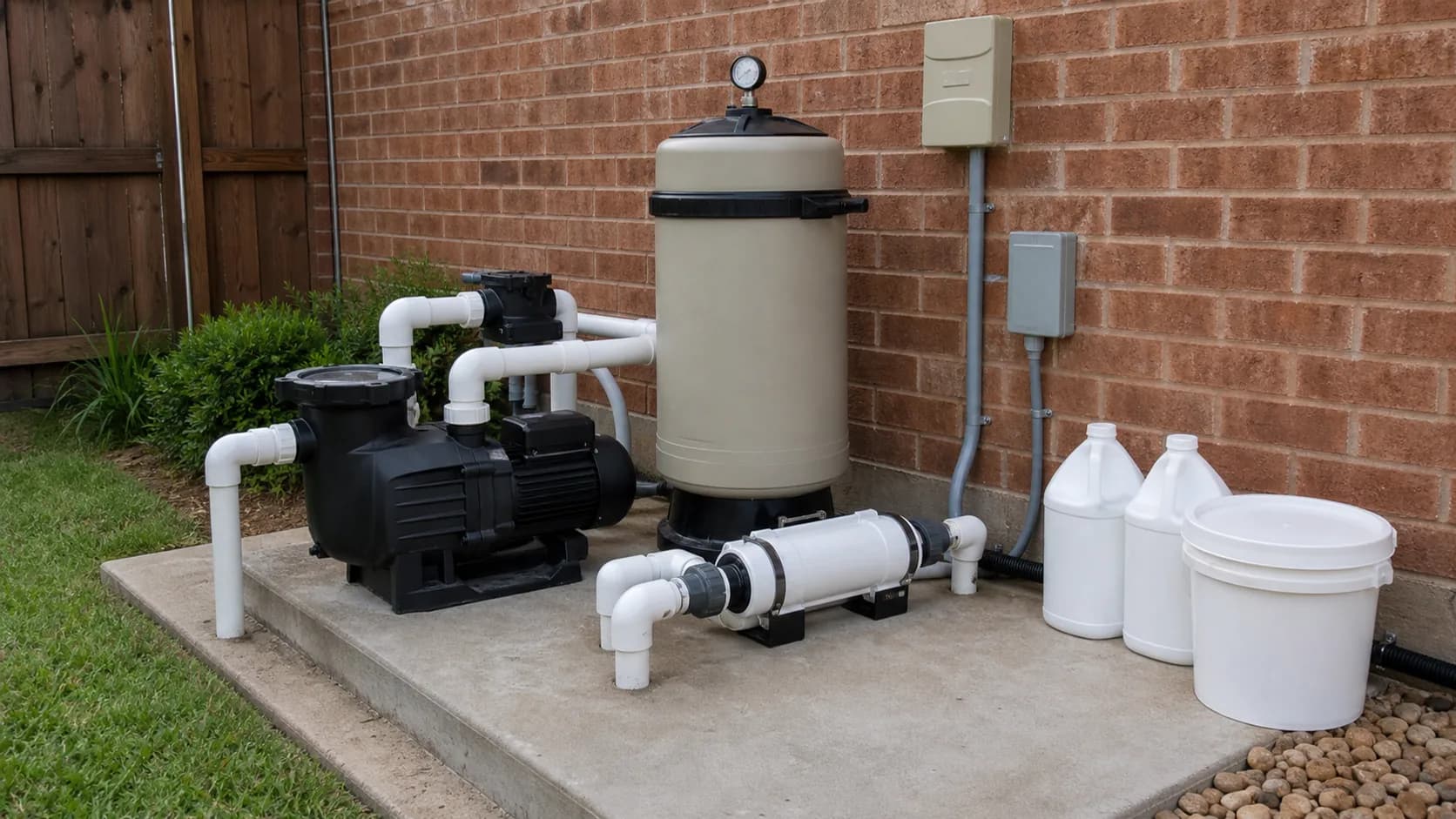
Published monthly rates for pool service around DFW currently run from about $120 to $220, and most of that spread is not a quality difference. It is an inclusion difference. Four different billing models are in common use here, they produce very different invoices for identical work, and almost nobody tells you which one they are quoting. Here is how to read your own bill, what legitimately costs extra, and what actually moves the number.
The four billing models in this market
Every quote you get in DFW is one of these four. None of them is dishonest by itself. The problem is comparing a quote from one model against a quote from another as though they were the same number, which is exactly what a homeowner collecting three quotes usually does.
| Model | What you are quoted | What arrives | Who it suits |
|---|---|---|---|
| All-inclusive | One monthly rate, chemicals in | The same number every month | Anyone who wants a predictable budget |
| Chemicals separate | A lower service rate | Service plus a chemical line that moves with the season | Owners who want to see exactly what went in |
| Chemicals capped | A rate including chemicals up to a limit | Flat most months, extra in a bad one | Standard pools with no surprises |
| Labor only | The lowest headline rate | Service only, and you buy and stock all chemicals | Hands-on owners who genuinely enjoy it |
The gap between the cheapest and the dearest published rate in this area is roughly $100 a month. Chemicals for a normal DFW pool generally account for $30 to $60 of that on their own, and the rest is mostly pool size, whether a filter clean is bundled, and whether a spa or water features are in scope. A $120 labor-only quote and a $195 all-inclusive quote can be the same amount of money by December, and the second one is the one that told you so in advance.
The comparison that goes wrong
Three quotes at $135, $165, and $210 look like a clear decision until you find out the first excludes chemicals, the second caps them, and the third includes chemicals plus two filter cleans a year. Ranked by twelve month total for the same pool, that order can reverse completely. Ask every company for the annual number, not the monthly one.
How to tell which model you are on from your own invoice
You can work this out in about five minutes with three months of statements, and it is worth doing before you call anybody to complain about a price.
- Line up three consecutive months and compare the totals. Identical to the cent means all-inclusive or capped. Varying by $20 or more means chemicals or extras are being passed through.
- Look for a separate chemical line. If it is itemized, you are on the separate model and the honest way to read your rate is service plus the twelve month average of that line, not the headline.
- Find your peak summer month. July and August are the expensive months in North Texas, because chlorine demand roughly doubles in real heat. If August looks like February, chemicals are included. If August is $40 higher, they are not.
- Look for one-off charges and ask what triggered them. Filter clean, extra visit, shock treatment, tab refill. Each is legitimate. Each should also have been predictable.
- Total the last twelve months and divide by twelve. That figure, not the quoted rate, is what your pool service costs. It is usually the first time an owner has seen the real number.
What legitimately costs extra, and roughly what it runs
These sit outside a weekly plan at nearly every company in this market, including ours. They are not upsells, they are jobs on their own schedule, and the difference between a fair company and an irritating one is whether you were told about them in advance.
| Item | Frequency | Rough DFW cost |
|---|---|---|
| Filter deep clean (tear down, rinse, reassemble) | Every 3 to 6 months | $125 to $150+ |
| First visit on a neglected pool | Once, at takeover | Priced by condition |
| Green pool recovery | As needed | A few hundred, condition based |
| Equipment repair labor and parts | As things fail | Quoted per job |
| Salt cell replacement | Every 3 to 6 years | $500 to $1,000 |
| Filter cartridges or sand media | Cartridges 3 to 5 yrs, sand 5 to 7 | Quoted per unit |
| Storm cleanup beyond a normal visit | After a real storm | One-time clean |
| Drain and partial refill | Rarely, chemistry driven | Quoted, water on your meter |
Two of these deserve a warning label. Filter cleaning is genuinely necessary maintenance rather than an optional extra, so a plan that excludes it is not cheaper, it is just billed differently, and a filter that never gets cleaned costs you in electricity and cloudy water instead. The first visit on a neglected poolis the other one: taking over a pool that has been unattended for a month is recovery work, not weekly work, and any company that quotes a normal monthly rate for it either has not seen the pool or is about to have an awkward conversation with you.
What is not on your bill, and probably should be in your budget
Service is one line of pool ownership. Electricity for the pump, water to replace roughly a thousand gallons a week of summer evaporation on a 15 by 30 pool, and a reserve for equipment that will eventually fail are the others. Sizing that reserve is easier than it sounds: pumps run 8 to 12 years here, salt cells 3 to 6, cartridges 3 to 5, and plaster 7 to 12. Divide each replacement by its years and you have the monthly number nobody puts on a quote.
What actually changes your price
These are the real inputs. If a quote moves for a reason that is not on this list, ask what the reason is.
Pool size
More gallons means more chemicals, more surface to brush, and more floor to vacuum. The single biggest driver of a weekly rate, and the reason published pricing is normally banded by small, medium, and large rather than quoted flat.
Tree load
Established Plano and Richardson neighborhoods with mature oak and pecan canopy put far more debris in the water than a newer Frisco or Prosper build with young landscaping. It is the difference between a five minute skim and a fifteen minute one, every week, forever.
Spa, water features, and attached systems
A spa is a second body of water with its own chemistry and its own surfaces. Waterfalls and deck jets add plumbing and splash-out. All of it is worth having and all of it is more work.
Salt versus chlorine
A salt pool is not chemical-free, it generates its own chlorine, so the recurring chemical cost is lower while the cell is a wear item with a replacement bill attached. Our salt water maintenance guide covers what those systems still need weekly, which is more than most owners are told at installation.
Starting condition
This one only affects the first visit, but it affects it a lot. A pool that is clear and balanced starts on the monthly rate. A pool that has been sitting starts with a recovery, and then goes onto the monthly rate. Both are normal. Being quoted the first and billed the second is not.
Service day and route density
Rarely disclosed, and genuinely real. A pool on an established route costs less to serve than one thirty minutes off it, which is why coverage areas exist and why a company that will drive anywhere is usually the one whose price is about to go up or whose visits are about to get short.
Why the same pool gets quoted $130 and $210
Assume an identical medium pool in Plano, no spa, moderate trees. Here is where each dollar of that spread actually sits.
| Difference | Typical monthly impact | Is it a quality difference? |
|---|---|---|
| Chemicals included or not | $30 to $60 | No, purely a billing choice |
| Filter cleans bundled or billed | $20 to $25 amortized | No, timing only |
| Vacuuming every visit or as needed | $10 to $20 | Sometimes, depends on the pool |
| Weekly versus biweekly | Up to half the rate | Yes, in a Texas summer |
| Pool size band | $30 to $100 | No, it is more work |
| Reporting and equipment checks | $0 to $15 | Yes, this is the part that catches repairs early |
Read the first column honestly and the conclusion is uncomfortable for the whole industry: most of the price spread in this market is not a quality signal at all. Which is exactly why picking on price alone works so badly, and why the cheapest quote so often turns into a recovery bill by August. Our Plano pool cleaning cost guide has the ranges by pool size and by condition, and weekly versus biweekly covers the one line in that table that genuinely is a quality difference here.
The questions that settle it in one phone call
Ask these five and you can compare any two quotes properly. Ask them of us too.
- Are chemicals included, with no cap? If capped, what is the cap and what happens in August when the pool goes through twice the chlorine?
- What is not included, in writing? The exclusion list is the real quote. Our task-by-task breakdown of a weekly visit is a reasonable standard to hold the answer against.
- How often is a filter clean needed on my filter, and what does it cost? The answer should reference your filter type rather than a generic interval. Our filter comparison covers why cartridge, DE, and sand differ on this.
- Is the first visit priced differently, and why? A straight answer here tells you they have assessed the pool rather than the postcode.
- What is the twelve month total for my pool, including everything above? The one number that makes quotes comparable, and the one nobody volunteers.
A price is a claim about scope, not about quality
The most useful reframe I can offer after four years of taking over other companies’ pools: a rate tells you what somebody has agreed to do, not how well they do it. Scope you can compare on the phone in ten minutes. Quality you can only verify afterward, from the readings and the photos each week, which is why the reporting question matters more than the price question.
Where our boundary sits
We run the all-inclusive model. Chemicals, testing and balancing, skimming, brushing, vacuuming, baskets, an equipment check, and a dated photo report with the readings are in the monthly rate, and that rate does not move because it was hot. Weekly maintenance starts at $120 a month for a small pool, $150 for a medium pool, and $225 and up for a large one, published on our weekly pool service page rather than held back for a callback.
Outside that boundary sit three things, and we would rather write them here than in an email later. Filter deep cleans are quoted separately at $125 to $150. Repairs and parts are quoted per job after an equipment inspection, with the diagnosis explained before anything is spent. And a pool that has been sitting starts with a recovery priced by condition, after which it goes onto the normal monthly rate like any other pool. No contract, no cancellation fee, and no chemical surcharge in the middle of August.
If you are holding an invoice you do not understand right now, the fastest thing to do is run the five minute check at the top of this article on your own last three statements. If the number turns out to be higher than you thought, you are not being unreasonable to ask why, and we service Plano, Frisco, McKinney, Allen, and the surrounding Metroplex if you want a second number to compare it against.
Frequently Asked Questions
Are chemicals included in pool service?
It depends entirely on the company, and this is the single biggest reason two quotes differ. Chemicals for a normal DFW pool run roughly $30 to $60 a month, so a rate quoted without them looks substantially cheaper while costing about the same by year end. Ask whether chemicals are included, and if they are capped, ask what the cap is and what August looks like when it is exceeded.
Why is my pool bill different every month?
Almost always because chemicals are being passed through at cost rather than included in a flat rate. Chlorine demand roughly doubles in a North Texas summer, so July and August bills climb while February looks cheap. The other common cause is a one-off charge such as a filter deep clean, which typically runs $125 to $150 and comes due every three to six months.
What do pool companies charge extra for?
Filter deep cleans, equipment repairs and parts, salt cell replacement, filter media and cartridges, draining, storm cleanups beyond a normal visit, and the first visit on a neglected pool, which is recovery work rather than weekly work. These sit outside a weekly plan at nearly every company in this market. The difference between a fair company and an irritating one is whether the list was published in advance.
Is filter cleaning included in weekly pool service?
Rarely, and it should not be treated as an optional extra when it is excluded. Cartridge and DE filters need a full tear-down clean every three to six months, typically $125 to $150 in this area. A filter that never gets cleaned raises your pump energy use and leaves the water cloudy, so a plan that excludes it is not cheaper, it is billed differently.
Why do pool service quotes in DFW range from $120 to $220 a month?
Mostly inclusion differences rather than quality differences. Chemicals account for $30 to $60 of the spread, bundled filter cleans another $20 to $25 amortized, and pool size band up to $100. The one line in that comparison that genuinely is a quality difference is visit frequency, because in a Texas summer the interval between visits is the interval during which the pool is unsupervised.
Does pool service cost the same in winter as in summer?
On an all-inclusive plan, yes, the rate is level year round. On a pass-through plan the winter months are noticeably cheaper and the summer months noticeably dearer, which averages out to a similar annual figure. Winter work is genuinely lighter here, but it is not nothing: freeze protection and equipment checks are the tasks that matter from December through February.
Ready to stop thinking about your pool?
True Texan Pools keeps your water swim-ready year-round across Plano and all of DFW. Clear pricing, no contracts, and a photo report after every visit. Austin handles every job personally.
Keep reading
How Much Does Pool Cleaning Cost in Plano, TX? (2026 Pricing Guide)
Most Plano pool companies hide their prices behind a phone call. Here is exactly what weekly service, one-time cleans, and green pool recovery actually cost in 2026, and what drives the number up or down.
Your Pool Company Stopped Showing Up. Here Is What to Do.
The visits stopped, the invoices did not, and nobody is returning your calls. There is an order to doing this that keeps both your leverage and your water, and most people get it backwards.