What Actually Happens on a Weekly Pool Visit, Task by Task

Austin Andrews
Founder, True Texan Pools
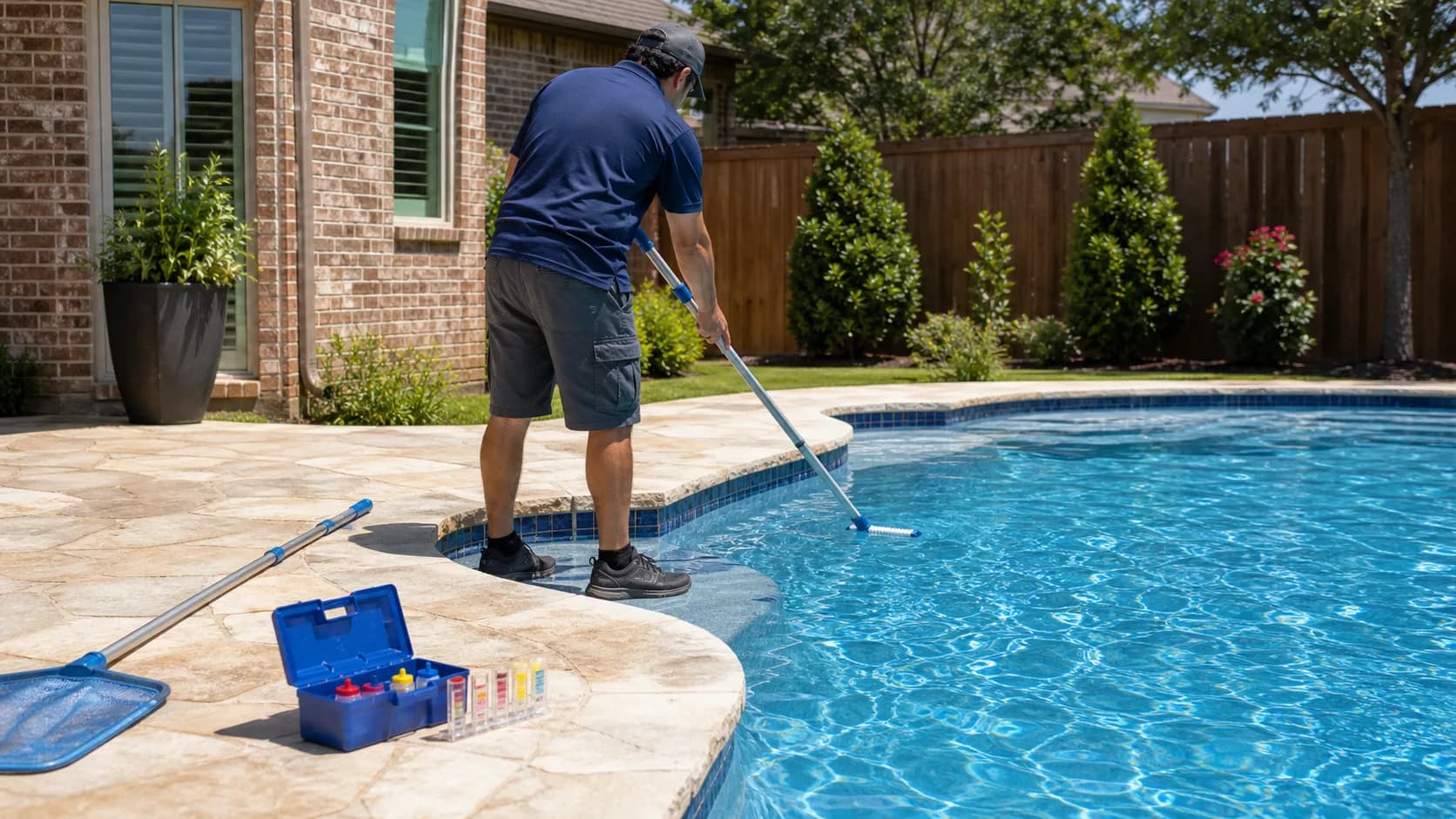
A weekly pool visit is eight tasks in a fixed order, and on a normal pool it takes twenty to thirty five minutes. Most articles about this publish the list of tasks. Almost none of them tell you how long each one honestly takes, what it leaves behind as evidence, or what is deliberately not included. Those three things are what you actually want to know, so that is what this article is.
How long a weekly visit actually takes
On a well-maintained medium pool with no spa and moderate tree cover, a full visit is twenty to thirty five minutes. That number surprises people in both directions, so it is worth being precise about where it goes.
| Task | Typical time | What it leaves behind |
|---|---|---|
| Surface skim | 3 to 5 min | Clear surface, wet net on the deck |
| Baskets, skimmer and pump | 2 to 4 min | Empty baskets, lids reseated, pump quiet |
| Brushing walls, steps, waterline | 5 to 10 min | Drag marks, no dust line on the tile |
| Vacuuming | 5 to 15 min | Clean floor, hose or robot moved |
| Water test | 2 to 4 min | Readings recorded, comparator rinsed |
| Chemical dosing | 3 to 5 min | Levels move by the next test, tab feeder refilled |
| Equipment check | 2 to 3 min | Filter pressure noted, lids and unions dry |
| Photo report | 1 to 2 min | Dated photos and readings in your inbox |
Add ten to twenty minutes for a spa, a heavy leaf week, a water feature, or a pool that has been left a while. Subtract nothing. If the visit is genuinely finishing in eight minutes every week, the arithmetic says something on that list is not happening.
Longer is not automatically better
A technician who knows the pool works faster than one who does not, and speed on a route is mostly the absence of wasted movement rather than corner-cutting. What you are judging is not the stopwatch, it is whether the eight outcomes are there afterward. A twenty two minute visit that leaves clean baskets, moved chemistry, and a noted filter pressure beats a forty minute visit that leaves the waterline untouched.
The visit in the order it happens
The order is not arbitrary. Debris comes out before chemicals go in, because chlorine spent on a mat of leaves is chlorine that never reaches the water. Brushing happens before the test, because brushing puts settled material into suspension where the filter and the sanitizer can reach it, and testing before you disturb anything gives you a reading of the calmest water in the pool rather than the water people swim in.
1. Surface skim
Leaves, bugs, pollen, and anything floating come off first, working from the downwind end where the debris has collected. This is partly cosmetic and partly not: organic material left floating consumes chlorine as it breaks down, and anything that sinks becomes a stain risk on plaster within a few days.
2. Skimmer and pump baskets
Both baskets, every visit, ten seconds each. This is the task with the highest ratio of importance to effort in the entire trade. A packed skimmer basket starves the pump of water, which costs you circulation and filtration all week, and a pump running short of water is a pump wearing out early. It is also, not coincidentally, the easiest evidence for you to check afterward.
3. Brushing
Walls, steps, the waterline tile, and the corners a vacuum head cannot reach. Five to ten minutes of real physical work, and the most commonly skipped task on any route, because it is the most tiring and the slowest to show its absence.
In North Texas the waterline in particular is not optional. Our fill water arrives hard: the North Texas Municipal Water District describes its treated water as moderately hard, with regional hardness reported up to roughly 202 ppm as calcium carbonate, which is at or above the 150 to 200 ppm range a pool is supposed to hold before a single day of evaporation has concentrated it further. Weekly brushing of the tile band is what keeps that from setting into the crust described in our calcium scale article, which is a very different and much more expensive job once it has hardened. The NTMWD publishes its own water quality and hardness figures if you want the source.
4. Vacuuming
Either manually with a vacuum head on the pole, or by running and repositioning a robotic or suction cleaner and emptying it. Five minutes on a clean pool, fifteen after a windy week. Worth knowing: many companies vacuum as needed rather than every single visit, on the reasoning that a pool with a working cleaner and a clean floor does not need it. That is defensible, but it should be stated rather than discovered.
5. Water test
At minimum free chlorine and pH every visit, with total alkalinity, cyanuric acid, and calcium hardness on a longer cycle. The CDC treats free chlorine and pH as the two things standing between pool water and the germs that spread in it, and their home pool treatment and testing guidance is the plain version of why these two are non-negotiable while the others are periodic.
A test strip dipped over the side is not the same instrument as a drop test taken elbow-deep away from the returns, and the difference shows up in the dosing. Whichever is used, the readings should reach you, because a test whose numbers you never see is a test that cannot be checked.
6. Chemical dosing
Chlorine to target, pH corrected, alkalinity adjusted when it has drifted, stabilizer only when it is genuinely low, and the tab feeder or floater refilled. Two things here are worth understanding as a homeowner.
- Chlorine target is not a fixed number. It scales with your stabilizer level, which is why two pools on the same street can need very different amounts of chlorine to be equally sanitary. Our cyanuric acid article covers what happens when that number climbs, and it climbs quietly on any pool run on tablets.
- Dosing is for the week, not the moment. A technician is aiming to have the pool still in range six days later, in the sun, which is a different calculation from getting it in range while standing there. This is the main reason a reading taken the day after a visit looks higher than the number you would target yourself.
7. Equipment check
Filter pressure read against its clean baseline, pump primed and not making new noises, no drips at the unions or under the heater, valves in the right positions, and the timer or automation schedule still doing what it was set to do. Two or three minutes, and it is the part of the visit that catches the expensive things early. A filter pressure creeping up eight or ten psi over baseline is a filter clean coming, not a mystery.
8. Photo report
Dated photos and the readings, sent the same day. This is the task that makes all seven others auditable, which is why we treat it as part of the visit rather than as a courtesy.
What is not included, and what those things cost
Every honest weekly plan has a boundary. The problem in this market is not that companies have exclusions, it is that they usually do not publish them, so the homeowner finds the boundary by getting an invoice. Here is where the line normally sits.
| Not in a weekly plan | How often it comes up | Rough cost in DFW |
|---|---|---|
| Filter deep clean, tear down and rinse | Every 3 to 6 months | $125 to $150+ |
| Green pool recovery on takeover | Once, at the start | Priced by condition |
| Equipment repair and parts | As things fail | Quoted per job |
| Salt cell replacement | Every 3 to 6 years | $500 to $1,000 |
| Filter media or cartridges | Sand 5 to 7 yrs, cartridges 3 to 5 | Quoted per unit |
| Draining or partial drain and refill | Rarely, chemistry driven | Quoted, water not included |
| Storm cleanup beyond a normal visit | After a real storm | One-time clean |
| Acid washing and stain treatment | Rarely | Quoted per job |
Two exclusions deserve a note because they cause most of the arguments. Filter cleaning is excluded almost everywhere and is not optional maintenance: a clogged filter quietly raises your energy use and leaves the water cloudy. The first visit on a neglected pool is a recovery, not a weekly visit, and it is priced separately, because the labor and chemicals scale with the condition rather than with the calendar. Our Plano pool cleaning cost guide publishes both numbers, and what your monthly bill actually covers walks through the four billing models used around here and how to tell which one your invoice is written in.
How to tell the visit happened when you were not home
Nearly nobody is home on their service day, which is the entire reason this trade has a trust problem. You do not need to be there. Each of the eight tasks leaves something behind, and four of them are checkable in about ninety seconds the following morning.
- Open the skimmer lid. The basket should be empty or nearly so. A basket packed and matted the day after service is the clearest single signal there is.
- Look along the waterline tile. No grey scum band, no dust line. This one tells you specifically about brushing, the task most likely to be skipped.
- Test the chlorine yourself, once a month. Not to second-guess the readings, just to confirm the number moves. Flat chlorine week after week means the dosing is not happening or is not enough for your stabilizer level.
- Look at the deck and the tab feeder. Splash marks and wet patches on a dry day, and tabs that are visibly being consumed. A feeder holding the same tabs at the same height for a month has not been opened.
Ask for the readings, not the reassurance
The single most useful thing you can ask any pool company, ours included, is to see the numbers from each visit. A company that sends readings has committed to something you can check. A company that says the pool is looking great has not. If the answer to that request is friction, you have learned what you needed to know, and our guide on what to do when a pool company goes quiet covers the rest.
What a technician should catch that you would not
The tasks are the visible part. The reason a weekly visit is worth paying for is the pattern recognition running underneath it, and most of it never appears on a checklist.
- Filter pressure trending up over three weeks rather than being high on one day. That trend is a filter clean scheduled instead of a cloudy pool discovered.
- Chlorine demand rising while nothing else changed. Usually the first sign of algae starting in a shaded corner, days before you can see it.
- A pump note that is new. Bearings and cavitation sound different from each other and both sound different from a basket full of leaves. Our repair or replace guide covers where that leads.
- Water level drifting faster than the weather explains. Summer evaporation in this area runs around half an inch a day, roughly a thousand gallons a week on a 15 by 30 pool. Meaningfully more than that, week after week, is the conversation in our leak or evaporation article.
- Stabilizer climbing. It only goes down by dilution, so a pool run on tabs walks steadily toward the point where chlorine stops working properly, and the only person watching that number is whoever is testing for it.
How often the pool actually needs this in North Texas
Weekly, most of the year, and the reason is local rather than commercial. There is no real off-season here. Water in the high 80s or low 90s through July and August grows algae fast and burns chlorine off under the sun daily, so the interval between visits is the interval during which the pool is unsupervised, and in August that gets expensive quickly. Winter is genuinely lighter work, but it is not zero: freeze protection and equipment checks are winter tasks, and our freeze protection guide explains what a single hard night can cost a pad nobody looked at.
Biweekly service is a legitimate choice on the right pool, and it is a bad choice on the wrong one. Our weekly versus biweekly comparison works through when it holds up and when it turns into a recovery in August, which is the honest version of that decision.
How to audit your own service
This is the part we would rather you read than skip, even though it is the part that makes our own work checkable. Set a monthly reminder and do four things.
- Read one report properly. Not the photos, the numbers. Free chlorine, pH, and the date. If you do not know what the numbers should be, our water chemistry guide has the ranges.
- Check the skimmer basket the morning after a visit. Ninety seconds, and it tests the whole arrangement.
- Test the water yourself once a month. Compare it to the report from two days earlier. They should be in the same neighborhood.
- Ask one question a quarter. What is the filter pressure doing? When is the next filter clean due? Where is my stabilizer? A company that answers those without hesitation is a company keeping records.
If any of that comes back wrong, the fix is usually a conversation rather than a replacement, and it should be an easy conversation. If it is not, that itself is the answer.
What our visits include
All eight tasks above, every visit, with the readings and dated photos sent the same day. Chemicals are in the price rather than billed on top, so the monthly number does not move because it was hot. Filter deep cleans are the one thing we quote separately, because pretending a $125 job is free just means it is priced into everybody else’s monthly rate whether they need it or not. Our weekly pool service page has the full inclusion list and the price, published, and we cover Plano, Frisco, McKinney, Allen, and the surrounding Metroplex.
Print this list if it is useful, and hold whoever services your pool to it. That includes us. A standard is only worth publishing if you are willing to be measured against it, and the whole point of a report landing in your inbox every week is that you can.
Frequently Asked Questions
How long should a weekly pool service visit take?
Twenty to thirty five minutes on a normal medium pool with no spa and moderate tree cover. Add ten to twenty minutes for a spa, water features, a heavy leaf week, or a pool that has been left a while. A visit consistently finishing in under ten minutes cannot contain all eight tasks, and an unusually long visit usually means something was wrong that day.
Does weekly pool service include chemicals?
Depending on the company, yes, no, or up to a capped amount. Chemicals typically account for $30 to $60 a month on a normal DFW pool, which is most of the difference between a cheap quote and an expensive one. Ask before comparing two rates, because a labor-only quote and an all-inclusive quote are not the same product.
Should a pool service vacuum the pool every visit?
Many companies vacuum as needed rather than every visit, reasoning that a pool with a working automatic cleaner and a clean floor does not require it weekly. That is defensible, but it should be stated in the plan rather than discovered later. Brushing, by contrast, should happen every single visit, because it is what keeps algae off the surfaces and calcium off the tile.
How can I tell if my pool guy actually came?
Check four things the morning after your service day. The skimmer basket should be empty or nearly so. The waterline tile should have no grey scum band. The deck should show splash marks or brush drag marks in the dust. And the tabs in the feeder should be visibly consumed. Test the chlorine yourself once a month, and confirm the number is moving.
Is filter cleaning part of weekly pool service?
Almost never. A full filter tear-down and clean is a separate job every three to six months, typically $125 to $150 in the DFW area. It is genuinely necessary maintenance rather than an upsell: a clogged filter raises pump energy use and leaves water cloudy no matter how good the weekly chemistry is.
Do I need to be home for a pool service visit?
No, and almost nobody is. The technician needs gate access and, on some pools, access to the equipment pad and a hose bib. That is exactly why a dated photo report with the readings matters: it is the only way a homeowner who was at work can confirm what happened and whether the chemistry moved.
Does a pool still need weekly service in a North Texas winter?
The work is lighter but it does not stop. Pools here are not winterized the way northern pools are, so circulation, chemistry, and debris still need attention, and freeze protection becomes the priority task from December through February. A single unprotected hard freeze can cost more than a year of service.
Ready to stop thinking about your pool?
True Texan Pools keeps your water swim-ready year-round across Plano and all of DFW. Clear pricing, no contracts, and a photo report after every visit. Austin handles every job personally.
Keep reading
Your Pool Company Stopped Showing Up. Here Is What to Do.
The visits stopped, the invoices did not, and nobody is returning your calls. There is an order to doing this that keeps both your leverage and your water, and most people get it backwards.
What Your Monthly Pool Bill Actually Covers, and What It Does Not
Three quotes at $135, $165, and $210 look like a clear decision until you find out they are written in three different billing models. Here is how to compare them properly.