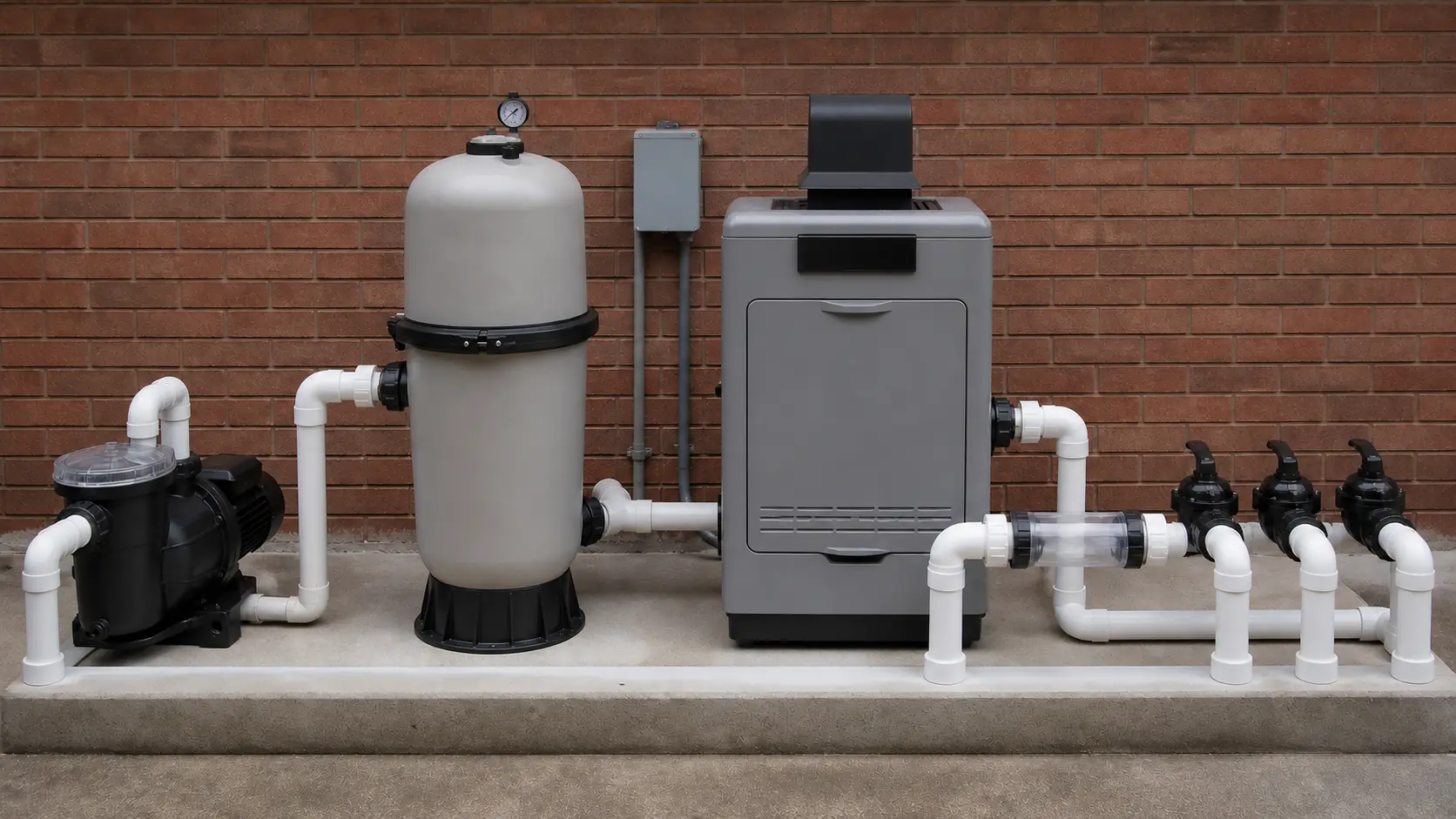
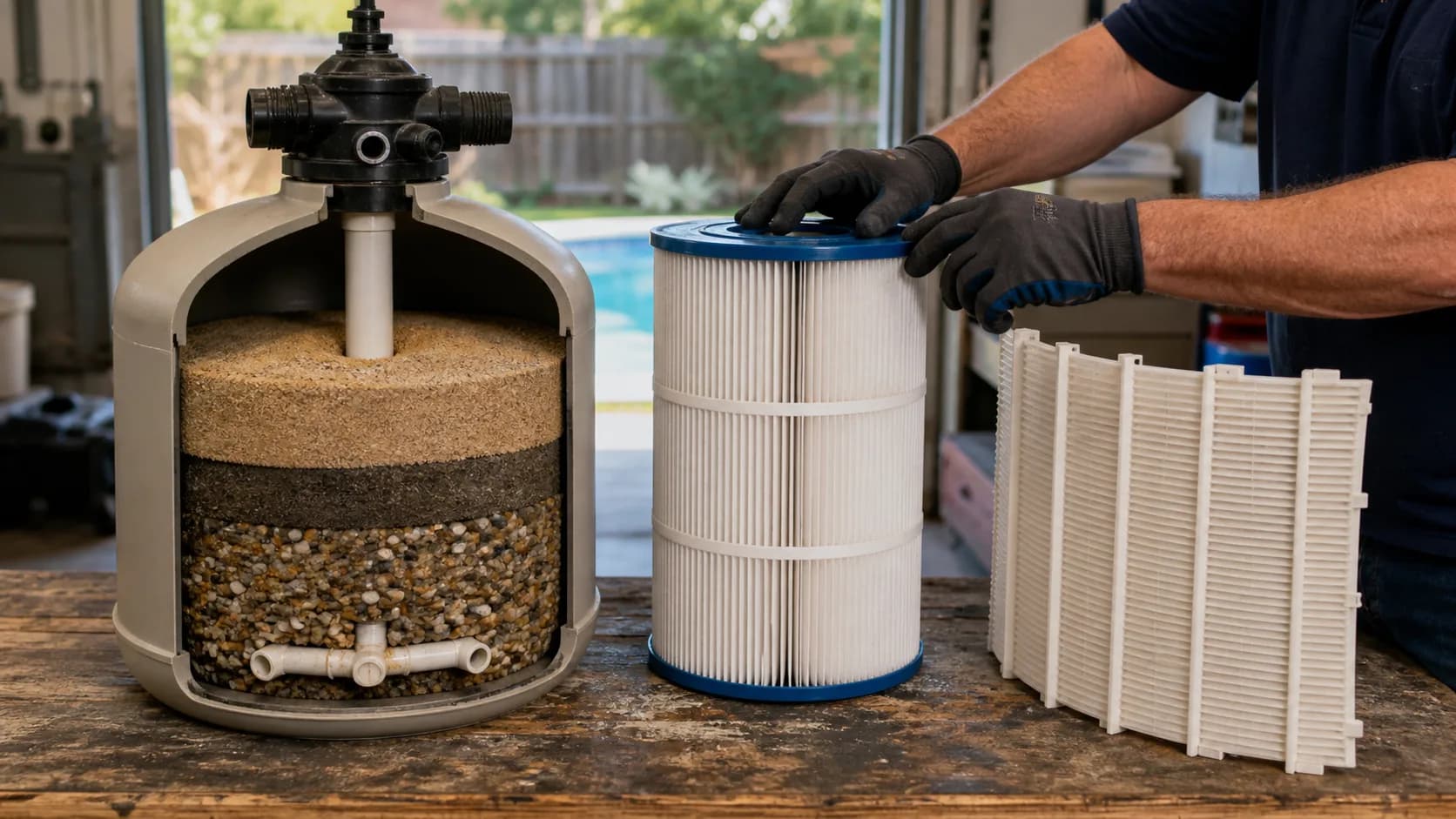
Sand, cartridge, or DE. Every pool has one of the three, most owners inherited theirs without choosing it, and the differences genuinely matter in North Texas, where heat, dust, and a long season all push more material through your filter than a milder climate would. Here is how each one works, what it costs you in maintenance, and which one we would pick for a Plano pool.
What a pool filter is doing
Your sanitizer kills things. Your filter removes things. They’re different jobs and neither substitutes for the other, which is why a pool with perfect chlorine and a clogged filter still looks hazy. Water leaves the pump, passes through the filter medium, and returns having left its suspended particles behind. The finer the medium, the smaller the particle it catches, and the faster it clogs.
That tradeoff is the entire comparison. Finer filtration means clearer water and more frequent cleaning. There’s no filter that is both the finest and the least maintenance, and anyone selling you one is selling.
The three types side by side
| Sand | Cartridge | DE | |
|---|---|---|---|
| Filtration fineness | Coarsest | Finer than sand | Finest |
| Cleaning method | Backwash | Remove and hose off | Backwash, then recharge with DE |
| Water used to clean | Significant | None | Significant |
| Routine effort | Lowest | Moderate | Highest |
| Medium replacement | Sand every several years | Cartridges periodically | DE powder after every clean |
| Handling caution | None notable | None notable | Do not inhale the powder |
About micron ratings
You’ll see confident micron numbers for each filter type all over the internet. They trace back to manufacturer marketing rather than to a published standard, and they vary between products within a type. The ranking is reliable and uncontroversial: DE filters finer than cartridge, which filters finer than sand. The specific numbers aren’t, so we have left them out rather than repeat a figure we can’t source.
There’s a real standard, and it’s worth knowing what it measures instead. Pool filters are certified to NSF/ANSI/CAN 50, the health and safety standard for pool and spa equipment, whose joint committee introduced enhanced performance validation testing specifically for filters. A filter carrying that certification has been tested against a defined procedure. A micron number on a box hasn’t.
Sand filters
A tank of specially graded sand. Water passes down through the bed, particles lodge between the grains, and clean water exits the bottom. To clean it you reverse the flow, which lifts the debris out and sends it to waste.
The appeal is that it is nearly foolproof. There’s no medium to buy every month and no cartridge to remove and hose down in the sun. The cost is filtration fineness and water: every backwash sends a meaningful volume of your pool down the drain, and you pay to refill it. That matters in a Texas summer and matters more under watering restrictions.
One thing worth getting straight, because it’s commonly stated backwards: backwashing doesn’t drive your calcium hardness up. Pool water carries more dissolved calcium than the fill water replacing it, so a backwash-and-refill is a partial dilution, which is the standard remedy when hardness gets too high. What concentrates calcium is evaporation followed by a top-off: the water leaves and the minerals stay. We cover that mechanism in the water chemistry guide.
Cartridge filters
A pleated fabric element in a housing. The pleats give a large surface area in a compact tank, so cartridge filters can run at lower flow resistance while catching finer material than sand.
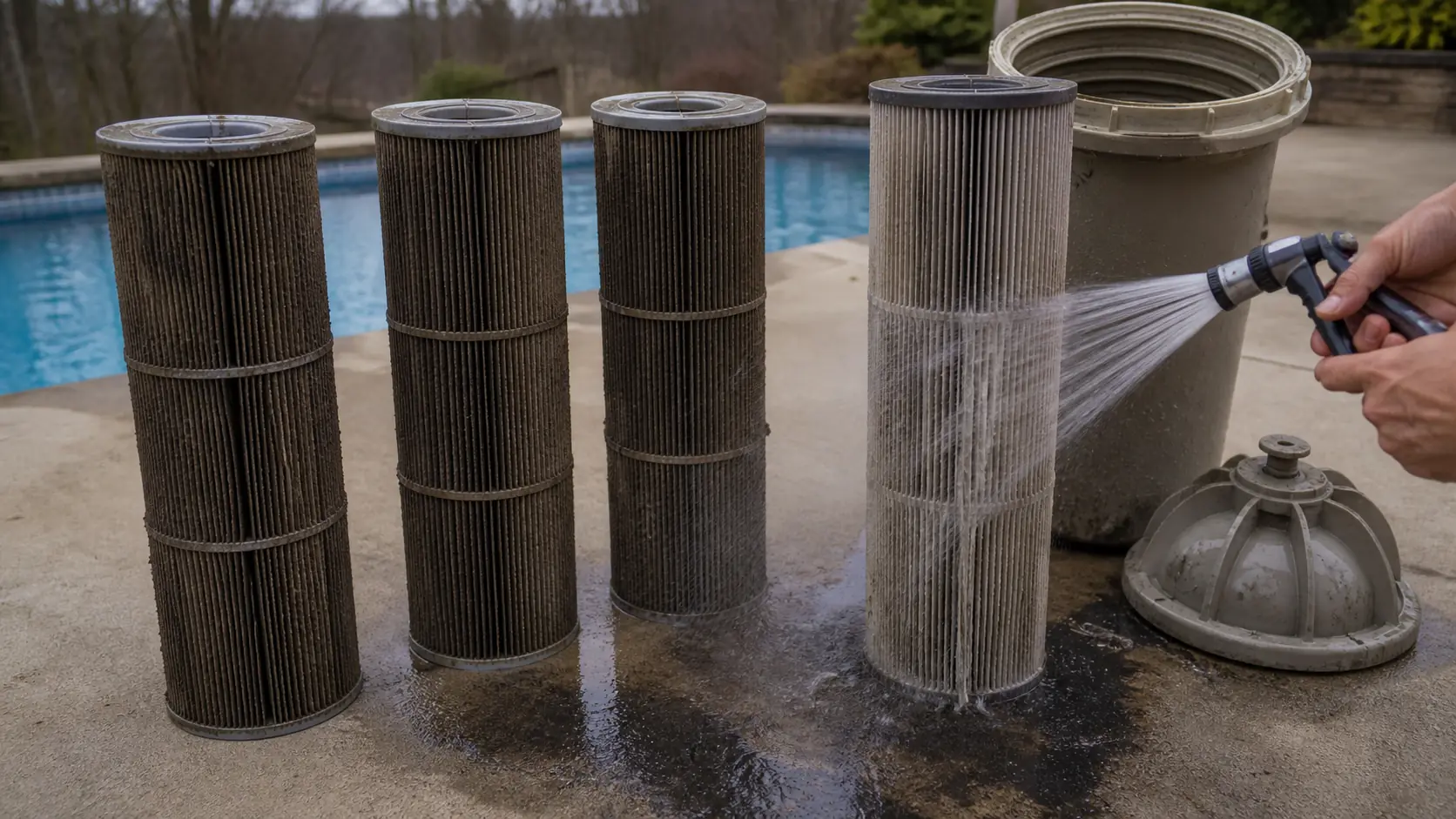
Cleaning means shutting down, opening the housing, pulling the cartridge, and rinsing the pleats out. It takes longer than flipping a backwash valve, but it uses no pool water at all, which matters in a Texas summer and matters again if your city is under watering restrictions. This is the type we see most on newer Frisco and Prosper builds, and for good reason.
The mistake we see most: cleaning a cartridge with a pressure washer. It drives grit into the fabric and shreds the pleats. A garden hose and patience is correct.
DE (diatomaceous earth) filters
DE is a fine powder of fossilized diatom skeletons, coated onto grids inside the tank. It gives the finest filtration of the three, and a well-run DE filter produces water with a particular polished clarity you can see.
It’s also the most work. After backwashing you must recharge the filter with fresh DE, and a filter that has been backwashed but not recharged is running on bare grids and filtering poorly. Skipping the recharge is the single most common DE mistake we find on pools we take over.
Handle DE powder carefully
Dry DE powder is a respiratory irritant and shouldn’t be inhaled. Follow the handling instructions on the product, keep your face out of the cloud when you pour it, and keep the bag away from children. This is a real precaution, not a formality.
The number that tells you when to clean
Regardless of type, the pressure gauge on your filter is the instrument that matters. Here is how to use it properly, which almost nobody does:
- Establish your clean baseline. Right after a thorough cleaning, with the pump running normally, note the pressure. That number is specific to your pool and equipment. Write it on the tank with a marker.
- Clean when pressure rises roughly 8 to 10 psi above that baseline. Not on a calendar. A pool under heavy cottonwood in April needs cleaning far more often than the same pool in October.
- A falling pressure with weak flow is a different problem. That points upstream, to a clogged basket or a suction-side blockage, not to a dirty filter.
Running a filter well past its cleaning point doesn’t just cloud the water. It forces the pump to work against resistance, which is hard on the equipment. If yours is climbing fast and you aren’t sure why, that’s worth an equipment inspection. What a clean costs on each type, and how often it should be needed, is in pool filter cleaning cost.
Size matters more than type
Here is the thing that changes a pool owner’s experience more than choosing between the three types: how big the filter is. Every filter carries a rating in square feet of media area, printed on the label or the tank, and that number sets how much dirt it can hold before pressure climbs and how hard your pump has to push to get water through it.
Builders have a standing incentive to fit the smallest filter that will pass, because the filter is a line item the buyer never asks about. The result is a lot of North Texas pools running a filter at the bottom of its acceptable range, which shows up years later as a filter needing cleaning every three weeks in the spring and a pump working against restriction most of the season. Going a size up within the same type costs a few hundred dollars once and buys longer intervals, lower operating pressure, and less strain on the pump for the rest of the pool’s life. There’s no performance penalty to an oversized filter, only cost and the space it takes on the pad.
So if your filter feels like it needs constant attention, check its square footage against what your pump moves before you conclude you picked the wrong type. The answer is often that the filter is simply too small for the pool it is on, and that’s worth knowing at replacement time rather than after you have bought the same size again.
What loads a filter around here
The seasonal pattern in North Texas isn’t the one people expect, and it hits the three types differently. Spring is the hard season, not summer: oak catkins, elm samaras, and cottonwood arrive in volume over a few weeks and are fine enough to pack the pleats of a cartridge or bind the top of a sand bed. That’s the stretch where a filter that normally runs six weeks between cleanings might need attention twice in a month.
Summer loads it differently: less bulk debris, more fine airborne dust and the dead algae and organic load that follows a storm. That storm load is worth planning for on its own, and what to do in the two days afterward is in your pool after a heavy rain. Dead algae after a green-pool recovery is the single heaviest thing you’ll ever ask a filter to catch, which is why a recovery job properly includes a filter clean at the end rather than leaving the customer to discover it. We publish the whole sequence, including where the filter fits into it, in the recovery log. Fall leaf drop is bulk material that mostly stops at the baskets if somebody is emptying them, which is the cheapest filter protection there is.
Which would we choose for a Plano pool?
For most homeowners here, cartridge. It filters finer than sand, uses no water to clean, and the maintenance burden is real but manageable. In a climate where summer evaporation is relentless and outdoor watering gets restricted, a filter that doesn’t send pool water down the drain every few weeks is a quiet long-term advantage. The trade is that you lose the incidental dilution a backwash provides, so on a cartridge filter you need to watch calcium hardness deliberately rather than relying on a partial refill to hold it down for you.
We would keep DE if you already have it and you value the clarity, as long as someone is recharging it properly. And sand remains a perfectly reasonable filter for an owner who wants the lowest-fuss option and isn’t chasing show-pool polish.
The honest summary: the best filter is the one that actually gets cleaned on schedule. A neglected DE filter produces worse water than a well-kept sand filter, every time. That’s the part we handle as part of weekly service, so the pressure gauge never gets the chance to become your problem.