A Green Pool Recovery, Stage by Stage, With the Readings

Austin Andrews
Founder, True Texan Pools
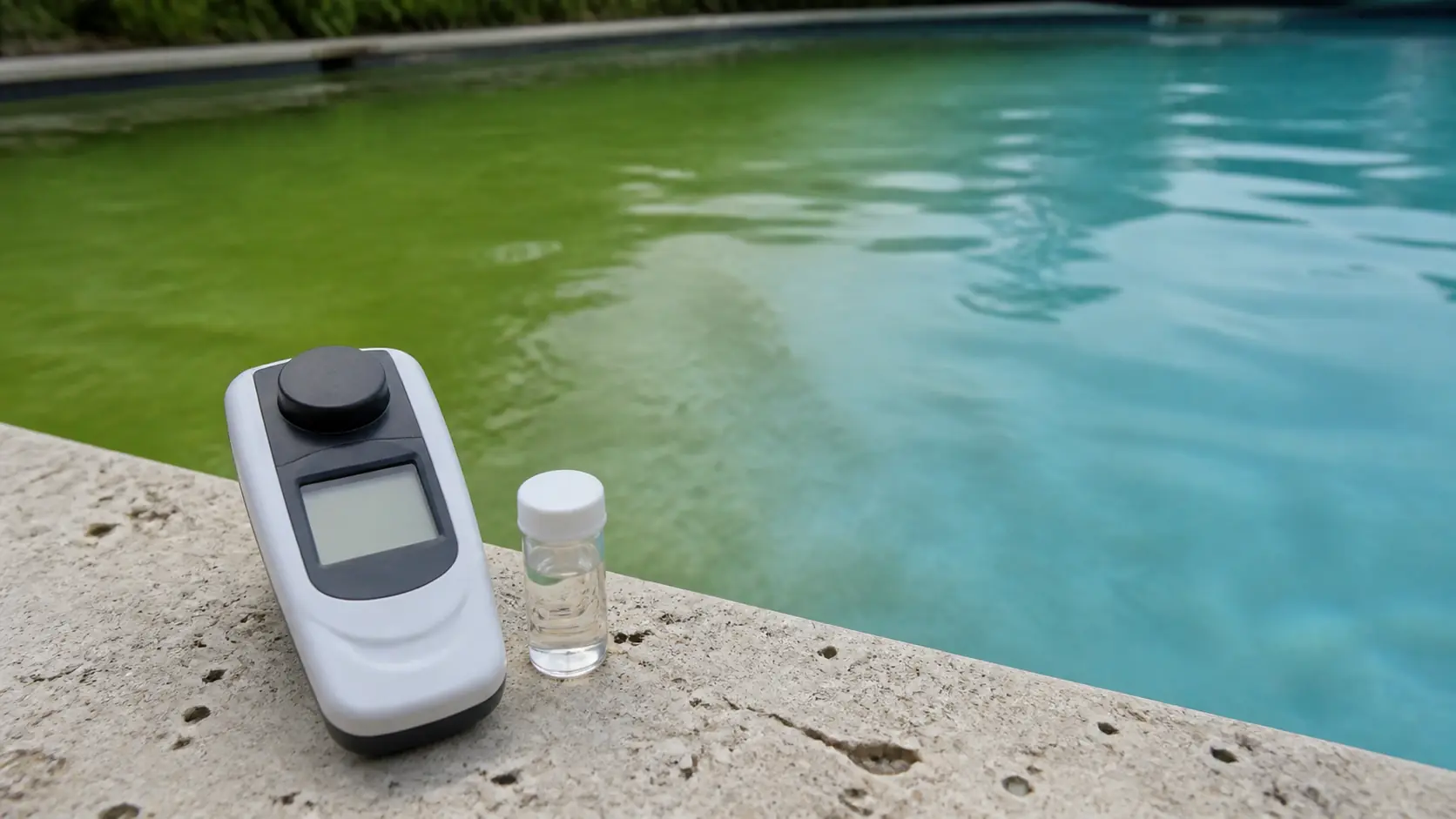
Most green pool articles tell you what to add. This one is the log: the readings we take at each stage of a recovery, the numbers we are trying to reach before moving to the next step, how long each stage honestly takes, and what we do when day three does not go the way it should. It is written so you can hold any company, us included, to a standard that is written down rather than described afterward.
What this is, and what it is not
This is our recovery procedure with the target readings attached, not a transcript of one customer’s pool. The numbers below are the thresholds we work to and the durations we actually see on a typical 15,000 to 20,000 gallon Collin County pool in summer. A real job deviates: some clear in three days, some take nine. Where a stage commonly runs long, we have said so rather than quoting the best case.
If you want the diagnosis side first, why the pool turned in the first place is covered in why is my pool green, the different organisms and what each one takes are in pool algae types identified, and what this costs when somebody else does it is in green pool cleanup cost in DFW. This article is the middle piece: the actual sequence, with the meters attached.
Day zero: the readings before anything is added
Nothing goes in the pool until the water has been tested properly, with a drop kit or a photometer rather than strips. Strips are unreliable at the extremes, and a green pool is nothing but extremes.
| Test | Why it decides the plan | What a green pool commonly reads |
|---|---|---|
| Cyanuric acid | Sets the entire shock dose. This is the number that determines the job | 60 to 120 ppm, often higher on a tablet-fed pool |
| Free chlorine | Confirms the sanitizer is actually absent | 0.0 to 0.5 ppm |
| Combined chloramines | High combined means organic load, not just algae | Often present |
| pH | Chlorine is far less effective at high pH | 7.8 to 8.4, usually high |
| Total alkalinity | Decides whether pH will hold once corrected | Variable |
| Calcium hardness | Affects whether we can safely use cal-hypo to shock | Frequently high here |
| Phosphate | Algae food. High phosphate means it comes back | Often elevated after storms |
| Filter pressure at startup | The baseline every later reading is compared to | Recorded, not judged |
We photograph the pool from a fixed corner on day zero and from the same spot every subsequent visit. Recovery is gradual and genuinely hard to judge by eye, and two photographs a day apart settle arguments that a memory cannot.
The cyanuric acid decision
This is the fork in the road and it is the step most often skipped. Chlorine’s effectiveness is governed by its ratio to cyanuric acid, not by its absolute reading. Shocking a pool at 100 ppm CYA to the same chlorine level that clears a pool at 40 ppm does very little, and the owner concludes that shock does not work.
So the first decision is whether to dilute before treating. Above roughly 80 to 100 ppm, a partial drain and refill comes first, because the alternative is a shock dose so large that it is both expensive and hard on the surface. How much water that takes is worked out in the cyanuric acid guide, and how to do it safely in this soil is in draining a pool in Collin County clay.
Day one: mechanical work, then the first dose
Chemistry goes in last on day one, after several hours of work that has nothing to do with chemicals. Dosing a pool full of leaves is dosing the leaves.
| Task | Typical time | Done when |
|---|---|---|
| Net out leaves and heavy debris | 20 to 60 minutes | Nothing large left floating or on the steps |
| Empty skimmer and pump baskets | 5 minutes | Both clear, lids reseated |
| Check the filter and clean if loaded | 20 to 45 minutes | Pressure back near baseline |
| Confirm the pump and returns are circulating | 10 minutes | Flow visible at every return |
| Brush every surface | 30 to 60 minutes | Walls, floor, steps, behind the ladder, waterline. This is the step that decides how well the shock works |
| Correct pH down toward 7.2 | Dose and circulate | pH reads 7.2 to 7.4 before shocking |
| Shock, dose calculated from the CYA reading | 15 minutes to dose | Full dose in, pump running |
| Run the pump continuously | Overnight, not on a timer | It does not stop until the pool is clear |
Brushing is not optional
Algae holds to surfaces behind a protective layer. Chlorine reaches the water first and the attached colony last, which is why an unbrushed pool can be dosed to 20 ppm and still be green in the morning while the chlorine reading collapses. Brushing breaks the layer and puts the organism into the water where the chlorine is. On a heavy recovery we brush at every visit, not only the first.
Day two: the overnight chlorine loss test
This is the measurement that tells you whether anything is working, and almost nobody outside the trade runs it.
Test free chlorine at dusk and record it. Test again at first light, before the sun is on the water. Sunlight destroys chlorine, so testing overnight removes that variable and leaves one explanation for a loss: something in the water is consuming it.
There are only three results. More than 1 ppm lost means living algae or a significant organic load is still in there: re-dose to shock level, brush again, and hold. One ppm or less means the kill is complete, and it is the moment to stop adding chlorine entirely. Chlorine gone altogether by morning means the dose was far too small for the stabilizer level, or the load is heavier than it looked, and the answer is to recheck cyanuric acid and recalculate rather than to repeat the same dose harder.
Passing this test is the milestone that changes the job. Before it, you are still killing. After it, adding more chlorine accomplishes nothing and the remaining work is entirely mechanical.
What day two usually looks like
Green becomes grey, cloudy, or milky blue. Owners frequently read this as the treatment having failed, because the pool looks worse in photographs than it did when it was a clear green. It has not failed. Grey is dead algae in suspension, and suspension is where the filter can finally reach it.
Days two to five: filtration, which is the long part
Killing algae is a day. Removing it is most of the week. This stage is limited by how much water passes through your filter and how fine that filter is, which is why filter type and pump run time matter more here than any product does.
| Reading | Target | What it tells us |
|---|---|---|
| Free chlorine | Held at shock level until the loss test passes, then 3 to 5 ppm | Whether anything is regrowing |
| Filter pressure | Clean when 8 to 10 psi above baseline | How much dead algae has been captured. Rising fast is good news |
| Water clarity by depth | Main drain visible, then sharp-edged | The actual progress measure |
| pH | 7.2 to 7.6 | Drifts during a recovery, needs watching |
| Pump hours | Continuous, 24 hours | Not a timer schedule. This is the stage that ends sooner with more run time |
On a cartridge filter, expect to pull and clean the element more than once during a heavy recovery, sometimes daily. On sand or DE, expect repeated backwashing, and expect to be adding water back. A recovery is the single heaviest thing a residential filter is ever asked to do, and the honest version of this stage includes telling the customer their filter may need attention rather than pretending the load appeared from nowhere. Costs are in what filter cleaning costs.
The flashlight test
At dusk, shine a light down through the water from the deck. Fine suspended particles scatter the beam and make it visible in the water column. As the pool actually clears, the beam sharpens to a defined line. It is a more sensitive test of clarity than looking at the main drain and it will tell you a day earlier whether progress has stalled.
When day three does not go to plan
Recoveries stall, and they stall for a short list of reasons. If the pool is not visibly better by the third morning, we work through this in order rather than adding more chemicals.
- Retest cyanuric acid from a fresh sample. The commonest cause by a distance: the dose was calculated against a number that was wrong or has since moved.
- Confirm the pump actually ran all night. A timer, an automation schedule, or a breaker that tripped in the dark undoes the whole previous day, and it leaves no evidence in the morning.
- Check filter pressure, and clean it if it is high. A blinded filter circulates without filtering, which looks identical from the deck.
- Watch the returns for real flow. A clogged impeller or a suction-side air leak halves the turnover while the pump sounds normal, and it is a commoner cause of a stall than people expect. The symptoms are in air bubbles at the returns.
- Retest pH. If it climbed, the chlorine sitting in the water is much less active than the reading suggests.
- Look hard at the color and the surfaces. Mustard clinging in shade and black algae rooted in plaster are different organisms with longer treatments, not a green recovery going slowly.
- Test phosphates. A heavy nutrient load can feed regrowth about as fast as the chlorine kills it.
Air on the suction side is a commoner cause of a stalled recovery than people expect, because it quietly halves the flow while the pump appears to be running normally. The symptoms are in air bubbles at the returns.
Closing the job
A recovery is not finished when the water is blue. It is finished when the pool is back to a state that will hold, and there are five things on that list.
- Clean the filter one final time. It is holding everything that came out of the pool. Leaving it loaded hands the customer a problem in two weeks.
- Vacuum the settled fines. Whatever the filter did not catch is on the floor as a grey film, and it goes to waste rather than back through the filter if the valve allows.
- Rebalance fully. Alkalinity first, then pH, then calcium, then stabilizer if the recovery involved diluting. In that order, for the reasons in the water chemistry guide.
- Deal with phosphates if they are high. Otherwise the same pool goes green again in a month and everybody blames the chlorine.
- Write down why it happened. A failed pump, a two week vacation, a storm, a tablet feeder that ran empty. A recovery without a cause identified is a recovery scheduled to repeat, and the causes are usually mundane.
The readings we sign off on are free chlorine at 3 to 5 ppm and holding overnight within 1 ppm, combined chloramines below 0.5, pH at 7.4 to 7.6, alkalinity in range and stable across two visits, cyanuric acid at 30 to 50, filter pressure back at its clean baseline and written down, and a main drain with a sharp edge to it when you look from the deck.
Those targets are deliberately tighter than the public health floor. The CDC’s home pool guidance sets a minimum of 1 ppm free chlorine, doubled to 2 ppm once there is stabilizer in the water, and a pH window running from 7.0 up to 7.8. Those are the numbers at which water is safe to swim in. They are not the numbers at which a pool that was green on Monday stays blue through a Texas week, and a recovery handed back at the bottom of that window has no margin in it at all. We aim well above the floor and we say what we hit.
How long it honestly takes
The ranges below are what we see, including the jobs that go long. Anybody promising a one day green-to-clean on a pool you cannot see the second step in is describing a chemical result, not a clear pool.
| Starting condition | Time to clear | Visits |
|---|---|---|
| Light green, floor still visible | 2 to 3 days | 1 to 2 |
| Solid green, steps not visible | 4 to 6 days | 2 to 3 |
| Dark green or black, surface film | 7 to 10 days | 3 to 4 |
| Swamp, standing debris, unknown equipment state | 10 days or more, sometimes with a drain | 4 or more |
| Mustard or black algae present | Add several days regardless of color | Extra visits, extra brushing |
What to demand from whoever does it
Whether it is us or somebody else, a recovery should come with a paper trail, because the entire job is invisible once the water is blue.
- Readings from day zero, written down, including cyanuric acid.
- A dose that was calculated rather than estimated, and a willingness to say what it was calculated from.
- Photographs from the same position at each visit.
- The overnight loss test result, or an explanation of what was used instead.
- A filter clean included in the price, not billed as a surprise at the end.
- Final readings at sign-off, and a stated cause.
That is the standard we publish for our own green to clean recoveries, and it is the same documentation habit behind our photo reports on ordinary weekly visits. A company unwilling to hand over the numbers is asking to be trusted on a job that is designed to be checkable.
Why we published the procedure
A recovery is the easiest job in this trade to do badly and get paid for. The water ends up blue either way, and by the time it does, nobody can tell whether the chlorine was calculated or guessed, whether the filter was cleaned or left loaded for the customer to discover in a fortnight, or whether anybody ever found out what caused it. The only defence a homeowner has is a written standard and a set of numbers, so here is ours, in public, where it can be held against us.
The whole thing compresses to this. Test cyanuric acid before anything else, because it sets the dose. Brush before you shock, and keep brushing. Use the overnight loss test to decide when the killing is finished. Then stop adding chemicals and let the filter work, cleaning it as often as the pressure tells you to. Finish with a full rebalance, a phosphate check, and a written cause. The chemistry is one day. Everything after that is circulation, filtration, and patience, and that is what you are really paying for on a green to clean.
Frequently Asked Questions
How long does it take to clear a green pool?
Two to three days for a light green pool where the floor is still visible, four to six days for a solid green one, and seven to ten days for dark green water with a surface film. Mustard or black algae adds several days regardless of color. The chemistry stage is roughly one day; the rest of the time is filtration, which is limited by your filter and how many hours the pump runs.
What is the overnight chlorine loss test?
Read free chlorine at dusk, then again at first light before the sun reaches the water. Sunlight is removed as a variable, so any loss is something in the water consuming chlorine. More than 1 ppm lost overnight means living algae or organic load remains and the pool needs another shock dose. A loss of 1 ppm or less means the kill is finished and the remaining work is filtration.
Why did my pool turn grey and cloudy after shocking it?
That is the treatment working. Green is living algae; grey or milky water is dead algae in suspension, which is where your filter can finally capture it. It looks worse in a photograph than clear green water did, which is why owners often conclude the shock failed at exactly the point it succeeded. Keep the pump running and clean the filter as pressure climbs.
Why did shocking my pool do nothing?
Almost always cyanuric acid. Chlorine’s effectiveness depends on its ratio to stabilizer, not on the absolute reading, so a pool at 100 ppm CYA needs several times the dose of one at 40 ppm. The other common causes are an unbrushed surface, high pH making the chlorine present far less active, and a pump that did not run all night.
Should I keep adding shock until the pool is clear?
No. Once the overnight loss test passes, the algae is dead and additional chlorine does nothing except cost money and stress the surface. Everything after that point is mechanical: circulation, filtration, filter cleaning, and vacuuming the fines that settle. Continuing to shock a pool that is merely cloudy is the most common way money gets wasted on a recovery.
What should a pool company give me after a green pool recovery?
Day zero readings including cyanuric acid, a dose that was calculated rather than guessed, photographs from the same position at each visit, the overnight loss test result, a filter clean included rather than billed as a surprise, and final readings at sign-off with a stated cause. A recovery is invisible once the water is blue, which is exactly why it should come with numbers.
Ready to stop thinking about your pool?
True Texan Pools keeps your water swim-ready all year, across Plano and the rest of DFW. Clear pricing, a photo report after every visit, and Austin doing every job himself.
Keep reading
What Actually Happens on a Weekly Pool Visit, Task by Task
Everybody publishes the task list. Nobody publishes how long each task honestly takes, what it leaves behind, or what is deliberately excluded. Those are the three things you actually want.
What to Do With Your Pool After a Heavy North Texas Rain
Four inches in an afternoon, the pool comes over the coping, and by Thursday it is green. Almost all of that damage happens in the forty-eight hours after the storm, not during it.