What to Do With Your Pool After a Heavy North Texas Rain

Austin Andrews
Founder, True Texan Pools
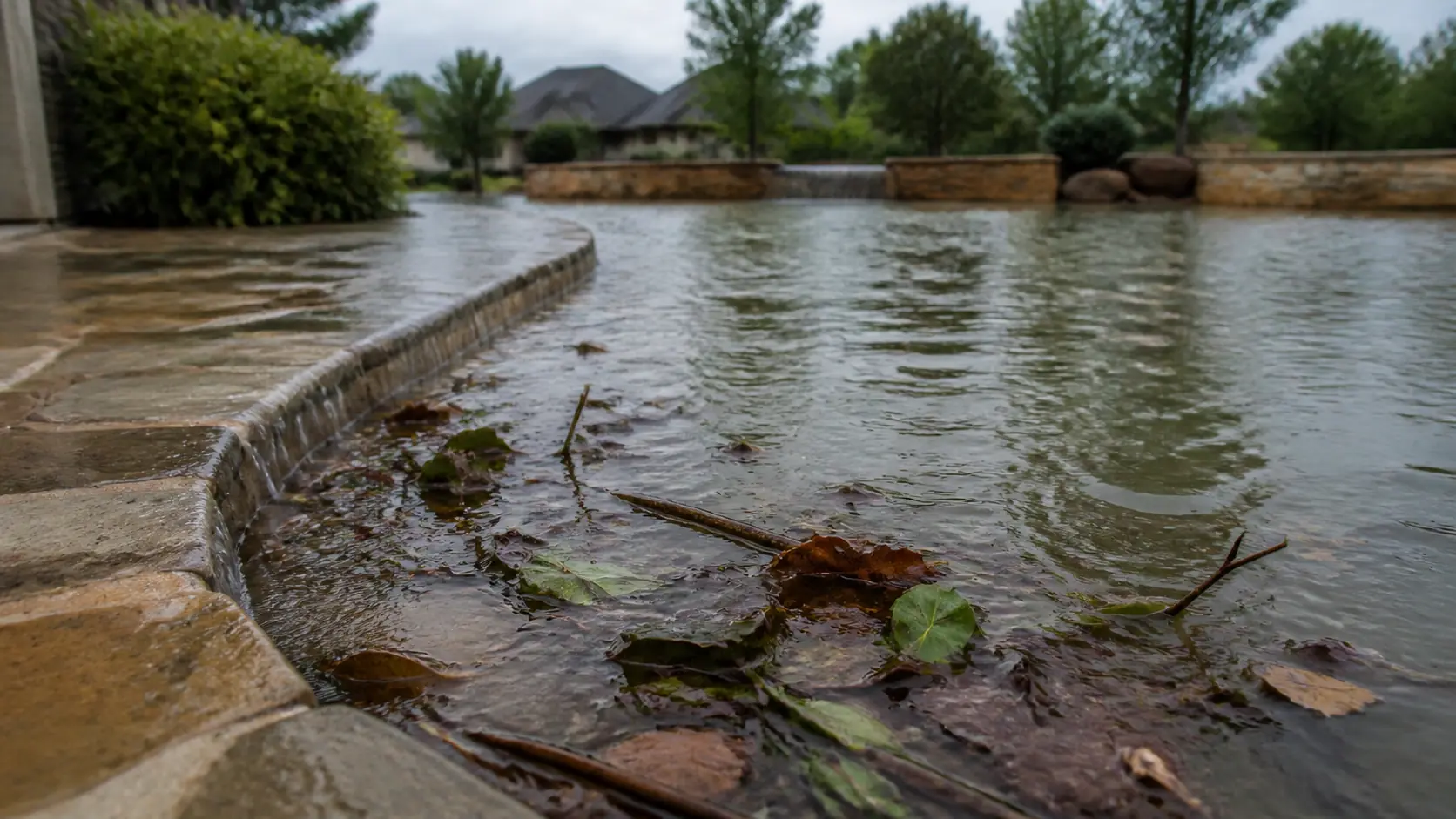
North Texas does not rain gently. We get four inches in an afternoon, the pool comes over the coping, the water goes flat and grey, and by Thursday it is green. That sequence is predictable enough to plan around, and almost all of the damage happens in the forty-eight hours after the storm rather than during it. Here is what a big rain actually does to your water, what to do the same evening, and what not to bother with.
The seasonal guides on this site treat freeze as the dangerous weather event here, and for equipment that is correct. For water, the dangerous event is a thunderstorm, and our rainfall arrives in two distinct windows rather than spread across the year. The National Weather Service’s Dallas/Fort Worth climate narrative describes precipitation here as a bimodal distribution, wet spring and fall against a dry summer and winter, with thunderstorm frequency and severe weather peaking in the spring and storms producing large hail, damaging winds, flooding, and tornadoes nearly every year. Those two wet windows are where most of the green pools we get called about actually begin. The North Texas pool year maps out the rest of the calendar around them.
What a heavy rain actually does to your water
Four separate things happen at once, which is why the aftermath is worse than any one of them would suggest.
| Effect | Mechanism | What you see |
|---|---|---|
| Dilution | Rain contains no chlorine, no cyanuric acid, and almost no minerals | Every reading drops, chlorine and alkalinity most visibly |
| Organic load | Wind and runoff bring in leaves, pollen, soil, grass clippings, and fertilizer | Cloudy or brown water, debris on the floor, chlorine consumed fast |
| Phosphate and nitrate delivery | Lawn fertilizer and soil wash off the yard into the pool | Nothing immediately, then algae with a food supply |
| Alkalinity crash | Rain is slightly acidic and carries no buffering capacity | pH that will not hold anywhere after the storm |
| Overflow | The pool passes the skimmer throat and keeps rising | Skimming stops entirely, surface film stays put, deck and pad get wet |
The interaction is the problem. Dilution cuts your chlorine roughly in proportion to the water added, which after four inches on a normal pool is not catastrophic on its own. But the same storm delivers a heavy organic load that consumes what remains, and it strips the cyanuric acid that was protecting your chlorine from the sun that comes out the next morning. Three mechanisms all pointing the same direction is how a pool that read 3 ppm on Saturday reads zero on Sunday afternoon.
Runoff into the pool is worse than rain into the pool
Rain landing directly in the water is mostly a dilution event. Water sheeting off a sloped yard, a flower bed, or a fertilized lawn into the pool is a nutrient delivery event, and it is the one that produces algae a week later. If your yard drains toward the pool, that grading problem is worth solving once rather than treating every spring. Mulch and soil in the skimmer after every storm is the tell.
The same evening, if you can get outside
Fifteen minutes of work while the deck is still wet saves a recovery. In priority order:
- Empty the baskets. Skimmer and pump basket both. A packed basket starves the pump, and a starved pump is not circulating the chlorine you are about to add.
- Test free chlorine. This is the number that decides whether the next few days are routine or expensive. If it is at or near zero, dose tonight.
- Chlorinate, using liquid. Liquid chlorine adds no cyanuric acid and works immediately, which is exactly what a diluted pool needs. Tablets are the wrong tool in this moment, for the reasons in liquid chlorine versus tabs.
- Run the pump. Overnight, not on the usual schedule. Circulation is what turns a dose into a treated pool.
- Get the big debris out. Net what floats. Leaves left on the bottom overnight start staining and start consuming chlorine.
- Look at the pad. Standing water around the equipment, a tripped breaker, or a pump that did not restart is a separate and more urgent problem.
What does not need doing tonight: pH, alkalinity, calcium, and anything involving a filter. Those matter, and they matter tomorrow.
Getting the water level back down
A pool sitting above the skimmer throat is not skimming. The surface film, pollen, and floating debris that the skimmer would normally pull off just sits there, and that film is where a good deal of the organic load lives. Getting the level back to the middle of the skimmer opening is a real chemistry action, not housekeeping.
| Method | Good for | Watch out for |
|---|---|---|
| Submersible pump on a hose | Any pool, any amount, most control | Where the water goes. Not into the yard next to the pool. |
| Filter valve to waste, sand or DE | A quick few inches if you have a multiport | Never with a cartridge filter, which has no waste setting |
| Letting it evaporate | An inch or two in a hot dry week | Useless in a wet week, which is when this happens |
| Doing nothing | A pool that only came up an inch | Above the tile is where grout and coping start to suffer |
Two cautions. Send the discharge away from the house and away from the pool: the clay under a Collin County backyard swells when saturated, and you have a whole article’s worth of reasons not to add water to it in the clay soil guide. And if your city is running any kind of discharge restriction, treated pool water going to a storm drain is generally not allowed, which is covered in more detail in draining a pool here.
The next day, in order
Alkalinity before pH
Rain is soft, unbuffered water, and a big storm can pull total alkalinity down noticeably. When alkalinity is low, pH will not stay where you put it, so correcting pH first is work you will repeat. Bring alkalinity back into range, let it circulate, then read pH and adjust. This is the same ordering the water chemistry guide argues for in general, and it matters most after a dilution event.
Then cyanuric acid
Stabilizer washes out with everything else, and a pool that had 40 ppm before a storm that added a fifth of its volume has something closer to 32. Unprotected chlorine in August sun disappears in hours. If the reading has fallen well below 30, that is worth correcting deliberately rather than waiting for tablets to do it slowly. The reverse problem, stabilizer that has climbed too high over a season, is the subject of the cyanuric acid guide.
Then brush, and only then filter
Brush the walls and floor before you vacuum. Storm debris packs into corners and behind steps, and a vacuum run over settled silt just clouds the whole pool. Once it is brushed and circulated, vacuum to waste if the load is heavy and you have the valve for it, otherwise vacuum normally and expect to clean the filter afterward.
Wait to clean the filter
The instinct after a storm is to backwash or pull the cartridge immediately. Resist it. Your filter is about to do the heaviest work it does all year, and a filter performs better slightly dirty than perfectly clean because the accumulated layer catches finer material. Clean it when pressure climbs 8 to 10 psi above baseline, or when the water is clear and the job is done, whichever comes first. The full logic is in pool filter cleaning.
Why the pool goes green on day five
The classic pattern is a storm on Saturday, a pool that looks fine on Monday, and a green tinge on Wednesday or Thursday. That delay confuses people into thinking the storm was not the cause. It was.
The storm delivered nutrients and removed the sanitizer at the same time. Algae then needs a few days of warm water and sunlight to multiply from invisible to visible. Free chlorine hits zero on Sunday, algae starts on Monday, and by Wednesday there are enough cells to tint the water. By the time you can see it, the population is already large, which is why green pool recovery is a job rather than a dose.
The prevention is unglamorous: hold measurable free chlorine every day of that week. A pool that never reaches zero does not go green, whatever the storm delivered.
Hail, wind, and the equipment pad
North Texas storms bring hail and straight-line winds, and those damage equipment rather than water. Before you worry about chemistry, walk the pad.
- Did the pump restart? A power blip can leave a variable speed pump in a fault state or reset its schedule to something wrong. Confirm it is actually running its program, not just humming.
- Is there standing water at the pad? Motors and control boards do not tolerate submersion. If the pad flooded, shut the breaker before touching anything and get it looked at dry.
- Check the automation and timers. Clocks reset. A pool running two hours a day instead of eight after an outage is a slow-motion green pool. See how long to run your pump.
- Hail on a heater or a filter lid. Cracks in plastic housings and dented heater cabinets are worth photographing while the storm date is fresh, because they are a homeowner’s insurance conversation.
- Fence and gate. Wind moves gates and breaks latches, and a self-closing gate that no longer closes is the most serious thing in this list. Barrier requirements exist for a reason and a storm is a common way they quietly stop being met.
What a service visit does differently after a storm
A weekly route that treats a post-storm pool like a normal stop is not doing the job. The visit after a heavy rain should be longer, and it should include a chlorine correction sized to the dilution rather than a standard dose, an alkalinity check, a genuine brush, and basket work at both ends. That is the difference between a pool that shrugs off a wet spring and one that needs a recovery in June.
It is also the argument for weekly rather than every other week through the wet months. A fortnightly pool that gets hit by a storm on day two of its cycle spends twelve days at zero chlorine with fertilizer runoff in it, and the arithmetic on that is in weekly versus biweekly service.
Austin’s Tip
Keep a jug or two of liquid chlorine in the garage through spring and fall specifically for this. The storms arrive in the evening, the pool store is closed, and the single highest value action available to you is a dose that night rather than one on Monday. Store it out of the sun and off the concrete, and follow the handling rules in chemical storage.
What we do on a route after a storm
We reorder the week. Pools that took the most water, pools with a yard that drains toward them, and pools we already know run thin on stabilizer move to the front, because a stop on Monday is worth two on Thursday. Everything else slides. It is the only week of the year where the route stops being a route and starts being a triage list, and the pools that get skipped in that reshuffle are the ones under cover, in shade, or on a spa-sized volume that a storm barely moved.
None of which is complicated, and all of it is available to you on the evening the rain stops, which is earlier than any company can get there. Storms do not turn pools green. Two days at zero free chlorine turns pools green, and a storm is simply the most reliable way to arrive at two days of zero. Empty the baskets, test, dose that evening, get the level back to mid-skimmer, fix alkalinity before pH in the morning, brush before you vacuum, and leave the filter alone until the water is clear. Do that and a four inch afternoon is an inconvenience rather than the start of a recovery.
Frequently Asked Questions
Do I need to add chlorine to my pool after heavy rain?
Yes, and preferably the same evening. Rain dilutes the chlorine you had, delivers an organic load that consumes what remains, and washes out the cyanuric acid that was protecting it from the sun. Three mechanisms pointing the same direction is how a pool reading 3 ppm on Saturday reads zero on Sunday. Liquid chlorine is the right tool here because it works immediately and adds no stabilizer.
Should I drain water out of my pool after it rains?
Lower it back to the middle of the skimmer opening, yes. A pool sitting above the skimmer throat is not skimming, so the surface film and floating debris that carry much of the organic load just stay there. A submersible pump gives the most control. Send the discharge away from the pool and the house, and check what your city allows before putting treated water into a storm drain.
Why did my pool turn green a few days after a storm?
The storm removed the sanitizer and delivered nutrients from lawn fertilizer and soil runoff at the same time. Free chlorine reaches zero within a day, algae starts multiplying, and it takes a few more days of warm water and sun to become visible. By the time you can see the tint the population is already large, which is why holding measurable chlorine every day of that week is the whole prevention.
Should I backwash my filter after a heavy rain?
Not immediately. Your filter is about to do the heaviest work it does all year, and it captures fine material better with an accumulated layer than when perfectly clean. Clean it when pressure reaches 8 to 10 psi above your clean baseline, or once the water is clear and the job is finished, whichever comes first.
Does rain lower pH or alkalinity in a pool?
Both, and alkalinity is the one that matters. Rain is slightly acidic and carries no buffering capacity at all, so a heavy storm dilutes total alkalinity and pH then refuses to stay where you put it. Correct alkalinity first, let it circulate, then adjust pH. Doing it the other way round means repeating the work.
What should I check on my pool equipment after a storm?
Whether the pump actually restarted and is running its program rather than sitting in a fault state, whether the pad flooded, whether timers or automation schedules reset after a power blip, and whether hail cracked a filter lid or dented the heater cabinet. Also check the gate: wind moves gates and breaks latches, and a self-closing gate that no longer closes is the most serious item on this list.
Work it out for your pool
All toolsFree, instant, and no email needed to see the answer.
Ready to stop thinking about your pool?
True Texan Pools keeps your water swim-ready all year, across Plano and the rest of DFW. Clear pricing, a photo report after every visit, and Austin doing every job himself.
Keep reading
What Changes in Your Pool Above 100 Degrees
A pool that has been effortless since April starts misbehaving in the second week of August, and the owner has changed nothing. That’s exactly the point.
Opening and Closing a Pool in North Texas (Most Never Close)
The close-in-September habit doesn’t survive North Texas. Our winters are mild but punctuated by hard freezes, and the pool you walk away from in November is the one you pay to recover in April.