Pool Filter Cleaning: Real Cost and How Often You Need It

Austin Andrews
Founder, True Texan Pools
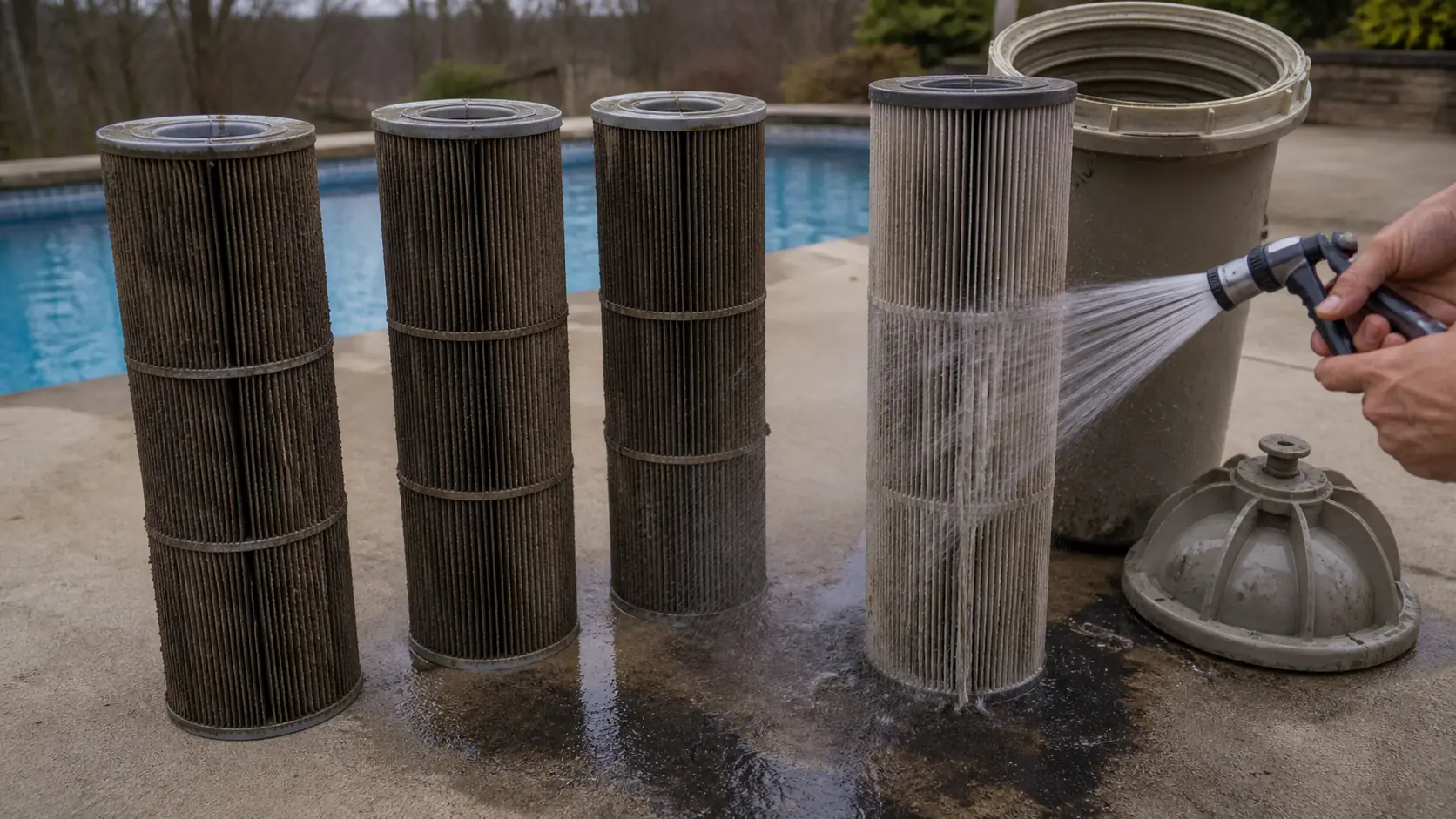
A filter deep clean runs $125 to $150 in the DFW area and is needed every three to six months on most pools. It is also excluded from nearly every weekly service plan in this market, which makes it the most common surprise on a pool owner’s bill. Here is how to tell when it is genuinely due rather than approximately due, what the job actually involves, and when a cleaning is no longer the answer because the media is finished.
Filter cleaning sits in an awkward spot: it is genuinely necessary maintenance, it is genuinely excluded from most weekly plans, and it is genuinely easy to sell to somebody who does not need it yet. The defense against all three is one number.
The number that decides everything
The pressure gauge on your filter is the most useful free instrument on the pad, and it is useless without a baseline. Absolute pressure means nothing: two identical pools can run at 12 psi and 22 psi clean, depending on plumbing, pump, and filter size.
So the first job is to establish yours. The next time the filter is genuinely clean, whether you did it or somebody else did, write down the pressure with the pump running at its normal speed. Put it on a label on the filter. That is your clean baseline for as long as the equipment stays the same.
From then on the rule is simple: roughly 8 to 10 psi above baseline means clean the filter. Not before, because you are throwing away filtration performance and, on a cartridge, physically wearing the pleats. Not much after, because the pump is now working against restriction every hour it runs.
Rising pressure and falling pressure mean opposite things
Rising pressure with weak return flow is a loaded filter. Clean it. Falling pressure with weak return flow is the opposite problem: something upstream is restricting suction, which means a clogged basket, a low water level, a closed valve, or an air leak. Cleaning the filter for that symptom accomplishes nothing, and it is one of the most common wasted service calls in this trade. Our suction-side diagnostic covers that case, and if the return jets are fizzing as well, air on the suction side is the place to start.
What the job actually involves, by filter type
The three types are genuinely different products with genuinely different service, which is why one price does not fit all three. Our filter comparison covers choosing between them.
Cartridge
The most common on newer North Texas builds, and the most labor per clean. Shut down, release pressure, open the housing, lift out the cartridges, hose every pleat from top to bottom at an angle, spread the pleats to reach the folds, inspect for damage, reassemble with a lubricated o-ring, restart, purge the air, and record the new clean pressure. Forty five minutes to an hour done properly, and there is no shortcut, because the dirt lives inside the folds.
Twice a year that clean should be preceded by an overnight soak in a filter cleaning solution, because oils, sunscreen, and mineral deposits do not come off with water alone. A cartridge that is only ever hosed will look clean and filter worse each time.
Sand
Backwashing is routine and takes a few minutes: reverse the flow to waste, then rinse, then return to filter. It is not a deep clean. Every year or so the sand benefits from a chemical clean to remove oils and mineral binding, and every five to seven years the media is finished and needs replacing, which is mostly the unpleasant labor of getting wet sand out of a tank.
Note that each backwash sends several hundred gallons to waste, which is worth remembering in a drought stage.
DE
Backwash, then recharge with fresh powder through the skimmer. Two or three times a year the grids should come out for a full tear-down clean, and grids last five to ten years. Powder blowing back into the pool through the returns means a torn grid rather than a dirty one.
What it costs, and why
| Job | Frequency | Typical cost | Notes |
|---|---|---|---|
| Cartridge deep clean | Every 3 to 6 months | $125 to $150 | The standard DFW filter clean |
| Cartridge soak and clean | Twice a year | Somewhat more | Needed for oils and minerals |
| Sand backwash | Every few weeks | Do it yourself, minutes | Not a substitute for a deep clean |
| Sand chemical clean | Annually | Quoted per job | Removes oils and mineral binding |
| Sand media replacement | Every 5 to 7 years | Media plus real labor | Tank usually lasts 10 plus |
| DE tear-down and clean | 2 to 3 times a year | Similar to a cartridge clean | Plus fresh powder |
| DE grid replacement | Every 5 to 10 years | Quoted as a set | Torn grids blow powder back |
| Cartridge replacement | Every 3 to 5 years | Quoted per set | Varies enormously by filter size |
Two things move the number: how many cartridges your filter holds, and whether the job includes a soak. A four-cartridge filter is more work than a single. Ask which you are being quoted for.
Doing it yourself
Cartridge cleaning is genuinely achievable and takes an hour. What you need: a hose with a decent nozzle, a spare o-ring, silicone lubricant, and patience with the pleats.
- Switch the pump off at the breaker and open the air relief to release pressure. Never open a filter housing under pressure.
- Note and record the pressure before shutdown, so you know what loaded looked like.
- Open the housing, lift out the cartridges, and note their orientation.
- Hose each pleat top to bottom at a slight angle, working around the whole element. Spreading the pleats gently is the part that matters.
- Inspect: limp pleats, permanent grey through the material, tears, or a distorted end cap mean replacement rather than cleaning.
- Clean the housing o-ring, lubricate it with silicone, and seat it properly.
- Reassemble, open the air relief, restart, close the relief when water comes out, and record the new clean pressure.
The two mistakes that cost money: a pressure washer, which destroys the media, and any petroleum-based lubricant on the o-ring, which degrades it.
Buy a second set of cartridges
On a cartridge filter this is the single best small purchase available. Swap the dirty set out in ten minutes, put the pool back into service immediately, and clean the dirty set at your leisure, including a proper overnight soak. It also doubles the life of both sets, because each spends half as much time in service, so it pays for itself rather than costing.
What a dirty filter is actually costing you
People defer this because the pool still looks fine. Four things are happening while it does.
- Electricity, every day. The pump is working against resistance, so it draws more power for less flow.
- Turnover. Reduced flow stretches the time to turn the pool over, so the schedule you set is no longer delivering what you set it for.
- Clarity. Water stays cloudy no matter how good the chemistry is, which sends owners chasing chemical solutions to a mechanical problem. Our cloudy water guide covers that misdiagnosis.
- Pump life. Sustained restriction is mechanical and thermal stress on a component that costs far more than a filter clean.
North Texas timing
Two moments in the year reliably load a filter here regardless of what the calendar says.
- Spring pollen, March and April. Oak pollen falls in sheets and goes straight into the filter. Expect to clean shortly after the drop ends, whatever you did in February.
- Leaf drop, October and November. Our drop is late, compressed, and heavy. Under a mature pecan or post oak canopy this is the month the filter needs attention most.
The best scheduled clean of the year is late February, before spring startup, so the filter begins the season clean and with a fresh baseline recorded. Spring startup covers the rest of that job, and the pool year puts it in context.
When cleaning stops being the answer
Media is a consumable. Signs it is finished rather than dirty:
- Cartridge: limp pleats, permanent grey through the material, tears, distorted end caps, or a clean pressure that has crept up permanently.
- Sand: the pool stays cloudy after a proper backwash, or the sand has bound into clumps you can feel. Sand also goes smooth and rounded with age and stops trapping.
- DE: powder returning to the pool through the jets, which means a torn grid or a failed manifold.
A useful rule: if the clean pressure after a proper service is meaningfully higher than the clean pressure was a year ago, the media is aging out. Our equipment lifespan guide has the realistic service life for each type here.
Where we sit
Filter deep cleans are quoted separately at $125 to $150 rather than bundled into the monthly rate, which is how nearly everyone in this market works and which what your bill covers sets out honestly. What is included in weekly service is reading the gauge against the baseline every visit and telling you when it is genuinely due, which is the part that stops a clean being sold on a calendar.
If you want the honest version: go and look at your gauge right now, and if you do not know what your clean baseline is, that is the actual problem to fix this week. Everything else on this page, including whether you are being sold a filter clean you do not need, follows from one number written on a label in marker pen.
Frequently Asked Questions
How much does pool filter cleaning cost?
A full tear-down deep clean typically runs $125 to $150 in the DFW area, and is needed every three to six months on most pools. Two things move the number: how many cartridges your filter holds, since a four-cartridge filter is more work than a single, and whether the job includes an overnight soak. It is excluded from nearly every weekly service plan in this market.
How do I know when my pool filter needs cleaning?
By pressure, not by calendar. Record the gauge reading the next time the filter is genuinely clean, because absolute pressure means nothing and two identical pools can run at 12 and 22 psi clean. From then on, roughly 8 to 10 psi above that baseline means clean it. Without a baseline the gauge tells you nothing, which is the actual problem on most pools.
What does falling filter pressure mean?
The opposite of a dirty filter, and this is the most common misdiagnosis in the trade. Rising pressure with weak return flow is a loaded filter. Falling pressure with weak return flow means something upstream is restricting suction: a clogged basket, a low water level, a closed valve, or an air leak. Cleaning the filter for that symptom accomplishes nothing.
Is backwashing the same as cleaning a filter?
No. Backwashing reverses flow to flush debris out of a sand or DE filter and takes a few minutes. It is routine, not a deep clean. Sand still benefits from an annual chemical clean and needs replacing every five to seven years; DE grids need a tear-down two or three times a year. A cartridge filter cannot be backwashed at all, which is why it needs the full tear-down.
What does a dirty pool filter actually cost me?
Four things, every day it stays dirty. Electricity, because the pump works against resistance for less flow. Turnover, because reduced flow stretches the time to circulate the pool. Clarity, because water stays cloudy no matter how good the chemistry is. And pump life, since sustained restriction is mechanical and thermal stress on a component that costs far more than a filter clean.
When should I replace filter media instead of cleaning it?
When a proper clean no longer restores the pressure. Cartridges are finished at limp pleats, permanent grey through the material, tears, or distorted end caps, typically at three to five years. Sand goes smooth and rounded and stops trapping, typically at five to seven years. DE grids are finished when powder blows back into the pool through the returns. A clean pressure that has crept up permanently over a year is the general signal.
Ready to stop thinking about your pool?
True Texan Pools keeps your water swim-ready year-round across Plano and all of DFW. Clear pricing, no contracts, and a photo report after every visit. Austin handles every job personally.
Keep reading
What Your Monthly Pool Bill Actually Covers, and What It Does Not
Three quotes at $135, $165, and $210 look like a clear decision until you find out they are written in three different billing models. Here is how to compare them properly.
How Much Does Pool Cleaning Cost in Plano, TX? (2026 Pricing Guide)
Most Plano pool companies hide their prices behind a phone call. Here is exactly what weekly service, one-time cleans, and green pool recovery actually cost in 2026, and what drives the number up or down.