Pool Equipment 101: Everything on Your Pad and What It Does

Austin Andrews
Founder, True Texan Pools
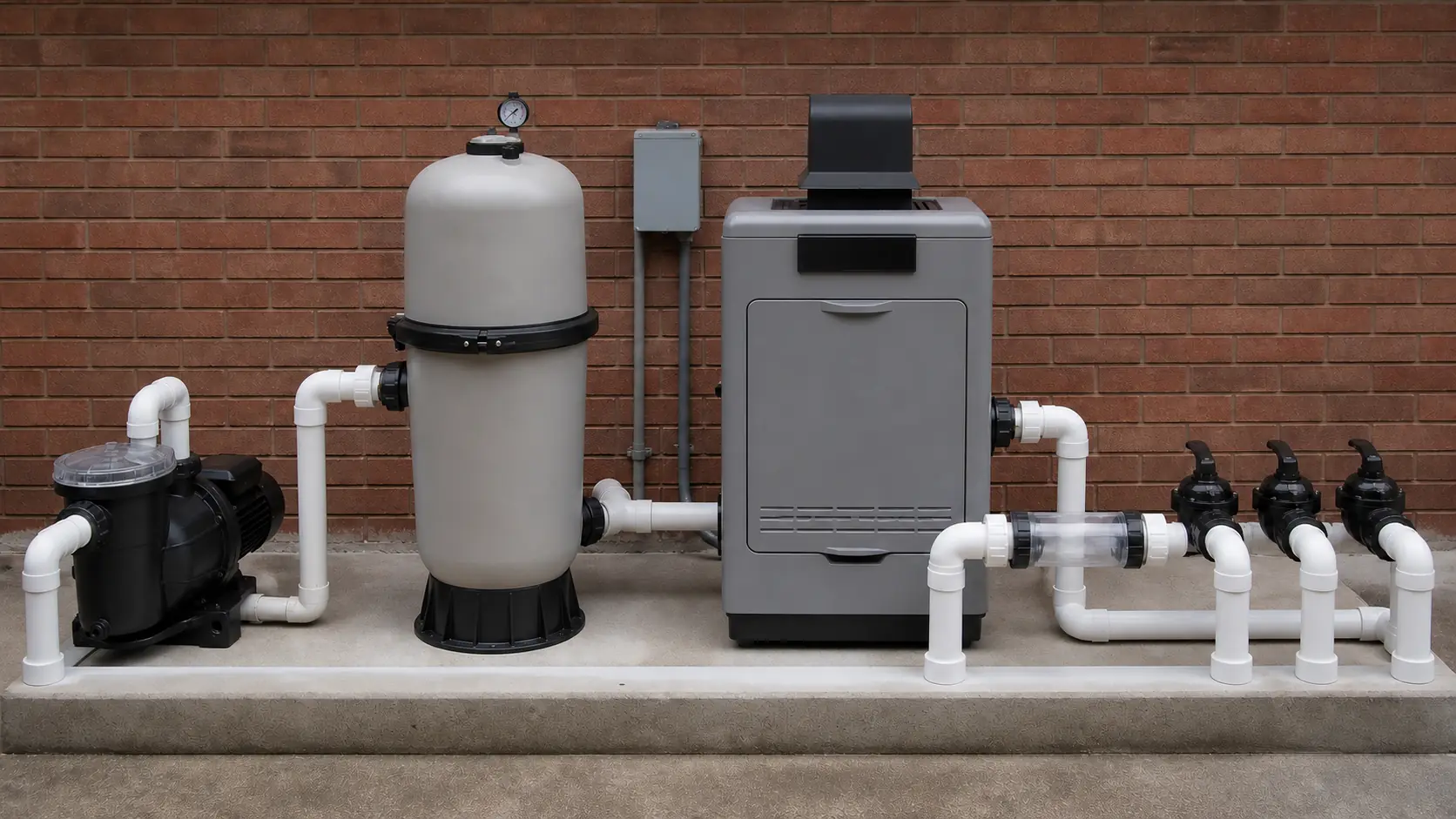
Almost every bad decision a pool owner makes about money starts with not knowing what the things on the slab are called. You cannot judge a repair quote for a part you cannot name, and you cannot tell a diagnosis from a sales pitch if the whole pad is a grey box. This is every component on a typical North Texas equipment pad, in the order water passes through it, what each one does, what it costs when it fails, and roughly how long it lasts in our climate.
A residential pool is a single loop. Water leaves the pool, gets pulled through a series of boxes in a fixed order, and comes back. Nothing on the pad works in isolation, which is why a symptom at one end so often has its cause at the other, and why the first question a technician asks is almost never about the part you called about.
The loop, in order
Follow the water and the whole system stops being mysterious.
- Out of the pool through the skimmers at the waterline and the main drain at the deep end.
- Through the suction plumbing and a valve or two to the pump.
- Through the pump, which is the only thing on the pad providing energy.
- Into the filter, which removes physical particles.
- Through the heater, if there is one.
- Past the sanitizer, meaning a salt cell or an inline chlorine feeder.
- Back to the pool through the return jets, and any spa or water feature.
Everything before the pump is the suction side and it operates under vacuum. Everything after it is the pressure side. Hold onto that distinction, because three useful things fall straight out of it. An air leak only ever shows up before the pump. A water leak mostly shows up after it. And whether a pool loses water with the pump on or off is a diagnosis rather than a curiosity.
The skimmers and the main drain
The skimmer is the rectangular opening in the pool wall with a floating weir door. It pulls water from the top inch or two of the surface, which is where floating debris, oils, and sunscreen sit, and traps the debris in a basket you can lift out. The main drain sits at the deep end and pulls from the bottom, mostly to keep the deeper water circulating rather than to drain anything.
Two things go wrong here and both are free to fix. A packed skimmer basket starves the pump, which costs you circulation all week and shortens the pump’s life. And a water level that falls below the skimmer throat lets the skimmer gulp air, which is the most common cause of a pump losing prime.
Two skimmers, one valve
Most pools have a valve at the pad that balances suction between the skimmers and the main drain. Fully closing the main drain increases surface skimming and is a reasonable summer setting. Fully closing the skimmers is not: it removes the pool’s ability to clear floating debris and, on many systems, removes the safety path that stops the pump running dry when the level drops.
The pump
A motor turning an impeller inside a wet housing. Water enters the strainer pot, passes through the pump basket, gets flung outward by the impeller, and leaves under pressure. If the pump is not running, nothing else on the pad is doing anything at all, including the sanitizer and the heater.
The visible parts are the clear lid and its o-ring, the basket underneath, the volute housing, and the motor at the back with its cooling fan. Modern pumps are variable speed, which matters more than it sounds: power draw falls with roughly the cube of speed, so running slower for longer moves the same water for a fraction of the electricity, and filters finer while doing it.
- Typical life here: 8 to 12 years, sometimes longer, with the motor and the shaft seal the usual failure points.
- Common symptoms: will not prime, loud, leaking at the shaft, tripping the breaker, or air swirling in the basket.
- The cheap causes first: a dried lid o-ring, a lid that is not seated, a full basket, a closed valve, or a low water level. Our repair or replace guide covers where the line falls.
The filter
A tank that traps particles too small to be caught by a basket. There are three kinds in common use around here and they are genuinely different products rather than three brands of the same thing.
| Type | How it is serviced | Media life | Notes |
|---|---|---|---|
| Sand | Backwash to waste every few weeks | Media 5 to 7 years, tank 10 plus | Least maintenance, coarsest filtration, wastes water each backwash |
| Cartridge | Tear down and hose the pleats every 3 to 6 months | Cartridges 3 to 5 years, housing to 10 | No backwash, so no water wasted. Most common on newer local builds |
| DE (diatomaceous earth) | Backwash then recharge with powder | Grids 5 to 10 years | Finest filtration available, most involved to service |
The pressure gauge on top of the filter is the most useful free instrument you own. Note the pressure the day the filter is genuinely clean, because that number, not any absolute value, is your baseline. Roughly 8 to 10 psi above it means the filter is loaded and needs servicing. Our filter comparison goes through the three types properly, including which one is worth switching to.
Pressure up or pressure down, and what each means
Rising pressure with weakening return flow is a dirty filter, which is normal and expected. Falling pressure with weakening return flow is the opposite problem: something upstream is restricting suction, meaning a clogged basket, a closed valve, a low water level, or an air leak. People frequently clean the filter for the second symptom, which does nothing at all.
The heater
Optional, expensive, and the most complicated box on the pad. Two kinds exist locally.
Gas heater
Burns natural gas or propane to heat water passing through a copper heat exchanger. Fast, so it suits a spa or a pool you want warm this evening, and expensive to run. Typical life is 5 to 10 years, and in our water the heat exchanger is the part that dies, because North Texas fill water is mineral rich and scale on the inside of an exchanger cooks it.
Heat pump
Moves heat from the air into the water rather than making it, which is far cheaper per degree but slow, and it loses effectiveness as the air cools, which is exactly when you want it. Typical life 10 to 20 years. Our winters make the choice between the two genuinely non-obvious rather than a formality.
Either way: a heater is where the DIY line sits. Gas, combustion, and high voltage in one cabinet. Our heater troubleshooting guide covers the handful of checks worth doing before calling somebody.
The sanitizer: salt cell or tablet feeder
Chlorine reaches the water one of three ways. Somebody pours it in, a tablet feeder dissolves trichlor tablets into the return flow, or a salt chlorine generator makes chlorine continuously from dissolved salt.
A salt cell is a short clear housing full of coated titanium plates, plumbed into the return line with a control box on the wall. Passing a current through saltwater converts chloride to chlorine, which sanitizes and then reverts to chloride, so the salt is not consumed. It is not a chlorine-free pool, it is a pool that makes its own. Cells last roughly 3 to 6 years and are a genuine replacement cost when they go.
An inline tablet feeder is a white cylinder with a screw lid holding a stack of tablets. Cheap and effective, with one catch worth knowing before you rely on it: trichlor tablets are around half stabilizer by weight, and stabilizer never leaves the water. That is the mechanism behind chlorine that reads fine while the pool goes green.
The valves, the timer, and the automation
The black three-way valves are what actually route water: suction between skimmers and main drain, and return between pool, spa, and water features. Automated systems replace the handles with actuators, small motors that turn them on a schedule.
The timer or controller decides when the pump runs. On older pads it is a mechanical dial with metal trippers. On newer ones it is a wall-mounted panel or an app. Either way, the two settings that matter most in North Texas are the daily schedule and the freeze protection setpoint, which starts the pump automatically below a threshold near freezing.
The setting worth checking today
Freeze protection is the cheapest insurance on the pad and it is frequently either unconfigured or was configured by somebody who moved away. Confirm it works in daylight in November, not at 11pm in January. Our freeze protection guide covers the settings and what to do when the power fails and the automation stops existing.
How long any of it lasts in Texas
National lifespan figures assume a pool that spends four months shut down. Ours do not get that. A twelve month run season, relentless UV on plastic housings, and freeze cycling all push real service life toward the bottom of every published range, and freeze damage bypasses wear entirely by killing a two-year-old component in a single night.
| Component | Commonly published range | What shortens it here |
|---|---|---|
| Pump | 8 to 12 years | Year-round running, heat soak, running dry after a freeze |
| Sand media | 5 to 7 years | Little, sand is durable |
| Filter cartridges | 3 to 5 years | Frequent cleaning cycles, heavy pollen and dust load |
| DE grids | 5 to 10 years | Rough backwashing and neglected tear-downs |
| Gas heater | 5 to 10 years | Scale in the exchanger from hard fill water |
| Heat pump | 10 to 20 years | Fan and coil exposure, hail |
| Salt cell | 3 to 6 years | Scale, and running output higher than necessary |
| Plaster surface | 7 to 12 years | Chemistry swings and aggressive acid washing |
Our equipment lifespan guide for Texas heat works through each of these and how to budget for them, because the real cost of pool ownership is not the monthly service, it is the replacement schedule nobody puts on a quote.
Reading the pad in sixty seconds
A useful habit, once a week, that catches most expensive failures early.
- Is the pump running when it should be, and is it quiet?
- Is the water in the pump basket clear rather than full of swirling air?
- What does the filter gauge read against its clean baseline?
- Is the concrete under the pad dry?
- Is the water level at mid-skimmer?
- Is anything dripping at a union, a valve stem, or the pump shaft?
Those six answers are most of an equipment inspection. If any of them is wrong, you now know enough to describe the problem accurately on the phone, which is worth real money when the person on the other end is quoting you.
What to do with this
Walk out to your pad with this article open and put a name to every box. Photograph the whole pad and each label. That set of photos is the single most useful thing you can hand a technician, it is what makes a phone quote possible at all, and it takes four minutes.
If you would rather have somebody assess the pad properly, an equipment inspection is what that is, and it is the right first step on a pool you have just bought or inherited. Our first thirty days guide covers the rest of that handover.
Frequently Asked Questions
What order does water flow through pool equipment?
Out of the pool through the skimmers and main drain, along the suction plumbing to the pump, into the filter, through the heater if there is one, past the sanitizer such as a salt cell or tablet feeder, and back to the pool through the return jets. Everything before the pump is the suction side and runs under vacuum; everything after it is the pressure side. That distinction explains most diagnoses.
What does the pressure gauge on a pool filter tell me?
Only what you compare it to. Note the pressure the day the filter is genuinely clean, because that baseline, not any absolute value, is the number that matters. Roughly 8 to 10 psi above it means the filter is loaded. Rising pressure with weak flow means a dirty filter; falling pressure with weak flow means a restriction upstream, such as a clogged basket or an air leak.
What is a salt cell and is a salt pool chlorine free?
A salt cell is a short housing full of coated titanium plates plumbed into the return line. Passing a current through salted water converts chloride to chlorine, which sanitizes and then reverts to chloride, so the salt is not consumed. It is not a chlorine-free pool, it is a pool that makes its own. Cells last roughly 3 to 6 years and are a genuine replacement cost.
Why do trichlor tablets cause problems over time?
Because they are around half stabilizer by weight, and stabilizer never leaves the water. An inline tablet feeder is cheap and effective, and it also raises cyanuric acid permanently every time it dissolves a tablet. That is the mechanism behind chlorine that reads fine while the pool goes green, and it is why the product choice on a pool matters more than it looks.
Which pool equipment setting matters most in North Texas?
Freeze protection on the timer or controller, which starts the pump automatically below a threshold near freezing. It is the cheapest insurance on the pad, it is frequently either unconfigured or was set by somebody who has moved away, and the time to confirm it works is in daylight in November rather than at 11pm in January.
What should I check on my equipment pad each week?
Six things, in about a minute. Is the pump running when it should be and is it quiet? Is the water in the pump basket clear rather than full of swirling air? What does the filter gauge read against its clean baseline? Is the concrete under the pad dry? Is the water level at mid-skimmer? Is anything dripping at a union, a valve stem, or the pump shaft?
Ready to stop thinking about your pool?
True Texan Pools keeps your water swim-ready year-round across Plano and all of DFW. Clear pricing, no contracts, and a photo report after every visit. Austin handles every job personally.
Keep reading
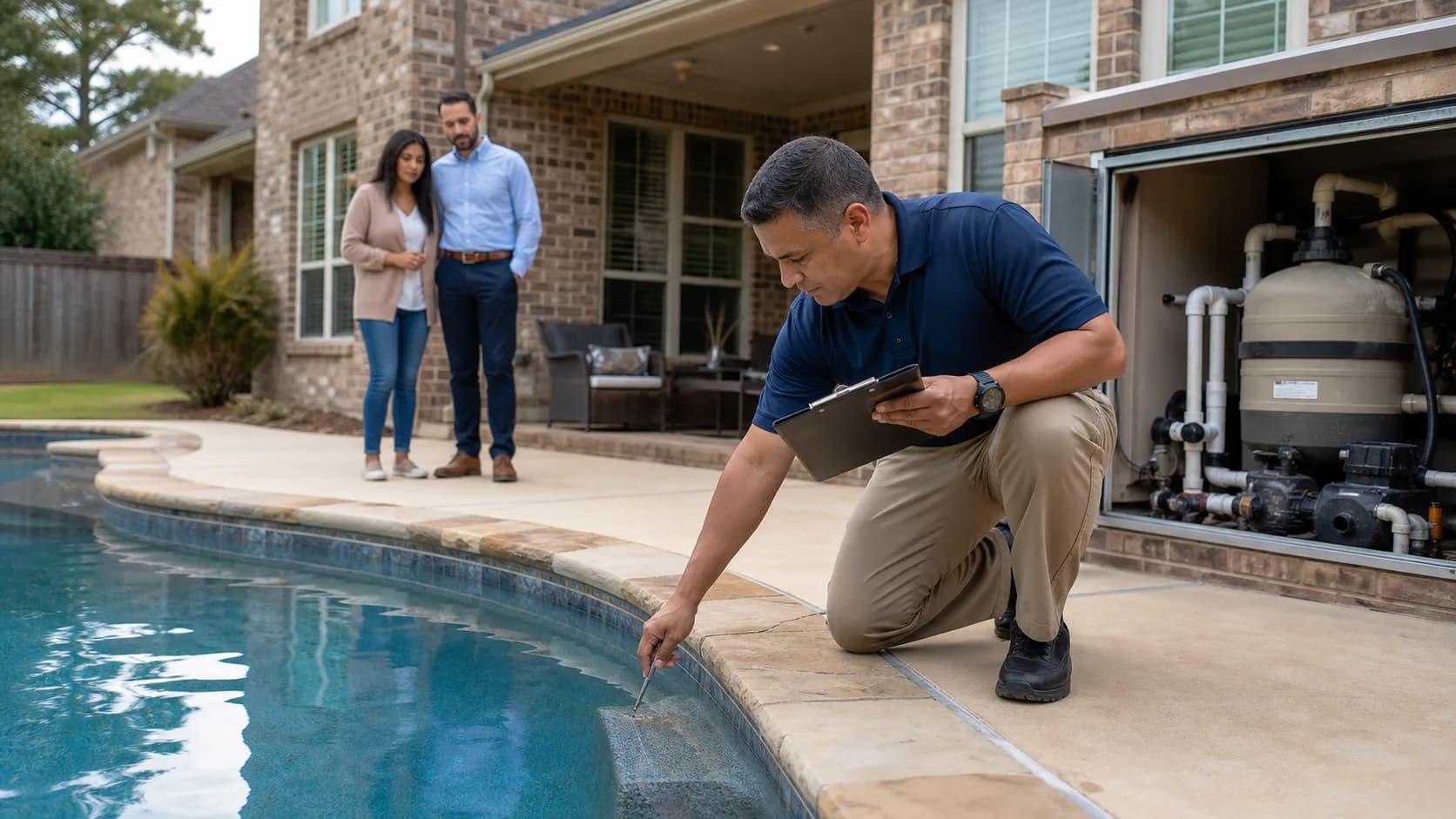
Buying a House With a Pool in DFW: What to Check Before You Close
The pool is often the most expensive system on the property after the roof and the foundation, and it is the one nobody looked at. Here is how to look at it during the option period, while you still have leverage.
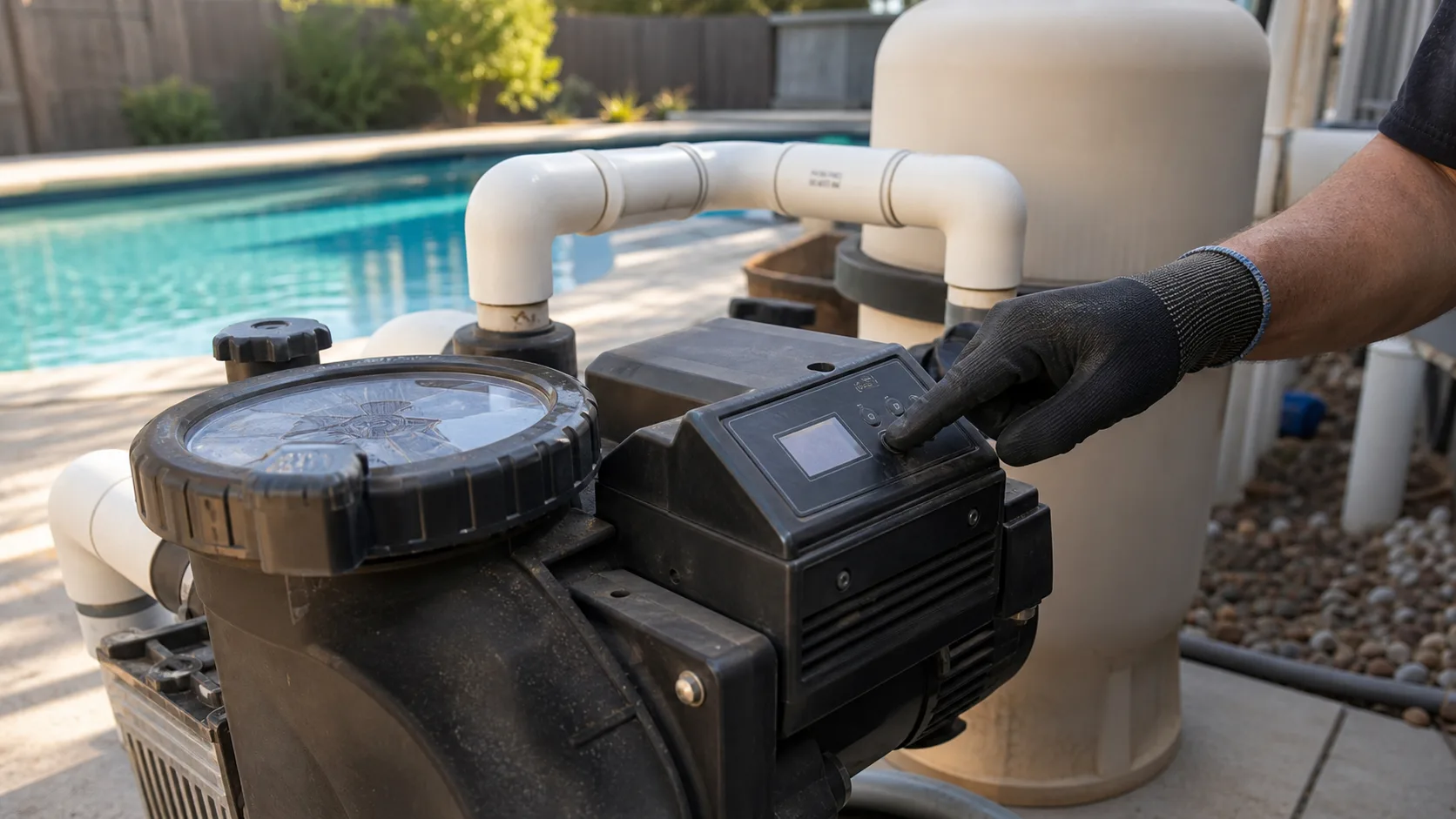
How Long Should You Run a Pool Pump? (North Texas Edition)
Ask ten people and nine say eight hours. That number answers the wrong question. What your pool needs is a volume of water moved, and hours are just how you buy it.