What It Costs to Convert a Pool to Salt Water in Texas

Austin Andrews
Founder, True Texan Pools
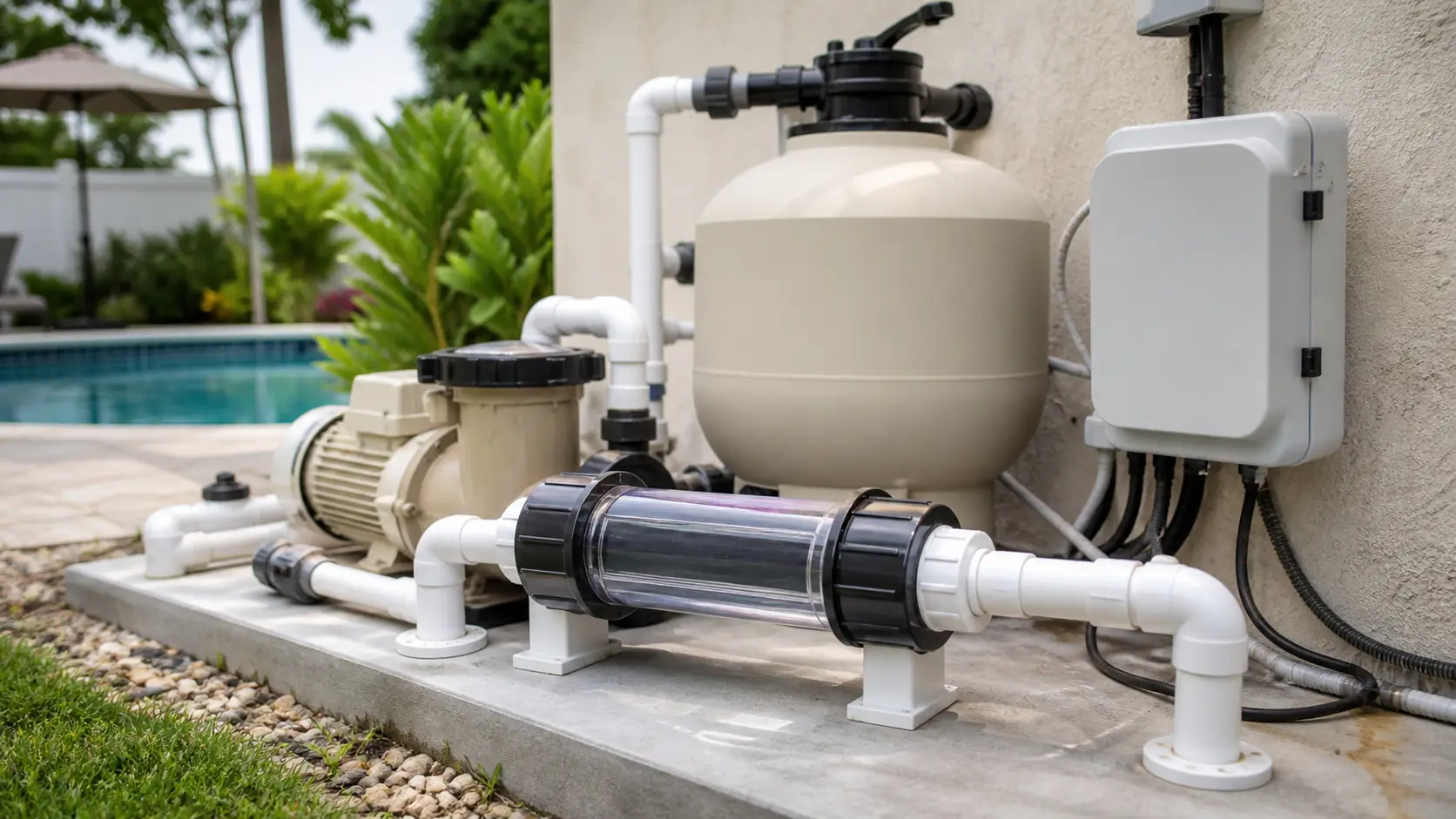
Converting a chlorine pool to salt is a smaller job than most people expect and a bigger commitment than most people are told. The hardware goes on in an afternoon and the bill lands between about $1,500 and $3,500 installed on a typical Collin County pool. What changes permanently is what your water does to your equipment and your plaster, and that part decides whether the conversion was a good idea. Here is the real cost, the pools it suits, and the two conditions that should stop you.
Salt conversions come up most often in two conversations: somebody tired of hauling chlorine in July, and somebody whose family complains about the water. Both are reasonable, and the conversion often does deliver. What it never delivers is a pool that manages itself, and the gap between those two expectations is where the disappointed owners come from.
What a salt system actually is
A salt chlorine generator dissolves nothing magical. You add salt to the pool, water passes through a cell containing coated titanium plates, an electrical current splits the dissolved salt, and the result is chlorine, made in your plumbing, at the moment it is needed. That chlorine then does exactly what chlorine from a jug does, and reverts to salt afterward, which is why the salt is not consumed.
So a salt pool is a chlorine pool. This is not a technicality, it is the whole basis for how the water should be managed, and the CDC states it plainly in its home pool water treatment guidance: the free chlorine a generator makes from salt is the same free chlorine you get from a jug, and the same targets apply, at least 1 ppm free chlorine, or at least 2 ppm in a pool carrying cyanuric acid, with pH between 7.0 and 7.8. Anybody who tells you a salt pool is chlorine-free is either confused or selling. What differs is delivery: continuous and low-level instead of intermittent and high, generated rather than carried, and with no cyanuric acid arriving alongside it the way it does with tablets. That last point is genuinely valuable here and is most of the case for the conversion, for reasons laid out in liquid chlorine versus tabs and the cyanuric acid guide.
The salt concentration in a pool is roughly a tenth of seawater. Most people notice the water feels softer and does not smell, and cannot taste it.
What the conversion costs
The parts list is short. A cell and a control box, a section of plumbing cut and re-piped to accept the cell, an electrical connection, a flow switch, and enough salt to bring the pool to the manufacturer’s target. The variance in quotes comes almost entirely from cell sizing and how much electrical work the pad needs.
| Line item | Typical cost | Notes |
|---|---|---|
| Salt cell and control unit | $900 to $2,000 | Size to at least twice your pool volume, not to it exactly |
| Plumbing and installation labor | $300 to $700 | Half a day on a normal pad |
| Electrical | $0 to $600 | Nothing if there is a suitable circuit, more if a new one is needed |
| Initial salt | $60 to $150 | Commonly 8 to 12 bags of pool-grade salt on a typical pool |
| Total installed | $1,500 to $3,500 | Larger pools and pads needing electrical work sit at the top |
| Cell replacement, later | $600 to $1,200 every 3 to 7 years | The ongoing cost that gets left out of the sales pitch |
Oversize the cell
The single best decision in a conversion is buying a cell rated for well beyond your pool volume, commonly double. A cell rated exactly to your pool runs at or near maximum output all summer to keep up in Texas heat, which wears the plates fastest and leaves you nothing in reserve during a heat wave or after a storm. An oversized cell runs at forty percent, holds the same chlorine level, and lasts substantially longer. The price difference is a few hundred dollars once.
What it saves
Chlorine for a typical pool here runs somewhere in the region of $300 to $700 a year depending on the summer and how you buy it. A salt pool replaces most of that with salt at maybe $60 a year, plus the electricity to run the cell, which is small but not zero, plus the cell fund. Amortize a $900 cell over five years and you are setting aside $180 a year against it.
Net, most pools here save something in the range of $100 to $300 a year on consumables. Against a $2,500 conversion, that is a payback measured in the better part of a decade, which is honest but unexciting. The full five year comparison, including the things that are easy to leave out, is worked through in salt versus chlorine over five years. Convert because you prefer the water and the routine. If somebody sells you a conversion on the savings, they are quoting the salt and forgetting the cell.
What changes about maintenance
This is the part that determines whether your conversion goes well, and it is consistently undersold.
pH climbs, continuously
Salt cells drive pH upward as a byproduct of how they work, and they do it every hour they run. A salt pool in a North Texas summer needs acid added regularly, not occasionally. Left alone, pH drifts high, chlorine becomes less effective at the same reading, calcium starts falling out of solution as scale, and the water quietly turns into the condition described in the hard water guide.
The countermeasure is holding total alkalinity a little on the low side of the usual range so pH has less push behind it, and then dosing acid on a schedule. It is not difficult. It is just something that has to actually happen every week.
The cell needs inspecting and sometimes cleaning
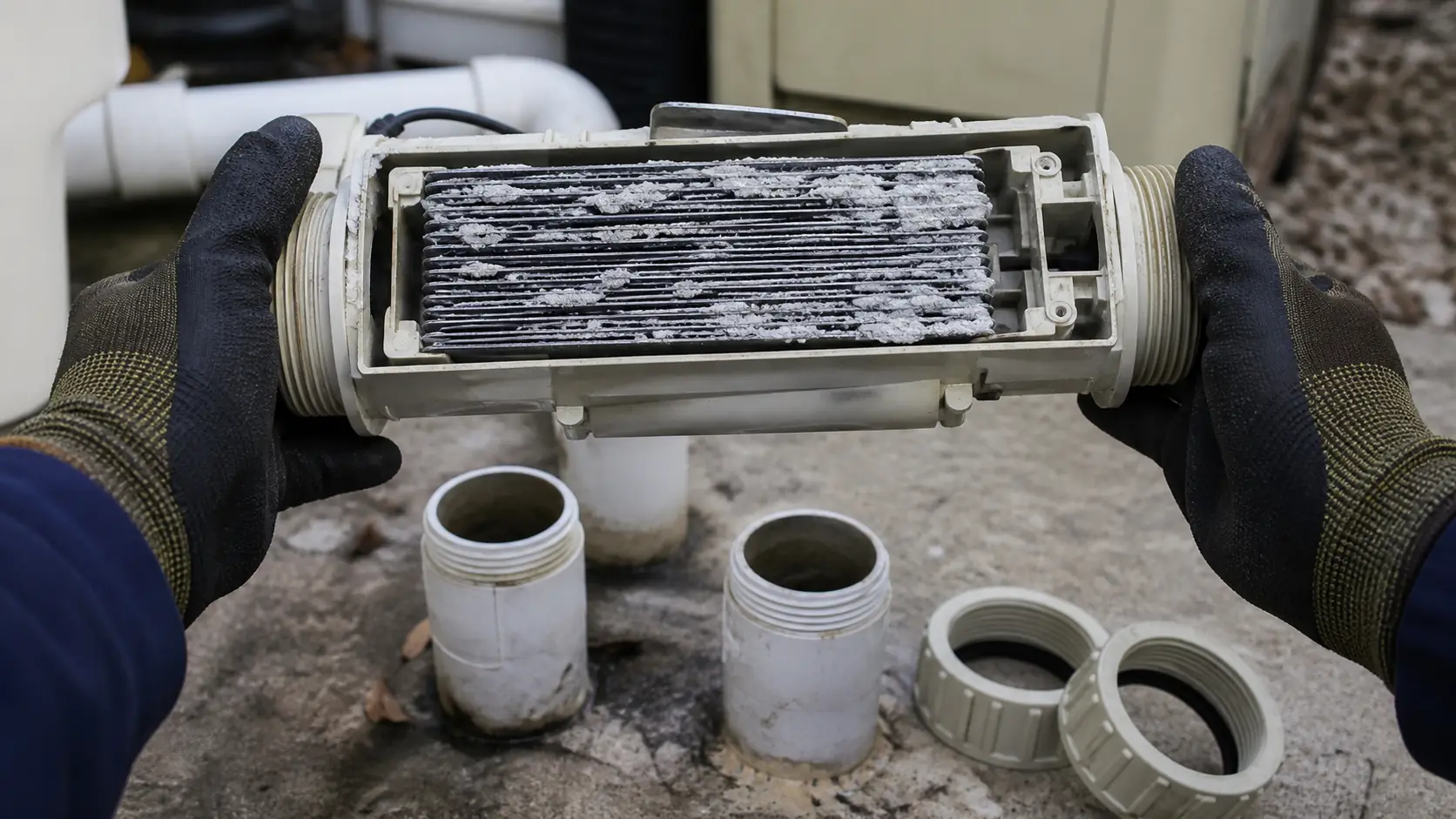
Hard water plus a surface that generates gas equals scale on the plates, and a scaled cell produces less chlorine while reporting that it is working. Cells get pulled, looked at, and acid-cleaned only when they need it, because acid cleaning removes a little of the coating every time. Twice a season is a normal inspection cadence here, and a self-cleaning cell reduces this but does not remove it.
Cold water stops production
Below roughly 60 degrees, most cells cut output sharply or shut off entirely to protect themselves. That is correct behavior and it means a salt pool in January is not making chlorine, so winter sanitation comes from liquid chlorine dosed by hand. This surprises people every year. What a pool actually needs through a North Texas winter is in should your pool run all winter.
Everything else stays the same
Filter cleaning, baskets, brushing, stabilizer, calcium, and the weekly test are unchanged. A salt pool is not a lower-maintenance pool. It is a pool where one specific chore, adding chlorine, has been automated, and where a different specific chore, managing pH, has been made larger. The full routine is in salt water pool maintenance.
Two reasons not to convert
Your plaster is near the end
Salt is mildly corrosive and salt pools run at higher pH by nature, which is a combination that finds every weakness in an old interior surface. Converting a pool with etched, chalky, thin plaster accelerates what was already happening, and you will be resurfacing sooner. If the surface is due within a couple of years, do the resurfacing first and convert at the same time or afterward. New plaster also has a waiting period before salt goes in, commonly around a month, so the sequencing matters. Costs and timing are in what resurfacing costs in DFW.
Your deck, coping, or fixtures will not like it
Salt is hard on some natural stone, on untreated metal, and on anything that gets splashed and then dries repeatedly. Flagstone coping and certain limestone products in particular can spall over years of salt exposure. Galvanized fasteners, some older handrail anchors, and unsealed stone are all worth looking at honestly before converting. This is not a reason to avoid salt in general, but it is a reason to look at your specific deck rather than assume.
Freeze protection first
A salt cell is another piece of water-filled equipment on the pad, and it does not survive a hard freeze any better than the pump does. Before adding one, make sure the pad has a working freeze protection strategy, because the January after a conversion is a bad time to discover it does not. The whole picture is in Texas pool freeze protection, and what a freeze actually breaks is in freeze damage to pool equipment.
How the conversion goes
Assuming a pool in reasonable condition and no electrical surprises, the work is straightforward and mostly happens in one visit.
- Balance the water first. Especially cyanuric acid and calcium. A conversion is a good moment to correct a stabilizer level that has climbed, because the tablets that caused it are about to stop.
- Cut in the cell. It goes last in the return line, after the filter and after the heater, with the flow switch upstream of it.
- Mount and wire the control box. On the pad, out of direct sun where possible, on a circuit that runs with the pump.
- Add the salt with the pump running. Broadcast it into the deep end and let it circulate. It takes hours to dissolve fully, and readings before then are meaningless.
- Set output low and adjust upward over a week. Starting at maximum is how people end up with a pool at 8 ppm and a surprised look.
- Stop using tablets. Continuing to run a floater alongside a salt cell puts cyanuric acid back into a pool that just escaped it, and it is the most common post-conversion mistake we see.
Is it worth it?
For a pool with sound plaster, a pad with freeze protection, and an owner who will keep an eye on pH, yes, usually. The water is pleasanter, the cyanuric acid problem that quietly ruins so many local pools largely goes away, and nobody carries jugs in August. Those are real benefits and they are the ones customers actually mention a year later.
For a pool with a tired surface, a stone deck you love, or an owner who wants less involvement rather than different involvement, it is a poor fit. The honest alternative in that case is not tablets, it is liquid chlorine dosed properly and a service that shows up.
What we do with a conversion request
We install and maintain salt systems, and we talk a fair number of people out of one. The check that decides it takes about twenty minutes: the state of the interior finish, what the coping and deck are made of, whether the pad has a freeze strategy, and what the existing chemistry history looks like. Two of those four regularly come back badly enough that the honest recommendation costs us the install, which is the entire reason we do the check before quoting rather than after. If you want that look before you spend anything, it is part of an equipment inspection.
The numbers, once more, are roughly $1,500 to $3,500 installed, a cell every three to seven years at $600 to $1,200, and consumable savings of a couple of hundred dollars a year. Oversize the cell. Fix the plaster first if it is close. Expect to manage pH deliberately rather than occasionally, and expect to dose chlorine by hand through the cold months when the cell stops producing. Convert for the water, not for the arithmetic, because the arithmetic on its own does not get you there.
Frequently Asked Questions
How much does it cost to convert a pool to salt water?
On a typical Collin County residential pool, $1,500 to $3,500 installed. That covers the cell and control unit at $900 to $2,000, plumbing and labor at $300 to $700, electrical work between nothing and about $600 depending on the pad, and the initial salt at $60 to $150. Larger pools and pads needing a new circuit sit at the top of the range.
How often do salt cells need replacing and what do they cost?
Every three to seven years, at $600 to $1,200. The cell is the consumable in a salt system and the cost most often left out of the sales pitch. Buying a cell rated for roughly double your pool volume is the single best decision in a conversion: it runs at a lower output to hold the same chlorine level, which is what makes the plates last toward the long end of that range rather than the short one.
Does a salt water pool save money?
Modestly, over years. Chlorine for a pool here runs roughly $300 to $700 a year and salt replaces most of that with about $60 of salt, but set aside $180 a year against a cell replacement and the net saving is more like $100 to $300 annually. Against a $2,500 conversion that is a payback measured in most of a decade. Convert because you prefer the water and the routine, not for the arithmetic.
Is a salt water pool less maintenance?
No, it is different maintenance. One chore, adding chlorine, is automated. Another, managing pH, gets larger, because salt cells drive pH upward every hour they run and a Texas summer means dosing acid on a schedule rather than occasionally. The cell also needs inspecting for scale a couple of times a season, and below about 60 degrees it stops producing, so winter chlorine is dosed by hand.
Can you convert an older pool with old plaster to salt?
You can, but it is usually the wrong order. Salt is mildly corrosive and salt pools run at higher pH by nature, which finds every weakness in a tired interior surface and brings the resurfacing forward. If the plaster is due within a couple of years, resurface first and convert at the same time or after, keeping in mind that new plaster has a waiting period, commonly around a month, before salt goes in.
Can I still use chlorine tablets in a salt water pool?
You should not, and doing it is the most common post-conversion mistake we see. Tablets add cyanuric acid with every one that dissolves, and escaping the stabilizer creep that tablets cause is one of the main reasons to convert in the first place. A salt cell plus a floater puts the pool straight back into the problem it just left.
Ready to stop thinking about your pool?
True Texan Pools keeps your water swim-ready all year, across Plano and the rest of DFW. Clear pricing, a photo report after every visit, and Austin doing every job himself.
Keep reading
Salt Cell Lifespan and What Replacement Costs
Nobody mentions the cell replacement at installation, which is why the bill arrives as a shock rather than as a scheduled item.

Pool Light Replacement Cost, and When It Is Worth Converting to LED
A light that has been out for two summers is the most deferred repair in the backyard, usually because nobody knows what it costs. Here is the real range and what moves it.