Salt vs Chlorine: The Five Year Cost in North Texas

Austin Andrews
Founder, True Texan Pools
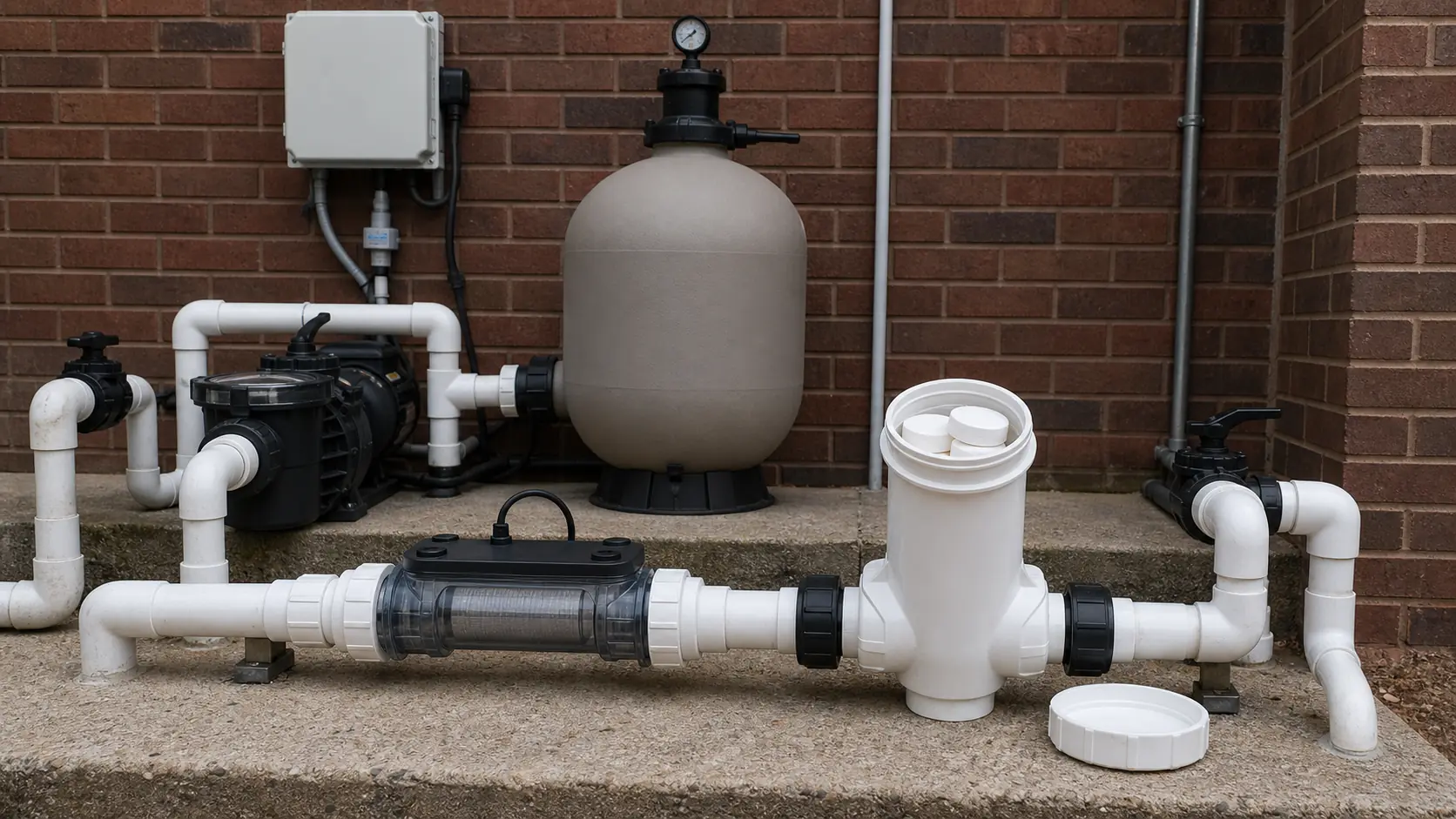
Every comparison of salt against chlorine you will find online is written nationally, which means it leaves out the two things that actually decide it in Collin County: our fill water is hard enough to shorten a salt cell’s life, and our pools run twelve months a year rather than seven. Here is the five year arithmetic with local numbers, and the honest conclusion, which is that the money is close and the reason to choose is not money.
First, the clarification that fixes half the confusion. A salt water pool is not chlorine free. A salt chlorine generator passes a current through salted water to convert chloride into chlorine, which sanitizes and then reverts back to chloride. That is why you rarely add salt and why the salt is not consumed. Chemically, the water your family swims in is a chlorinated pool with a very steady dosing mechanism.
What people actually mean when they say salt pools feel better is that they hold a stable, low chlorine residual without the peaks and troughs of manual dosing, and that fewer chloramines form as a result. That is a real benefit and it is a water quality benefit rather than a chemical-free one.
The five year comparison
Assume a normal Collin County pool: 15,000 to 20,000 gallons, running year round, on the same service either way.
| Line | Traditional chlorine | Salt system |
|---|---|---|
| Up-front equipment | An inline feeder, inexpensive | Generator and cell installed, a real purchase |
| Routine sanitizer | Liquid chlorine or tablets, ongoing | Salt, topped up occasionally and cheap |
| Cell replacement | None | $600 to $1,000 installed, once or twice in five years |
| Acid demand | Depends on product. Trichlor pushes pH down, cal hypo up | Higher. Generation drives pH up, so acid is a steady recurring cost |
| Stabilizer | Trichlor supplies it whether you want it or not | Dosed deliberately to 60 to 80 ppm |
| Water exchange | Driven by cyanuric acid accumulation on tablets | Driven by calcium and total dissolved solids |
| Electricity | None for sanitizing | Small, the cell runs with the pump |
| Equipment wear | Normal | Salt is mildly corrosive to some metals and stone over time |
Run those out over five years and the two columns land close. Salt costs more up front and less per month, then hands back a lump when the cell goes. Chlorine costs less up front and more per month, steadily. Which one wins depends mostly on how long you own the house, because the salt system’s advantage accrues over years and its first cell replacement lands somewhere in year three to six.
Why we will not publish a single five year total
Because it would be invented. The number depends on your pool volume, your sun exposure, your cyanuric acid level, what you pay for chemicals, whether you run the cell at 30 percent or 70, and which cell your system takes. Anybody publishing a precise five year figure without those six inputs is showing you their example pool, not yours. The structure above is the useful part: fill it in with your own numbers.
The two North Texas factors that move the answer
1. Hard water shortens cells here
Chlorine generation raises pH locally right at the plate surface, and high local pH is exactly when calcium comes out of solution. So a salt cell is, by design, the most scale-prone component in the entire system. Now add North Texas water, which arrives moderately hard and then concentrates in the pool year after year, because evaporation leaves the calcium behind and nothing takes it out.
Scale between the plates insulates them, so output falls, and makes the cell work harder for the same result, so the coating erodes faster. That is why the same cell that gives six years in a soft water market may give four here. It is manageable with chemistry discipline and a sequestrant, and it is a genuine local cost. What hard water does to a whole pool covers the system, and salt cell lifespan and cost covers getting the long end of the range.
2. We run twelve months
Cell life is driven by generating hours rather than by calendar years, and a pool that never closes accumulates them faster than a pool that shuts down for winter. Partially offsetting that: most cells stop generating in cold water, which is a design feature rather than a fault, so a North Texas salt pool does get a genuine rest in December and January. It also means you should be adding liquid chlorine directly through the cold months rather than assuming the cell is covering it, and testing rather than trusting the display. Running through winter covers that.
What salt actually buys you
- Water that feels better. Softer on skin and eyes, and less of the swimming-pool smell, because a steady low residual produces fewer chloramines. This is the real reason people like salt pools and it is not a small thing across a summer.
- Stability. Continuous generation holds a residual more evenly than twice-weekly dosing does, which matters most in the exact conditions where it is hardest: August.
- No carrying chlorine. No jugs in the car, no jugs in the garage, and a much smaller chemical storage problem, which is a genuine safety benefit. Our chemical safety guide covers why that matters.
- Less product decision-making. No debate about tablets versus liquid, and no cyanuric acid creeping up on you unnoticed, which is the single most common self-inflicted problem on a traditional chlorine pool here. Liquid versus tabs covers that trap.
What it costs you beyond money
- Acid demand. Generation pushes pH up continuously, so a salt pool needs regular acid. Owners who did not expect this find themselves adding it far more often than they did before.
- A component that fails. A jug of chlorine cannot break. A cell, a control board, and a flow switch all can, and when they do the pool stops being sanitized while appearing to run normally.
- Mild corrosivity. Salt water is gentle on skin and less gentle over years on some metals, on natural stone coping, and on heater components. Not a reason to avoid it, and a reason to rinse stone decking and to make sure any heater is compatible.
- A false sense of automation.The most common problem on a salt pool is an owner who believes it looks after itself. It does not: it needs the same testing, the same balancing, and specifically it needs cyanuric acid held at 60 to 80 ppm and salinity confirmed with a real test rather than with the cell’s own estimate. Salt water maintenance covers the weekly reality.
The mistake that wrecks the economics
Setting the cell output high and never revisiting it. Cell life is consumed by generating hours, so a pool running at 80 percent year round is buying cells at nearly twice the rate of the same pool at 40. If you genuinely need 80 percent, something upstream is wrong: usually cyanuric acid out of range, a pump schedule too short for the cell to work, or a filter restricting flow. Fix that rather than raising the dial.
Converting an existing chlorine pool
Straightforward, and worth checking three things first.
- Your heater. Older heaters with certain metal components do not enjoy salt water. Check compatibility before buying a generator, not after.
- Your coping and decking. Natural stone in particular benefits from being rinsed, and salt splash-out over years is real.
- Your cyanuric acid. If tablets have pushed it well past range, convert after correcting it, not before, because the new system will otherwise inherit a chlorine demand it was never sized for. The CYA guide covers the staged exchange.
Do not drain the pool to convert. Our expansive clay can lift an empty shell, and there is no version of this job that requires it. Clay soil and your pool covers why.
The honest recommendation
Over five years the money is close enough that it should not be the deciding factor. Choose salt if you want better water and less chemical handling, and go in knowing the cell is a consumable that will cost $600 to $1,000 every three to six years, faster on our water than in the brochure. Choose traditional chlorine if you want the lowest up-front cost, the simplest equipment, and nothing else that can fail, and go in knowing that the product you choose matters and that tablets will raise your cyanuric acid whether you intended it or not.
Either way, the line that actually determines what your pool costs over five years is not the sanitizer. It is the pump, the filter interval, and whether the water is kept balanced. What it really costs to own a pool in Collin County sets all five lines beside each other.
We service both kinds on the same terms and the same published rate, with chemicals included, on our weekly service page. If you are weighing a conversion, an equipment inspection will tell you whether your heater, your plumbing, and your current chemistry make it a good idea before you buy anything.
Our position, for whatever it is worth from a company that services both: choose salt because you prefer the water, and treat the five year cost as a wash. Anybody selling you salt on the savings has not put the cell in the arithmetic, and anybody warning you off it on the cell has not counted the chlorine you would otherwise be carrying home every fortnight.
Frequently Asked Questions
Is a salt water pool cheaper than a chlorine pool?
Over five years they land close. Salt costs more up front and less per month, then hands back a lump when the cell needs replacing at roughly $600 to $1,000 installed every three to six years. Chlorine costs less up front and more per month, steadily. Which one wins depends mostly on how long you own the house, because the salt system's advantage accrues over years while its first cell replacement lands somewhere in year three to six.
Is a salt water pool chlorine free?
No. A salt chlorine generator passes a current through salted water to convert chloride into chlorine, which sanitizes and then reverts back to chloride. Chemically your family is swimming in a chlorinated pool with a very steady dosing mechanism. What people mean when they say salt pools feel better is that a stable low residual produces fewer chloramines, which is the thing that actually irritates eyes and smells.
Do salt cells last as long in North Texas?
Usually toward the short end of the three to six year range. Chlorine generation raises pH right at the plate surface, which is exactly when calcium comes out of solution, and NTMWD water is moderately hard with regional hardness reaching roughly 202 ppm. Scale between the plates insulates them and makes the cell work harder, which erodes the coating faster. Chemistry discipline and a sequestrant genuinely extend it.
What are the hidden running costs of a salt pool?
Acid, mostly. Chlorine generation pushes pH up continuously, so a salt pool needs regular acid additions that surprise owners who did not expect them. Beyond that: a small amount of electricity, salt topped up occasionally, and the fact that a cell, a control board, and a flow switch can all fail, at which point the pool stops being sanitized while appearing to run normally.
What should I check before converting my pool to salt?
Three things. Whether your heater is compatible, since older heaters with certain metal components do not tolerate salt water. Whether your coping is natural stone, which benefits from rinsing. And your cyanuric acid level, because if tablets have pushed it well past range you should correct that before converting, not after, or the new system inherits a chlorine demand it was never sized for. Do not drain the pool to convert.
Does a salt pool need less maintenance?
Less chemical handling, not less maintenance. It still needs the same weekly testing and balancing, plus two things specific to salt: cyanuric acid held at 60 to 80 ppm rather than the 30 to 50 of a chlorine pool, and salinity confirmed with an independent test rather than trusting the cell's own estimate. The most common problem on a salt pool is an owner who believes it looks after itself.
Ready to stop thinking about your pool?
True Texan Pools keeps your water swim-ready year-round across Plano and all of DFW. Clear pricing, no contracts, and a photo report after every visit. Austin handles every job personally.
Keep reading
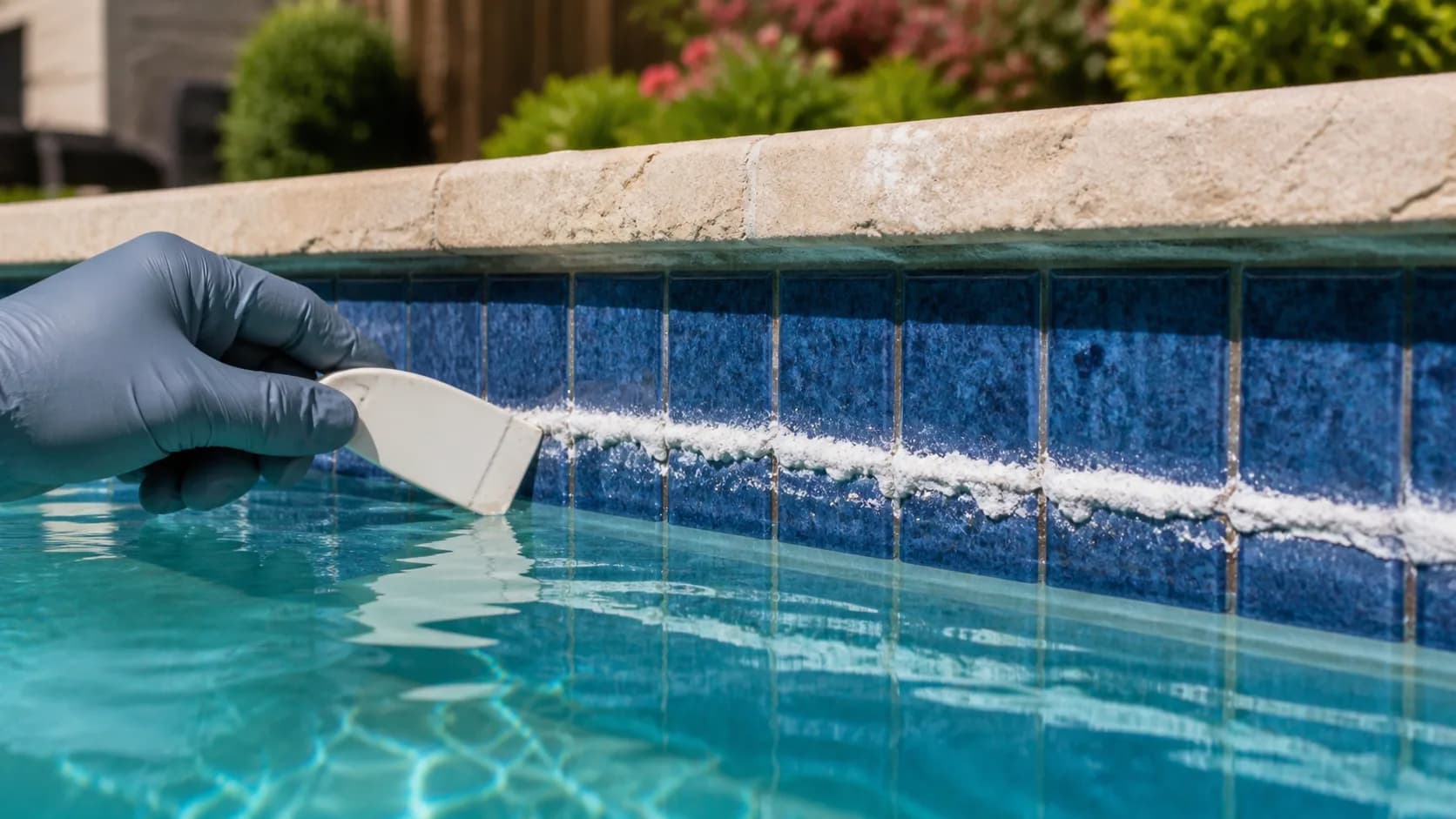
Calcium Scale on Pool Tile: Why It Keeps Coming Back
You can scrub the tile, and you should, but unless you deal with what put the scale there it comes back before the season is out. In DFW, that means understanding why your calcium hardness only ever goes up.
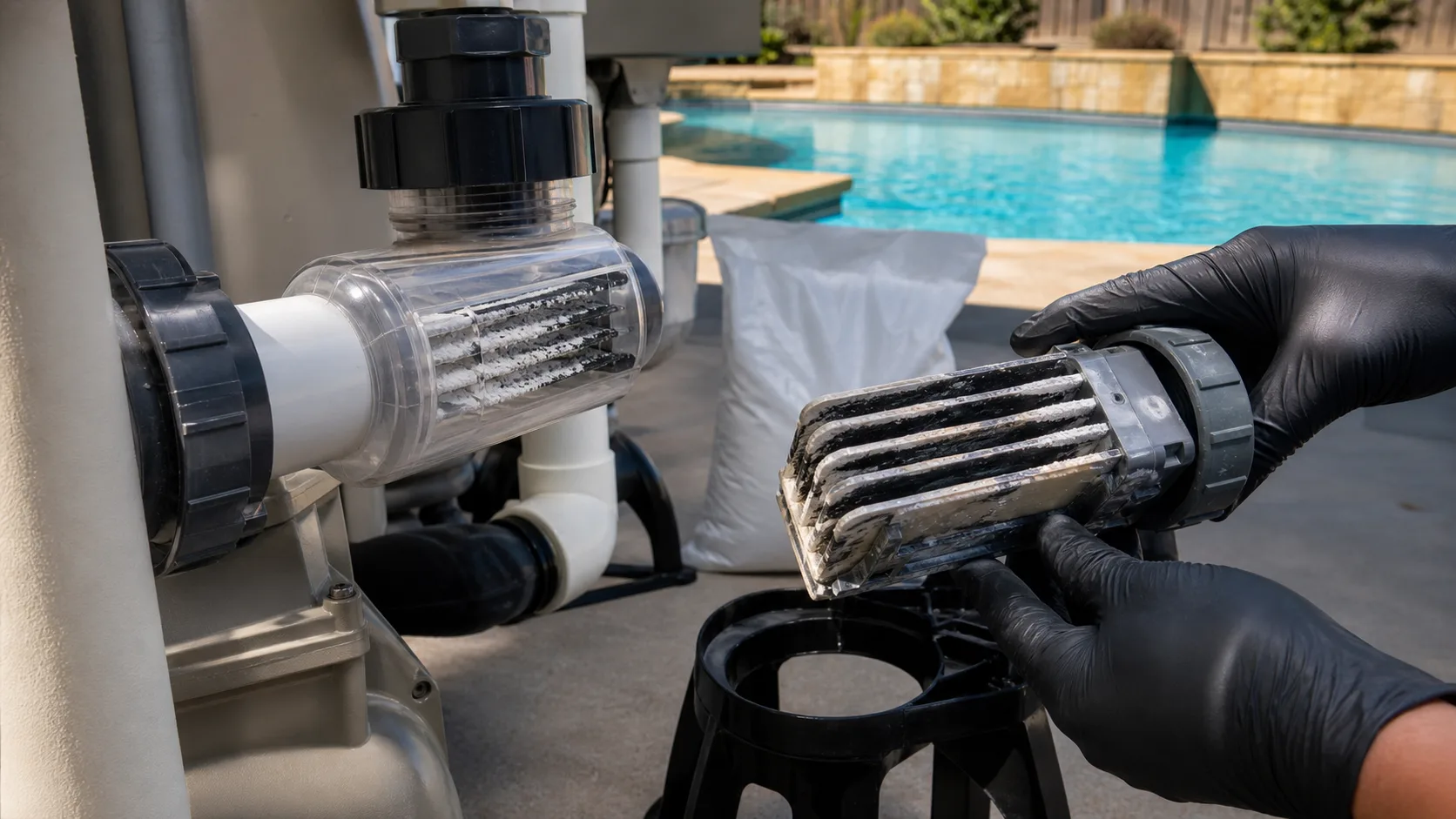
Salt Water Pool Maintenance in North Texas: What Nobody Tells You
Salt pools are not chlorine-free and not lower maintenance. They trade weekly chemical handling for a standing requirement to control pH and keep the cell clean, which is harder here than most places.