Draining a Pool in Collin County Clay Without Wrecking It

Austin Andrews
Founder, True Texan Pools
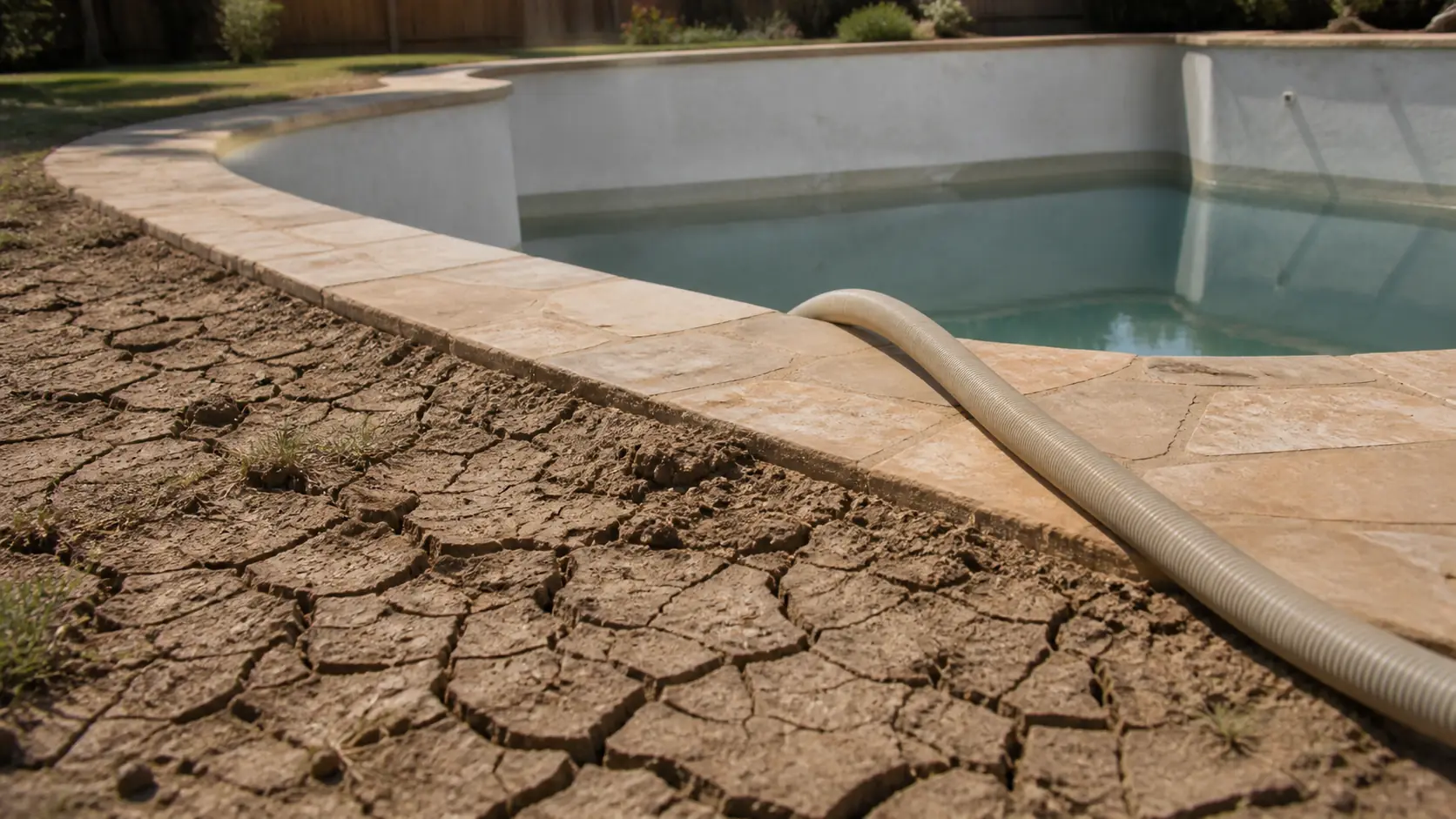
Sooner or later somebody tells you the water has to go. Cyanuric acid is pinned, the calcium won’t come down, the plaster is due, or a repair needs a dry shell. In most of the country that’s a Saturday with a hose. In Collin County it’s the single most expensive thing you can do to a pool wrong, because the ground here pushes back on an empty shell hard enough to lift it out of the yard. Here is when a drain is genuinely necessary, how to do it without floating the pool, and the two ways to avoid it entirely.
We wrote at length about what the soil under your pool does in the Collin County clay soil guide, and the one-line summary there was that nobody local should ever fully drain a pool casually. This is the article that owes you the rest of that sentence, because sometimes the water really does have to come out, and the difference between a routine job and a five-figure disaster is entirely in the preparation.
When a drain is actually necessary
Shorter list than most people think. A pool needs to be fully empty for structural or surface work: replaster or resurfacing, tile and coping replacement at the waterline, a crack repair, a main drain or light niche repair that can’t be done wet. Those are real, and when the plaster is done, it’s done. We cover the timing and the money in what pool resurfacing costs in DFW.
Everything else on the usual list is a water chemistry problem, and water chemistry problems are solved by dilution, not by emptiness. Dilution is a ratio. Taking out half the water and refilling cuts a dissolved level roughly in half, whether the pool ever sits empty or not. Nothing about the last twelve inches of water makes the math work better, and that last twelve inches is where all of the risk lives.
| Reason | Full drain required? | What actually works |
|---|---|---|
| Cyanuric acid too high | No | Partial drain and refill, sized to the reduction you need, or reverse osmosis |
| Calcium hardness too high | No | Partial drain and refill, though our fill water is hard, so it takes more of it |
| Total dissolved solids high | No | Partial drain and refill, or reverse osmosis |
| Old salt pool being converted | No | Partial drains over time, or simply letting the salt fall as water is replaced |
| Replaster or resurfacing | Yes | Planned drain with the resurfacing crew on site |
| Waterline tile or coping replacement | Yes | Planned drain, usually a short one |
| Structural crack repair | Yes | Planned drain, engineer or specialist involved |
| Stains you want to acid wash off | Usually yes | Worth a second opinion first, since acid washing removes plaster permanently |
The one that catches people
High cyanuric acid is the most common reason a North Texas homeowner is told to drain, and it is the reason with the least justification for emptying the pool. CYA comes down by exactly one mechanism, which is replacing water with water that doesn’t have any in it. A partial drain does that. We work the arithmetic out with real numbers in the cyanuric acid guide.
Why an empty pool floats in Collin County clay
A full pool is heavy. A twenty thousand gallon pool holds something on the order of eighty tons of water, and that mass is what holds the shell down against everything underneath it. Take the water out and you’ve removed the ballast while leaving a large watertight hull sitting in wet ground.
Groundwater in saturated soil exerts upward pressure on that hull. This is hydrostatic pressure, and it doesn’t care that the pool cost you sixty thousand dollars. If the pressure under the shell exceeds the weight of the empty shell, the pool moves. Gunite pools crack or shift. Fiberglass pools, being far lighter, can lift several inches out of the ground and are the classic pop-out photograph. Vinyl liners have their own failure, where the liner shrinks and creases the moment it dries out and never seats properly again.
The Blackland Prairie clay under Plano, Frisco, and McKinney makes this worse in two directions at once. It holds water rather than draining it, so saturation persists for days after the rain stops. And it swells as it takes that water on, which adds soil pressure to water pressure against the walls. This is the same shrink-swell cycle that cracks decks and breaks underground plumbing here, only concentrated on a structure you’ve just removed eighty tons of weight from.
A pool that pops out is not repaired. It’s a demolition and rebuild conversation, or a structural lift by a foundation contractor with no guarantee about the plumbing. It is the worst outcome in residential pool ownership and it is entirely preventable.
The hydrostatic relief valve nobody checks
Most gunite pools were built with a hydrostatic relief valve in the main drain sump. It is a simple thing: a spring-loaded plug that opens when the pressure underneath exceeds the pressure above, letting groundwater into the empty pool instead of lifting it. Some pools also have a well pipe beside the shell so a contractor can measure or pump the water table down before starting.
Two problems with relying on it. First, on a pool built in the 1990s or 2000s, that valve has spent twenty or thirty years under water, packed with plaster dust, scale, and grit, and there’s a real chance it will not open. Second, nobody knows whether a given pool has one until somebody looks, and the looking has to happen while the pool still has water in it or immediately as it comes down.
Before any full drain, the crew doing the work should be able to tell you whether your pool has a relief valve, whether it is free, and what the plan is if the water table comes up during the job. If the answer to any of those is a shrug, that is your signal to stop and get someone else. This is exactly the kind of question worth a second opinion.
The partial drain, which is what you almost always want
A partial drain lowers the water to somewhere between the tile line and the top of the deep end wall, refills from the hose, and never leaves the shell empty for a second. The ballast stays in the pool. There’s no hydrostatic risk worth the name, no plaster drying out in the sun, no liner shrinking, and no crew required.
The rule of thumb is a straight proportion. Replacing a third of the water cuts a dissolved level by roughly a third. Replacing half cuts it roughly in half. To get from a cyanuric acid reading of 120 down to a working 40, you’re replacing about two thirds of the water, which most people do in two rounds a week or two apart rather than one dramatic afternoon.
| Water replaced | Roughly what a reading of 120 becomes | Practical note |
|---|---|---|
| 25 percent | 90 | One easy round, safe on any pool |
| 33 percent | 80 | Common single round, water down to about the returns |
| 50 percent | 60 | Down near the top of the deep wall, still fully ballasted |
| 67 percent | 40 | Do it as two rounds rather than one deep one |
| 75 percent | 30 | Getting close to the level where risk starts, plan it properly |
Our fill water is not blank
Dilution math assumes the replacement water contains none of what you’re diluting. That holds for cyanuric acid and salt. It does not hold for calcium hardness, because North Texas tap water is hard to begin with, so you’re replacing hard water with slightly less hard water. Diluting calcium here takes considerably more turnover than the simple ratio suggests, and on some pools it never gets all the way down. The hard water guide covers what to do instead of chasing it.
How to do a full drain without wrecking anything
If the work genuinely requires an empty shell, the job is to keep the empty window short and the ground as dry as it gets. In practice that means the following order, and it means the resurfacing or repair crew is scheduled before the water starts moving, not after.
Pick the season, not the weekend
The safest windows in North Texas are late summer through early fall, when the clay has given up its moisture, and the coldest part of winter when nothing is growing and rain is lighter. The worst window is spring, which is both our wettest season and the one everybody wants their pool resurfaced in. Watch the ten day forecast and understand that a big rain two days before the drain is a reason to reschedule, not a reason to hurry.
Keep the empty window measured in hours
A pool that sits empty for a day carries a fraction of the risk of one that sits empty for a week because a contractor is waiting on materials. Confirm the crew has everything on the truck. Plaster also should not bake dry in a Texas afternoon before it’s worked, which is the same argument from a different direction.
Have the relief valve open and a pump ready
The valve gets pulled or opened as the water comes down, not before and not after. If groundwater starts coming up through the sump, that’s the system working, and the answer is a submersible pump running continuously for the duration of the job rather than plugging it back up.
Protect the surface while it’s exposed
Bare plaster in direct August sun gets hot enough to matter, and a dry vinyl liner starts shrinking within hours. Shade cloth over the shell is cheap insurance on a summer job. Nobody walks on a dry liner.
Refill in one continuous run
Once the work is done, the pool refills without stopping, from the bottom, until it’s back at the tile. A refill that pauses overnight halfway is an empty-ish pool with all the same exposure and none of the excuse. Plan for the water bill: twenty thousand gallons is a noticeable line on a City of Plano or Frisco statement, and on a hard freeze schedule you also want the equipment protected the moment flow returns.
Where the water is allowed to go
This part gets skipped, and it is also the part most often stated too simply. The problem is not the pool water, it is the chlorine in it. Texas writes that distinction into the permit that governs municipal storm sewers. The TCEQ small MS4 general permit, TPDES General Permit TXR040000, lists at Part II, Section C the non-stormwater discharges a city’s storm sewer is allowed to accept, and item 13 on that list is dechlorinated swimming pool discharges that do not violate Texas Surface Water Quality Standards. The same section ends that permission with a caveat that matters: those discharges are allowable unless they are otherwise prohibited by the MS4 operator, which is your city.
So the accurate version is this. Chlorinated pool water going to a storm drain is an illicit discharge, and our storm drains run to creeks that feed Lake Lavon and Lake Lewisville, where chlorine kills fish. Dechlorinated pool water may be acceptable, and may not be, depending on what your particular city has decided. Which is why the first step is a phone call rather than a hose.
- Call your city’s water utility or public works before the drain and ask what they require. The answer differs between Plano, Frisco, McKinney, and Allen, and it is a five minute phone call. Many will point you to a sanitary sewer cleanout at a controlled rate, which sidesteps the question entirely.
- Dechlorinate first, whatever the destination. Chlorine falls on its own if the pool sits uncovered and undosed for several days, and it can be neutralized directly. This is the step that turns a prohibited discharge into a possibly permitted one.
- Never run twenty thousand gallons onto a neighbor’s lot or into an alley. Beyond the ordinance question, you’re saturating exactly the clay you’re trying to keep dry.
- Keep the discharge away from the pool itself. Dumping the water next to the shell while emptying the shell is the most self-defeating version of this job we see.
Reverse osmosis, the option nobody mentions
Mobile reverse osmosis is a truck that parks in your driveway, pulls water out of the pool, pushes it through membranes that strip out the dissolved material, and returns it clean. The pool stays full the entire time. Cyanuric acid, calcium, salt, and total dissolved solids all come down, and you keep most of your water.
It isn’t free, and on a straightforward high-CYA pool a couple of partial drains is usually cheaper. Where it earns its keep is the pool that has several of these problems at once, the pool with calcium so high that dilution against our hard fill water can’t win, and any drain-averse situation where the shell is old, cracked, or fiberglass. In a drought summer with watering restrictions in force, refilling twenty thousand gallons is not always something the city wants you doing anyway.
Get a quote for both. The comparison is the treatment cost against the water bill plus the chemistry cost of rebalancing a largely new pool, and it lands differently on different pools.
What it costs when it goes wrong
The ranges below are what we see locally rather than a published tariff, and the point of the table isn’t the middle column. It’s the gap between the top row and the bottom one.
| Job | Typical range | Notes |
|---|---|---|
| Partial drain and refill, done yourself | Water bill only | A submersible pump rental if you don’t own one |
| Partial drain, refill, and rebalance by a service | $150 to $350 plus water | Chemistry after a big refill is real work |
| Planned full drain as part of a resurface | Included in the resurface | Should be, and if it isn’t, ask why |
| Mobile reverse osmosis | Quoted per pool, commonly four figures | Compare against water plus chemicals, not against zero |
| Cracked or shifted shell after an unballasted drain | Five figures | Structural, and insurance frequently declines it as maintenance |
Austin’s Tip
If a company proposes draining your pool over the phone, before anyone has read your water and before anyone has mentioned the relief valve or the forecast, that’s not a plan, it’s a default. Ask two questions: what number are we trying to move, and why won’t a partial drain move it? A company that can answer both is worth listening to. One that can’t is about to gamble your shell to save itself an afternoon of arithmetic.
What we do when a customer is told to drain
We start by asking the two questions above, and most of the time the answers end the conversation: the number will move on a partial, and the job turns into a hose, a submersible pump, and an afternoon. When it really is resurfacing or a crack, the order we insist on is crew booked, forecast read, relief valve confirmed, city called, and only then a drop of water out of the pool. We have never regretted making somebody wait two weeks for a dry stretch. We have seen what the other version costs.
The part we would rather do is earlier than all of that. A cyanuric acid reading climbing through a summer is visible months before anybody says the word drain, and catching it at 60 ppm means one easy partial in the fall rather than an argument about an empty shell in the spring. That is the ordinary work of weekly service, and it is the cheapest version of this entire article.
Frequently Asked Questions
Can you drain a pool in North Texas?
Yes, but only with preparation, and only when the work genuinely requires an empty shell. Collin County sits on expansive Blackland Prairie clay that holds water and swells, so groundwater pressure under an unballasted pool can crack, shift, or float it. A pool that pops out is not repaired, it is a demolition or a structural lift, which is why the drain is the risky part of most jobs rather than the work itself.
Do I have to drain my pool to lower cyanuric acid?
No, and this is the most common reason people are told to drain with the least justification. Cyanuric acid comes down by dilution, which is a ratio: replacing half the water halves the reading whether the pool ever sits empty or not. Nothing about the last twelve inches improves the math, and that last twelve inches is where all of the risk lives. Two partial drains a week or two apart do the job.
What is a hydrostatic relief valve?
A spring-loaded plug in the main drain sump that opens when groundwater pressure under the shell exceeds the pressure above, letting water into the empty pool rather than lifting it. Most gunite pools have one. On a pool built in the 1990s or 2000s it has spent decades under water packed with plaster dust and scale, so whether it will actually open is a question to answer before the drain, not during it.
How much water do I need to replace to fix my chemistry?
It is a straight proportion for anything the fill water does not contain. Replacing a third cuts a reading by about a third, half cuts it roughly in half, and getting from 120 ppm of cyanuric acid to a working 40 means replacing about two thirds, best done in two rounds. Calcium hardness is the exception, because North Texas tap water is already hard, so diluting it takes considerably more turnover than the simple ratio suggests.
Where can I drain pool water in Plano or Frisco?
Call your city’s water utility or public works and ask before you start, because the answer differs between cities and it is a five minute call. Chlorinated pool water is toxic to aquatic life and our storm drains run to creeks feeding local lakes, so discharging treated water to a storm drain is generally prohibited. The usual approved route is a sanitary sewer cleanout at a controlled rate.
Is reverse osmosis better than draining a pool?
It is worth pricing against a drain, particularly on a pool with several problems at once. A mobile RO truck filters the existing water in place, stripping cyanuric acid, calcium, salt, and total dissolved solids while the pool stays full, so there is no hydrostatic risk and you keep most of your water. On a straightforward high-CYA pool, a couple of partial drains is usually cheaper. Get both quotes.
Work it out for your pool
All toolsFree, instant, and no email needed to see the answer.
Ready to stop thinking about your pool?
True Texan Pools keeps your water swim-ready all year, across Plano and the rest of DFW. Clear pricing, a photo report after every visit, and Austin doing every job himself.
Keep reading
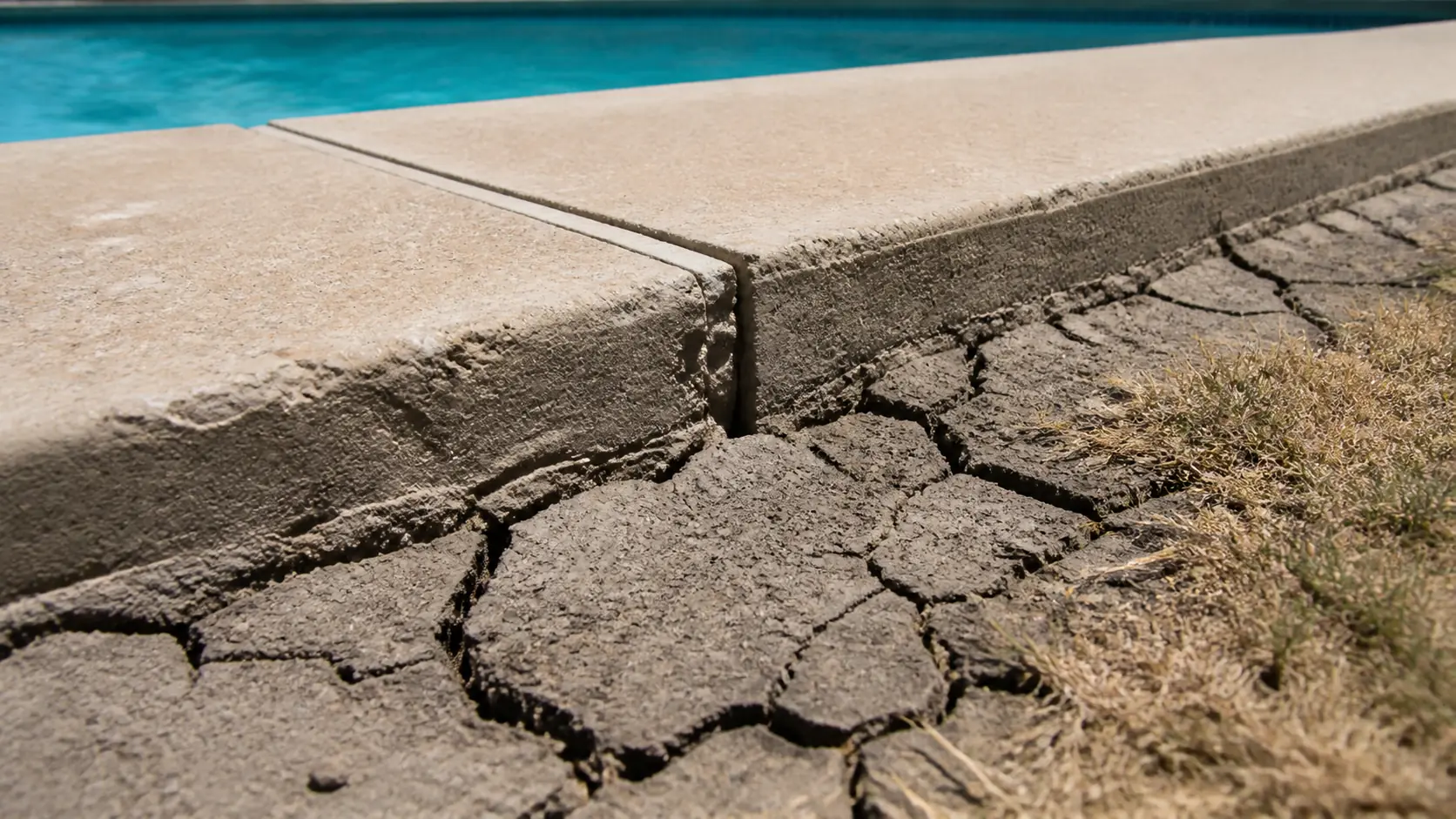
How Collin County Clay Soil Shows Up in Your Pool
The ground under your pool moves, in both directions, annually. It’s the local condition that produces the most expensive pool failures in this county.
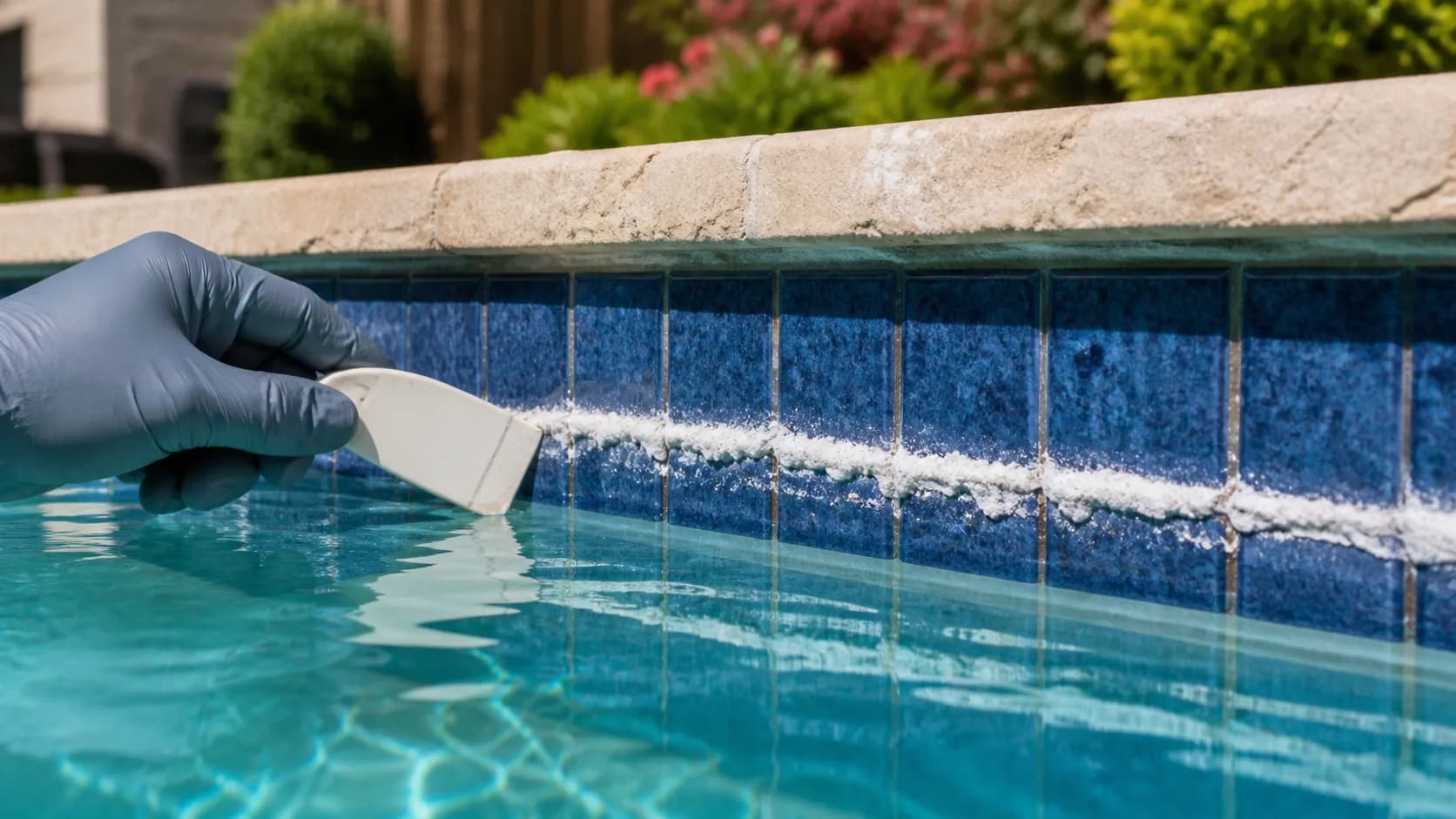
Calcium Scale on Pool Tile: Why It Keeps Coming Back
You can scrub the tile, and you should, but unless you deal with what put the scale there it comes back before the season is out. In DFW, that means understanding why your calcium hardness only ever goes up.