Freeze Damage: How to Tell if Your Pool Equipment Cracked

Austin Andrews
Founder, True Texan Pools
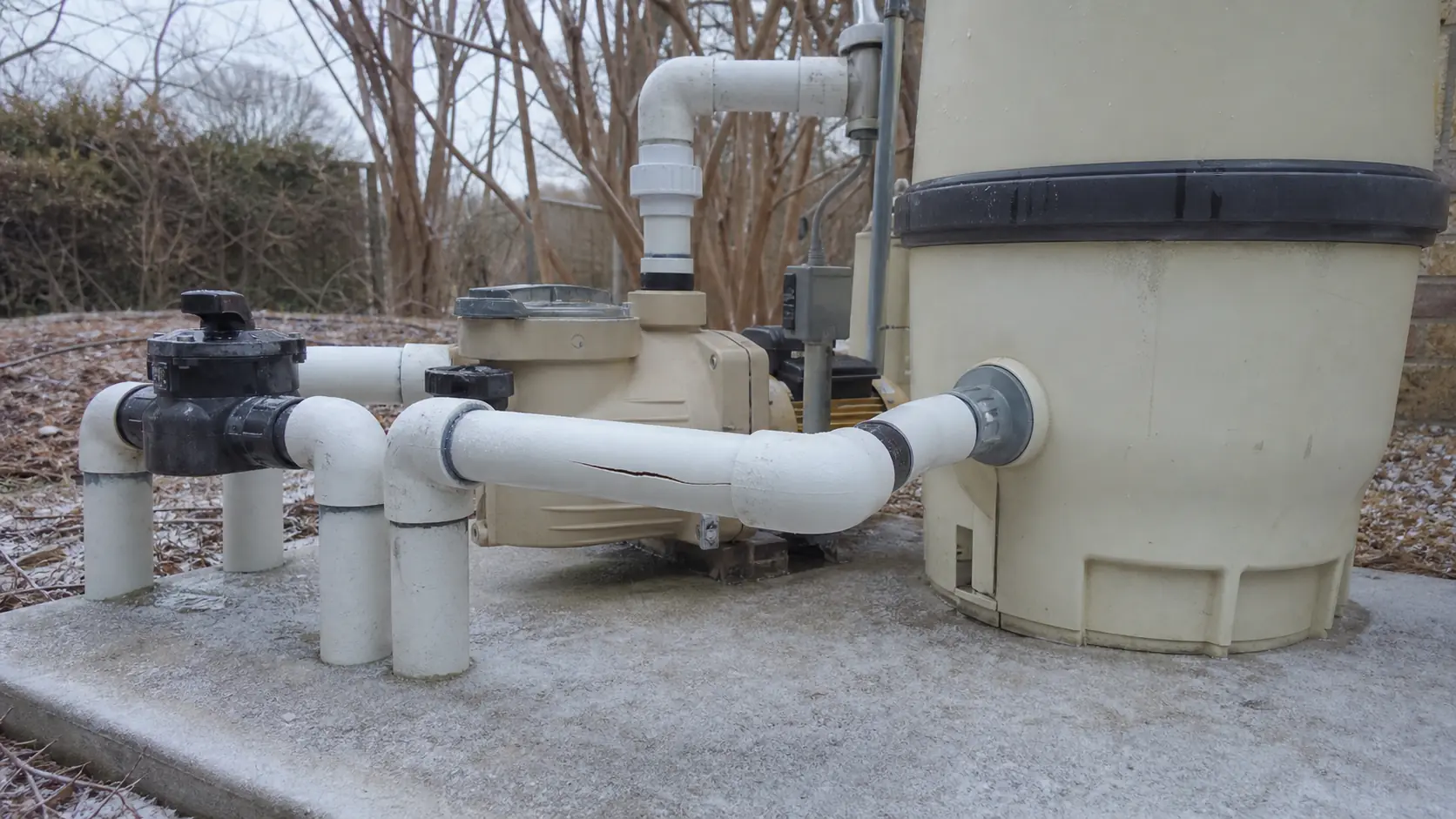
The freeze has passed, everything looks normal, and you want to know whether you got away with it. Most freeze damage in North Texas does not announce itself. It sits in a split pipe or a cracked pump housing doing nothing at all until the system is pressurized again, which can be the same afternoon or can be six weeks later. Here is how to inspect a pad properly after a hard freeze, what each kind of damage looks like, and which findings mean stop.
North Texas gets a particular kind of freeze that is unusually good at breaking pool equipment. It is not sustained cold, which pools are winterized against in other states. It is a mild fortnight, then a night at 12 degrees, then a mild fortnight again. Nobody drains anything for that, and nothing is buried deep enough to be safe from it, so the damage lands on whatever was holding still water above ground when the temperature dropped.
Wait for the thaw before you touch anything
The single most expensive mistake after a freeze is made in the first hour. If the pump was off through the cold and the plumbing is still frozen, starting it forces the impeller against a solid plug of ice, and the motor either burns or the housing cracks. If a valve will not turn, it is frozen, and forcing the handle shears the stem.
- Leave the breaker off until air temperatures have been above freezing for several hours and you can see moving water in the skimmer.
- Do not pour hot water on anything. Rapid temperature change on cold PVC or a cold filter tank cracks it, and hot water on a frozen pump seal ruins the seal.
- Do not use a torch or a heat gun. PVC softens well below the point where it looks affected, and a heater with a torch near it is a different category of problem.
A hair dryer or a heat lamp at a distance, used patiently on a specific fitting, is the only heat worth applying, and even then the better answer is usually to wait.
The five minute walk-around, in order
Do this in daylight, with the pump off, before you restart anything. You are looking for water where water should not be, and for shapes that have changed.
- The concrete under the pad. A dark wet patch on a dry day is the single most reliable tell there is. Note where it is wettest, because that is roughly where the split is.
- The pump lid and pot. Look for a crack radiating across the clear lid, a split along the top of the pot, or a lid that no longer seats flat. This is the most commonly damaged single component because it holds a large volume of still water in thin plastic, right at the top of the system.
- Every run of exposed PVC. Sight down each pipe. A freeze split is a fine longitudinal line, often only an inch or two long, frequently on the underside where you have to crouch to see it. Run a dry finger along the pipe: you can often feel it before you can see it.
- The filter tank and its clamp band. Look for a weeping seam at the band, a bulge in the tank wall, or a cracked pressure gauge, whose little bourdon tube is one of the first things to go.
- The heater. Look underneath it for water and check for a cracked header at either end. Heater damage is the most expensive item on this list and the hardest to see, because the part that splits is inside.
- The salt cell and any inline feeder. Both are plastic housings full of still water. Check the unions at each end and the cell body for a hairline.
- The pool itself. Look at the tile line and the skimmer throat for new cracking, especially if the water level dropped below the tile during the freeze.
Where the crack usually is
Freeze splits concentrate in the components that hold still water in the largest volume with the thinnest wall, and above ground where the air reaches them. In practice that means the pump pot and lid first, then above-ground PVC, then the filter, then the heater. Buried lines rarely split. If the wet patch is out in the yard rather than at the pad, you are more likely looking at ordinary ground movement in a leak that was already developing.
Restarting, and what to watch in the first ten minutes
Once the system is genuinely thawed and the walk-around found nothing obvious, restart it deliberately rather than casually. Most freeze damage is discovered at this moment, and you want to be standing at the pad when it is.
- Top the water up to mid-skimmer if the level dropped.
- Open every valve to its normal running position, gently. Nothing should need force.
- Fill the pump pot with water, seat the lid with a lightly lubricated o-ring, and switch on.
- Watch the pressure gauge. It should climb to its usual clean-filter number within a minute or so.
- Walk the whole pad twice while it runs and look for spray, drip, or a growing wet line.
| What you see | Most likely cause | What to do |
|---|---|---|
| Pump runs but pressure stays at zero | Air leak or a split on the suction side | Shut it down. Running dry destroys the seal in minutes. |
| Pump will not hold prime | Cracked lid, failed lid o-ring, or a split suction pipe | Check the lid first, it is the cheap answer |
| Water spraying or dripping at the pad while running | Split PVC or a failed union | Turn the pump off and locate it before running again |
| Wet concrete, nothing visible | A split on the underside of a pipe, or the filter seam | Dry the pad, run five minutes, and look again |
| Pressure much higher than usual | Ice still in the system, or a closed valve | Shut down and wait for a full thaw |
| Heater will not fire, or leaks underneath | Cracked header or heat exchanger | Stop. This one is not a homeowner repair. |
| Pool water level fell overnight after the freeze | A shell or plumbing leak revealed by the freeze | Run the bucket test before assuming evaporation |
What the repairs actually cost around here
Freeze repairs are usually cheaper than people fear and more urgent than people treat them. The ranges below are what this work typically runs in the DFW area. What moves the real number is access: how much plumbing has to be cut out to reach the split, and how busy every pool company in the Metroplex is that week.
- Pump lid and o-ring. The cheapest outcome on the list, and a genuinely common one.
- A section of split PVC. Modest, provided it is accessible above ground. Cost climbs quickly if the split is under concrete.
- Pump housing or a whole pump. A cracked pot usually means a new wet end, and on an older single-speed pump the sensible answer is often a whole variable-speed replacement instead. Our repair or replace guide works through that decision.
- Filter tank. A cracked tank is a tank replacement. The internals normally survive.
- Heater heat exchanger. The expensive one, frequently close enough to the price of a new heater that replacing the unit is the better value on anything older.
Check the warranty before you check the price
Freeze damage is excluded from most manufacturer warranties, on the reasoning that it is a maintenance failure rather than a defect. Homeowner insurance is the better question. Some policies treat a burst pool line the way they treat any other burst pipe, and it is worth one phone call before you pay out of pocket, particularly if the damage extends into the decking or the yard.
Why this keeps happening here specifically
Three local conditions stack up. Our freezes are short and severe rather than long and steady, so nobody prepares for them the way a northern owner prepares for a season. Our pools are built to run year round, with equipment above ground and uninsulated because for 350 days a year that is the right design. And our power grid has, in recent memory, failed during exactly the events that make freeze protection matter, which removes the one defense that actually works.
That last point is worth sitting with. Automatic freeze protection is only as good as the electricity feeding it. A pool whose entire cold-weather plan is a temperature sensor is a pool with no plan at all during an outage, which is why our freeze protection guide covers manual draining as a real option rather than as a footnote.
The delayed failure that catches people out
A split that opens on the pressure side may not leak at all while the pump is off, and plenty of North Texas owners have come through a February freeze apparently untouched, only to find a leak in March when the schedule went back up for spring. If your water level starts falling faster than evaporation explains within a few weeks of a hard freeze, treat the freeze as the prime suspect and run the bucket test rather than topping up and hoping.
Where this stops being a homeowner job
Plenty of freeze damage is genuinely fixable with a hacksaw, a coupling, and an afternoon. Some of it is not, and the line is fairly clear.
- Anything involving the heater. Gas, combustion, and an internal exchanger, all at once.
- Anything electrical: a motor that hums, trips a breaker, or smells hot.
- A leak that is under the deck or out in the yard rather than at the pad.
- A pump that ran dry for any length of time, which needs the seal inspected regardless of how it sounds now.
- Any repair where you would be guessing at which pipe is which.
If you want somebody to look at it, an equipment inspectionafter a hard freeze is the cheapest diagnostic on our list. Finding a hairline split in February rather than in May is the difference between a scheduled repair and an emergency in the middle of everyone else’s emergency. We cover Plano, Frisco, McKinney, and Allen among others, and after a metro-wide freeze the honest answer about scheduling is that everybody is booked, so calling early genuinely matters.
Frequently Asked Questions
How do I know if my pool equipment was damaged by a freeze?
Inspect after the thaw with the pump off. Look for wet concrete on a dry day, a crack across the pump lid or a split along the top of the pot, a fine longitudinal line on any exposed PVC including the underside, a weeping filter clamp band, a cracked pressure gauge, and water underneath the heater. Then restart deliberately and watch the pad for ten minutes.
Why does freeze damage not show up straight away?
Because water expands as it freezes and splits the component, but the split does not leak until the ice thaws and the pump pressurizes it again. A split on the pressure side may not leak at all while the pump is off. Plenty of North Texas owners come through a February freeze apparently untouched and find a leak in March when the schedule goes up for spring.
What should I not do after a pool freeze?
Do not switch the pump on while the plumbing is still frozen, because the impeller meets a plug of ice and either the motor burns or the housing cracks. Do not force a valve that will not turn, which shears the stem. Do not pour hot water on anything, since rapid temperature change cracks cold PVC. And never use a torch or heat gun near PVC or a heater.
What does freeze damage cost to repair on a pool?
It ranges enormously by component and by access. A pump lid and o-ring is the cheapest outcome. A section of split PVC above ground is modest, and climbs quickly if the split is under concrete. A cracked pump pot usually means a new wet end, and on an older single-speed pump a whole variable speed replacement often makes more sense. A cracked heat exchanger is the expensive one.
Does warranty or insurance cover pool freeze damage?
Freeze damage is excluded from most manufacturer warranties, on the reasoning that it is a maintenance failure rather than a defect. Homeowner insurance is the better question, since some policies treat a burst pool line the way they treat any other burst pipe. It is worth one phone call before paying out of pocket, particularly if the damage extends into the decking or the yard.
Why is freeze damage so common on North Texas pools?
Three conditions stack up. Our freezes are short and severe rather than long and steady, so nobody prepares for them as a season. Our pools are built to run year round with equipment above ground and uninsulated, which is right for 350 days a year. And our grid has failed during exactly the events that make automatic freeze protection matter, removing the one defense that works.
Ready to stop thinking about your pool?
True Texan Pools keeps your water swim-ready year-round across Plano and all of DFW. Clear pricing, no contracts, and a photo report after every visit. Austin handles every job personally.
Keep reading
Chlorine Reads Fine and the Pool Still Went Green
Three parts per million of free chlorine, and the walls still feel slick. The problem is not the chlorine number, it is the number you are reading it against.
Is My Pool Leaking or Just Evaporating? The Bucket Test
There is a definitive test for this, it costs nothing, and it takes 24 hours. Here is how to run it, and how the pattern of the loss tells you which part of the system to suspect.