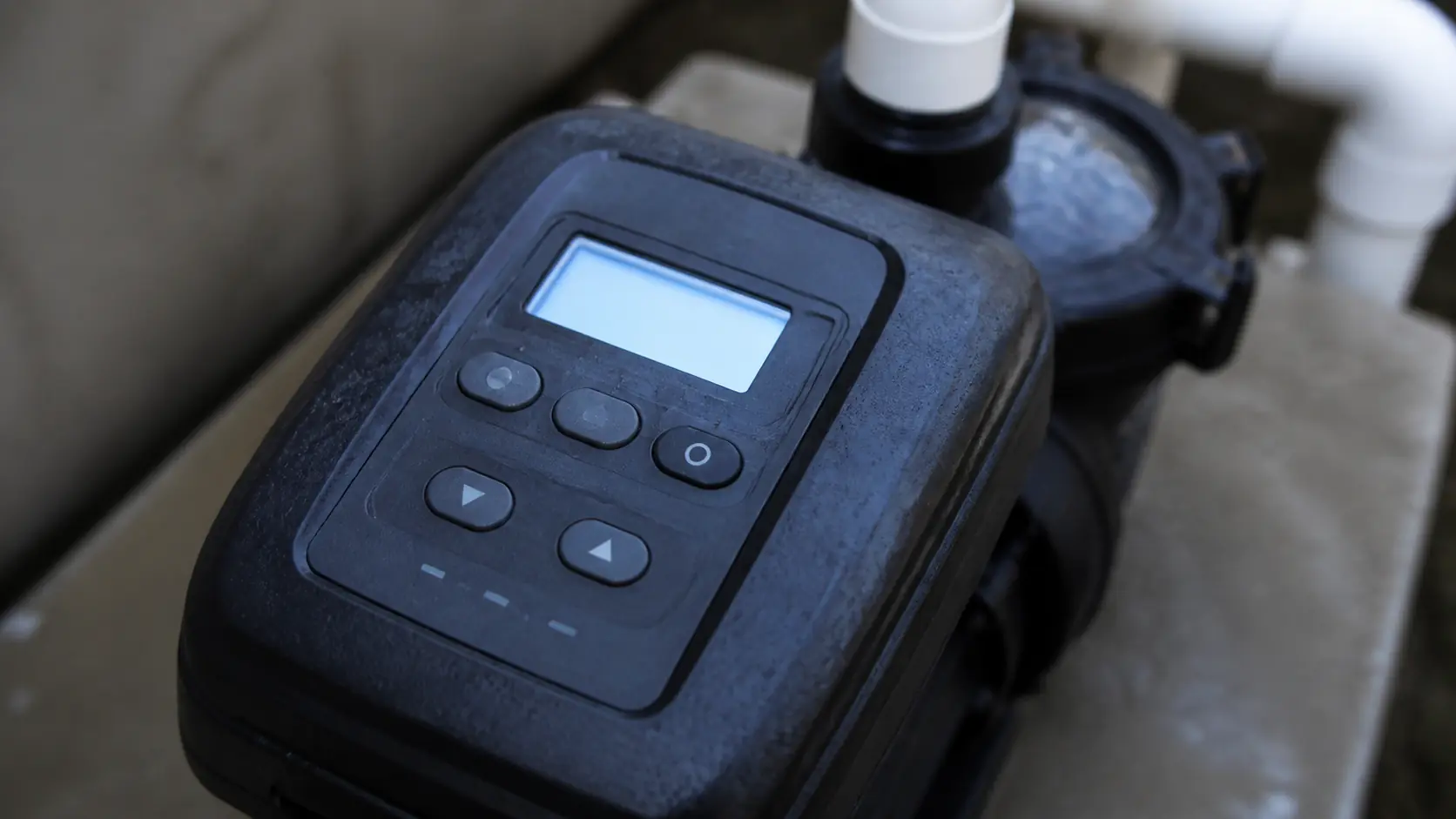
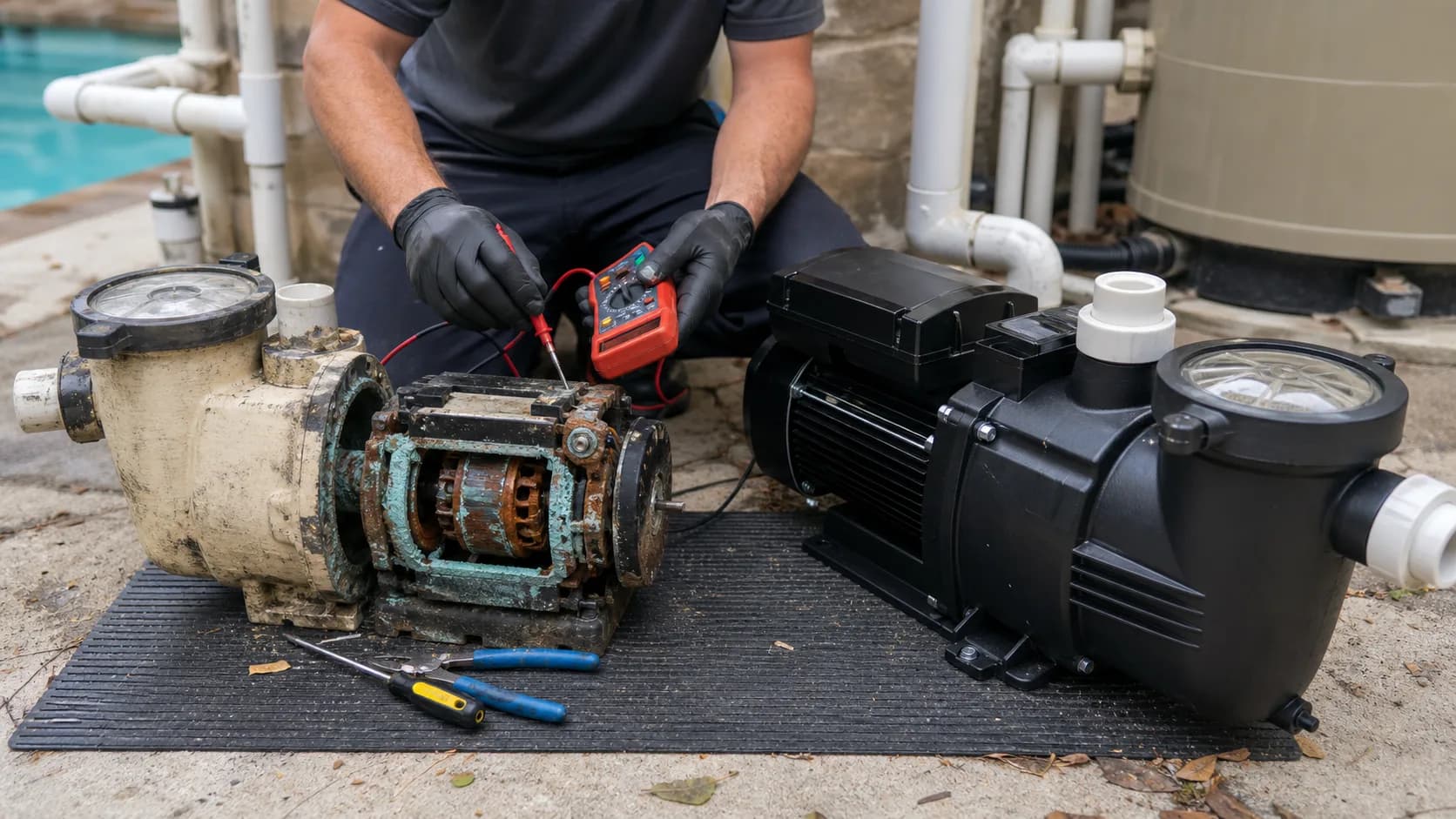
Your pump is making a noise, or it stopped priming, or it just died. The question is whether to fix it or replace it, and the honest answer has changed recently for a reason most pool owners have never heard of: federal efficiency rules now decide part of it for you. Here is how to think it through without getting talked into a bigger purchase than you need.
First, make sure it is actually the pump
A surprising share of the pump calls we get aren’t pump failures. Before anyone quotes you a motor, rule these out, because several of them cost nothing:
- A losing-prime problem is usually an air leak, not a dying pump. The lid o-ring dries out and shrinks, the lid isn’t seated, or a drain plug has backed off. If you see air swirling in the pump basket while it runs, you have a suction-side air leak. That’s a gasket, not a motor.
- Weak flow is usually a blockage. Full skimmer and pump baskets, or a dirty filter, will starve the pump. Check and clean both before assuming anything is wrong with the equipment. If your filter pressure is high, the filter is the problem.
- A pump that hums but won’t turn is very often a failed start capacitor, which is a real repair rather than a replacement.
- A pump that trips the breaker immediately is an electrical fault. Stop, leave the breaker off, and get an electrician or a qualified technician. Do not keep resetting it.
The rule that quietly changed the math
The U.S. Department of Energy sets efficiency standards for what it calls dedicated-purpose pool pump motors. Most pool blogs still cite the 2021 date, which applied to the earlier pump standard. The current motor rule is the final rule published 28 September 2023, and its schedule is the one that affects a replacement decision today.
| Motor total horsepower (THP) | Requirement | Compliance date |
|---|---|---|
| Under 0.5 THP | 69% full-load efficiency, no speed requirement | 29 September 2025 |
| 0.5 up to 1.15 THP | Variable-speed control | 28 September 2027 |
| 1.15 up to 5 THP | Variable-speed control | 29 September 2025 |
What that means in practice: if your pump is in the common residential range at or above 1.15 THP, the variable-speed requirement is already in force. If it is a smaller motor between 0.5 and 1.15 THP, you have until September 2027 before the same requirement applies. Either way, the era of dropping in a cheap single-speed replacement is ending, and for the larger sizes it has already ended.
This is a standard on what can be manufactured, not a pool police
Nobody is going to make you replace a working pump. These standards govern what manufacturers may produce and ship. The practical effect on you is narrower and simpler: when your pump does die, the like-for-like single-speed swap you were picturing may not be available, and the replacement will likely be variable-speed. That’s worth knowing before you’re standing over a dead pump in July. What that means for run time and for the savings a variable-speed pump actually delivers here is in the variable speed pump guide.
One thing worth checking while you are at the pad: what the pump is being asked to do. A suction-side pool cleaner forces the pump to run at a much higher speed than the pool itself needs, which shortens the motor’s life and eats the savings a variable-speed pump was bought for. The three cleaner types and what each costs the pad are compared in robotic, suction, or pressure cleaners.
How to read your motor nameplate, because HP isn’t THP
The federal thresholds turn on total horsepower, and that isn’t the number printed largest on your pump. The sticker on the side of a motor advertises nameplate horsepower. The figure the standard cares about is total horsepower, which is nameplate horsepower multiplied by the service factor, and the service factor is printed on the same plate in much smaller type, usually as SF or S.F.
The gap between the two is larger than most owners expect. A motor stamped 1.5 HP with a service factor of 1.65 is 2.475 THP, which puts it well inside the group already subject to the variable-speed requirement. Meanwhile a 1.0 HP motor with a 1.1 service factor is 1.1 THP and still sits in the group with time left on the clock. Two pumps that look almost identical on the shelf can therefore land on opposite sides of the rule.
Do this before you call anyone
Kill the breaker, then photograph the motor nameplate, the whole plate, not just the horsepower. It carries the model number, the horsepower, the service factor, the voltage, and the full-load amps. Sending that one photo turns a guessing conversation into a specific one, and it’s the single most useful thing a homeowner can do before getting a quote on a pump.
What the noise is telling you
Pumps announce most of their failures before they finish them. The sound is diagnostic, and it narrows the repair-or-replace question considerably.
| What you hear | Usual cause | Repair or replace |
|---|---|---|
| Loud hum, motor won’t spin | Failed start capacitor | Repair, and an inexpensive one |
| Rising screech or grinding that got worse over weeks | Motor bearings | Repairable, but on an aging pump it buys time rather than solving anything |
| Rattling or gravelly noise that changes with speed | Debris in the impeller | Often free to fix once you can reach it |
| Gurgling or sucking, air visible in the basket | Suction-side air leak | Repair. Usually a lid o-ring or a drain plug |
| Vibration and a hot motor housing | Failing bearings or a motor running against restriction | Shut it down and diagnose before it becomes a replacement |
| Nothing at all, breaker trips on reset | Electrical fault | Stop. Leave the breaker off and call a qualified technician |
The rule we apply when it’s borderline is a simple one: if the repair costs more than about half of an installed replacement, and the pump is already past the middle of its life, replace it. A whole variable-speed pump installed commonly runs $1,200 to $2,500 around here, and our DFW repair cost guide breaks down where the rest of the pad falls.
Repair or replace: how we decide
Usually worth repairing
- Lid o-ring, drain plugs, gaskets. Consumables. Replace them and move on.
- Shaft seal. A pump dripping between the motor and the wet end usually needs a seal. Worth doing on a pump that is otherwise healthy, though on a very old motor the labor can approach the value of the unit.
- Start capacitor. Inexpensive, and a classic cause of the hum-but-no-spin symptom.
- Impeller clog. Free to fix if you can reach it. Debris jams the impeller vanes and flow collapses.
Usually worth replacing
- A cracked or warped housing. Pool plastics live outdoors in Texas sun and eventually go brittle. Patching a pressurized housing isn’t a real repair.
- A burned-out motor on an old single-speed pump. This is the common case. Once you’re buying a motor, the marginal cost of a modern variable-speed unit is often smaller than people expect, and it’s what the standards are steering the market toward anyway.
- A seized shaft, or bearings that have been screaming for a season. Bearings are technically replaceable; on an aging pump, replacing them buys you time, not a solution. If you are not sure the noise is bearings at all, what each pump noise means separates it from cavitation and debris before anybody prices a motor.
- Anything that has already been repaired twice. Three repairs on one pump is a replacement paid for in installments.
Why a variable-speed pump saves money
The physics is the whole argument, and it’s worth understanding rather than taking on faith. Flow through a pump scales roughly with speed, while the power it draws scales with roughly the cube of speed. Halving the speed therefore cuts power draw dramatically, and you simply run the pump longer to move the same total volume of water. You end up filtering more thoroughly for less electricity.
Running longer at lower speed also filters better. Water moving slowly through the media spends more time in contact with it, and the pool gets a gentler, more continuous turnover instead of a few hours of violent circulation.
We aren’t going to quote you a payback period, because the honest inputs vary too much: your electricity rate, your pool volume, your current pump size, your run schedule. Anyone who gives you a confident dollar figure without asking all four is guessing. What we’ll say is that the pump is typically the biggest electrical load in a residential pool equipment set, which is exactly why it is the piece where efficiency is worth paying for.
One practical wrinkle is worth raising before you commit to a motor-only repair. A pump is a motor bolted to a wet end, and the two age together. Putting a new motor on a wet end whose housing has spent a decade in Texas sun frequently means the seal plate cracks during reassembly, or the housing that was fine last week starts weeping a month later. On a pump that is truly old, the motor swap that looked like the cheap option becomes two visits and a replacement anyway. Ask whoever quotes you the motor what condition the wet end is in, and take a straight answer as a good sign.
If you do go variable-speed, the settings are the whole point
A variable-speed pump left running at full speed all day is an expensive single-speed pump. The savings come from the schedule: a long low-speed filtration period, with short bursts of higher speed for skimming, vacuuming, or running a spa jet or waterfall. We set the schedule when we install one and adjust it seasonally, because the right run time in February isn’t the right run time in August.
What to do right now
If your pump is dead or dying, the sequence is: kill the breaker, check the cheap causes first, and find out your motor’s total horsepower, which is printed on the motor nameplate. If the failure followed a freeze rather than arriving on its own, read freeze damage to pool equipment first, because the pump is often not the only thing that cracked. That number tells you which row of the table you’re in and therefore what your replacement options actually look like.
If you would rather not diagnose it yourself, that’s what our equipment inspection is for. We diagnose first and tell you the smaller fix before the bigger one, which is the whole test of whether a pool company is being straight with you. If you want the rest of that test, we wrote it down in the eleven questions to ask a pool company.