How to Protect Your Plano Pool From a Texas Freeze

Austin Andrews
Founder, True Texan Pools
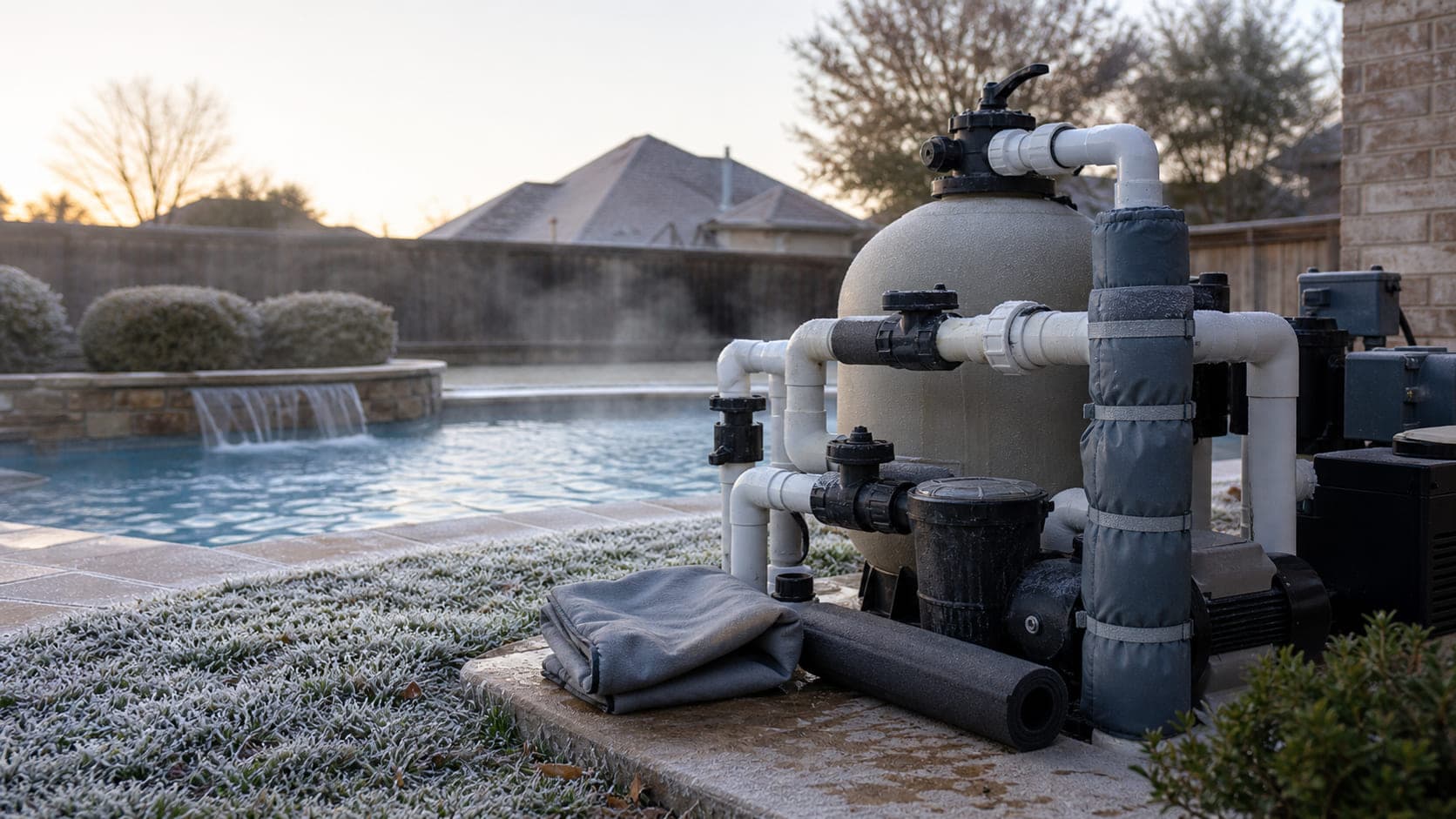
Texas pool owners don’t think about freezes for most of the year, and then a hard cold front drops out of the plains and the temperature falls into the teens overnight. After the February 2021 freeze, nobody in Plano needs reminding how much damage a few below-freezing hours can do. The National Weather Service in Fort Worth recorded 139 consecutive hours at or below freezing at DFW Airport during that event, from the evening of February 13 through midday on February 19. That is nearly six straight days, and it is why so much equipment failed. The good news is that protecting your pool through a freeze is straightforward once you know the plan. The key is that moving water does not freeze nearly as easily as still water.
Why freezes crack pool equipment
Water expands when it freezes. When water sitting still inside your pump, filter, plumbing, or valves turns to ice, it pushes outward with enough force to crack a pump housing, split a filter, or burst a pipe. The pool itself, with thousands of gallons of relatively warm water, almost never freezes solid in our climate. The vulnerable parts are the small volumes of water in the exposed equipment above ground, where the cold air reaches them directly.
That’s why the entire strategy comes down to one idea: keep the water moving so it can’t freeze where it would do damage.
| Conditions | Risk level | What to do |
|---|---|---|
| High 30s F overnight | Low, but this is where your equipment starts protecting itself | Confirm any built-in freeze guard is enabled. Pentair automation engages near 36 F, Hayward defaults to 38 F |
| Brief dip just below 32 F overnight | Low to moderate | Run the pump overnight |
| Below freezing for 12+ hours | Moderate to high | Run the pump continuously, monitor |
| Hard freeze, low 20s or teens for a day or more | High | Run pump nonstop, check equipment, be ready to act |
| Hard freeze plus a power outage | Severe | Equipment is exposed; relieve pressure and seek help |
Before the freeze: get ready
North Texas usually gives you a day or two of warning before a hard front arrives. Use it.
- Confirm your pump will run continuously. If you run on a timer, set it to run 24 hours through the freeze event, or switch it to manual on. The pump shutting off in the middle of the night is the classic failure.
- Clear leaves and debris from the skimmer and pump baskets. Good flow matters more than ever when you’re relying on circulation.
- Make sure the water level is normal. Too low and the skimmer can suck air, which breaks circulation. Top off if needed before it gets cold.
- Open any freeze-protection features. Many newer systems have a built-in freeze guard that kicks the pump on automatically when it gets cold. Know whether yours has one and that it is enabled.
- Insulate exposed equipment if you can. Wrapping the pump and exposed pipes with towels, blankets, or pipe insulation buys you margin, especially if the power flickers.
Run features that move water through your plumbing
If you have a spa, waterfall, or spillover, running it during the freeze keeps water moving through those lines too. Any plumbing with still water in it is a candidate to freeze. The more of your system has water actively circulating, the safer you’re.
The freeze guard problem nobody explains
Most homeowners assume a freeze guard means the pool is handled. It’s more limited than that, and the limits are worth understanding before the front arrives rather than after. Start by working out which of three setups you actually have, because they behave completely differently.
| Your setup | What happens when it gets cold | What you have to do |
|---|---|---|
| Mechanical time clock | Nothing. It runs the hours its pins are set to and stops | Set it to run continuously yourself, by hand, before the freeze |
| Automation panel with freeze protection | Overrides the schedule and runs the pump below its setpoint, near 36 F on Pentair, 38 F by default on Hayward | Confirm it is enabled and the setpoint is sane, then set your valves |
| Variable-speed pump with a freeze mode | Starts the pump at a preset speed, which may be lower than normal circulation | Check the programmed speed actually moves water through everything |
Four traps sit inside that table. The first is the biggest: freeze protection is a feature of powered equipment. It does nothing during an outage, which is the exact scenario that broke so much equipment in 2021. Anyone treating a freeze guard as insurance against a Texas grid event has misread what it is.
The second is valve position. Freeze protection circulates water through whatever path your valves are currently set to. If a three-way valve is turned to pool only, the spa plumbing, the spillover line, and the waterfall feed all sit full of still water while the pump hums away thinking it has done its job. Raised spas and sheer descents are usually the most exposed plumbing on the property, which makes this an expensive thing to get wrong.
The third is speed. A variable-speed pump in freeze mode runs at whatever RPM it was programmed to, and a low, energy-saving preset can be enough to satisfy the pump without being enough to keep water moving through a long run of exposed pipe. If you have a variable-speed pump, find out what speed its freeze mode uses before you need it.
The fourth is where the sensor lives. Freeze protection triggers off an air temperature sensor, and a sensor mounted in a sheltered spot, in direct afternoon sun, or inside a warm equipment enclosure will read several degrees higher than the pipes it is meant to be protecting. That gap is why the manufacturers set their defaults in the high 30s rather than at 32 in the first place.
The heater is the expensive one
If your pad has a gas heater, it deserves separate attention. A heat exchanger full of still water that freezes is the single costliest failure on the pad, and unlike a pump housing it isn’t a modest part swap. Some heaters have their own internal freeze protection, but as with everything else on this list, it depends on the unit having power. Before a hard freeze, know where the heater drain plugs are. During an extended outage, they come out along with the pump and filter plugs.
Salt systems have a different cold-weather quirk: most chlorine generators reduce or stop output once water temperature drops into the low to mid 50s, so a salt pool in a cold snap is effectively unsanitized until it warms back up. We cover how to handle that in running a pool through the winter.
During the freeze: keep it moving
Once the temperature is below freezing, the rule is simple: don’t turn the pump off. Let it run continuously, day and night, until temperatures climb back above 32 degrees and stay there. Moving water in the pipes and equipment resists freezing far better than still water, so as long as the system keeps circulating, you’re in good shape.
Check on the equipment periodically through the cold snap. You want to confirm the pump is still running and water is still flowing. If you see flow stop, that’s the moment to act rather than wait.
A power outage is the real emergency
The dangerous scenario is a hard freeze combined with a power outage, exactly what happened across Texas in 2021. With no power, your pump stops, water goes still, and the equipment is exposed. If that happens and you can’t restore power quickly, the safest move is to relieve pressure by opening the drain plugs on the pump, filter, and heater so any expanding ice has somewhere to go instead of cracking the housing. Switch the pump breaker off too, so it doesn’t kick back on and run dry when power returns. If you aren’t sure how, call us. We would rather walk you through it than see you replace a pump.
After the freeze: check for damage
Once it warms back up and any ice has thawed, do a walk-around before you assume everything is fine:
- Look for leaks around the pump, filter, valves, and visible plumbing. A hairline crack from freezing often shows up as a drip or a puddle once the system is running normally again.
- Check the pump basket and lid for cracks, and watch that the pump primes and holds pressure.
- Watch your water level over the next few days. A slow, unexplained drop can mean a freeze-cracked line.
- Listen and look for odd behavior from the equipment, such as new noises, low flow, or pressure that won’t build.
Catching a small freeze crack early can mean a simple part replacement instead of a flooded equipment pad and a much bigger repair bill. If the walk-around turns up something, our guide to freeze damage covers the restart sequence, what each repair runs around here, and the point at which to stop and call.
Do you need to winterize a pool in Plano?
Not in the way northern states do. In cold climates, pools are fully drained down, blown out, and closed for months. In DFW, our winters are mild with short freeze events, so you keep the pool full and running year-round and simply protect the equipment when a freeze comes through. In fact, draining a pool in our expansive clay soil can do real harm, since an empty pool can shift or pop out of the ground. The water belongs in the pool.
What does help over winter is keeping up on basic chemistry and circulation, even at a reduced level. A pool that goes into a freeze already balanced and clean comes out the other side in much better shape. If you would rather not stand outside at midnight checking your pump in an ice storm, this is one of the things a service plan is for. We keep an eye on freeze events and make sure your system is set up to ride them out.
Going into a cold snap unsure about your setup?
If you aren’t confident your pump, timer, or freeze guard is ready for the next hard front, reach out. An equipment inspection ahead of time means you aren’t figuring it out at 11 PM when the temperature is dropping. Start with our contact form or give us a call.
Frequently Asked Questions
Should I run my pool pump during a freeze in Texas?
Yes. Moving water is much harder to freeze than still water, so the standard guidance during a hard freeze is to run your pump continuously until temperatures climb back above freezing. The danger comes when a pump shuts off and water sits still inside the equipment and pipes.
At what temperature does pool equipment freeze?
Earlier than freezing. Manufacturers set their own freeze protection to engage above 32 degrees Fahrenheit: Pentair activates near 36 and Hayward defaults to 38. Treat the high 30s as the point to start paying attention. Real damage shows up in the low 20s and teens, and exposed equipment freezes well before the pool water does.
Do I need to drain my pool for winter in Plano?
No. Pools in the DFW area aren’t fully drained and closed the way pools are in colder climates. You keep the water in and protect the equipment from short freeze events instead. Draining a pool in our soil can actually damage it.
Does a pool freeze guard work during a power outage?
No, and this is the most common misunderstanding about it. Freeze protection is a feature of powered automation or a powered pump, so it does nothing once the power is out. That combination, a hard freeze plus an outage, is what destroyed so much Texas pool equipment in February 2021.
Do I need to turn my pool valves before a freeze?
Yes, and people skip it. Freeze protection only circulates water through the path your valves are currently set to, so a raised spa, spillover, or waterfall line sits full of still water if the valves are turned to pool only. Those lines are usually the most exposed plumbing you have.
Work it out for your pool
All toolsFree, instant, and no email needed to see the answer.
Ready to stop thinking about your pool?
True Texan Pools keeps your water swim-ready all year, across Plano and the rest of DFW. Clear pricing, a photo report after every visit, and Austin doing every job himself.
Keep reading
What Changes in Your Pool Above 100 Degrees
A pool that has been effortless since April starts misbehaving in the second week of August, and the owner has changed nothing. That’s exactly the point.
Opening and Closing a Pool in North Texas (Most Never Close)
The close-in-September habit doesn’t survive North Texas. Our winters are mild but punctuated by hard freezes, and the pool you walk away from in November is the one you pay to recover in April.