A pool heater that won’t fire is frustrating, and it’s also the one piece of pool equipment where guessing can genuinely hurt you. Gas, high voltage, and combustion are all involved. So this guide splits cleanly into two halves: the things you can safely check yourself in ten minutes, and the things where the correct action is to stop and call someone licensed.
Stop reading and act if you smell gas
If you smell gas near the equipment pad: don’t operate any switch, don’t try to light anything, leave the area, and call your gas utility from a safe distance. This isn’t a troubleshooting scenario. Nothing below applies until that is resolved by a professional.
Start here: it’s probably flow
Every pool heater has a flow-related safety interlock, usually a pressure switch. Its job is to confirm that enough water is moving through the heat exchanger before allowing the burner to fire. Without that, the exchanger would heat with little or no water in it and destroy itself.
So a heater that won’t fire is very often a heater correctly protecting itself from a flow problem somewhere else in the system. Check, in this order:
- Skimmer and pump baskets. Full baskets starve the pump. This is free to check and fixes a real share of no-heat calls.
- Filter pressure. A filter well past its cleaning point chokes flow. Compare against your clean baseline; if it’s 8 to 10 psi above, clean it and try again. Our filter guide covers how to establish that baseline.
- Valve positions. Someone may have left a valve turned after vacuuming or backwashing, diverting flow away from the heater.
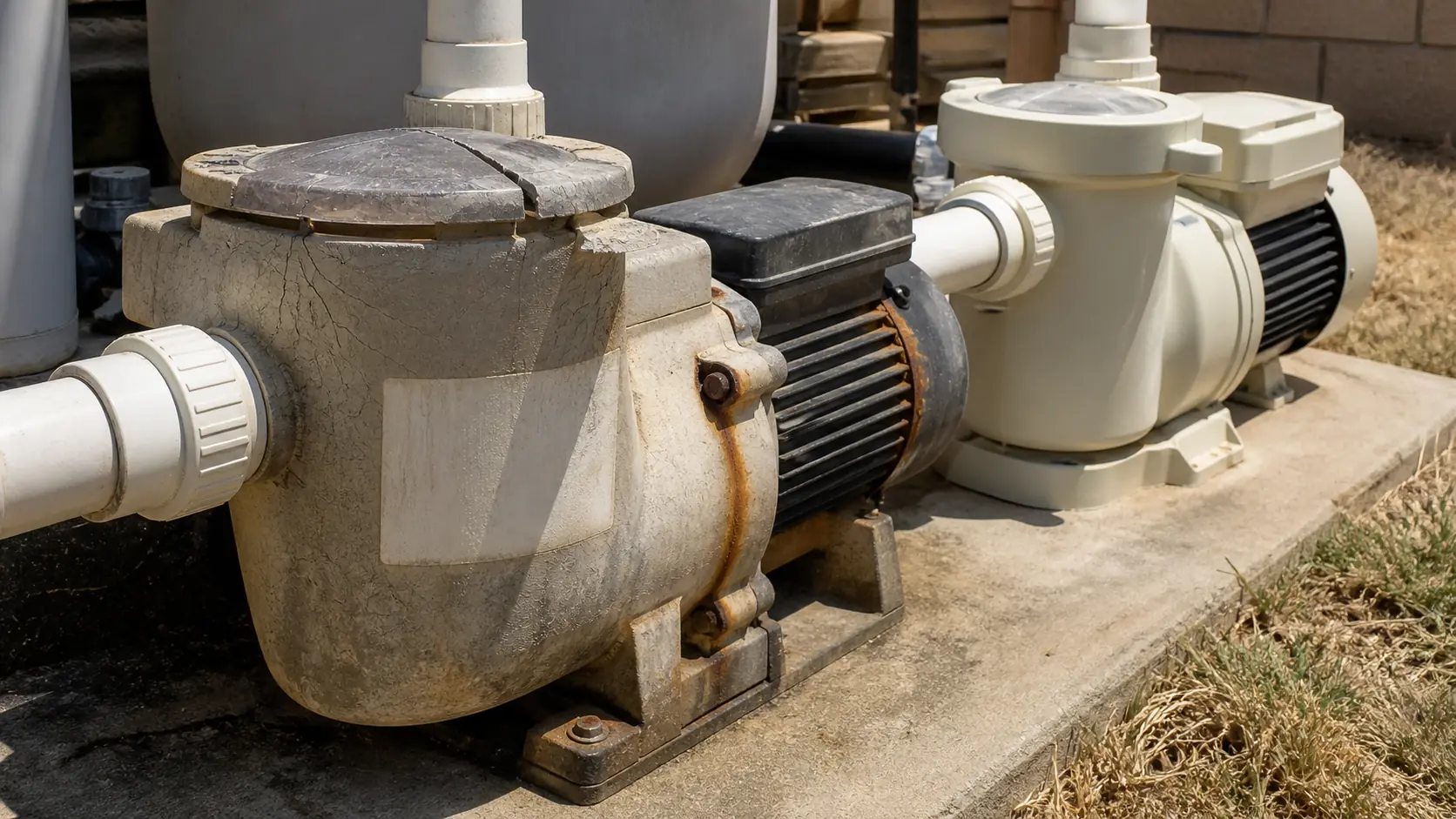
- Pump speed.This one catches a lot of people with newer equipment. A variable-speed pump running at a low, efficient filtration speed may not move enough water to satisfy the heater’s pressure switch. Many systems are programmed to step the pump up when heating is called for; if that programming is wrong or was lost after a power outage, the heater will simply never fire. Try running the pump at high speed and see if the heater lights.
Is it broken, or just slower than you expected?
A real share of no-heat calls turn out to be heaters working exactly as designed while the owner expects something the equipment was never sized to do. The math is simple enough to run yourself, and it settles the question in about a minute.
One BTU raises one pound of water one degree, and a gallon of water weighs 8.34 pounds. So a 15,000-gallon pool is about 125,000 pounds of water, and raising it one degree takes roughly 125,000 BTUs. A 400,000 BTU gas heater running at around 84 percent thermal efficiency delivers something like 336,000 BTUs an hour into the water, which works out to about 2.7 degrees per hour before losses. Count the losses from an uncovered surface on a breezy night and one and a half to two degrees an hour is a realistic figure.
| Equipment | Output into the water | Degrees per hour, before losses |
|---|---|---|
| 250,000 BTU gas heater | About 210,000 BTU/hr | About 1.7 |
| 400,000 BTU gas heater | About 336,000 BTU/hr | About 2.7 |
| 125,000 BTU heat pump, mild day | About 125,000 BTU/hr | About 1.0 |
| 125,000 BTU heat pump, cold morning | Substantially less | Well under 1.0 |
Two things fall out of that table. First, taking a cool pool from 68 to 88 degrees is not an afternoon job on any residential equipment; it’s most of a day on a strong gas heater and potentially several days on a heat pump. Second, if your heater is producing somewhere near its expected rate, it isn’t broken, and no amount of service will make it faster. What will help is a cover, which addresses the loss side of the equation rather than the input side.
Run this before you call anyone. A heater climbing two degrees an hour is healthy. A heater climbing a quarter of a degree an hour, or fired for an hour with no measurable change at all, is a genuine fault worth diagnosing.
What the symptom pattern tells you
No-heat is rarely the actual complaint. The pattern of the failure narrows the cause considerably, and knowing which pattern you have makes any call you place far more productive.
| What you observe | Where it usually points |
|---|---|
| Fires, runs a few minutes, shuts off, tries again | Flow or overheat cycling. Filter, baskets, valves, or pump speed, in that order |
| Never fires at all, no error code, no sound | Power, gas supply, set point, or the heater not being in a mode that calls for heat |
| Fires and runs steadily, water barely warms | Usually correct behavior for the equipment size. Run the math above before assuming a fault |
| Heats the spa fine but not the pool | Almost always valve position or automation programming, not the heater |
| Worked yesterday, dead today, after a storm or outage | Lost programming or a tripped breaker. Check the pump speed schedule before anything else |
| Soot, scorching, or an odd flame | Stop. Shut it down and call a professional |
The other safe checks
- Is it actually calling for heat? Set point above current water temperature, heater in the right mode, and if you have pool and spa set points, confirm you’re adjusting the one you think you are.
- Power and gas supply. Check the breaker for the heater, and check that the gas supply valve is open. If other gas appliances in the house are also misbehaving, the problem is upstream of your pool.
- Read the error code. Modern heaters display one, and it’s the most useful piece of information available. Look it up in your manual. If you call us, that code is the first thing we’ll ask for, and having it can turn a diagnostic visit into a single-trip repair.
- Look at the airflow.Leaves, nesting material, or debris blocking the heater’s vents or exhaust will prevent firing. Clearing debris from around the outside of the unit is safe. Opening it up isn’t.
Where to stop
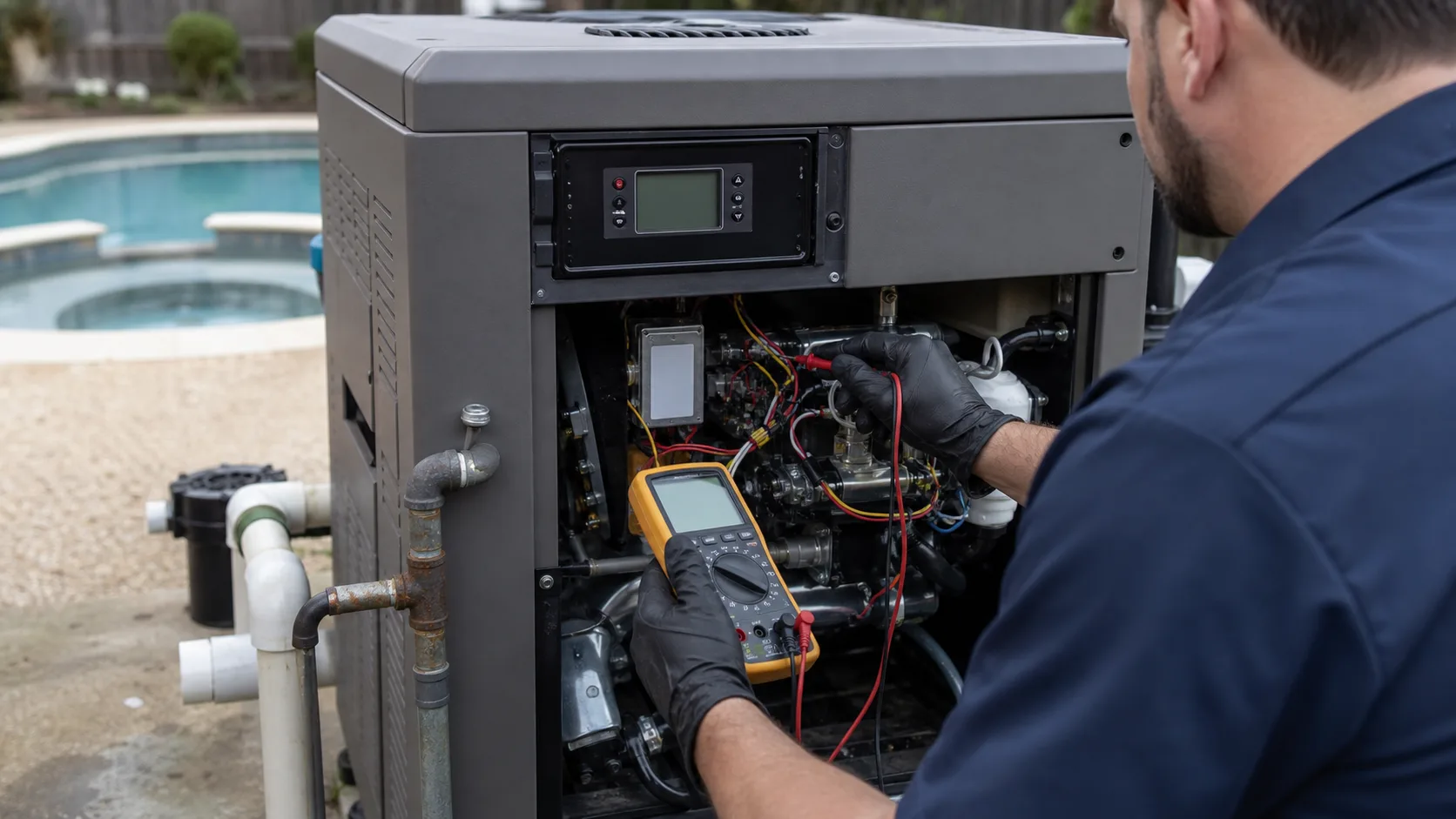
The following aren’t DIY, regardless of what a video suggests. Gas appliances fail dangerously when they’re worked on by people without the training and tools to test them properly.
This is a licensing line as well as a safety one. Under Texas Department of Licensing and Regulation rules, installing or replacing pool heaters and other pool-related electrical devices requires at minimum a Residential Appliance Installer License, and work needing a new or upgraded circuit requires a licensed electrical contractor. Anyone offering to do it without that is telling you something useful about the rest of their work.
| Symptom or task | Who should handle it |
|---|---|
| Full baskets, dirty filter, wrong valve position, pump speed too low | You, safely |
| Reading the error code, checking breaker and gas valve, clearing exterior debris | You, safely |
| Any gas smell | Gas utility, immediately |
| Ignitor, burner, gas valve, or flame sensor | Licensed professional |
| Internal wiring, control board, or high-voltage components | Licensed professional |
| Corroded or leaking heat exchanger | Licensed professional |
| Soot, scorching, or an unusual flame appearance | Shut it down, call a professional |
Why scale shows up here too
A heat exchanger is a place where water is heated across metal surfaces, which is exactly the condition that encourages calcium to come out of solution. In our area, where NTMWD describes its treated water as moderately hard and evaporation concentrates that calcium further with every top-off, an unbalanced pool will scale the inside of a heat exchanger over time. Scale insulates, so the heater works harder for less result, and eventually the restriction damages the unit.
This is one of the quieter reasons that keeping calcium and pH in range is worth doing properly rather than approximately. The chemistry that protects your tile is protecting the most expensive component on your pad at the same time. The ranges are in our water chemistry guide.
The failure runs in the other direction too, and it has a visible tell. Water held aggressive for weeks, which is a common outcome of chasing pH on a salt pool, dissolves the copper heat exchanger itself. The first thing most owners notice is not a heater fault but a blue-green stain spreading under the returns, and if that is what you are looking at, start with metal stains in pool water, because the heater is the source rather than the victim.
Gas heater or heat pump, in a North Texas winter
These fail differently and it’s worth knowing which you own.
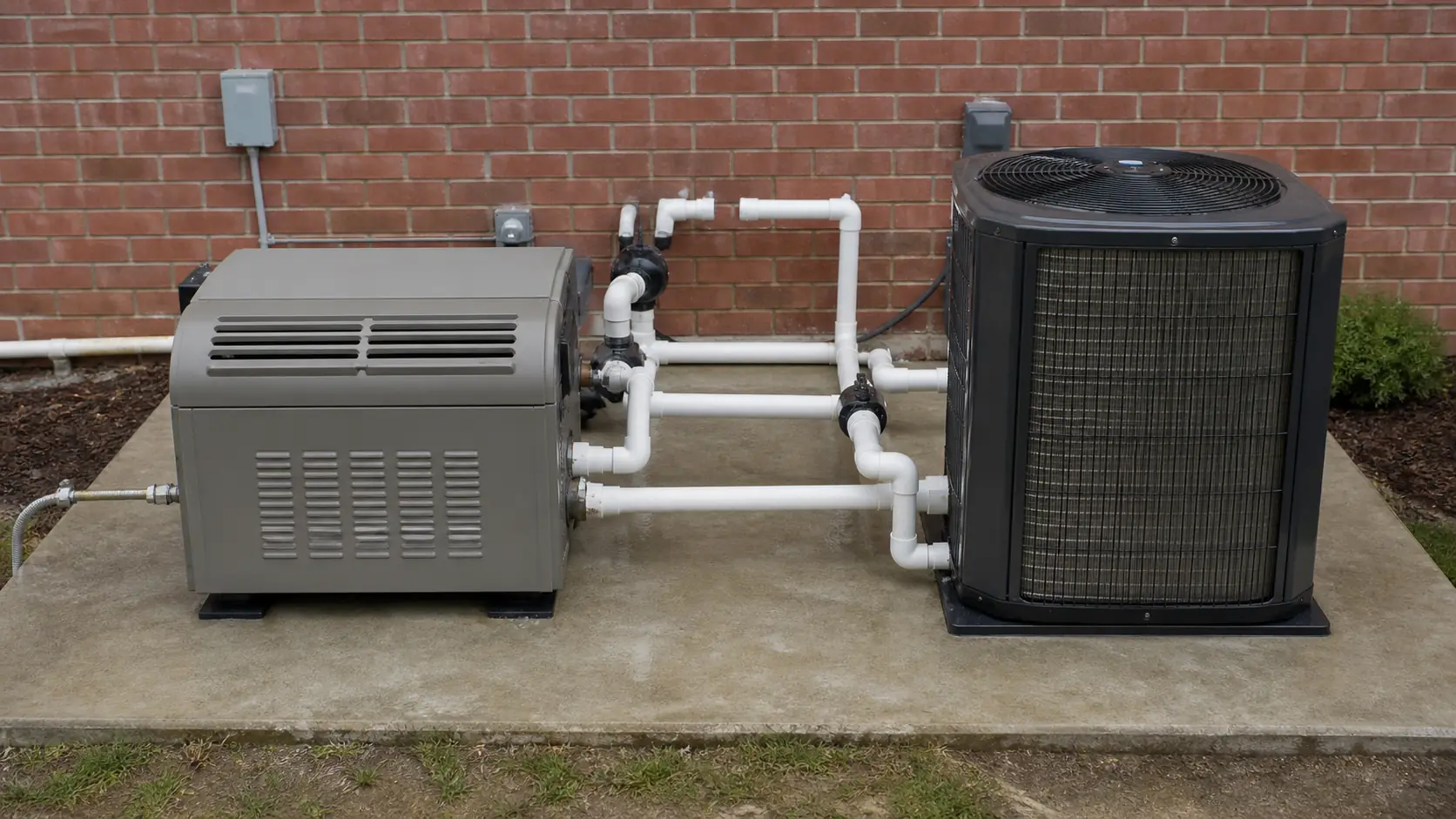
- Gas heaters burn fuel to make heat, so they work regardless of how cold it is outside and they heat quickly. They cost more to run per hour, which makes them a good fit for someone who heats the pool occasionally or heats a spa on demand.
- Heat pumpsmove heat from the air into the water rather than generating it. That’s far more efficient, but it depends on there being usable heat in the outside air. As air temperature drops their output falls and their run times get much longer, and below a certain point they effectively stop being useful. So the common complaint that a heat pump “stopped working in winter” is often not a fault at all, it’s the technology behaving as designed on a cold Texas morning.
The North Texas version of this problem has a particular shape. Our genuine shoulder seasons, the stretches in March, April, October, and November when the water is a few degrees too cool to enjoy but the air is pleasant, are precisely when a heat pump is working hardest for the least return, because it’s pulling from cool morning air. On a damp morning in the 40s a heat pump may also stop periodically to defrost its coil, which owners reasonably read as the unit cutting out. It isn’t. If you’re choosing between the two, the trade-offs are laid out in gas heater versus heat pump in North Texas.
Sizing is the other quiet culprit. Pools with an attached spa are frequently fitted with a heater chosen for the spa volume and the builder’s budget rather than for the pool, which heats the spa in half an hour and the pool over two days. That isn’t a fault you can service your way out of, and it’s worth knowing before you pay anyone to look for one.
A cover does more for heat retention than most upgrades
Evaporation is the largest single route by which a pool loses heat, and it runs all night. A cover reduces that directly. If you’re heating regularly and not covering the pool, you’re paying to warm the air above it, and no heater upgrade fixes that as cheaply as a cover does.
The other thing worth knowing before you call anybody is where each of these outcomes sits on price, because they are not close together. A flow problem is usually free and takes an afternoon. A sensor or pressure switch at the end of its life on a sound heater is a part and an hour. A corroded heat exchanger lands close enough to the price of a new heater that the age of the unit decides it for you. What pool repairs cost in DFW sets out what drives each of those, and how long equipment lasts here gives a heater a service life you can hold a replacement quote against.
If you would rather someone else sort it out
Our equipment inspection covers diagnosing heater problems, and our approach is the one we would want as a customer: find out what is actually wrong, tell you the cheaper fix before the expensive one, and be honest when something is beyond what we should touch. If your heater needs gas work, we’ll tell you that plainly rather than improvising, and we would rather send you to the right trade than guess with a combustion appliance in your backyard.