Should Your Pool Run All Winter in North Texas?

Austin Andrews
Founder, True Texan Pools
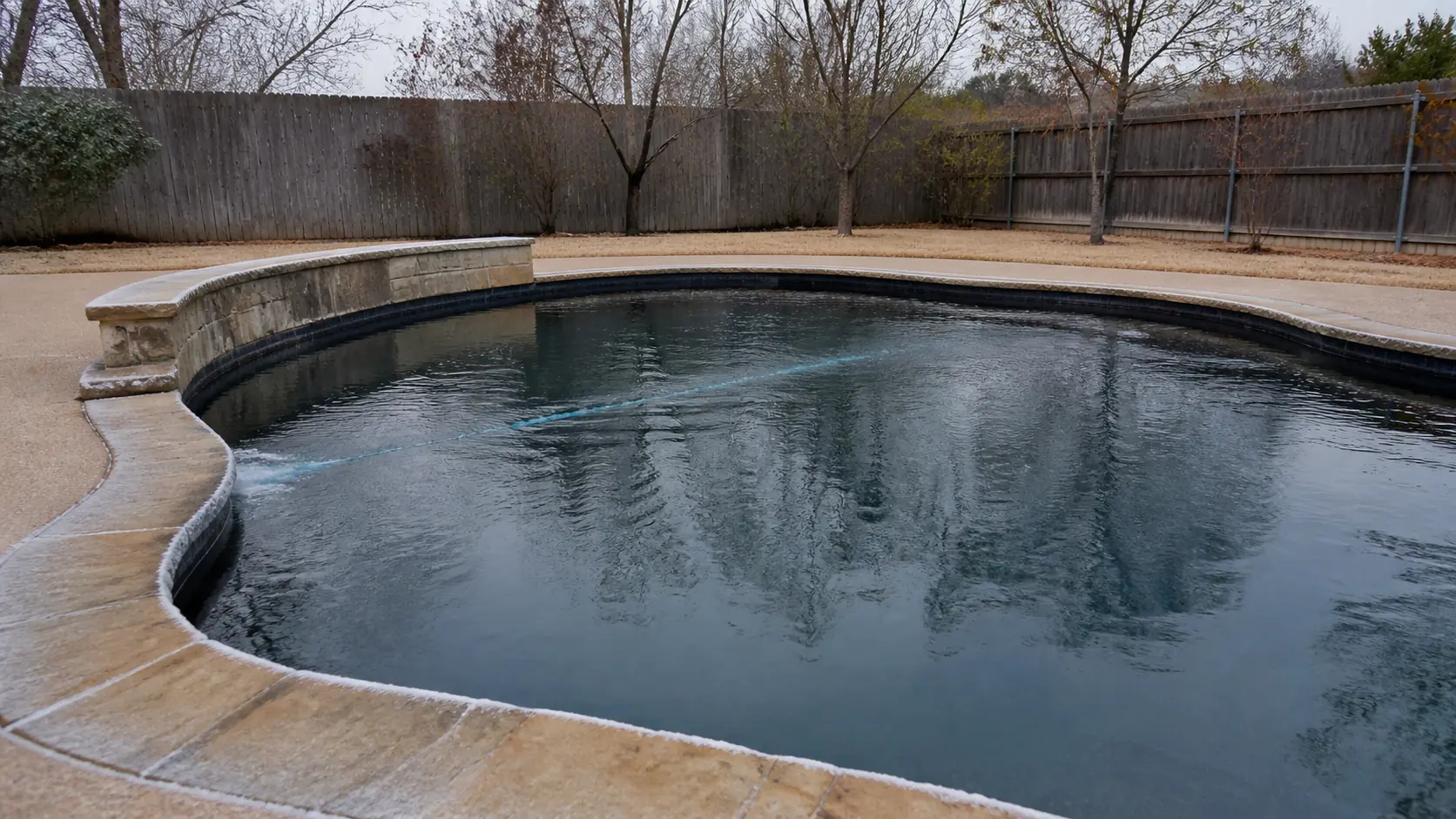
Yes, but not on the summer schedule, and the reason has almost nothing to do with keeping the water clear. In North Texas the winter pump schedule is a freeze insurance policy first and a circulation schedule second. Here is how many hours a pool here actually needs from December through February, what it costs to run them, and the one night of the year when the schedule stops mattering and continuous running takes over.
This question gets asked every December, usually with a utility bill in hand, and it is a reasonable question. Nobody swims in January. The pool looks the same whether the pump ran or not. In most of the country the honest answer would be to shut it down, and in most of the country that is exactly what happens: the pool is closed, blown out, plugged, and covered until spring.
We do not do that here, and the reason we do not is worth understanding before deciding how to run yours.
Why North Texas pools are not closed for winter
Closing a pool properly means removing the water from every line, plugging every fitting, and lowering the pool below the skimmer and returns, so that there is nothing left to freeze. That is a full day of work, it needs to be reversed in spring, and it makes sense in a climate with four unbroken months below freezing.
Our winter is not that. We average plenty of days in the 50s and 60s in January, punctuated by a handful of nights in the teens. A pool that was fully closed here would spend most of the winter shut down for weather that never arrived, and would still be sitting still on the night that actually mattered unless someone had done the work perfectly. So the local practice is the opposite: leave the pool running, keep the water in the pipes moving, and treat the cold nights as events rather than as a season.
Moving water is the whole defense
Water freezes from the outside of a pipe inward and needs still conditions to do it. A steady flow, even a slow one, keeps warmer water from the body of the pool cycling through the exposed above-ground plumbing all night. This is why the standard advice during a hard freeze is to run the pump continuously rather than to run it harder, and why turning the pump off to save money during a cold snap is the most expensive economy in pool ownership.
How many hours a winter pool actually needs
Circulation requirement scales with what the water is doing biologically, and in winter the water is barely doing anything. Below about 60 degrees algae is effectively dormant, chlorine is consumed slowly, and sunlight is weaker and shorter. The pool needs enough turnover to distribute chemicals, move water through the filter, and keep the surface from stagnating.
| Season | Water temperature | Daily run time | Speed |
|---|---|---|---|
| Deep winter (Dec to Feb) | Below 60 | 4 to 6 hours | Low |
| Spring (Mar to Apr) | 60 to 75 | 6 to 10 hours | Low to medium |
| Summer (May to Sep) | Above 80 | One full turnover, often 10 to 14 at low speed | Low, longer |
| Autumn (Oct to Nov) | 60 to 75 | 6 to 10 hours, more during leaf drop | Low to medium |
| A hard freeze, any month | Air below 32 | Continuous | Low is fine, do not stop |
Four to six hours is the number most North Texas pools sit at through January. The exception is a pool with a spa, a heavily shaded pool full of winter leaf drop, or a pool with a salt system, which brings its own wrinkle covered below.
Run those hours in the warmest part of the day, roughly late morning to mid afternoon. Daytime circulation in winter costs you nothing extra and it puts the flow where it is least likely to be needed for freeze protection, leaving the automatic controls to handle the night. For how to calculate a real turnover rather than guessing at hours, our pump run time guide has the arithmetic.
What it costs to run through the winter
This is the part that decides the argument for most people, and the answer depends almost entirely on which pump you have.
On a variable speed pump
Power draw falls with roughly the cube of pump speed, so a pump turning at half speed uses somewhere near an eighth of the power. Five hours a day at a low winter speed is a small number on a North Texas electricity plan, and it is comfortably less than the deductible on any repair it prevents. There is no serious financial argument for shutting a variable speed pump down over winter.
On an older single speed pump
The calculation is less comfortable, because a single speed pump has one setting and it is expensive. Even so, five hours a day for three months is a modest total, and one split pipe or one cracked pump housing costs more than several winters of it. If the winter bill is what is driving the question, the honest fix is the pump rather than the schedule, and repair or replace covers when that upgrade pays for itself.
Weight the schedule toward cheap hours, do not abandon daylight
Plenty of Texas electricity plans price overnight hours cheaply, and it is tempting to move the whole winter schedule into them. Two reasons not to go all the way. First, a salt cell produces less chlorine in cold water and none at all while the pump is off. Second, a pool that only ever circulates at 2am is a pool nobody sees running, which is how a failed pump goes unnoticed for a fortnight in January.
What still needs doing in the water
Not much, and that is the point. A winter pool is a low-maintenance pool, which is exactly why it is so easy to neglect past the point of recovery.
- Chlorine. Hold the low end of your range rather than the top. Cold water consumes very little, and a winter pool will often hold a residual for two or three weeks. Test every two weeks rather than weekly.
- pH and alkalinity. Check monthly. Cold water tends to drift, and pH drifting high in winter is what sets up scale on the tile come spring, particularly on our fill water. Our calcium scale guide covers why that band appears.
- Water level. The most important physical check of the winter. Keep it at mid-skimmer. A level that has dropped below the skimmer throat lets the pump pull air, and a pump that loses prime during a cold snap is a pump that is no longer protecting anything.
- Debris. Empty the baskets. Winter leaf and pecan drop is real here well into December, and a clogged basket restricts the flow you are relying on.
- Brushing. Every couple of weeks is plenty. It is the cheapest insurance against the algae that will otherwise be waiting in March.
The salt pool complication
Salt chlorine generators produce less chlorine as water cools, and most cells stop generating entirely somewhere around the mid 50s to protect themselves. That is a design feature rather than a fault, but it means a salt pool in a North Texas January is frequently making no chlorine at all while its owner assumes it is.
Two consequences. First, check free chlorine with a test kit rather than trusting the cell, and add liquid chlorine directly when it has fallen. Second, do not raise the cell output percentage to compensate, because it is not a percentage problem. Our salt water maintenance guide covers cold water cutoff and what winter does to cell life.
The night the schedule stops applying
Everything above is the routine. A hard freeze is not routine, and on those nights the answer changes from four to six hours to continuous, plus a set of physical steps at the pad. That is a job of its own and our Texas freeze protection guide covers it properly, including the case that catches Texans specifically: what to do when the power goes out and the automatic protection you were relying on stops existing.
The short version, so nobody is caught without it. When air temperatures are forecast below freezing, run the pump continuously through the event rather than on a timer. Open the valves that keep water moving through every line, including the spa and any water features. Leave the freeze protection setpoint alone rather than switching the system off overnight. And if the power fails, the pool stops being self-defending, and the plumbing needs draining by hand.
If you take one thing from this article
The pool that gets damaged in a North Texas freeze is almost never the pool that was running on a modest winter schedule. It is the pool somebody switched off in November to save money, or the pool whose water level dropped below the skimmer in December and lost prime without anybody noticing. Both are free to prevent and both cost a plumbing repair to get wrong.
Where we sit on it
We keep customer pools running year round on a reduced winter schedule, and winter visits exist mostly to check the things above: water level, prime, freeze settings, baskets, and a chemistry reading that has probably barely moved. It is genuinely lighter work than August and our rate does not change for it, which is the trade a level annual price makes in both directions.
If you would rather somebody else was watching the pad through January, weekly service is published with its pricing, and an equipment inspection before the first hard freeze is the cheapest thing on our list.
Frequently Asked Questions
Should I run my pool pump in winter in Texas?
Yes, on a reduced schedule. Four to six hours a day at a low speed is where most North Texas pools sit through January, run in the warmest part of the day. The reason is freeze protection rather than water quality: moving water is far harder to freeze than still water, and still water in above-ground plumbing is what splits pipe on our sudden cold nights.
Why are Texas pools not closed for winter like northern pools?
Because our winter is not sustained cold, it is mild days punctuated by a handful of nights in the teens. A fully closed pool here would spend most of the winter shut down for weather that never arrived, and would still be sitting still on the night that actually mattered unless the work had been done perfectly. So the local practice is to leave it running and treat cold nights as events rather than as a season.
How much does it cost to run a pool pump through winter?
On a variable speed pump, very little, because power draw falls with roughly the cube of speed, so five hours a day at a low winter speed is comfortably less than the deductible on any repair it prevents. On an older single-speed pump the number is larger but still modest across three months, and one split pipe costs more than several winters of it.
What pool maintenance is needed in a North Texas winter?
Less than you think, and none of it optional. Hold the low end of your chlorine range and test every two weeks rather than weekly, since cold water consumes very little. Check pH and alkalinity monthly. Keep the water level at mid-skimmer, which is the most important physical check of the winter. Empty the baskets, and brush every couple of weeks.
Why is my salt cell not making chlorine in winter?
Most cells stop generating in cold water, typically around the mid 50s, to protect themselves. That is a design feature rather than a fault, and it means a salt pool in a North Texas January is frequently making no chlorine while its owner assumes it is. Test with a kit and add liquid chlorine directly. Do not raise the output percentage, because it is not a percentage problem.
What should I do when a hard freeze is forecast?
Run the pump continuously through the event rather than on a timer, open the valves that keep water moving through every line including the spa and water features, and leave the freeze protection setpoint alone rather than switching the system off overnight. If the power fails, the pool stops being self-defending and the plumbing needs draining by hand.
Ready to stop thinking about your pool?
True Texan Pools keeps your water swim-ready year-round across Plano and all of DFW. Clear pricing, no contracts, and a photo report after every visit. Austin handles every job personally.
Keep reading
What Changes in Your Pool Above 100 Degrees
A pool that has been effortless since April starts misbehaving in the second week of August, and the owner has changed nothing. That is exactly the point.
Opening and Closing a Pool in North Texas (Most Never Close)
The close-in-September habit does not survive North Texas. Our winters are mild but punctuated by hard freezes, and the pool you walk away from in November is the one you pay to recover in April.