Ask ten people how long to run a pool pump and you’ll get “eight hours” nine times. That number is a leftover from an era when every pool had a single-speed pump, and it is the wrong question anyway. What your pool needs is a certain volume of water moved and a certain amount of sanitizer distributed. Hours are just how you buy that. Here is how to work out your own number, and why the answer changed when you installed a variable-speed pump.
What run time buys you
A pool pump is doing four separate jobs, and only one of them is obvious.
- Filtering. Water only passes through the filter while the pump runs. Everything suspended in your pool stays suspended the rest of the time.
- Distributing sanitizer. Chlorine that stays where you added it protects that corner of the pool and nowhere else. On a salt pool the connection is even more direct, because the cell only produces chlorine while water is flowing through it.
- Skimming. The surface is only being cleared while there’s suction at the skimmer, and the surface is where leaves, pollen, sunscreen, and dust arrive.
- Preventing stagnation. Algae establishes in still water. Circulation is not just how the treatment reaches the water, it’s part of the treatment.
This is why cutting run time to save money so often costs more. The pump is the cheapest part of the system to run and the most expensive to compensate for.
Turnover: the number that governs it
Turnover is the time it takes to circulate a volume of water equal to the whole pool through the filter. The working residential baseline is one turnover a day. Some pools with heavy use, heavy tree cover, or a stubborn algae history do better with more.
Two pieces of arithmetic get you there.
Step one: your pool volume
For a roughly rectangular pool, multiply length by width by average depth in feet, then by 7.5 to convert cubic feet to gallons. Average depth is the shallow-end depth plus the deep-end depth divided by two, which is close enough for this purpose on most pools.
A 15-by-30-foot pool that runs from 3 feet to 8 feet has an average depth of 5.5 feet, so 15 × 30 × 5.5 × 7.5 is about 18,600 gallons. Freeform and kidney shapes are estimates whatever you do; take the longest and widest dimensions and shade the result down by fifteen percent or so.
Step two: your pump flow rate
Turnover hours equals volume divided by flow rate in gallons per minute, divided by 60. For the pool above, a pump moving 45 gallons per minute delivers 2,700 gallons an hour, so a full turnover takes just under 7 hours.
The catch is that flow rate isn’t a fixed property of the pump. It’s the result of the pump curve meeting the resistance of your plumbing and, crucially, the current condition of your filter. A dirty filter cuts flow, which quietly stretches your turnover time without changing anything on the timer. That’s one of the better arguments for cleaning the filter on pressure rather than on the calendar, and the three filter types differ in how much warning that pressure gives you.
The cheap way to measure this properly
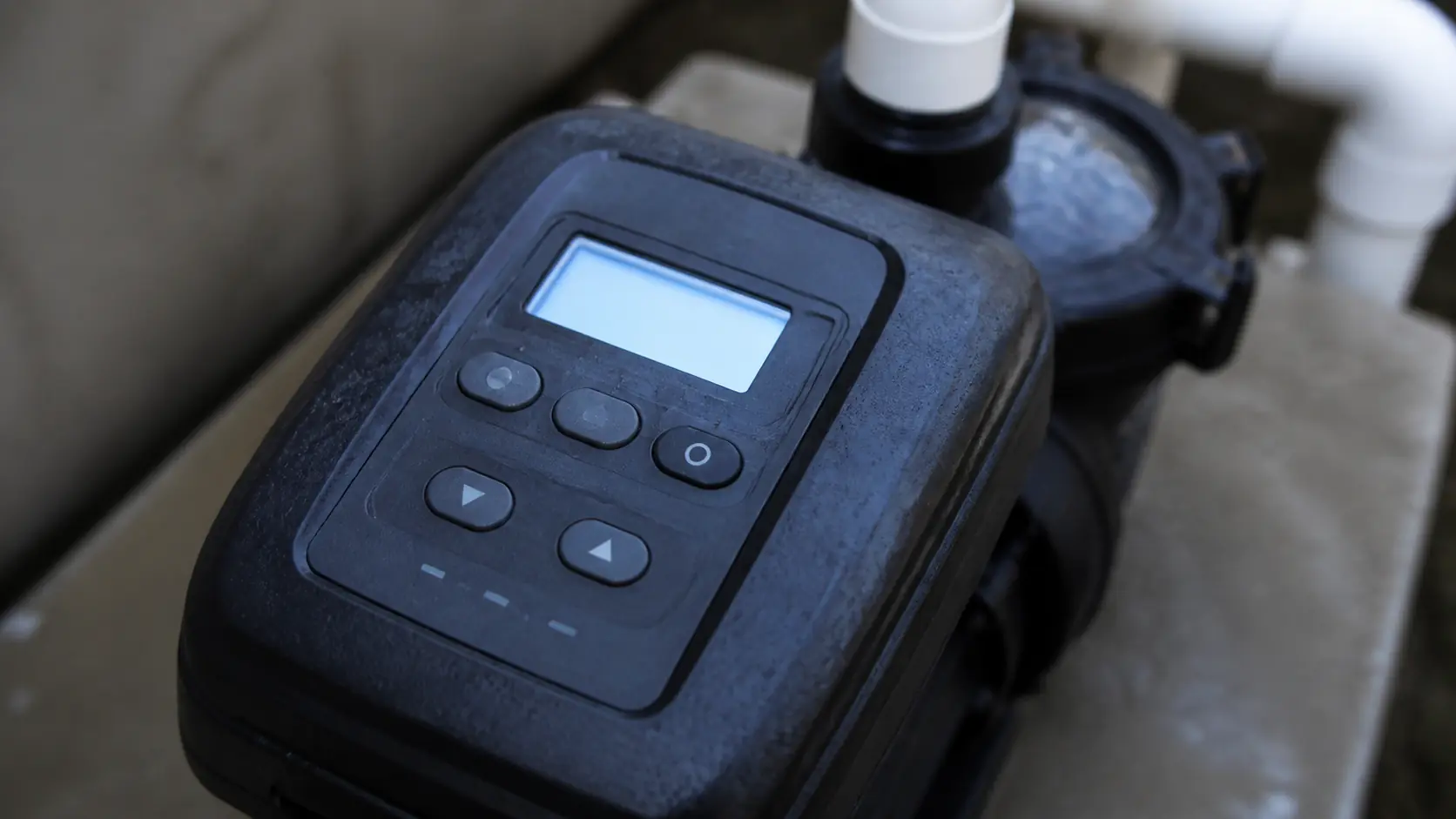
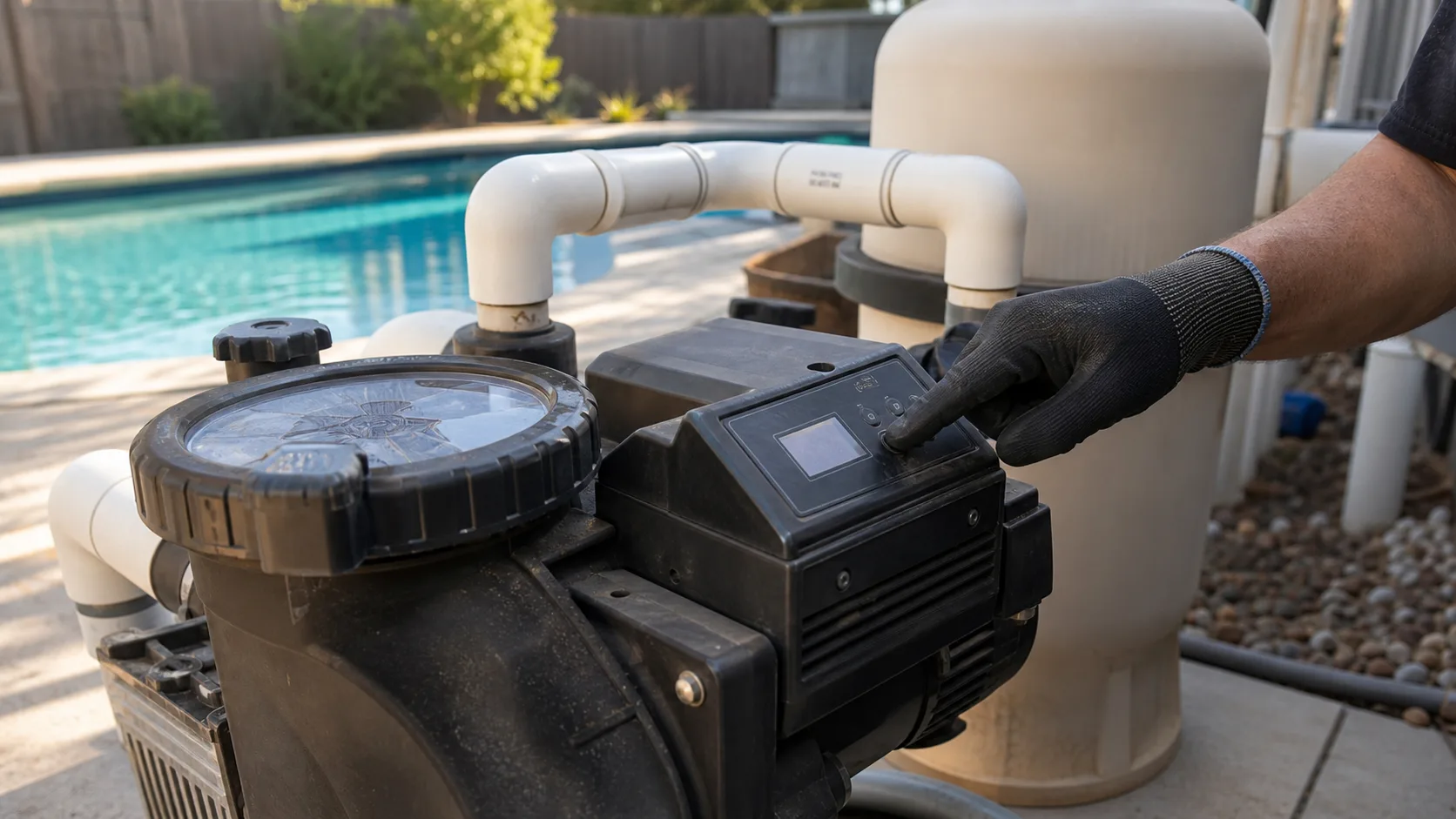
If your equipment pad has a flow meter, read it. If it doesn’t, a variable-speed pump with a display will show you either flow or the RPM and watts it is drawing, and the manual maps those to flow at typical head. Either beats guessing. The half hour spent working out your real turnover time is the one piece of homework that makes every other decision below concrete instead of theoretical.
Why a variable-speed pump changes the answer completely
Here is the physics that makes slow-and-long the right strategy. Flow through a pump falls roughly in proportion to speed, but the power it draws falls roughly with the cube of speed. Halve the RPM and you move about half the water while drawing something in the region of one eighth the power.
Run that out: at half speed you need twice as long to move the same volume, but you’re drawing an eighth of the power for those doubled hours. The same daily turnover, for roughly a quarter of the energy. That’s the whole case for variable speed, and it’s why the Department of Energy wrote it into law: the final rule for dedicated-purpose pool pump motors, published 28 September 2023 is what pushed the market this way. Our repair-or-replace guide covers the dates and horsepower thresholds that decide whether it applies to your replacement.
There’s a filtration bonus on top of the energy saving. Water moving slowly through the filter spends longer in contact with the medium, and slower flow tends to filter finer. A pool running 14 hours at a low speed generally has clearer water than the same pool running 7 hours flat out, even though the turnover is identical.
| Pump type | Approach |
|---|---|
| Single speed | Shortest schedule that delivers a full turnover, usually 8 to 10 hours in summer. Nothing to optimize beyond that. |
| Two speed | Long stretch on low for turnover, short burst on high for skimming, vacuuming, or heating. |
| Variable speed | Run most of the day at the lowest speed that satisfies your equipment, with brief higher-speed periods when needed. |
What sets the floor on how slow you can go
Low speed is cheap, but several things on your pad have a minimum flow they need, and they will fail quietly rather than complain.
- The skimmer. Below a certain flow the surface stops being pulled in properly, and debris that would have been skimmed sinks and has to be vacuumed instead.
- A salt cell. Most cells have a flow switch and will simply stop producing chlorine if the pump is too slow. The pool then loses sanitizer with no error that a homeowner would notice until the water dulls. Our salt pool guide covers the run time-to-output relationship.
- A heater. Heaters have a flow interlock and won’t fire below it. If your heater refuses to start, an over-optimized pump schedule is one of the first things to check, as covered in our heater troubleshooting guide.
- Suction-side cleaners and in-floor systems. Both need real flow to work at all.
- Spillways and water features. Purely cosmetic, but people notice.
The North Texas schedule
Our climate doesn’t have two seasons, it has about four distinct pool regimes, and the schedule should change with them.
| Period | What is happening | Run time direction |
|---|---|---|
| June to September | Peak heat, maximum UV, fastest chlorine loss and algae growth | Longest schedule of the year, at least one full turnover, often more |
| April to May and October | Warming or cooling water, pollen and leaves | Moderate, adjusted by how well chlorine holds |
| November to February | Cold water, slow biology, low demand | Substantially reduced, but never off |
| Any hard freeze | Still water in pipes is what cracks equipment | Continuous, overriding everything above |
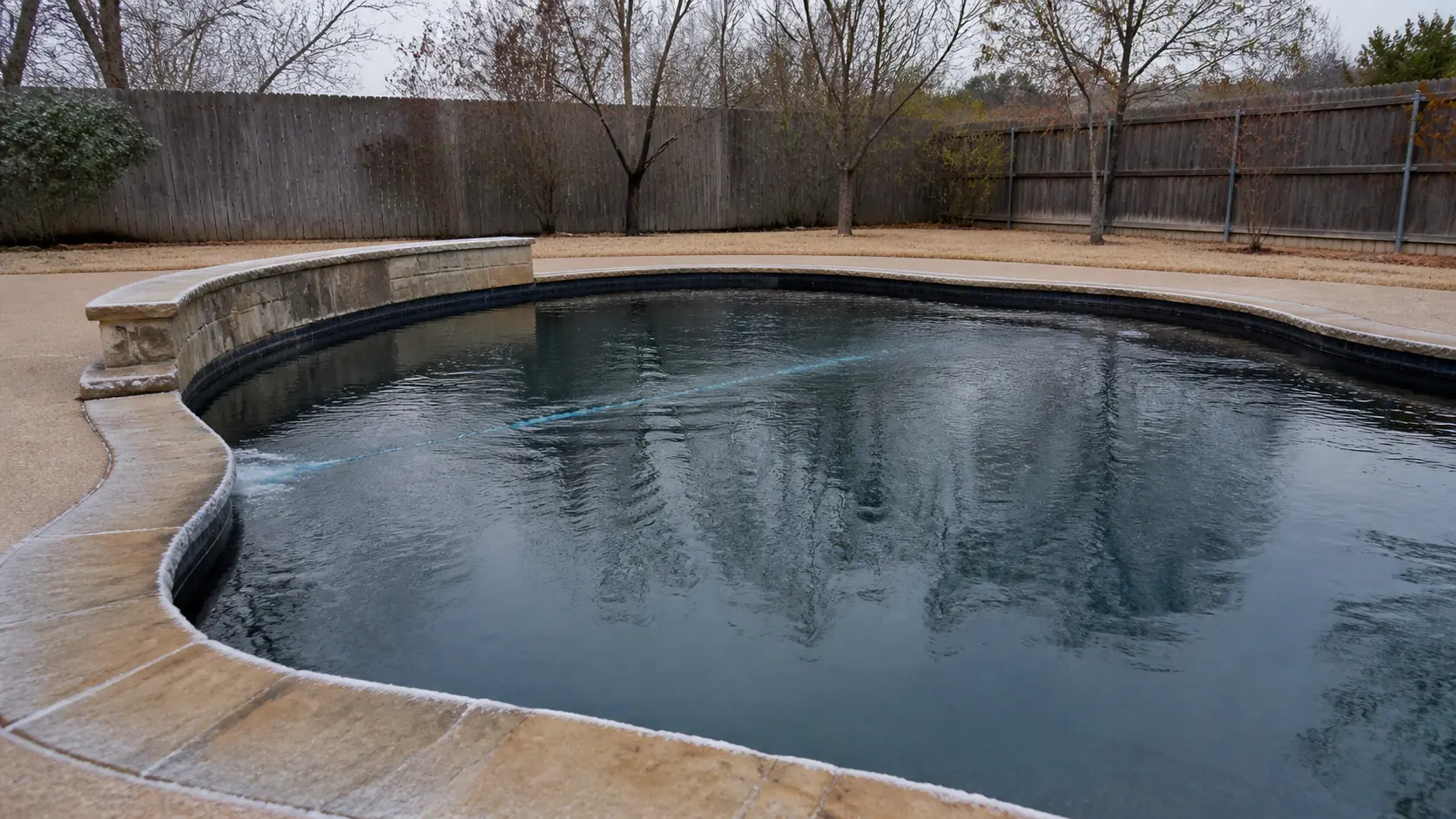
That last row isn’t a suggestion. During a hard freeze the pump runs day and night regardless of what the schedule says, because moving water is far harder to freeze than still water. The full sequence, including what to do if the power goes out, is in our freeze protection guide.
Do not run the pool only at night in July
Plenty of Texas electricity plans price nights cheaply, and it’s tempting to move the entire schedule into those hours. Be careful with that in midsummer. Chlorine is being destroyed by sunlight and consumed by heat all afternoon, which is exactly when a salt cell isn’t producing and the water isn’t circulating. A pool that goes green in August costs far more to recover than the overnight rate saved. If you want to chase off-peak pricing, weight the schedule toward the cheap hours rather than moving all of it, and keep some daytime circulation.
Tuning it by what the water does
All of the arithmetic above gets you a sensible starting point. The pool tells you the rest. Treat it as an experiment with one variable.
- Start from your calculated turnover, or from 8 hours if you can’t measure flow.
- Hold it for two weeks without changing anything else, testing chlorine at the same time of day.
- If chlorine holds and the water stays clear, reduce by an hour and hold another two weeks. Keep going until something slips.
- When something slips, go back up an hour. That’s your number for this season.
Signs you have gone too short: chlorine falling faster between tests, the water losing its sparkle by the end of the week, a ring forming at the waterline, debris settling instead of skimming, or algae appearing on steps and in corners first. Those corners are the dead spots, and they’re always the early warning. If they show it while the middle of the pool looks fine, you may have a circulation problem rather than a run time problem, which our cloudy water guide covers.
Signs you’re running longer than you need: nothing, really, other than the bill. Extra circulation doesn’t damage a pool. It’s the one lever where erring generous costs you a small, known amount of money instead of an unpredictable amount of recovery work.
A reasonable default, if you want one
For a typical Plano backyard pool with a variable-speed pump and a salt system, the shape that works out most often is a long low-speed block through the middle of the day, extended into the evening, plus a short higher-speed period to skim properly and satisfy anything on the pad that needs real flow. In midsummer that tends to land somewhere in the region of 10 to 14 hours at low speed. In January it might be four or five.
Take that as a starting shape rather than a prescription, because the correct answer depends on your volume, your pump, your filter condition, your tree cover, and how much your pool gets used. If you would rather have it set properly once, an equipment inspection includes working out your turnover and programming the pump around it, and on weekly servicewe adjust it through the year instead of leaving April’s schedule running in August.