Pool owners who moved here from a colder state usually arrive with a habit: close the pool in September, open it in May, forget about it in between. That habit doesn’t survive contact with North Texas. Our season is long, our winters are mild but punctuated by sudden hard freezes, and the pool you completely walk away from in November is the pool you spend a fortune recovering in April.
The North Texas reality: most pools never close
In a climate with months of sustained sub-freezing weather, closing makes sense: you blow out the lines, plug them, cover the pool, and the water can’t freeze in anything that matters. Our winters don’t work like that. We get long mild stretches where a pool would happily keep circulating, interrupted by short, sharp freezes.
Short doesn’t mean harmless, and February 2021 is the reason nobody here needs convincing. The National Weather Service in Fort Worth recorded 139 consecutive hours at or below freezing at DFW Airport in that event, from the evening of February 13 through midday on February 19, which ties for the eighth-longest such stretch on record. A pool closed badly and a pool left running with no freeze plan both fail in a week like that, which is why the seasonal decision below and the freeze plan are two separate questions.
That pattern makes full closure a poor fit for most residential pools here. What we recommend instead, and what most established DFW pool owners already do, is to keep the pool running year round at reduced settings: shorter run times, lower speed on a variable-speed pump, less frequent but still regular chemistry checks.
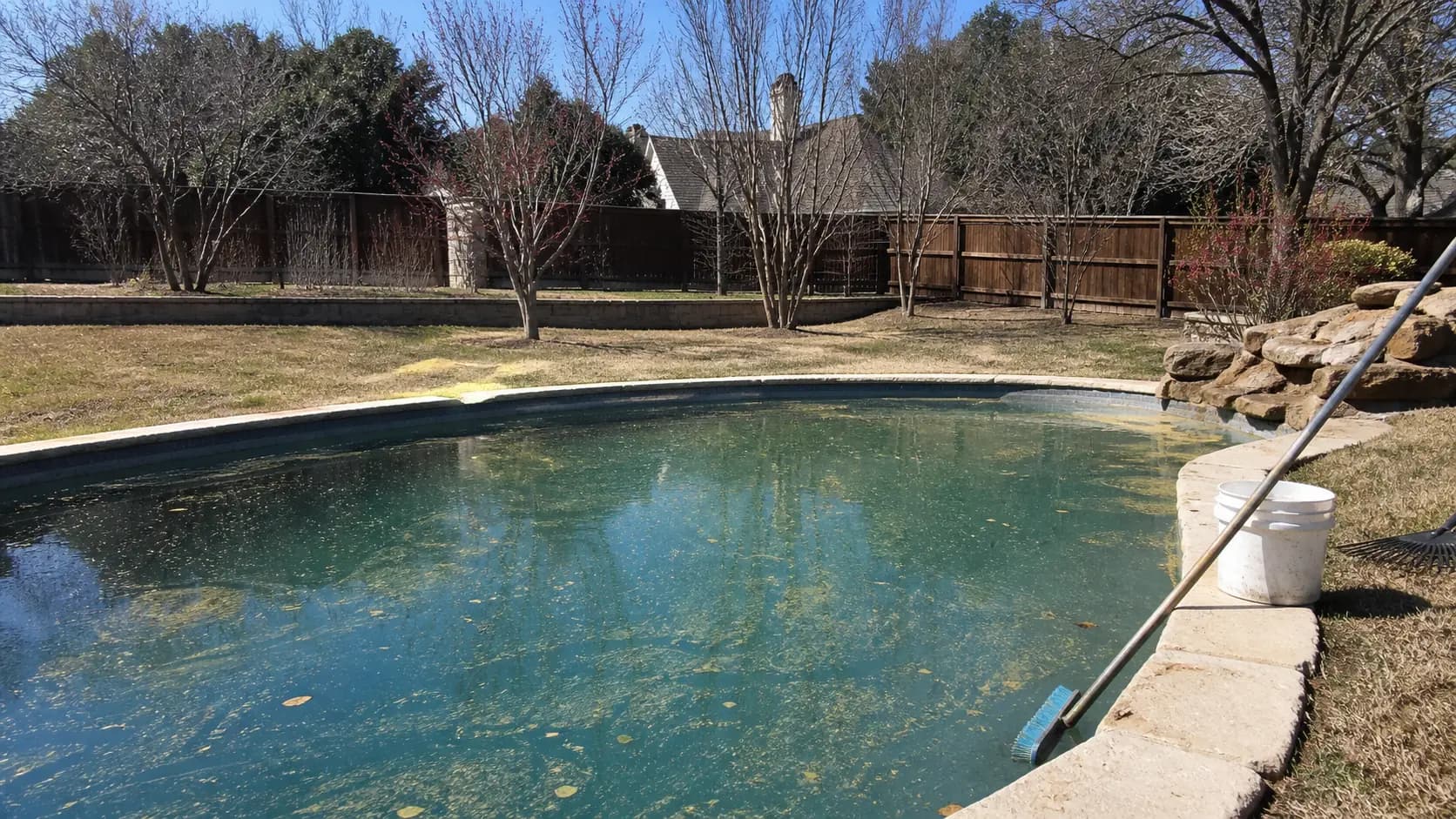
The reasoning is economic as much as anything. Water left standing and untreated for four months doesn’t stay still. Algae establishes, organic debris breaks down, and chemistry goes badly out of range. The cost of a green pool recovery in April routinely exceeds what light winter maintenance would have cost over the whole off-season, and the recovery also takes days you would rather be swimming.
Circulation is your freeze defense
There’s a second reason not to shut everything down. Moving water is much harder to freeze than still water, which is why the standard advice during a hard freeze is to keep the pump running continuously rather than switch it off. A pool that has been fully shut down for the winter, with equipment still holding water, is a pool with no defense at all when a cold snap arrives. Our freeze protection guide covers what to do before, during, and after.
Winding down for winter, the version we recommend
This isn’t closing. It’s downshifting, and it usually happens around the time night temperatures start dropping consistently and the trees finish dropping their leaves.
- Deep clean first. Brush, vacuum, and get the leaf load out. Organic debris left on the floor over winter stains plaster and feeds algae the moment the water warms.
- Balance the water properly before you reduce attention to it. Going into a low-maintenance stretch with pH or alkalinity already out of range means months of drift in the wrong direction.
- Clean the filter. Starting the quiet season with a clean filter is free; discovering a clogged one in March isn’t.
- Cut run time, don’t eliminate it. Cold water holds chlorine far better and algae grows far more slowly, so the pool needs less circulation. It doesn’t need none.
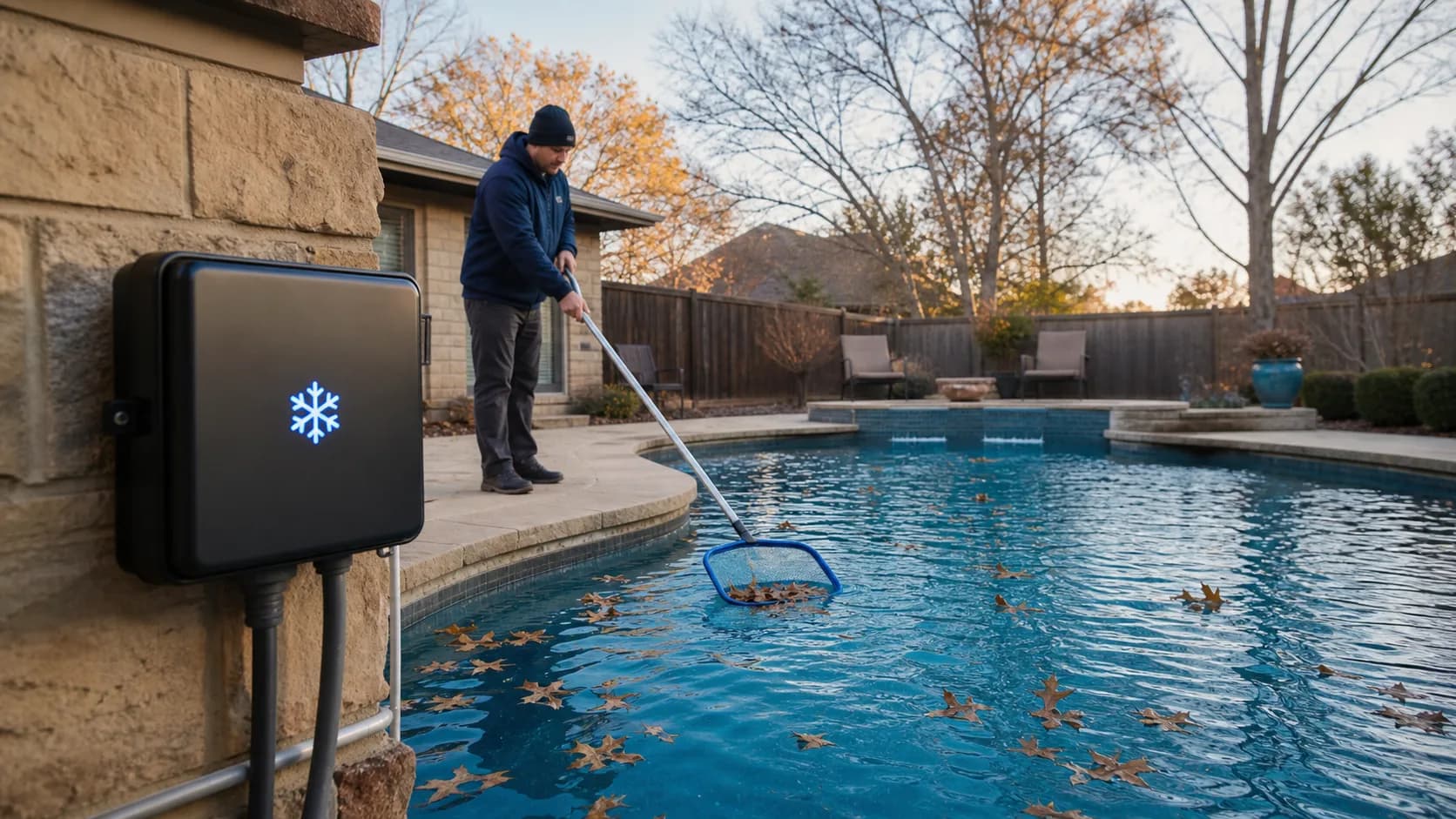
- Verify freeze protection actually works. If your system has a freeze guard, confirm it is enabled and that you know what it does. Do this in November, not during the first hard freeze warning.
- Keep testing, just less often. Chemistry drifts more slowly in the cold. It doesn’t stop.
When a real winterization does make sense
There are legitimate cases: a vacation or rental property nobody will visit, a pool at a house being sold, or an owner who won’t look at it until spring and would rather it be properly shut down than half-neglected.
If that is you, understand that a partial winterization is worse than none. The danger is water left sitting in pipes, pumps, filters, and heaters. That water expands when it freezes and cracks whatever is containing it, and the damage often isn’t discovered until the system is restarted in spring and starts leaking.
A proper job means lowering the water level appropriately, clearing water out of the plumbing and equipment, plugging the lines, protecting the equipment, and covering the pool. It’s worth having done by someone who does it regularly, because the failure mode is expensive and invisible until spring.
Does a North Texas pool need a winter cover?
Most pools around here spend the winter uncovered, and that’s a defensible choice. Our cold season is short enough that the main argument for a cover, keeping months of freezing debris out of a pool nobody is touching, doesn’t carry the same weight it does further north. But the question is worth answering deliberately rather than by default, because the three options behave very differently.
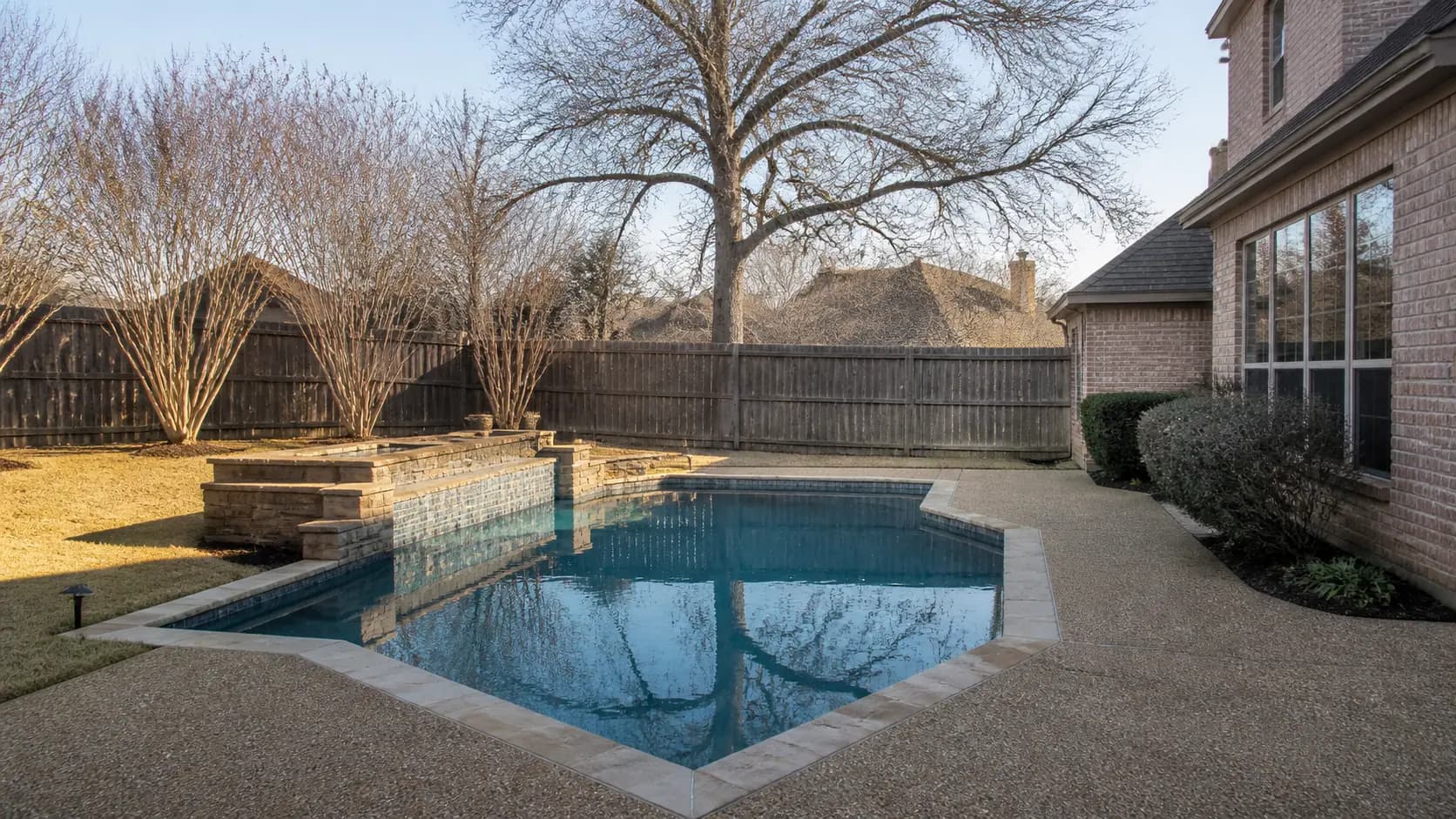
- No cover. Fine for a pool that keeps circulating and gets regular attention. You accept the leaf load and the evaporation, and in exchange the skimmer works normally and your freeze plan is unobstructed.
- A mesh safety cover. Anchored into the deck, rated to hold weight, and it sheds rain through the mesh rather than pooling it. It cuts debris and evaporation substantially and, for a pool nobody will use for months, it’s also a genuine barrier. The costs are the price and the deck anchors, which have to be installed properly.
- A solid floating cover. The inexpensive option, and the one that causes trouble. Rain and debris collect on top instead of passing through, and a shallow pool of water sitting on a floating cover is a real hazard to a child or a pet who walks onto it. If you use one, it needs a cover pump and it needs checking after every storm.
The North Texas constraint that overrides all of this: whatever you put on the pool has to be compatible with running the pump through a freeze. A cover that stops the skimmer from drawing, or that has to be dragged off in the dark before you can start circulating, is a cover working against your freeze plan. And a solar cover is a heating accessory, not a winter cover and not a safety device, whatever the packaging suggests.
Opening in spring
The single biggest mistake is timing. People open the pool when they want to swim, which is weeks after they should have started. Water warms up before anyone considers it swimming weather, and warm untended water is where algae wins. Start when the water starts warming, not when you feel like getting in.
The order that works
- Clear the debris before you add anything. Get leaves and sediment out first. Dosing chemicals into a pool full of organic material just consumes the chemicals.
- Restore water level and get circulation running. Inspect the equipment as you start it. Spring startup is when freeze damage from the winter reveals itself, so look for drips and listen for anything new.
- Test everything, then fix in the right order. Alkalinity first, then pH, then sanitizer, then calcium and stabilizer. Adjusting pH before alkalinity is the classic wasted afternoon, because unstable alkalinity will just drag pH back.
- Run the filter hard for the first stretch. Opening is the one time of year when long run times earn their electricity.
- Expect to clean the filter more than once early on. Watch the pressure gauge rather than the calendar, as covered in our filter comparison.
If it is already green, don’t just shock it and hope
A pool that opened green needs a real recovery process, not one big dose of chlorine. Shock kills the algae but doesn’t remove it, and skipping the brushing and filtration is why so many pools go from green to cloudy gray and stall there. The full sequence is in our green pool recovery guide.
The year-round rhythm, in one place
- Spring: the heaviest workload. Warming water, pollen, cottonwood, and a filter that needs constant attention. Chemistry demand rises quickly.
- Summer: peak demand. Heat and UV burn chlorine off fast, evaporation concentrates calcium with every top-off, and a pool can go from clear to green in a few days if chlorine dips. This is when weekly service stops being optional.
- Fall: the leaf problem. Chemistry demand eases but debris load spikes, and skimmer baskets need emptying far more often than owners expect.
- Winter: lowest demand, highest risk. Very little grows, but one hard freeze can do more damage in a night than a whole season of neglect.
That’s the argument for consistent year-round service rather than seasonal attention: the work changes shape through the year, but there’s no month where a pool here genuinely needs nothing. If you want the fuller comparison of service frequency, we laid it out in weekly versus biweekly service, and the full spring sequence has its own guide in spring pool startup.
Where to stop and call someone
Two points in this year are worth handing off rather than improvising. The first is a genuine winterization. Clearing water out of the plumbing is the part that protects you, it is done with equipment most homeowners don’t have, and a line that was missed does not announce itself until a freeze splits it underground. If you have decided to properly close a pool, have it closed properly.
The second is a spring startup on a pool that sat untouched. If you restore circulation and the pump won’t hold prime, the filter pressure behaves oddly, or the water level keeps dropping once the system is running, stop treating it as a chemistry problem. Those are the signatures of freeze damage that happened months earlier, and continuing to run a system that is leaking somewhere underground turns a repair into a much larger one.