A pool that has been effortless since April starts misbehaving in the second week of August, and the owner has changed nothing. That’s the point. The routine that worked in May isn’t a routine that survives a run of 105-degree afternoons, because nearly every rate in the pool has changed at once. Here is what actually shifts when the water gets that hot, and which parts of your routine need to move with it.
Why a heat wave changes the math
Three things happen simultaneously, and each one alone would be manageable.
Sunlight destroys chlorine faster. Unstabilized chlorine in direct summer sun has a half-life measured in tens of minutes. Longer days at a higher sun angle mean more total UV hitting the water each day, so a pool that held its chlorine overnight in April is burning through it by three in the afternoon in August.
Warm water accelerates everything biological. Algae and bacteria reproduce faster as water warms, and the curve is steep rather than gentle across the range pools actually live in. A pool sitting at 92 degrees isn’t marginally more prone to a bloom than the same pool at 78. It’s a different situation, and the chlorine level that comfortably held the line in spring is now being outrun by something reproducing several times faster.
Bather load peaks at the same time. August is when people are actually in the water, and every swimmer brings sweat, sunscreen, and organics that consume chlorine directly. A weekend with eight kids in the pool can take out more chlorine than the previous four days of sun.
This is why service intervals matter more in August than in April
The gap between visits is a gap in which chlorine falls. In spring that decay is slow enough that fourteen days is survivable. In August the same fourteen days lands the pool below the algae floor for the last several of them, which is exactly when a bloom starts. It’s the seasonal version of the tradeoff in our weekly versus biweekly comparison, and it is why we don’t recommend biweekly through a Texas summer.
What to change, in order of how much it matters
1. Carry more chlorine, and know what more means
The single most effective change. But “more chlorine” is only meaningful relative to your stabilizer, because cyanuric acid determines how much of your chlorine is actually working. The floor is about 7.5 percent of your CYA level on a chlorine pool, 5 percent behind a salt cell. At 40 ppm of stabilizer that is 3 ppm of free chlorine; at 70 ppm it is over 5.
That percentage is a practitioner convention, but the floor underneath it isn’t. The CDC recommends at least 2 ppm of free chlorine in a pool using cyanuric acid, double the 1 ppm it recommends without it, and that’s a year-round minimum rather than a heat-wave target. If an August reading has you at or near 2, you’re sitting on the floor in the week your pool is under the most stress.
If you’re heading into a heat wave, aim for the upper end of your range rather than the middle, and test more often rather than dosing more heavily. This is also the season when an over-stabilized pool gets found out, so if your chlorine seems present but ineffective, read the cyanuric acid article before you buy more chemicals.
2. Brush the shaded corners twice a week
Algae starts where circulation is weakest and the surface is roughest: behind the ladder, in the corners of steps, under the lip of a tanning ledge, along the shadowed wall. In a heat wave those spots go from a slow problem to a fast one. Brushing does two things at once, it physically dislodges the film and it exposes what was under it to the chlorine in the water. Ten minutes with a brush, twice a week, prevents more August green pools than any product on the shelf.
3. Run the pump longer, but slower
Summer needs more turnover, and if you have a variable-speed pump the cheap way to buy it is more hours at a low speed rather than the same hours at a high one. Flow falls roughly in proportion to speed while power draw falls with roughly the cube of it, so a longer, slower schedule delivers the same volume of water for a fraction of the electricity, and filters finer while doing it. The full calculation is in our pump run time guide, and if you don’t know your volume, the pool volume calculator gets you the gallons that calculation starts from.
Two heat-specific notes. Keep genuine daytime circulation in the schedule even if your electricity plan makes nights cheap, because the afternoon is when chlorine is being destroyed and a salt cell that is off all afternoon isn’t replacing it. And if you have a salt system, remember the cell only produces while the pump runs, so cutting hours to save money cuts chlorine production by the same proportion.
4. Watch pH, which will drift up
Warm water, aeration from water features, and salt cell operation all push pH upward, and high pH makes the chlorine you do have less effective. It’s a quiet double penalty in the exact week you can’t afford one. Test pH weekly through a hot spell and keep it toward 7.4 rather than letting it sit at 7.8.
5. Keep up with the water level
Half an inch a day is normal August evaporation here, which is about 140 gallons a day on a 15-by-30 pool. Let it fall below the middle of the skimmer mouth and the skimmer starts gulping air, which loses prime and can run a pump dry. This is also the season when a slow leak hides inside normal evaporation; if the loss seems excessive, the bucket test settles it in 24 hours for free.
Every refill changes your chemistry
Water that evaporates leaves its minerals behind, and the hose water replacing it arrives with more. Over a hot summer that pushes calcium hardness steadily up, which is how scale ends up on the tile by September. Refills also dilute stabilizer, so a pool that gets topped up constantly can drift low on CYA even while its calcium climbs. Both are worth a test at the end of August.
When the pool stops being refreshing
A separate complaint, and a fair one: after a long run of triple-digit days, an unshaded North Texas pool can sit in the low to mid 90s. Body temperature is 98.6, so water at 94 does very little to cool anybody down. People describe it as bathwater and they aren’t exaggerating.
There’s no cheap way to move a whole pool several degrees, but there are things that help:
- Run water features and returns overnight. Evaporation is the main way a pool sheds heat, and a spillway, waterfall, or deck jet running from midnight to dawn, when the air is at its coolest and driest, will pull the temperature down noticeably by morning. Aiming the return jets upward to break the surface has a smaller version of the same effect.
- Uncover it at night. A solar cover is doing its job in April and working against you in August. Off overnight, and off entirely through a heat wave.
- Check that the heater is genuinely not firing. More common than it sounds. A stuck valve, an automation schedule nobody has looked at since March, or a spa setting left engaged will happily heat a pool that is already at 92.
- Accept that shade is the real answer. The long-term fix is a tree or a structure on the west side. Every other option is fighting the sun on the day.
Worth knowing that warm water isn’t just a comfort problem. It’s the same condition that accelerates algae, raises chlorine consumption, and shortens how long a dose lasts, so the weeks the pool feels least pleasant are the weeks it needs the most attention.
The afternoon thunderstorm that ends the heat wave
Heat waves here often break with a pop-up storm, and that storm undoes a fair bit of your week. Heavy rain dilutes chlorine and stabilizer, drops pH and alkalinity, and washes organic debris, dust, pollen, and fertilizer off the deck and out of the yard into the water. Then the sun comes back out over a pool with less sanitizer and more to sanitize.
That combination is behind a large share of the pools that go green in the last week of August. The response is short: after any heavy rain, empty the baskets, brush, test, correct pH first, and shock at dusk. Doing that the same evening is a twenty-minute job. Discovering it three days later is a recovery.
The equipment side of a heat wave
The pad is having a harder week than you are. Worth knowing what a hot spell does to it:
| Component | What heat does | What to watch for |
|---|---|---|
| Pump motor | Air-cooled, so a 105-degree day means a hotter motor and less cooling headroom | Tripping on thermal overload, a burning smell, or a motor too hot to touch briefly |
| Salt cell | Output is temperature-compensated, and scaling accelerates in warm high-pH water | A cell that reports low output, or a system that can’t keep up at 100 percent |
| Filter | Higher demand plus higher organic load means it clogs faster than in spring | Pressure 8 to 10 psi above clean, and poor return flow |
| Heater | Usually idle, but a hot spell is when a failed heater bypass shows up | Nothing, unless you have a spa. Note it for fall. |
| Automatic cleaner | Plastic and hoses get brittle with prolonged UV and heat exposure | Cracked hoses, a cleaner that stalls in one spot |
A pump that shuts itself off in the afternoon is a warning, not a quirk
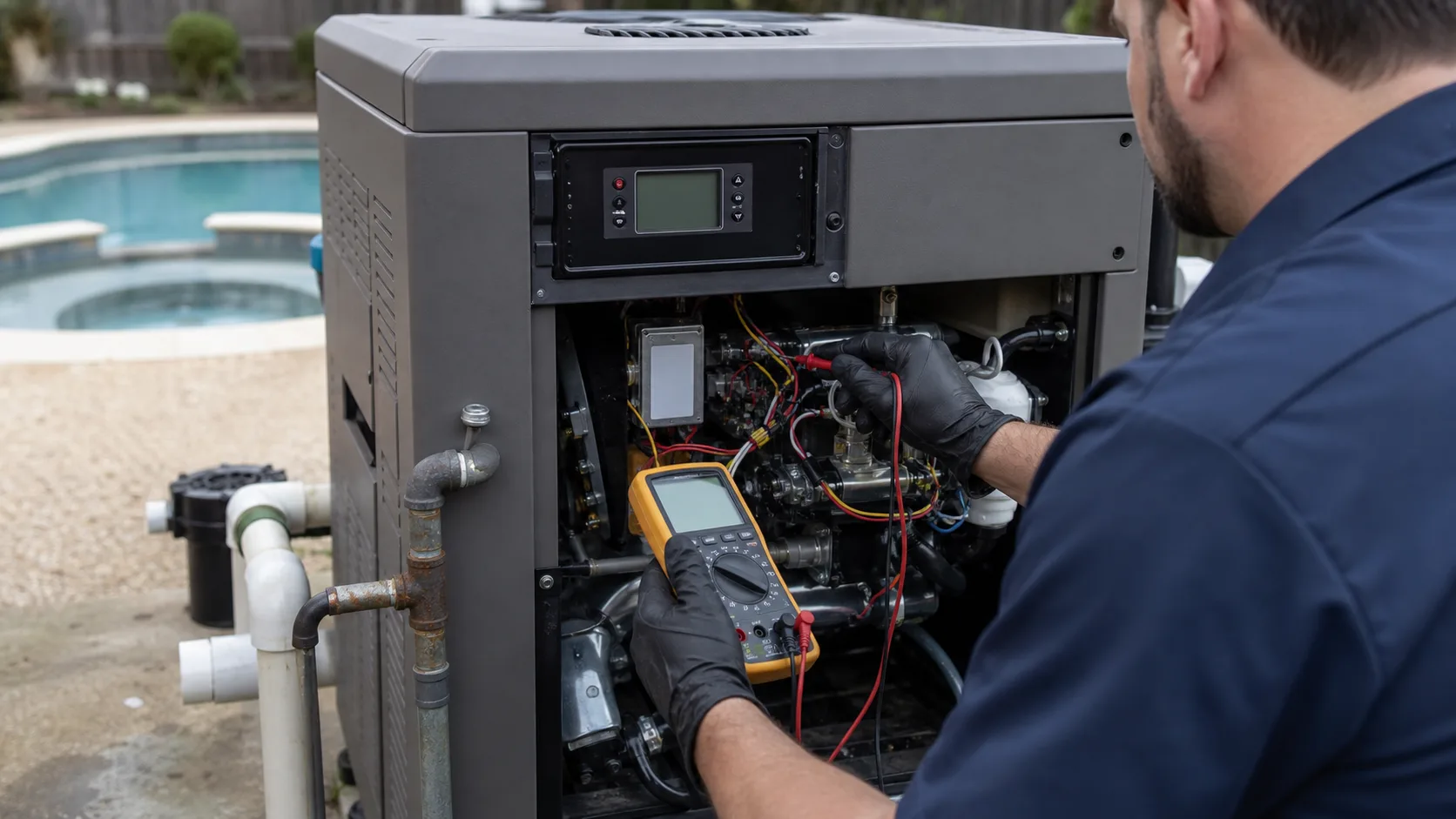
Motors have a thermal cutout that stops them before the windings are damaged. If yours trips on hot afternoons and restarts once it cools, it’s telling you it is running at its limit, usually because of a failing bearing, a blocked motor vent, restricted flow from a dirty filter, or an enclosure with no airflow. Ignoring it through August is how a repair becomes a replacement. Our repair or replace guide covers where that line falls.
Things people do in a heat wave that make it worse
- Shocking at two in the afternoon. A large part of the dose is destroyed by sun before it does any work. Shock at dusk and let it run all night.
- Reaching for tablets to keep up. Understandable, and it works for a week. It also adds stabilizer permanently, which is the mechanism that turns a manageable August into an unmanageable one next year.
- Cutting pump hours to save on the electric bill. The bill is genuinely high in August. Cut the speed, not the hours. Cutting hours costs you circulation and, on a salt pool, chlorine production.
- Adding algaecide instead of chlorine. Algaecide is a preventive supplement, not a sanitizer. It doesn’t fix a pool that is short on chlorine, and copper-based products can stain plaster.
- Skipping the test because the water looks fine. Water looks fine right up until it doesn’t. By the time there is a visible tint the bloom has been building for days.
A workable August routine
If you want the short version, this is what we would tell a customer who handles their own pool through a hot spell:
- Test free chlorine and pH twice a week, not once. Adjust before the weekend, not after.
- Hold chlorine at the top of your range for your CYA level rather than the middle.
- Brush the shaded corners and steps twice a week, every week, without exception.
- Empty skimmer and pump baskets weekly. Restricted flow undoes everything else.
- Check filter pressure weekly and clean at 8 to 10 psi above its clean reading.
- Keep water at mid-skimmer, and glance at the equipment pad while you’re back there.
- Shock at dusk after any heavy-use weekend or any rain.
None of that is exotic. It’s the ordinary routine, run at summer frequency instead of spring frequency, which is the whole point of this article. If keeping that cadence through the hottest six weeks of the year isn’t realistic, that’s precisely what weekly service exists for, and August is the month it earns its keep. If the pool has already turned, our green-to-clean service handles the recovery, and the green pool guide explains the sequence we follow.