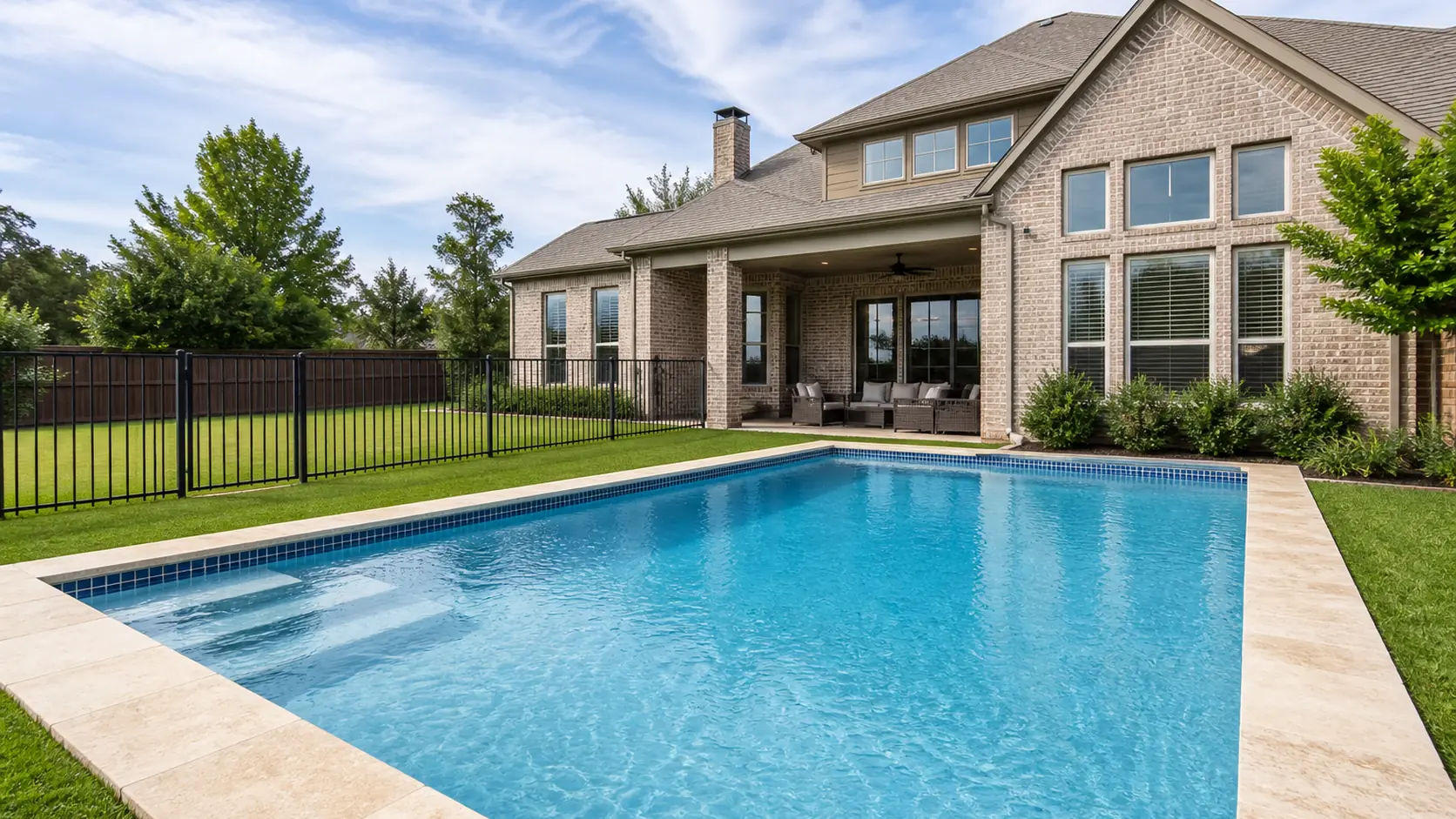
A standard Texas home inspection isn’t required to cover the pool. Most inspectors note that a pool exists, confirm the equipment powers on, flag anything obviously unsafe, and move on. That isn’t a criticism of them, it’s the scope of the license. Meanwhile the pool is frequently the single most expensive system on the property after the roof and the foundation, and it’s the one nobody looked at. Here is what to check, what it costs when it goes wrong, and which findings are worth walking away over.
What a standard home inspection actually covers
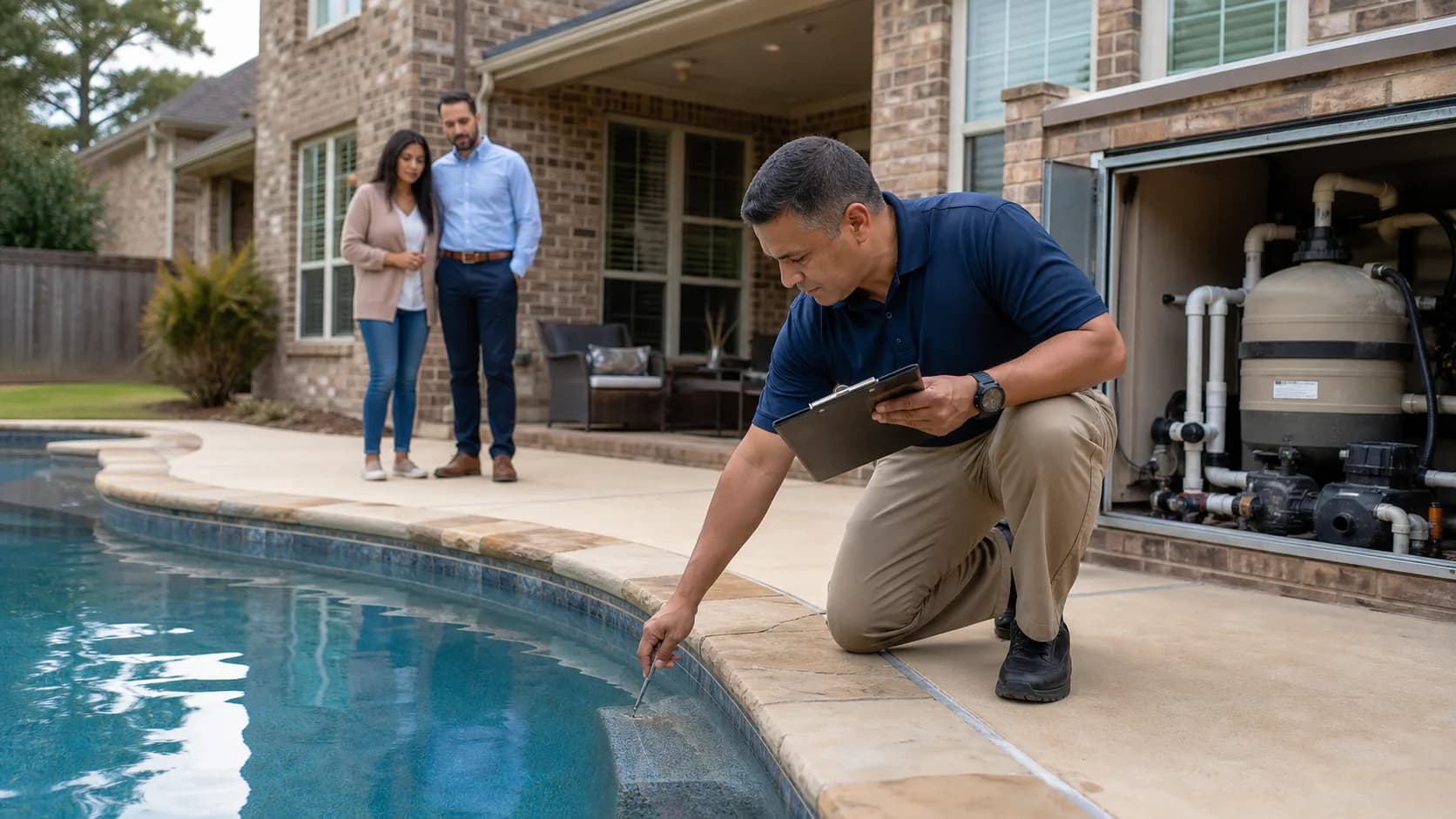
In Texas, a licensed inspector works from a standard of practice that treats pools and spas as an optional system. Where a pool is inspected at all, the scope is essentially visual: does the equipment turn on, is there obvious damage, are there visible safety hazards. An inspector isn’t required to run a pressure test on the plumbing, evaluate the condition of the plaster underwater, assess the remaining life on a heater, or diagnose why a pump sounds the way it does.
So the practical rule is simple: if you want the pool inspected, request it explicitly and expect to pay separately for it. Either through an inspector who offers pools as an add-on, or through a pool company, which is what we do. Either way, do it during the option period, because that’s your only real leverage.
A clean pool at a showing is a marketing decision
Sellers get the pool serviced before listing. That’s normal and not dishonest, but it means the water you’re looking at is a few days old as evidence and tells you nothing about the year behind it. A pool that has been neglected for eighteen months and cleaned last Tuesday looks identical to one that has been maintained properly, right up until the first month you own it. The paperwork is the evidence, not the water.
The walk-around: what you can check yourself at a showing
You aren’t diagnosing anything here, you’re deciding whether to pay for a real inspection and how hard to push in negotiation. Fifteen minutes gets you most of the signal.
The shell and the waterline
- Look at where the water level sits. If it is well below the skimmer mouth on a house that is being actively sold, ask why. Either nobody is topping it up, or it will not hold.
- Check the tile line for a heavy calcium band. A thick white crust is a record of years of hard water and inconsistent chemistry, not a cosmetic issue. Our calcium scale article explains what removing it involves and why it comes back.
- Look for stains, rough patches, and exposed aggregate. Plaster that feels like sandpaper underfoot is near the end of its life. A resurface is a five-figure job in this market.
- Note any crack that runs from the shell into the deck. Surface crazing in plaster is common and mostly cosmetic. A crack that continues across two materials is a movement question, and in North Texas clay that deserves a real answer.
The deck and the surroundings
- Does the deck slope away from the pool? Water should run off, not in.
- Are coping stones loose, or is there a gap between coping and deck? Frequently the visible end of soil movement or a leak washing material out underneath.
- Is one section of deck noticeably lower than the rest? Settlement. Ask when it started.
- Any patch of lawn that is greener or soggier than everything around it? In an August drought, a strip of lush grass near the equipment or the pool is a plausible underground leak.
- How far are the trees? Large trees close to a pool mean debris every day and roots that eventually reach plumbing. Not a dealbreaker, but it changes what maintenance costs.
The equipment pad
- Read the labels and note the brand, model, and any date on the units. You can look up ages and parts availability later, which is exactly the homework nobody does.
- Look for rust on motor housings and heater cabinets, and for corrosion at the unions. Rust means water has been getting somewhere it shouldn’t.
- Count the repairs visible in the plumbing. A pad with six couplings and three different vintages of PVC is a pad that has been patched repeatedly.
- Check whether the pump is single-speed. If it is, budget for a variable-speed replacement. Federal efficiency standards already require variable-speed capability for pool pump motors at the common residential sizes, so this is a cost you will meet whenever the old one dies, and the running-cost saving usually makes doing it sooner the cheaper choice. Our repair-or-replace guide has the horsepower thresholds and compliance dates.
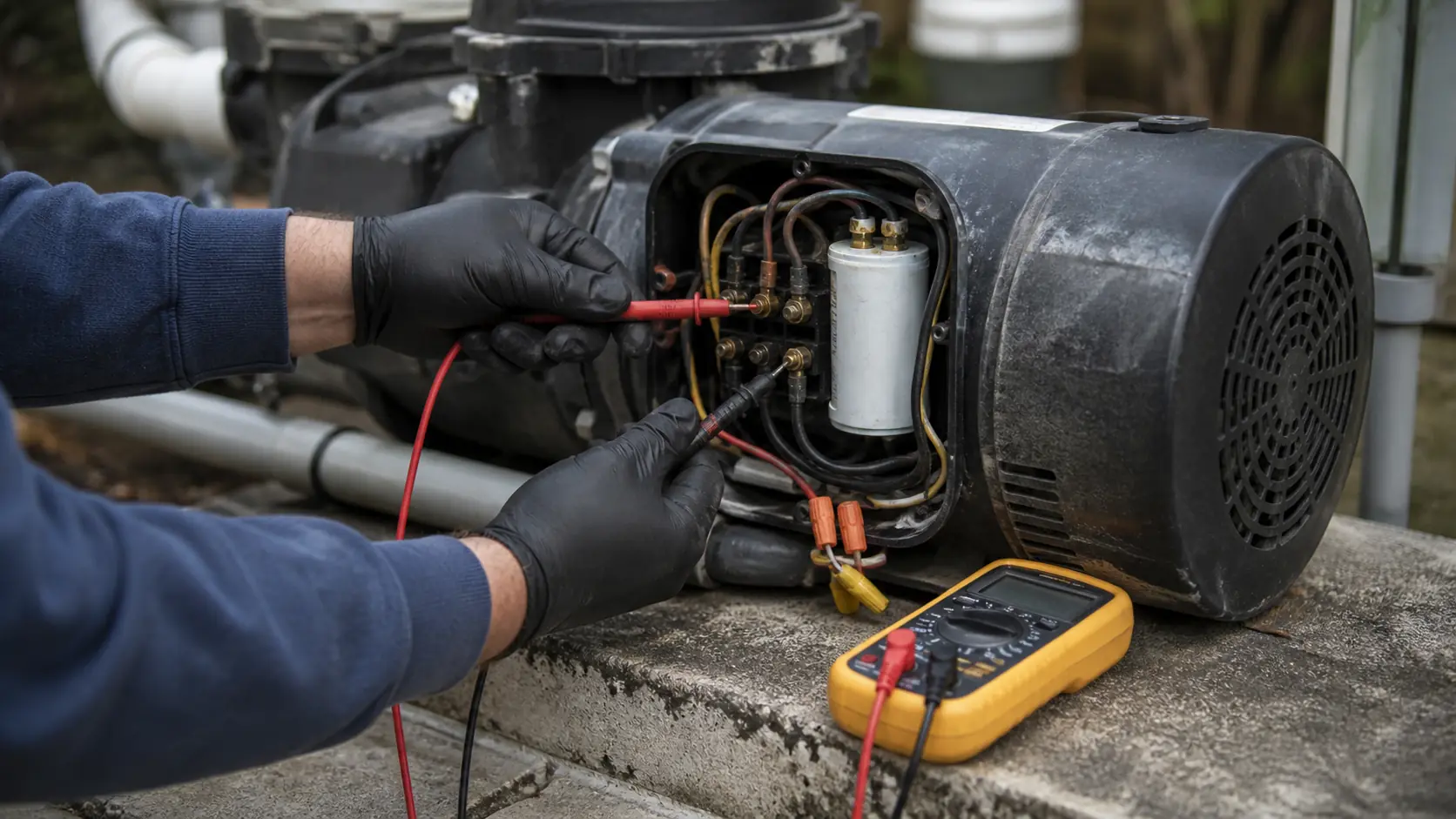
- Look at the electrical. Extension cords, unbonded metal, missing GFCI protection, or a panel that has clearly been improvised are safety findings, not preferences.
Run it, if you’re allowed to
With permission, have the system turned on while you’re there. Listen for a pump that screams or grinds, look for bubbles coming from the return jets, which suggest a suction-side leak, note the filter pressure gauge reading, and check that water actually moves at every return. If there is a heater, ask for it to be fired even in August. Nobody wants to discover in November that it hasn’t run in three years.
What the failures cost
Rough North Texas figures, so you can size a negotiation rather than guess. These are ranges, and specifics depend on the equipment and the pool.
| Finding | Rough cost | Urgency |
|---|---|---|
| Pump replacement (variable speed, installed) | $1,200 to $2,500 | Soon, if it’s failing |
| Filter replacement | $700 to $2,000 | Depends on type and condition |
| Salt cell replacement | $600 to $1,000 | Cells are a wear item, 3 to 6 years |
| Heater replacement | $3,500 to $6,000+ | Only if you’ll use it |
| Leak detection and repair | $400 to several thousand | Immediate; leaks grow |
| Plaster resurface | $6,000 to $15,000+ | Years of warning, usually |
| Deck repair or replacement | $3,000 to $15,000+ | Varies with cause |
| Bringing a fence to code | $1,500 to $5,000 | Before anyone swims |
| Green-to-clean recovery | A few hundred | Immediate but minor |
The pattern is what matters. Equipment is expensive but bounded, predictable, and replaceable at known prices. Structure and plumbing are the open-ended ones, which is why a proper inspection spends its time there and why those are the findings worth taking seriously in a negotiation.
Ask for the service history in writing
The single most useful document you can request is a year of pool service invoices or receipts, and the seller either has them or doesn’t. A pool on consistent weekly service is a known quantity. A pool with no records at all isn’t necessarily bad, but it’s unmeasured, and unmeasured in this business generally means the stabilizer is high, the calcium is high, and something on the pad is overdue.
Check the drain covers while you’re there
Anti-entrapment drain covers carry a service life stamped on them, commonly five to seven years, and they go brittle in Texas sun. The CPSC also keeps issuing recalls on non-compliant covers sold through online marketplaces, so a cheap replacement cover fitted by a previous owner is worth a look. A cracked or missing cover is a safety finding rather than a bargaining chip.
Seven questions to put to the seller in writing
Ask these through your agent, and ask for the answers in writing. The answers are useful, and so is a refusal to answer. It is also worth knowing what the seller was advised to do before listing, which is set out from their side in selling a house with a pool in North Texas.
- Who has serviced the pool for the last year, and can I see the invoices? The single most informative document available. A consistently serviced pool is a known quantity.
- What equipment has been replaced, and when? A pump replaced two years ago is money you don’t have to spend. A pad where nothing has been touched in twelve years is a queue forming.
- When was the pool last resurfaced? Plaster has a finite life. Knowing it is eighteen years old changes your number.
- Has the pool ever leaked, and was it repaired? A disclosed and repaired leak is far less worrying than the same leak found by your own testing.
- What happened during the last hard freeze? Specifically whether the pump was kept running and whether anything cracked afterward.
- Is the pool on a separate water meter, and what does it run monthly? Not common, but where it exists it is the closest thing to a leak history you’ll get.
- Are there permits and any warranty documentation for work done? Relevant for recent resurfacing, equipment, or a fence that was added after the house was built.
Things buyers routinely miss
Freeze damage that hasn’t shown itself yet
A pipe or fitting split during a hard freeze often doesn’t leak visibly until the system is under pressure again months later. A pool bought in summer can start losing water the following spring from damage that happened before you owned it. If the house went through a hard freeze without protection, that history matters. Our freeze protection guide covers what should have been done.
The safety barrier becomes your problem at closing
Enclosure requirements aren’t negotiable between buyer and seller, they attach to the property, and the liability transfers to you the day you close. Self-closing and self-latching gates, latch height, gaps under the fence, and any door from the house into the pool area all matter. Check it against the Texas pool fence rules before you close, not after, especially if you have small children or plan to rent the property out.
The pool that was “closed”
Pools in North Texas are generally not winterized the way northern pools are, so a pool sitting covered and dormant in a listing is usually a pool that has been abandoned rather than properly closed. Expect a full recovery, and expect the equipment to have been sitting unused, which is its own category of problem. There’s more on why we run pools year-round here in our opening and closing article.
The ongoing cost, which isn’t a one-time number
A pool is a recurring line item forever: chemicals, electricity, water, service, and a reserve for equipment that will eventually fail. Buyers usually budget for the repairs the inspection finds and forget the monthly cost entirely. Our pool cleaning cost guide covers what service actually runs in this area, and it’s a more honest number to plug into your budget than whatever the listing implies.
How to use the inspection during the option period
- Book it early. A Texas option period is short and everyone is booking inspections in the same window. Schedule the pool inspection at the same time as the home inspection, not after you have read the home report.
- Get findings in writing with photographs.A verbal “the pump is getting on” isn’t a negotiating position. A written report with photographs and estimated costs is.
- Separate safety, structural, and wear items. They deserve different treatment. Safety findings should be fixed or credited before closing. Structural findings may justify walking. Wear items are a price conversation.
- Prefer a credit over a promised repair. A seller with one foot out the door will hire the cheapest bid. Take the money and choose your own contractor.
- Get the pool serviced immediately after closing. Whatever the chemistry was doing under the previous owner, you want a full panel and a baseline in the first week, especially calcium and cyanuric acid, since neither of those goes down on its own.
Two findings that justify a real conversation
A pool that won’t hold its water level, and a crack that crosses from the shell into the deck. Everything else on a typical report is a number you can put a price on. Those two are the ones where the honest answer is that the cost isn’t known until somebody digs, and they’re worth either a serious credit or a serious rethink.
If you want somebody to look at it
Worth being precise about what we do and don’t do here. We’re a pool service company, not a licensed home inspector, so what we provide is a diagnostic walkthrough rather than a TREC inspection report. We go over the equipment, the pad, the plumbing we can see, and the condition of the shell and waterline, then tell you plainly what needs attention, what can wait, and roughly what each will cost. For a lot of buyers that is the more useful document, because it’s priced. If you need a licensed inspector’s report for a lender or a formal amendment, get that too.
Our equipment inspection and diagnostics service is the starting point, and if the water level is the question, that turns into leak detection. We cover Plano, Frisco, McKinney, Allen, and the surrounding Metroplex. Option periods are short, so call earlier than feels necessary.
One closing thought, offered as somebody who services pools rather than sells houses: a pool with real problems isn’t automatically a bad buy. Nearly everything on that checklist has a price, and a priced problem is a negotiable one. What ruins the first year of pool ownership isn’t finding a bad pump. It’s finding a bad pump in October, after closing, with no credit and no idea it was coming.