Weekly vs Biweekly Pool Service: What Plano Homeowners Need

Austin Andrews
Founder, True Texan Pools
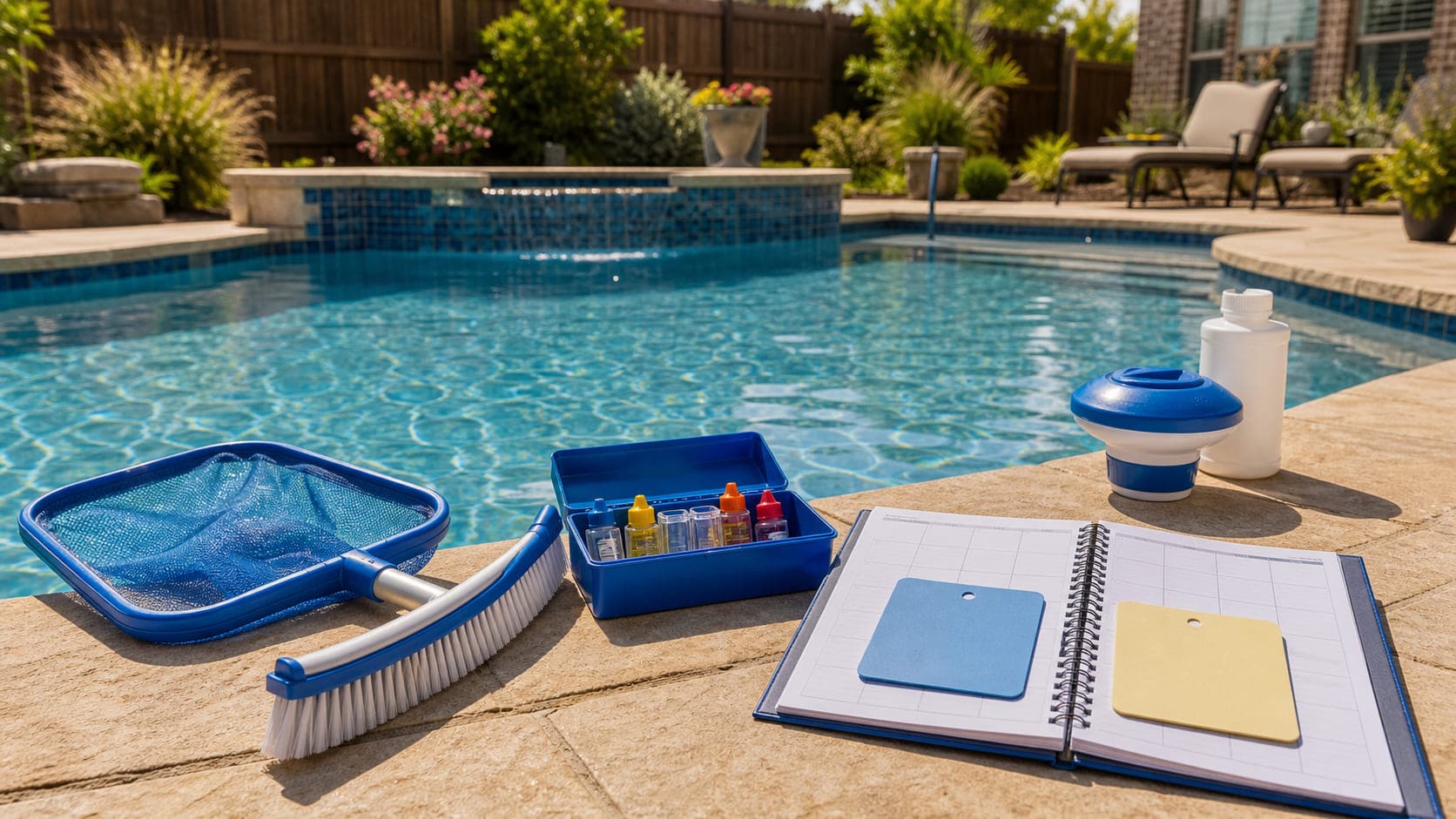
When homeowners call about service, one of the first questions is almost always the same: do I really need someone every week, or can I get away with every other week? It’s a fair question, and the honest answer is that it depends on your pool, how you use it, and the time of year. But in a Plano summer, the math leans heavily one way. Here is how to think it through.
What actually happens between visits
The whole question hinges on one thing: how fast your water drifts out of balance when nobody is touching it. In our climate, the answer is fast. Heat and intense sunlight burn off chlorine, summer storms dilute and disrupt the chemistry, and warm water is a perfect home for algae. A pool that is balanced and clear today can be low on chlorine in four or five days and showing early algae by day seven or eight.
Storms are the part people underestimate. A North Texas thunderstorm does three things to a pool at once: it dumps rain that dilutes your sanitizer and drags pH down, it blows organic debris across the surface that then consumes more chlorine as it breaks down, and it washes lawn runoff with its phosphates and nitrogen toward the deck. A pool that was comfortably in range on Friday can be behind by Sunday night. On a weekly schedule that gets caught at the next visit. On a biweekly schedule the pool may sit in that state for ten more days, in August, which is precisely the recipe for a bloom.
Bather load compounds it. Every swimmer brings in sweat, sunscreen, and organic matter that chlorine has to oxidize, so the weekend that your pool gets the most use is also the weekend it burns through the most sanitizer. The visits and the demand tend to be out of phase, and a shorter interval is what keeps that from mattering.
It’s worth being clear about what a service schedule can and can’t do. The CDC recommends testing chlorine and pH at least twice a day, and more often when a number of people are swimming. No visit schedule, weekly or otherwise, meets that on its own. What a weekly visit does is keep the water inside its range so that the days between visits stay uneventful, and give you a baseline recent enough to be worth something. Fourteen days doesn’t.
That timeline is why weekly service is the default recommendation for most of the year. A seven-day cycle catches the pool right around the point where it starts to drift, and corrects it before anything goes wrong. Stretch that to fourteen days and you’re asking the water to hold itself together through two full Texas weekends, which it often won’t do.
The seven-day clock changes with the month
Chlorine demand isn’t a constant. It tracks water temperature and how much ultraviolet light is hitting the surface, and both of those swing hard across a North Texas year. That’s why the honest answer to this question changes depending on when you’re asking it. The full month-by-month picture lives in our guide to the North Texas pool year; here is the same calendar viewed purely as a scheduling decision.
| Season | What the water is doing | Sensible cadence |
|---|---|---|
| March to April | Water still cool, algae slow, but oak and elm pollen loads the surface and the filter | Weekly, mostly for debris and filter load |
| May to June | Water crosses into the 80s, chlorine demand climbs steeply | Weekly |
| July to August | Peak heat and UV, heaviest bather load, storm dilution | Weekly, and this is the month biweekly fails |
| September to October | Sun angle drops, demand eases, water stays warm a while longer | Weekly through September, then reassess |
| November to February | Algae effectively dormant, freeze events are the real hazard | Biweekly is reasonable, with a freeze plan |
Notice that the spring entry has nothing to do with algae. Plenty of Plano owners drop to biweekly in March because the water still looks cold and clean, then spend April fighting a filter packed with pollen and a skimmer that overflows every few days. Debris load and sanitizer demand peak in different months here, and a schedule set for one of them will miss the other.
The cost comparison that matters
On paper, biweekly service is cheaper because you’re paying for half as many visits. But the monthly invoice isn’t the whole cost. Here is the fuller picture:
| Factor | Weekly service | Biweekly service |
|---|---|---|
| Monthly visit cost | Higher | Lower |
| Chemical usage | Steady, efficient | Higher per visit to correct bigger swings |
| Water clarity | Consistently clear | Can cloud or green between visits in summer |
| Algae bloom risk (summer) | Low | Elevated |
| Risk of a paid recovery clean | Low | Higher, and a recovery can erase the savings |
| Equipment problems caught early | Weekly eyes on it | Two weeks for a small issue to grow |
The line that catches people is the recovery risk. Our own recovery pricing runs $280 to $455 for a visibly green pool, and severe cases that need a drain sit outside that range entirely. Set that against a biweekly plan that saves you perhaps $60 to $100 a month, and one bloom in July erases three or four months of savings. Skip enough visits and the cheaper plan quietly becomes the more expensive one. You can see how recovery pricing scales with condition in our Plano pricing guide, and why two green pools get quoted so differently in our green pool cleanup cost breakdown.
Chemistry swings cost more than they look
When a pool sits two weeks, the technician isn’t just maintaining it, they’re correcting two weeks of drift. That takes more chemicals than nudging a pool that is already close. So part of what you save in labor, you spend back in product. The wider the swing, the smaller the real savings.
What a two-week gap hides on the equipment
The chemistry argument gets all the attention, but the quieter cost of a stretched schedule is that nobody is looking at your equipment. A weekly plan is 52 inspections a year. A biweekly plan is 26. Every one of those visits is a chance to catch something while it’s still cheap.
The failures that matter here are the slow ones. Filter pressure creeping up two or three PSI over a month is a filter asking to be cleaned; the same creep ignored is a pump working against restriction all summer. A weeping shaft seal costs a modest repair the week it starts and a full pump replacement once it has run dry. Scale building on a salt cell is reversible until it isn’t. None of these announce themselves, and none of them look like anything to a homeowner walking past the equipment pad.
Water level is the sharpest example. A North Texas pool loses roughly half an inch a day to summer evaporation, close to 1,000 gallons a week on a 15-by-30 pool, which means a genuine leak can hide inside what looks like normal loss for a long time. Someone checking weekly builds a mental baseline for your pool and notices when the drop stops matching the weather. We walk through telling the two apart in leak or evaporation.
When biweekly genuinely makes sense
Biweekly isn’t wrong for everyone. It’s a reasonable choice when the conditions are right:
- The cooler months. From late fall through winter, algae growth and chlorine burn-off slow way down. Many pools do fine on a stretched schedule once the heat breaks, though you still want to watch for winter freeze events, which are the main cold-weather hazard for a Plano pool.
- A lightly used pool. A pool that rarely has swimmers in it has a lighter organic load and holds its balance a bit longer.
- An owner who does upkeep between visits. If you’re willing to empty baskets, run the pump enough hours, and test and tweak the chemistry midweek, biweekly professional service can fill in around your own work nicely.
- A pool with strong automation. A reliable saltwater system or a chemical feeder that holds sanitizer steady gives you more cushion between visits.
Biweekly isn’t the same as do-nothing
The biggest mistake with biweekly service is assuming the pool is fully handled for two weeks. It isn’t. If you go biweekly, plan to do a little maintenance in between, especially after a storm or a busy pool weekend. A pool left completely alone for fourteen summer days in Plano is the most common green-pool call we get.
A simple way to decide
If you want a quick rule of thumb:
- Spring through fall, pool in regular use: go weekly. The heat makes it the safer and usually cheaper choice once recovery risk is counted.
- Winter, or a lightly used pool with good automation: biweekly is worth considering, especially if you’ll do light upkeep between visits.
- Not sure: start weekly through your first summer so you learn how your specific pool behaves, then dial it back if it holds up well.
When the schedule isn’t the problem
There’s a point where changing the cadence stops helping, and it’s worth knowing where it is before you pay for more visits than you need. If your pool blooms twice in one season, or the free chlorine reads at or near zero every single visit no matter how recently someone was there, the interval isn’t the variable. Something is eating the sanitizer faster than any schedule can replace it.
The usual culprit is cyanuric acid. Every trichlor tablet adds stabilizer that nothing in normal maintenance removes, so after a few seasons on tabs the level climbs high enough to hold your chlorine hostage, and the pool behaves as though it were never treated. That’s a cyanuric acid problem, not a scheduling one, and going from biweekly to weekly will only spread the same frustration across twice as many visits. Get a full panel run, including CYA, before you buy more frequency. The same goes for a pool that keeps clouding after every visit: check the filter and the turnover before blaming the calendar.
We run month to month, so you’re never locked into a schedule that doesn’t fit your pool or the season. Plenty of our clients run weekly through the hot months and shift to a lighter cadence over winter. If you want help picking the right plan for your pool, that’s exactly the kind of thing I will give you a straight answer on. Reach out through our contact form or give us a call and we will figure out what your pool actually needs.
Frequently Asked Questions
Is weekly or biweekly pool service better in Texas?
For most Plano pools, weekly service is better from spring through fall. Texas heat burns off chlorine fast and accelerates algae growth, so a week is about the longest most pools can go before chemistry drifts out of range. Biweekly can work in the cooler months or for lightly used pools.
Does biweekly pool service save money?
It can lower your monthly bill, but it often shifts cost elsewhere. With two weeks between visits, chemistry swings further and the technician uses more chemicals to correct it, and the risk of an algae bloom that needs a paid recovery goes up. Many homeowners find weekly service is cheaper once those costs are counted.
Can I do my own maintenance between service visits?
Yes, and on a biweekly plan it helps a lot. Emptying skimmer baskets, running the pump enough hours each day, and testing the water midweek will keep things stable between visits. We’re happy to show new clients exactly what to check.
How long can a pool sit unserviced in a Texas summer?
Roughly a week before the water starts working against you. A balanced pool in July can be low on chlorine by day four or five and showing early algae by day seven or eight, because heat and ultraviolet light burn sanitizer off faster than any other factor. Two weeks unattended is where blooms begin.
Should I switch to biweekly pool service for the winter?
It’s a reasonable move once the heat breaks, since algae growth and chlorine burn-off both slow sharply. The catch in North Texas is freeze events rather than water quality, so a winter biweekly plan needs a clear answer to who is protecting the equipment when a hard freeze arrives.
Work it out for your pool
All toolsFree, instant, and no email needed to see the answer.
Ready to stop thinking about your pool?
True Texan Pools keeps your water swim-ready all year, across Plano and the rest of DFW. Clear pricing, a photo report after every visit, and Austin doing every job himself.
Keep reading
Calcium Scale on Pool Tile: Why It Keeps Coming Back
You can scrub the tile, and you should, but unless you deal with what put the scale there it comes back before the season is out. In DFW, that means understanding why your calcium hardness only ever goes up.
Salt Water Pool Maintenance in North Texas: What Nobody Tells You
Salt pools aren’t chlorine-free and not lower maintenance. They trade weekly chemical handling for a standing requirement to control pH and keep the cell clean, which is harder here than most places.