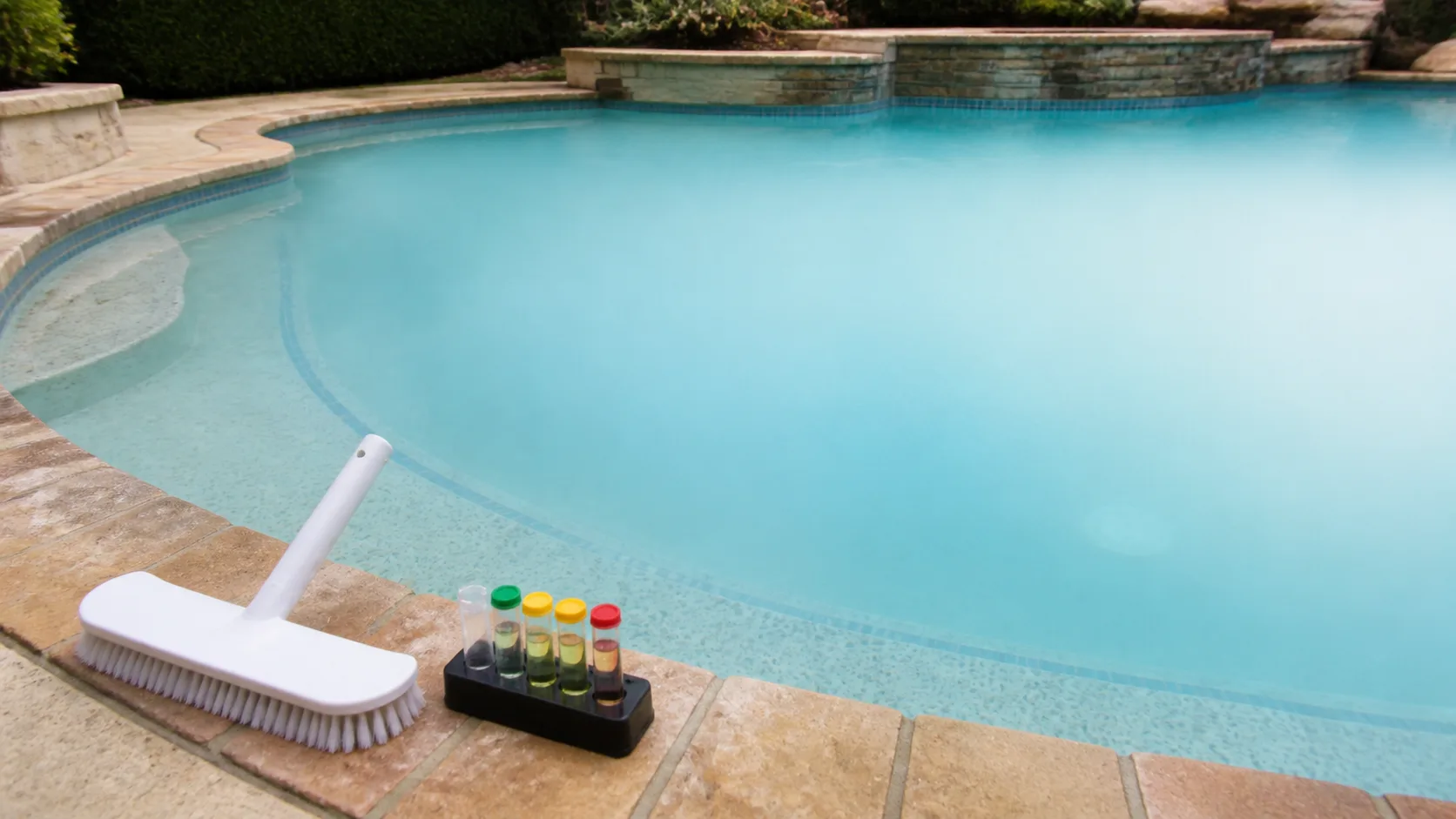
Cloudy water is the most frustrating pool problem because nothing is obviously wrong. The chlorine reads fine, the pump is running, nothing smells, and yet the water has gone from glass to milk and you can’t quite see the main drain. The reason it resists fixing is that six different faults produce the same symptom, and the usual response, dumping in more shock, only corrects one of them. Here is how to find out which one you have.
What cloudiness is
Clear water is water with nothing suspended in it. Cloudy water is water carrying particles small enough to stay afloat and numerous enough to scatter light. That’s the whole of it. So every cause below is a version of one of two failures: something is producing particles faster than normal, or the filter has stopped removing them.
Holding that in mind saves a lot of wasted product. If your filter isn’t catching what is in the water, no amount of chemistry will clear the pool, and if the water is constantly precipitating new calcium, no amount of filtration will keep up.
Check these six things, in this order
1. Sanitizer, because it’s free to rule out
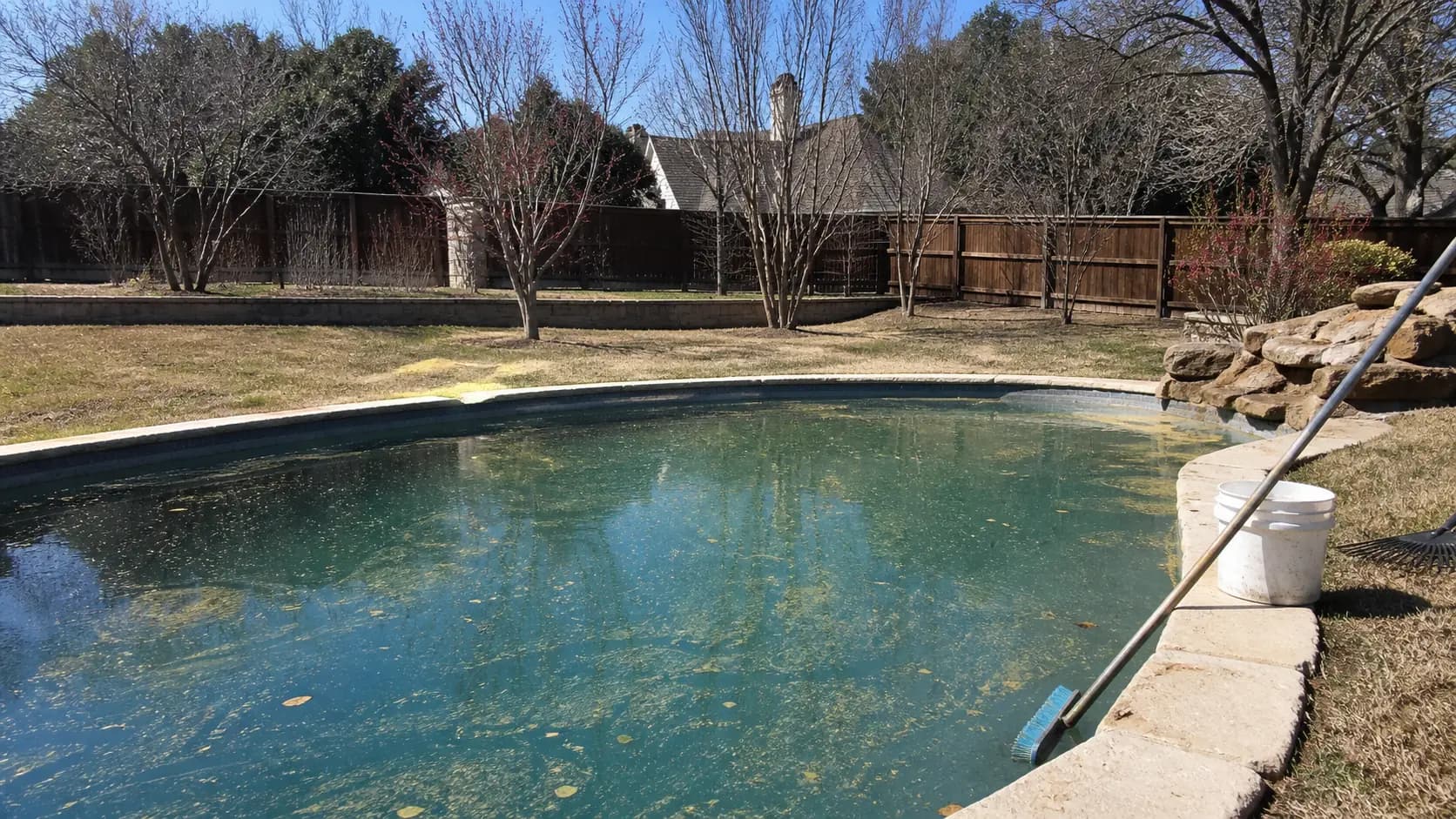
Test free chlorine first, against a real floor rather than a vibe. The CDC recommends at least 1 ppm of free chlorine in a pool, and at least 2 ppm if the pool uses cyanuric acid, which covers anyone running stabilized tablets or a salt cell. If it is low, you aren’t looking at a cloudy pool, you’re looking at the earliest stage of a green one, and every hour you spend on the filter is an hour algae spends multiplying. Water that has gone dull and slightly green-tinted, with walls that feel faintly slick, is an algae bloom that hasn’t announced itself yet. Go to the green-to-clean sequence instead of this article.
Also check cyanuric acid while you’re there. If CYA has climbed high, which it does steadily on any pool running trichlor tablets, your chlorine reading can look perfectly respectable while doing very little work. High stabilizer is one of the quieter reasons a pool goes dull in July with a textbook chlorine number on the test strip.
2. pH, alkalinity, and calcium
If sanitizer is fine, this is the most likely culprit in North Texas, and it’s the one most owners never check. When pH drifts up, or total alkalinity is high, or calcium hardness has crept up over several summers of topping off, dissolved calcium starts falling out of solution as microscopic crystals. Those crystals are the cloud.
The tell is that the water is milky white rather than green or gray, chlorine is perfectly adequate, and the cloudiness got worse after a hot stretch or right after a heavy shock, both of which push pH up. It often arrives alongside the first white crust at the waterline, which is the same chemistry depositing on a surface instead of staying suspended. Our guide to calcium scale on pool tile covers the underlying balance in detail, and the fix is the same: bring pH back to 7.4 to 7.6, get alkalinity toward the lower end of range, and find out what your calcium hardness actually is.
3. The filter
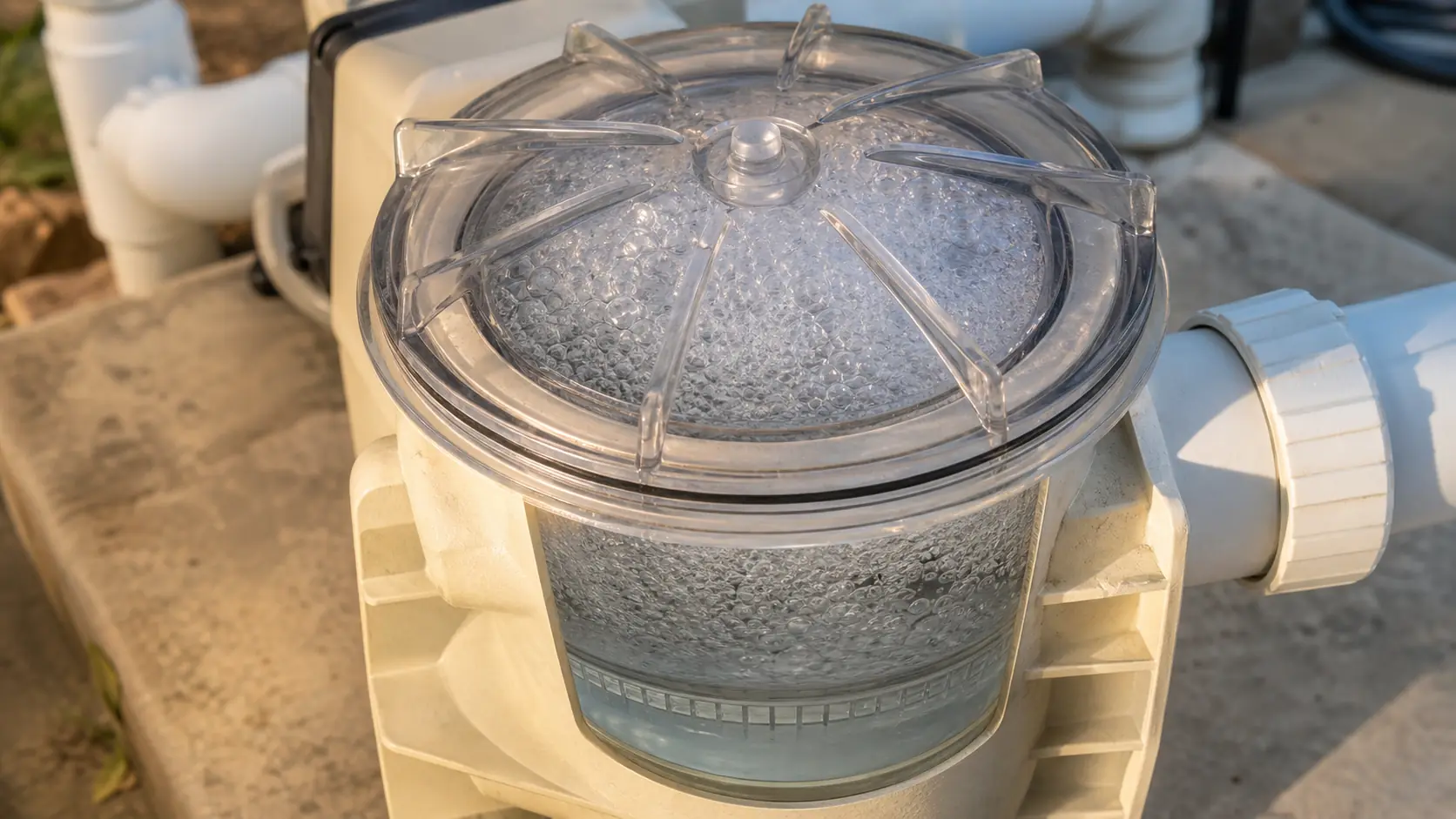
Now check whether the filter is doing its job, which isn’t the same as checking whether it is running.
- Pressure well above the clean baseline. Roughly 8 to 10 psi above the reading you took after the last thorough cleaning means flow is choked and it’s time to clean, regardless of the calendar.
- Pressure at baseline but water still cloudy. This is the interesting case. It suggests the media is passing particles rather than catching them: sand that has channeled or gone smooth with age, a cartridge whose pleats are worn or crushed, or a DE grid with a tear that is letting water bypass the medium entirely.
- Pressure below baseline with weak returns. That’s a flow problem upstream, not a filter problem. Look at baskets, the pump lid o-ring, and valve positions.
Filter age matters more than people expect. Sand is usually good for years but not forever, and cartridges are consumables. If yours is several seasons old and the pool has been slightly off all summer, the element is a strong suspect. The differences between the three media are in our filter comparison.
4. Run time
A filter only filters while the pump is running. Plenty of North Texas pools are run on a schedule that was set in April and never revisited, and in the middle of a Texas August that schedule is simply too short. If the water goes dull between service visits and clears up for a day after one, you have a run time problem more often than a chemistry problem. Our guide to how long to run a pool pump covers how to work out the right number for your pool rather than guessing.
5. Circulation and dead spots
Water that never reaches the filter can’t be filtered. Check that your return eyeballs are aimed to create a rotation rather than pointing straight across at each other, and that at least one is angled slightly downward so the deep water moves. Steps, benches, tanning ledges, behind ladders, and the corners of a rectangular pool are where circulation dies, and they’re exactly where a cloudy pool looks worst.
A quick diagnostic: if the water in the middle looks better than the water over the steps, it is a circulation problem. Cloudiness from chemistry is uniform.
6. Particles too fine for the filter
If everything above checks out and the water is still hazy, you have particles smaller than your filter can catch. This is common after a dust event, after a big storm, after a heavy weekend of swimmers, on a freshly plastered pool shedding plaster dust, and in the tail end of a green-to-clean recovery when dead algae is finer than live algae ever was.
This is the one case where a chemical product is the right answer, and there are two of them that do opposite things.
| Clarifier | Flocculant | |
|---|---|---|
| What it does | Clumps fine particles into pieces the filter can catch | Clumps everything into a heavy mass that sinks to the floor |
| Where the debris ends up | In the filter | On the pool floor |
| What you have to do | Keep running the pump | Turn the pump off, let it settle, then vacuum to waste |
| Time to clear | A day or two, gradually | Overnight settle, then a slow careful vacuum |
| Works with a cartridge filter? | Yes | No, avoid it |
Do not use flocculant with a cartridge filter
Flocculant only works if you can vacuum the settled mass out to waste, bypassing the filter entirely. A cartridge system has no multiport valve and no waste line, so the only route is back through the filter, which immediately clogs it and puts everything you just dropped straight back into the pool. On a cartridge pool, use clarifier and patience. On a sand or DE filter with a multiport, flocculant is a legitimate tool for a bad case.
Reading the color
| What you see | Most likely cause |
|---|---|
| Milky white, chlorine normal | Calcium out of solution, or a filter passing particles |
| Hazy with a green tint, chlorine low | Early algae bloom, not a cloudiness problem |
| Gray or dull, right after a shock | Dead algae the filter hasn’t caught up with yet |
| Cloudy with a brown or tan cast | Dust, pollen, or storm debris; also possible metals after a fresh fill |
| Clear in the middle, cloudy over steps and corners | Circulation dead spots |
| Cloudy only in the afternoon heat | Chemistry drifting as the water warms, usually pH |
How long clearing should take
Once the actual cause is corrected, a cloudy pool clears from the top down and from the deep end in. A mild haze with a working filter and a corrected pH generally clears within a day or two of continuous filtration. A pool that needed a filter cleaning plus a chemistry correction can take two to four days. Anything still cloudy after a week of continuous running with balanced water and a clean filter is telling you the diagnosis was wrong, not that it needs more time.
The most common way people lose a week is by fixing the sixth thing on the list before the second: adding clarifier to water whose pH is driving the cloudiness in the first place. The clarifier does its job, the calcium keeps precipitating, and the pool never clears.
Write the clean baseline on the filter tank
Almost every diagnosis above depends on knowing what your filter pressure reads when it is genuinely clean. Take that number after the next cleaning, with the pump at its normal speed, and put it on the tank with a paint pen. It costs nothing and it converts a guess into a measurement.
When to hand it over
Cloudy water that resists a full round of correct steps usually has an equipment cause behind it, and that’s worth diagnosing properly rather than treating repeatedly. Our equipment inspection covers filter condition, flow, and circulation, and our chemical balancing covers the full panel including the calcium and stabilizer numbers most home test strips don’t measure well. If the pool has tipped past cloudy into green, that’s a green-to-clean job instead, and it’s better caught early than late.
The two ends of this are far apart on price, and separating them early is worth doing. A filter deep clean is routine maintenance priced like maintenance, and what a filter clean costs covers when it is genuinely due rather than approximately due. A pool that has tipped past cloudy into green is a different job on a different scale, and what a green pool cleanup costs explains what moves that number.