Is Weekly Pool Service Worth It in Texas?

Austin Andrews
Founder, True Texan Pools
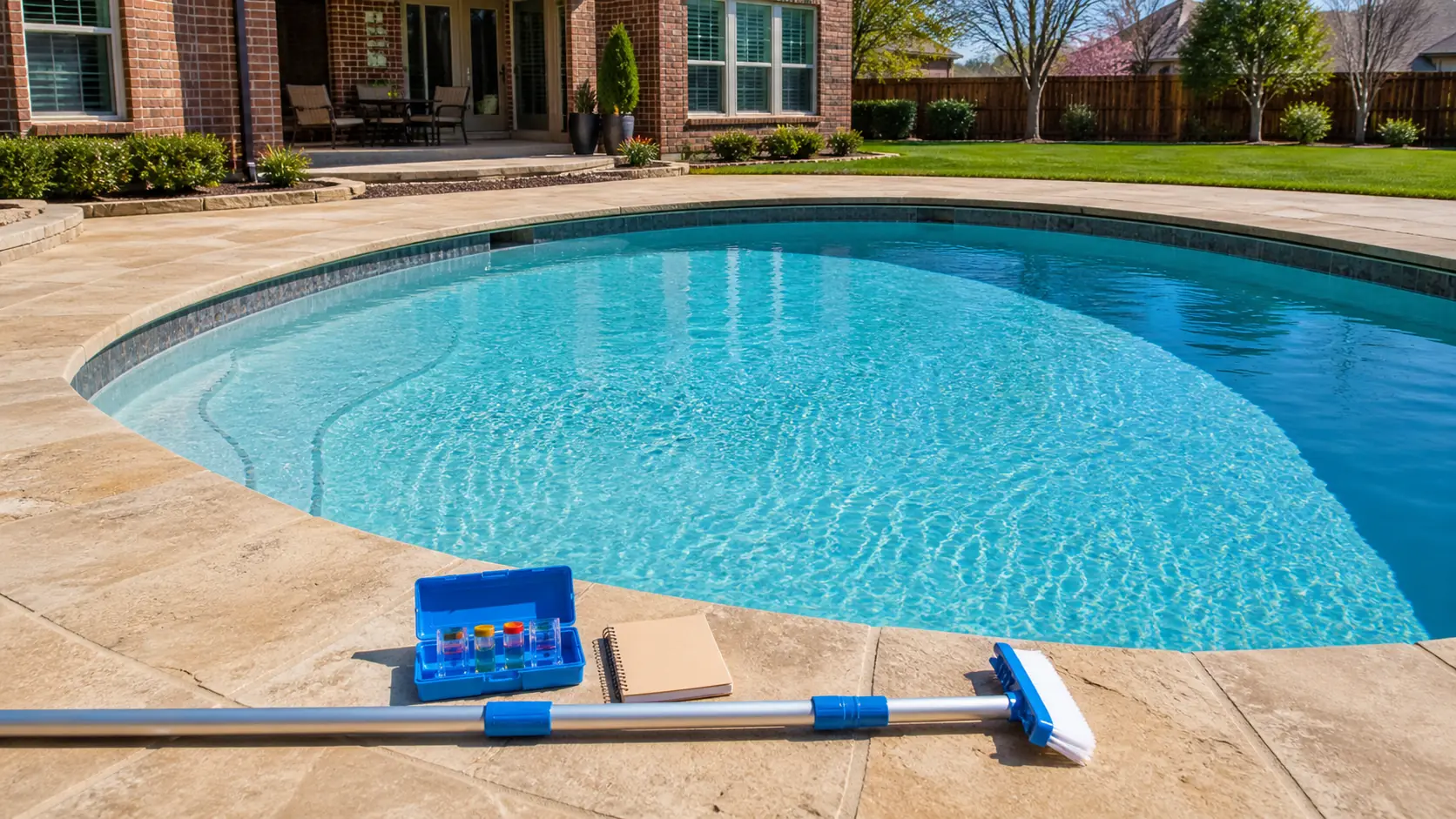
Most of the content answering this question was written in Florida or California, and the answer genuinely differs here. Not because Texas pools are special, but because Texas summers remove the margin for error that makes a fortnightly interval defensible elsewhere. The question is not whether a pool needs attention every seven days. It is what happens on days eight through fourteen, in August, at 95 degrees.
Start with what a visit actually is. Eight tasks, roughly twenty to thirty five minutes on a normal pool: skim, empty both baskets, brush including the waterline, vacuum or reposition the cleaner, test, dose, check the equipment, and report. Our task-by-task breakdown covers each one with an honest duration and what it leaves behind as evidence.
The interval question is really a question about which of those eight tasks degrades fastest when it is skipped, and the answer is not the one people expect. It is not skimming. It is the chlorine.
Why Texas breaks the fortnightly answer
Three things stack up here in a way they do not in a milder climate.
Sunlight destroys chlorine
Ultraviolet light breaks down free chlorine continuously. Longer days at a higher sun angle mean more total UV reaching the water, and a July pool in Collin County can easily consume twice what the same pool used in a mild June week. Stabilizer slows this down, which is why cyanuric acid exists, and it does not stop it.
Warm water accelerates everything biological
Algae reproduction rises steeply with temperature. A pool sitting in the low 90s is a materially different problem from the same pool at 78 degrees. This is why the same amount of neglect produces very different outcomes in April and August.
Use adds load exactly when the water is weakest
August is when people actually swim, and sweat, sunscreen, and organics consume chlorine directly. The pool is under its heaviest demand at the point when sunlight is destroying the sanitizer fastest.
Put the three together and you get the number that governs this entire decision: once free chlorine reaches zero in a North Texas summer, a pool turns green in roughly two to three days. Not two weeks. Days.
What the gap actually looks like
On a biweekly plan in August, the technician doses on day one to a level intended to carry the pool. By day six or seven it is at the bottom of range on a hot week. By day nine it is at zero. Days ten through fourteen are unsupervised growth. The pool is not slightly worse on the second week, it is on a different trajectory, and the visit on day fifteen is a recovery rather than a maintenance visit.
The season-by-season answer
| Period | Water | Honest interval | Why |
|---|---|---|---|
| May to September | 78 to 90 plus | Weekly | Chlorine demand is at its peak and the failure mode is fast |
| March and April | 60 to 75 | Weekly | Algae wakes up, pollen arrives, storms dilute. The month the year is decided |
| October and November | 60 to 75 | Weekly during leaf drop | Debris load, not chemistry, is what drives it |
| December to February | Below 60 | Every two weeks is defensible | Cold water consumes little chlorine. Freeze protection is the real task |
That table is the actual answer, and it is more useful than a yes or a no. Anybody telling you a Texas pool needs the same intensity of attention in January that it needs in July is not being straight with you. Anybody telling you fortnightly is fine in August has not recovered many August pools. Weekly versus biweekly goes into the interval comparison in more detail, and the month-by-month pool year covers what each month actually needs.
The money, done properly
Published DFW rates run about $120 to $220 a month for weekly service. A biweekly plan is typically somewhat more than half of that rather than exactly half, because the drive is the same and the work per visit is greater.
Set the annual saving against one number: a green pool recovery in this market costs several times a monthly rate, with published ranges running from $200 to $300 for a light bloom up to $500 to $1,500 where a partial drain is involved. What a green recovery costs in DFW has the detail.
So the arithmetic is straightforward. If dropping to biweekly produces one recovery a year, it costs you money. If it produces none, it saves you some. Which of those two happens depends almost entirely on whether somebody is watching the pool between visits, and that is a question about your own summer rather than about the pool.
The genuinely honest middle option
Weekly from March through October and biweekly from November through February matches the actual workload rather than a subscription tier. It costs less than year-round weekly, it does not create the August gap, and it keeps somebody checking the pad through freeze season. If a company will not structure it that way, that is a business decision on their part rather than a technical requirement.
What weekly service buys that is not a task list
Three things, and the price comparison usually misses all of them.
- Consistency in the weeks you would have skipped. This is the whole product, and it is hard to sell because its value is the absence of an event.
- Somebody reading the equipment weekly. A filter gauge drifting up, a shaft seal starting to weep, a salt cell losing output, a pump pulling air. Each is cheap early and expensive late, and each is invisible unless somebody looks.
- Early detection of the slow problems. Calcium hardness climbing, cyanuric acid drifting up on tablets, a water level falling faster than evaporation explains. None of these announce themselves and all of them cost real money by the time they do.
When weekly service is genuinely not worth it
Four honest cases.
- You enjoy doing it and you are home. The routine is achievable and plenty of people prefer it. The DIY comparison has both columns.
- Winter, on a simple pool. Fortnightly is defensible from December to February.
- A small, shaded, lightly used pool with modern equipment. Genuinely lower demand, and a candidate for a mixed schedule.
- You would be paying for a visit nobody verifies. Service you cannot audit is not service, it is a direct debit. Ask for dated photos and the readings.
When it is clearly worth it
- You travel in summer, or your weeks are unpredictable.
- Full sun, no canopy, which raises chlorine demand substantially.
- A spa, water features, or a heater, all of which add chemistry and equipment to watch.
- Heavy tree load, which puts debris in faster than a fortnight can absorb.
- The pool has gone green before. Once is bad luck, twice is an interval problem.
- A rental or second property, where nobody walks past it daily.
How to judge whichever you choose
The interval only matters if the visits actually happen and actually work. Four checks the morning after your service day, whatever you are paying for:
- The skimmer basket should be empty or nearly so.
- The waterline tile should have no grey scum band.
- The deck should show splash or brush drag marks in the dust.
- The tabs in the feeder should be visibly consumed.
Test the chlorine yourself once a month and confirm the number is moving. If it is not, the interval is not your problem. What to do when a pool company stops showing up covers that situation properly.
Where we stand
We run weekly, year round, and the rate does not change between February and August, which is a trade that runs in both directions: you pay the same in the light months and the same in the month the pool is genuinely hard work. Pricing is published on the weekly service page rather than held back for a callback, there is no contract, and every visit ends with dated photos and the readings so the interval is something you can verify rather than something you are told.
If your honest answer after reading this is that you want weekly in summer and lighter in winter, say so when you call. That is a reasonable thing to want and it matches what the pool actually needs.
The honest summary is that this is not really a question about service. It is a question about what happens to your pool in the second week of August when nobody has looked at it. If the answer is that somebody will, the interval is yours to choose. If the answer is that nobody will, weekly is not an upsell, it is the thing standing between you and a recovery bill.
Frequently Asked Questions
Is weekly pool service worth it in Texas?
From May through September, yes. From December through February, genuinely not on a simple pool, and anybody claiming otherwise is selling. The controlling fact is that a North Texas pool goes from clear to green in roughly two to three days once free chlorine reaches zero, so a fortnightly gap in August is not half the service, it is a week of unsupervised growth.
How often should a pool be serviced in North Texas?
Weekly from March through October, and every two weeks is defensible from December through February. March matters as much as August, because water crosses 60 degrees and algae wakes up while most owners are still on a winter routine. October is driven by leaf load rather than chemistry. The winter task that actually matters is freeze protection, not water quality.
Is biweekly pool service cheaper overall?
Only if it does not produce a recovery. Biweekly typically costs somewhat more than half of a weekly rate, because the drive is the same and the work per visit is greater. Set the annual saving against a green pool recovery, which in this market runs from $200 to $300 for a light bloom up to $500 to $1,500 where a partial drain is needed. One bloom a year erases the saving.
What does weekly pool service buy beyond the task list?
Three things the price comparison misses. Consistency in the weeks you would have skipped, which is the whole product and is hard to sell because its value is the absence of an event. Somebody reading the equipment weekly, since a rising filter gauge or a weeping shaft seal is cheap early and expensive late. And early detection of slow problems such as calcium and cyanuric acid drifting out of range.
Do pools need service in a North Texas winter?
Yes, but lighter, and the work changes rather than stopping. Pools here are not winterized the way northern pools are, so circulation continues and the water level, the prime, and the freeze protection settings are the things that matter from December through February. A single unprotected hard freeze can cost more than a year of service.
How can I tell whether my pool service is actually doing the work?
Four checks the morning after your service day. The skimmer basket should be empty or nearly so, the waterline tile should have no grey scum band, the deck should show splash or brush drag marks in the dust, and the tabs in the feeder should be visibly consumed. Test the chlorine yourself once a month and confirm the number has moved.
Ready to stop thinking about your pool?
True Texan Pools keeps your water swim-ready year-round across Plano and all of DFW. Clear pricing, no contracts, and a photo report after every visit. Austin handles every job personally.
Keep reading
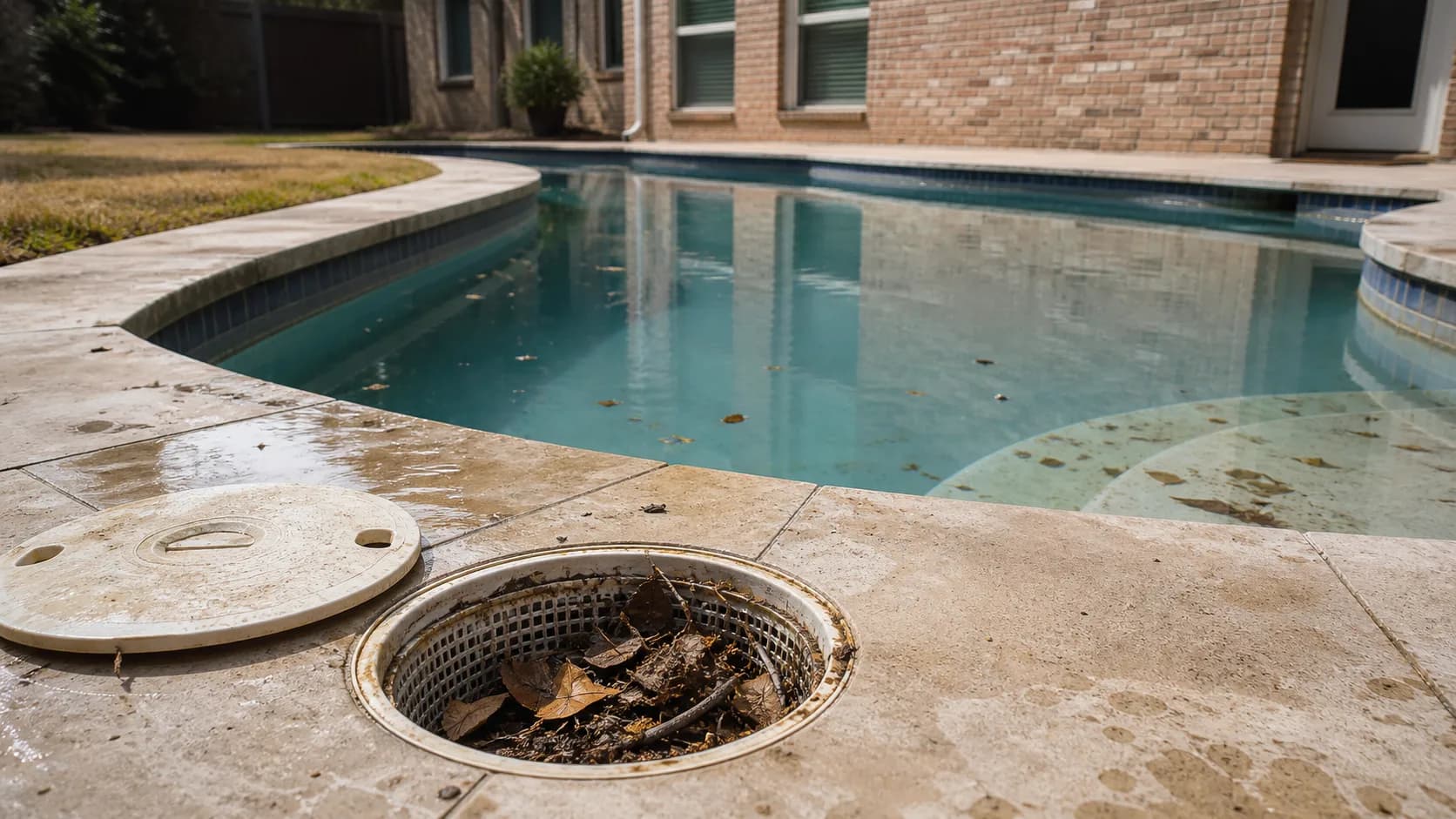
Your Pool Company Stopped Showing Up. Here Is What to Do.
The visits stopped, the invoices did not, and nobody is returning your calls. There is an order to doing this that keeps both your leverage and your water, and most people get it backwards.

How to Choose a Pool Service Company in Plano (10 Questions)
The pool service market in Plano is full of rotating technicians, vague pricing, and long contracts. Here are the 10 questions that separate a great pool company from a frustrating one.