The North Texas Pool Year, Month by Month

Austin Andrews
Founder, True Texan Pools
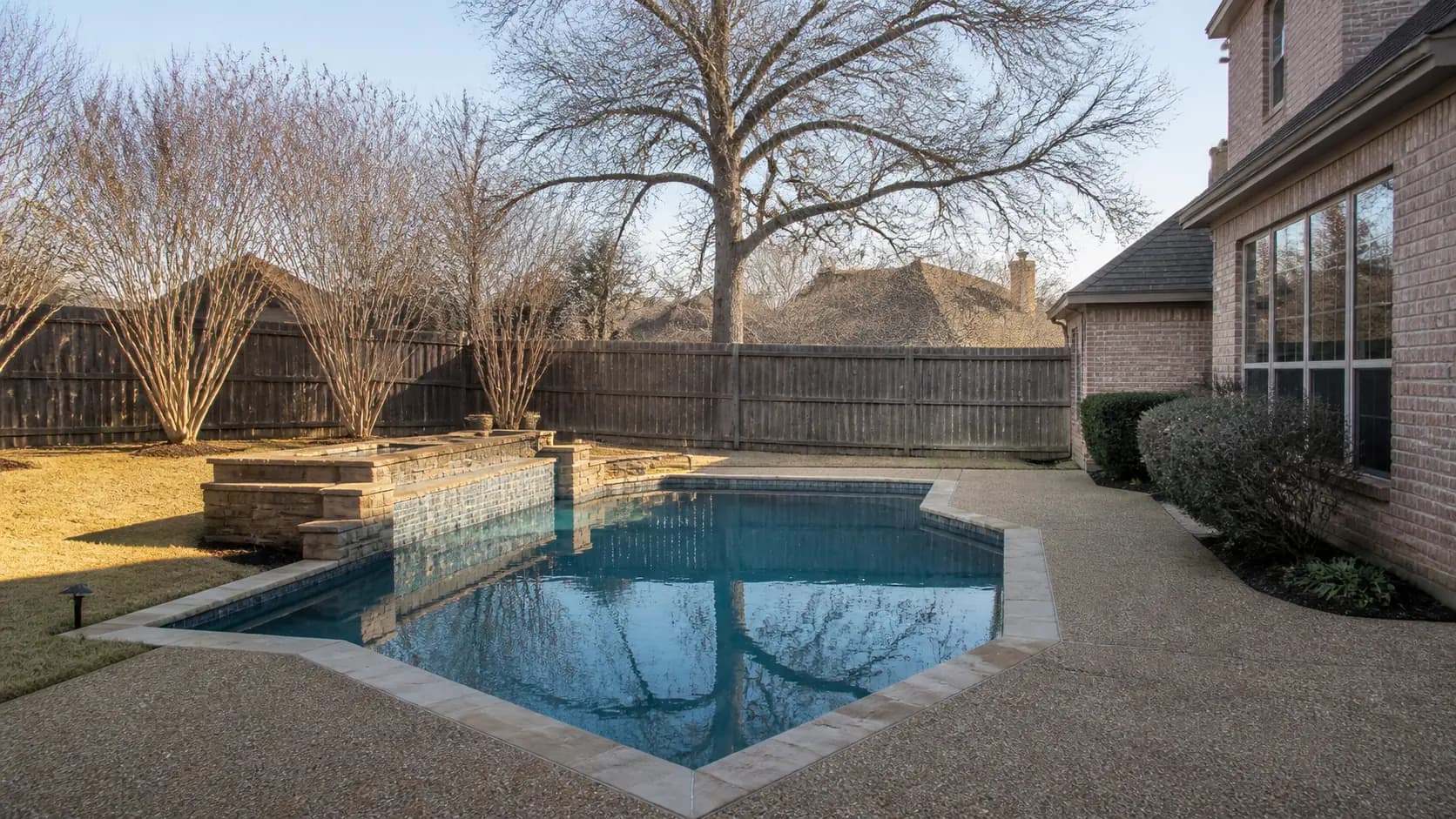
A pool in Collin County is never closed and never finished. There is no winter shutdown to hide behind and no month where the water can be left alone, but there are twelve genuinely different jobs, and doing each one in the right month is most of what separates a pool that is easy from a pool that is a running argument. This is the whole year, month by month, with the weather that drives each one and the single mistake people make in it.
Two things make our calendar different from the one on the back of a chlorine bucket. The first is that we do not have a season. A pool in Minnesota gets covered in September and uncovered in May, so its owner has eight months off. Ours circulates in February. The second is that our winter is not cold, it is intermittently cold, which is worse for equipment. A pool that freezes solid for three months is a known problem with a known solution. A pool that sits at 55 degrees for six weeks and then drops to 12 overnight is the problem that splits pipe, and it is the North Texas problem.
Everything below assumes a normal residential pool in Plano, Frisco, McKinney, Allen, or the surrounding Metroplex, running year round with no cover. Where a month has a job big enough to deserve its own guide, it links to one rather than repeating it here.
January: protect the equipment, ignore the water
Water temperatures sit in the 40s and low 50s. Almost nothing grows down there, chlorine demand is at its floor for the year, and the water will look after itself for weeks at a time. Everything that matters in January is at the equipment pad.
- Set freeze protection properly and confirm it actually runs. On most systems that means the pump starting automatically below about 37 degrees, and it means testing it once rather than assuming.
- Keep the water level up. A skimmer that drops below its throat during a freeze pulls air and loses prime, which is how a pump ends up dry and the plumbing ends up still.
- Check chlorine every two weeks rather than weekly. It will barely move. Hold the low end of your range instead of the top.
The January mistake
Turning the pump off to save electricity during a cold snap. Moving water is the entire freeze defense on a North Texas pool, and the night you switch it off to save two dollars is the night that costs a plumbing repair. Our freeze protection guide covers the sequence, including what to do when the power goes out and the choice is taken away from you.
February: the freeze audit, then the first look at spring
February holds our coldest recorded snaps and our first warm week in the same four weeks. It is a month of two halves. Early February is still January. Late February is where spring startup begins, and starting it early is the cheapest advantage available on this calendar.
- After every hard freeze, walk the pad in daylight and look for wet concrete, a hairline split along a pipe, a cracked pump lid, or a filter housing weeping at its clamp band. Freeze damage frequently does not leak until the system is pressurized again.
- Pull and clean the filter before the season rather than during it. A filter that starts March clean is a filter that can cope with pollen.
- Test calcium hardness and cyanuric acid, the two numbers that only ever climb. February is when a partial water exchange is comfortable to do, because nobody wants to swim yet.
The February mistake
Waiting until the water is warm to look at the equipment. A cracked pipe found in February is a scheduled repair. The same crack found in May is an emergency in the middle of everyone else’s emergency.
March: the month the year is decided
Water crosses 60 degrees somewhere in March, and that is the number that matters. Below it, algae is effectively dormant. Above it, algae reproduces, and every week of casual chemistry you got away with in January starts compounding. Pollen arrives at the same time and eats chlorine on its own account.
- Go back to weekly testing and weekly brushing. This is the single highest-value change on the whole calendar.
- Raise the pump schedule toward a full daily turnover. Winter hours will not keep a warming pool clear.
- Get the chemistry actually balanced rather than approximately balanced, in the order alkalinity, pH, calcium, stabilizer, chlorine. Our water chemistry guide has the targets and the reason for that order.
The March mistake
Treating March like February. Almost every green pool we recover in April was fine in March and was being maintained on a January schedule. Spring startup is a real job, and opening and closing in North Texas covers it properly.
April: pollen, storms, and the first swim
Oak pollen falls in sheets, spring storms drop several inches at a time, and the first warm weekend brings the first swimmers. All three consume chlorine. April water is usually still in the 60s and low 70s, which is cold to swim in and warm enough to grow things.
- Skim daily during pollen drop if you can. Pollen that sinks is organic load your chlorine has to deal with.
- After every storm, empty the baskets, brush, then test. Heavy rain dilutes chlorine and stabilizer and drops pH.
- Before the first swim, confirm free chlorine against your cyanuric acid level rather than against a strip color, and check that the barrier and gate still latch after a winter of ground movement.
The April mistake
Reading a chlorine number without reading the stabilizer number beside it. A pool holding 3 ppm of chlorine at 90 ppm of cyanuric acid is not sanitized, and April is when that quietly stops being theoretical. Why chlorine reads fine and the pool goes green explains the ratio.
May: the real start of the season
Water reaches the mid to high 70s, the pool gets used properly for the first time, and storms are at their most active. May is the month the pool stops being a maintenance object and starts being a thing your family is in.
- Get the equipment inspected before the heat arrives, not after something fails in it.
- Check the heater now if you have one, because you will want it in October.
- Verify the automatic cleaner actually covers the floor rather than one favorite corner.
The May mistake
Booking service after the first hot week. Every pool company in the Metroplex fills its route between mid-April and Memorial Day. The month you can get on a schedule easily is February.
June: settle into the routine that will carry the summer
Air temperatures reach the 90s, water into the 80s, and the pool begins consuming chlorine in earnest. June is not dramatic. It is the month to build the habit that August will test.
- Twice-weekly testing from here until September.
- Watch the water level: evaporation is now roughly half an inch a day.
- Check local watering and fill rules before topping off from a hose, especially in a drought year.
The June mistake
Assuming an autofill means you never have to look at the water level. An autofill hides a leak perfectly. If your water bill jumps in June, run the bucket test before you accept the number.
July: chemistry, not cleaning
Water in the mid 80s, relentless UV, and heavy use. Chlorine consumption is at or near its annual peak, and the pool is not dirty so much as it is chemically hungry.
- Hold the top of your chlorine range, not the middle.
- Shock at dusk. Anything added in the afternoon is partly destroyed before it works.
- Watch filter pressure, which climbs faster in summer than any other season.
The July mistake
Sanitizing the July pool on the June dose. Nothing looks wrong until the day it does.
August: the hardest month of the year
Water can reach 90 degrees and stay there. Chlorine demand roughly doubles against a mild June week, algae reproduces fastest, and the equipment pad has the least thermal headroom it will have all year.
- Test twice a week without exception, and dose for six days out rather than for today.
- Buy turnover with longer hours at a lower pump speed rather than the same hours flat out.
- Deal with the afternoon thunderstorm the same evening it lands, not the next weekend.
The August mistake
Going on vacation with a floater full of tablets and no plan. What changes above 100 degrees covers the August routine in full, including why an unattended pool here goes green in days rather than weeks.
September: the reprieve, and the month to fix things
Heat breaks somewhere in September, water falls back through the 80s, and demand eases. It is the best repair window of the year: parts are available, technicians are free, and nothing is urgent.
- Do the repairs you deferred in July.
- Bring cyanuric acid back down if a summer of tablets pushed it up.
- Clean the filter properly before leaf season rather than after it.
The September mistake
Relaxing the routine before the water has actually cooled. Mid-September water is still summer water.
October: leaf season, which is our real autumn problem
North Texas leaf drop is late, compressed, and heavy. Live oak, post oak, and pecan put more material in the water in four weeks than the rest of the year combined, and every bit of it consumes chlorine and clogs something.
- Empty skimmer and pump baskets far more often than weekly during peak drop.
- Get leaves off the floor before they break down and stain plaster.
- Consider a skimmer sock or leaf canister for four weeks only, then take it off.
The October mistake
Letting a packed skimmer basket sit for a week. It starves the pump, which costs you circulation for seven days and shortens the pump’s life for no benefit at all.
November: winterize the equipment, not the pool
Our first real freeze usually lands in November. The pool is not closing, but the pad now needs to be ready for a hard night with no notice.
- Set and test freeze protection before you need it.
- Insulate exposed plumbing and the pump, and know where your shutoffs are in the dark.
- Finish leaf cleanup and get the filter clean going into winter.
The November mistake
Discovering on the night of the first hard freeze that the freeze protection was never configured. Test it in daylight in November while the stakes are zero.
December: light work, high stakes
Water in the 50s, minimal chemical demand, and the least attractive month to walk outside and look at a pool. The work is small and the consequence of skipping it is not.
- Keep the water level at mid-skimmer.
- Confirm the pump runs when it is told to, on the coldest night of the month.
- Test monthly, hold a low chlorine residual, and leave it alone otherwise.
The December mistake
Cancelling service for the winter to save four months of fees. Winter service is cheap insurance against a freeze repair, and the pool that is dropped in December is the pool that needs a recovery in March. Weekly versus biweekly covers where the real interval risk sits.
The year in one table
| Month | Typical water | The job that matters | The failure it prevents |
|---|---|---|---|
| January | Upper 40s to low 50s | Freeze protection | Split plumbing |
| February | Low 50s | Freeze audit and filter clean | A May emergency |
| March | Upper 50s to 60s | Back to weekly chemistry | An April green pool |
| April | 60s to low 70s | Pollen and storm response | Chlorine collapse |
| May | Mid to upper 70s | Equipment check before the heat | Peak season failure |
| June | Low 80s | Routine and water level | A hidden leak |
| July | Mid 80s | Hold chlorine at the top of range | Algae bloom |
| August | Upper 80s to 90 | Twice-weekly testing | A full recovery |
| September | Low 80s falling | Repairs and CYA correction | Next summer's bills |
| October | 70s | Leaf removal | Clogged equipment and stains |
| November | 60s | Freeze prep and testing | First-freeze damage |
| December | 50s | Water level and circulation | A dry, still, frozen pad |
What this looks like if you would rather not do it
Every job above is achievable by a homeowner with a test kit and a Saturday. What is hard is not the individual task, it is doing the right one in the right week, twelve months running, including the February one where the water looks perfect and the work is entirely preventive. That is most of what a service plan actually buys.
We run weekly service year round rather than seasonally, because a North Texas pool has no month where nothing needs doing, and the two months where the water needs least are the two months where the equipment needs most. Pricing is published on that page, we cover Plano, Frisco, McKinney, and Allen among others, and there is no contract to sign for it.
If you only take one thing from this calendar, take the March line. Everything expensive we get called about in April and May was preventable in March, and almost nobody is looking at their pool in March.
Frequently Asked Questions
What is the pool maintenance schedule for North Texas?
It changes four times. December through February is freeze protection with light chemistry. March through May is the ramp-up, with weekly testing and a full turnover schedule as water crosses 60 degrees. June through September is chemistry, with twice-weekly testing and chlorine held at the top of range. October and November are leaf load and freeze preparation. There is no month with nothing in it.
Which month matters most for a pool in North Texas?
March. Water crosses 60 degrees, which is the point at which algae stops being dormant and starts reproducing, and pollen arrives to feed it at the same time. Almost every green pool we recover in April was fine in March and was still being maintained on a January schedule. Everything expensive we get called about in spring was preventable in March.
Do North Texas pools need winterizing?
The equipment does, the pool does not. Pools here are not drained, plugged, and covered the way northern pools are, because our winter is mild days punctuated by a few hard nights and a closed pool would still be sitting still on the night that mattered. What is needed is freeze protection set and tested, water level kept at mid-skimmer, and circulation maintained.
When should I book pool work in North Texas?
February. Every pool company in the Metroplex fills its route between mid-April and Memorial Day, so an equipment inspection, a filter service, a spring startup, or a new customer slot is trivially available in February and difficult in May. It is also when a freeze-cracked pipe is a scheduled repair rather than an emergency in the middle of everyone else's emergency.
What is the biggest pool mistake people make in a Texas winter?
Turning the pump off during a cold snap to save electricity. Moving water is the entire freeze defense on a North Texas pool, and the night you switch it off to save two dollars is the night that costs a plumbing repair. The second biggest is cancelling service for the winter, which is how a pool that was fine in December needs a recovery in March.
How much does pool care change between summer and winter here?
Substantially, in both directions. In August it is twice-weekly testing, chlorine held at the top of range, dosing for six days out, and same-evening storm response. In January it is a two-week testing interval, four to six pump hours a day, and a water level check. The work is genuinely lighter in winter, which is exactly why it is so easy to neglect past the point of recovery.
Ready to stop thinking about your pool?
True Texan Pools keeps your water swim-ready year-round across Plano and all of DFW. Clear pricing, no contracts, and a photo report after every visit. Austin handles every job personally.
Keep reading
What Changes in Your Pool Above 100 Degrees
A pool that has been effortless since April starts misbehaving in the second week of August, and the owner has changed nothing. That is exactly the point.
Opening and Closing a Pool in North Texas (Most Never Close)
The close-in-September habit does not survive North Texas. Our winters are mild but punctuated by hard freezes, and the pool you walk away from in November is the one you pay to recover in April.