How Much It Costs to Fix a Green Pool in DFW

Austin Andrews
Founder, True Texan Pools
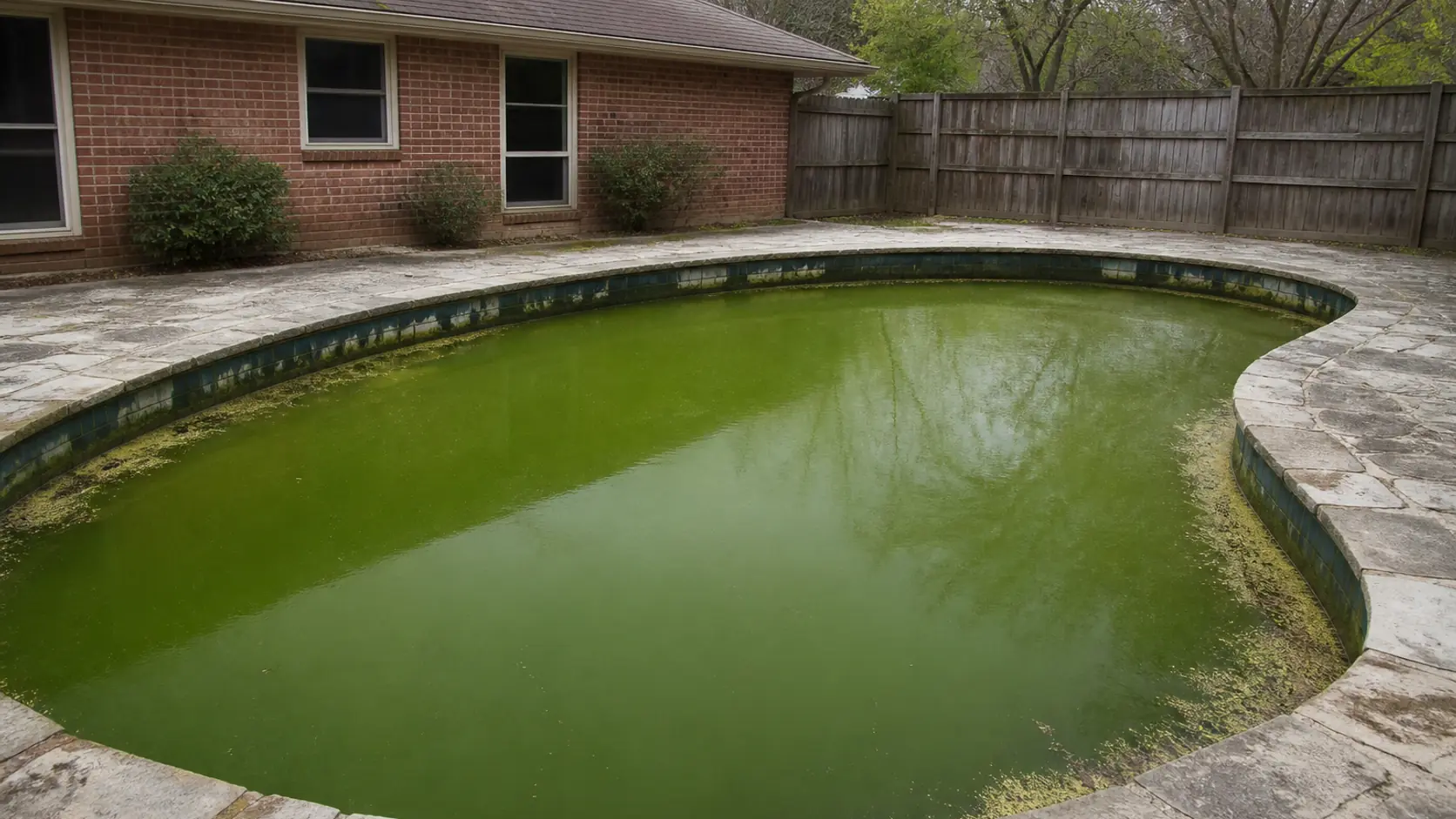
Published prices for clearing a green pool are all over the place: $200 to $300 in one guide, $250 to $800 in another, $300 to $800 for chemical treatment, and $500 to $1,500 where a drain is involved. That spread is not sloppiness, it is the article. Four things determine which end of it your pool lands on, three of them are visible from the deck, and one of them is a number most owners have never tested. Here is how to work out your own band before anybody quotes you.
A green pool is an algae bloom, and an algae bloom means free chlorine reached zero and stayed there. In a North Texas summer that takes roughly two to three days. The recovery is not complicated in principle: kill the algae, filter out the dead algae, and fix whatever let chlorine hit zero. The reason prices vary so wildly is that each of those three steps scales differently depending on your specific pool.
This article is about what it costs and why. If you want to do it yourself, our green pool guide has the recovery sequence and does not need repeating here.
Driver one: how green is it, actually
| What you see | What is happening | What the job involves |
|---|---|---|
| Water clear but faintly tinted, bottom visible | An early bloom, caught within a day or two | Shock, brush, filter. Often clear within 24 to 48 hours |
| Definitely green, bottom visible in shallow end only | An established bloom | Repeated shocking, heavy brushing, several days of filtration and filter cleaning |
| Opaque green, no bottom visible anywhere | A heavy bloom over a week or more | Multiple large chlorine doses, debris removal blind, repeated filter cleans, several days |
| Dark green or brown, debris and organics on the floor | Weeks to months unattended | Physical debris removal first, then chemistry. Partial drain often cheaper |
| Black spots on plaster, whatever the water looks like | Black algae, rooted into the surface | A different job. Mechanical scrubbing plus targeted treatment, over weeks |
The single most useful thing you can do before calling anybody is take a photograph from the deck standing in the same place, plus one straight down at the shallow end steps. Whether the steps are visible sorts a pool into the top half or the bottom half of that table immediately.
Worth checking which organism you actually have before pricing anything, because the bottom row of that table is not a green pool at all. Telling green, mustard, and black algae apart takes ten seconds with a brush, and black algae is quoted as a different job on a different timeline.
Driver two: the number nobody mentions
This is the part that explains why two pools that look identical get quoted hundreds of dollars apart, and almost nobody publishes it.
Chlorine effectiveness is governed by your cyanuric acid level, not by an absolute chlorine number. Stabilizer binds chlorine into a slowly released reserve, which is exactly what you want against Texas sunlight, and which also means that the higher your CYA, the more free chlorine you need to achieve the same sanitizing power. Roughly 7.5 percent of your CYA is the working target, and killing an established algae bloom requires holding a much higher level than that for days.
So consider two identical 18,000 gallon pools, both fully green. One is at 40 ppm cyanuric acid. The other has been running trichlor tablets for three seasons and is at 120 ppm. The second pool needs roughly three times the chlorine to reach and hold the same shock level, for the same number of days. That is not a small difference on a chemical bill, and it is the single largest hidden driver of a green pool quote.
Which is why the honest quote sometimes includes a drain
On a pool with very high cyanuric acid, the cheapest route to clear water is frequently to replace some of the water first, bringing CYA down, and then to shock a pool that responds normally. That is why a quote that includes a partial exchange can be lower than one that does not, and why any company that has not tested your CYA is quoting a guess. The cyanuric acid guide explains the mechanism.
Driver three: volume and equipment
- Pool size scales the chemical cost directly. A 30,000 gallon pool costs roughly twice what a 15,000 gallon pool costs to shock, for the same result.
- Filter type and condition determines the second half of the job. Once algae is dead it has to be physically removed, and that is filtration. A sand filter clogs and needs repeated backwashing; a cartridge filter needs repeated tear-down cleaning, sometimes daily during a recovery; DE needs recharging each time. Filter labor is a real line on a recovery quote.
- A pump that is not working stops the job entirely. There is no chemical route to a clear pool without circulation, so a recovery on a pool with a dead pump is a repair first and a recovery second.
Driver four: what is on the floor
A pool that went green in August is a chemistry job. A pool that has been sitting since last autumn has a layer of decomposed leaves on the bottom, and that is physical labor performed blind, by feel, through opaque water. It is slow, it destroys filter media, and it is the reason the top of every published range exists.
In North Texas this is seasonal. The pools that need this treatment are usually the ones that went through an October leaf drop and a winter unattended, which is why our recovery calls cluster in March and April.
Where the published ranges actually come from
| Published range | What it is describing |
|---|---|
| $200 to $300 | A light bloom caught early, chemicals and a visit or two |
| $250 to $800 | The general residential range across severity tiers |
| $300 to $800 | Chemical treatment specifically, excluding drains |
| $500 to $1,500 | Jobs where a partial or full drain is needed |
Read together, these are not four competing answers. They are four different jobs, and the question to ask is which one you have. A quote at the bottom of the range for a pool at the top of the severity table is not a bargain, it is a misunderstanding that will be corrected later in the week.
Drain and refill: when it makes sense, and the local warning
Sometimes replacing water genuinely is cheaper than treating it, particularly when cyanuric acid is very high, when total dissolved solids are saturated, or when the water is so organically loaded that chlorine demand is effectively bottomless.
Do not fully drain a pool in Collin County
Our expansive clay holds groundwater that exerts real upward pressure on an empty shell, which can lift or crack it. That is a structural repair rather than a resurface, and it is the most expensive mistake available in this county. Exposed wet plaster also crazes within hours in real heat. Never drain after heavy rain. If a pool genuinely needs a large exchange, it is done in stages, or done by somebody watching a hydrostatic relief valve, and clay soil and your pool covers why.
Also budget the water itself. A large partial exchange is thousands of gallons on your meter, and it arrives hard, so the refill needs rebalancing. Hard water covers what fresh NTMWD water brings with it.
How long it actually takes
Three to five days is realistic for a genuine recovery, and it is not because anybody is being slow.
- Day one: test, balance pH so chlorine can work, remove what debris can be removed, first large chlorine dose, brush everything.
- Day two: water often turns cloudy grey or blue-grey, which is progress rather than a setback. It means the algae is dead and suspended. Maintain chlorine, brush, clean the filter.
- Days three to five: filtration does the work. Clean the filter repeatedly, keep chlorine up, vacuum settled material out.
- After: rebalance fully, and fix the cause, or you will be doing this again.
Anybody promising a swamp cleared same-day is describing a different job. The chemistry can be fast; the filtration cannot.
How not to pay for it twice
A recovery that is not followed by a cause fix is a subscription. The four causes we actually see, in order of frequency:
- Cyanuric acid drifted high on tablets, so chlorine that reads fine is not working. See liquid chlorine versus tabs.
- Service was cancelled or lapsed, frequently over winter to save four months of fees, and March arrived.
- The pump or filter failed and nobody noticed for a fortnight.
- A vacation with a floater full of tablets and no plan, in July.
Ask any company quoting a recovery what they believe the cause was. An answer naming a mechanism is a company that will not be back for the same job next year.
What we do
Green to clean recovery is priced by condition rather than by a flat rate, because the four drivers above genuinely determine the work. What we will do before quoting is test the water, including cyanuric acid, and look at the filter and pump, because a quote given from a photograph alone is a number with no reasoning behind it.
After the recovery the pool goes onto the normal monthly rate like any other pool, published on our weekly service page, and what your bill covers sets out where the boundary sits. We cover Plano, Frisco, McKinney, Allen, and the surrounding Metroplex.
One last piece of arithmetic worth doing. A recovery at the middle of the published range costs several times a monthly service rate. If the pool goes green once a year, the recovery is not the cheaper path, it is the more expensive one paid in a way that feels like bad luck.
Frequently Asked Questions
How much does it cost to fix a green pool?
Published ranges run $200 to $300 for a light bloom caught early, $250 to $800 across typical residential severity, $300 to $800 for chemical treatment specifically, and $500 to $1,500 where a partial drain is needed. Those are four different jobs rather than four competing answers. The useful question is which one you have, and severity, pool volume, cyanuric acid level, and what is on the floor decide it.
Why do two green pools get quoted so differently?
Usually cyanuric acid. Chlorine effectiveness is governed by your stabilizer level, so a pool at 120 ppm CYA needs roughly three times the chlorine that an identical pool at 40 ppm needs to reach and hold the same shock level, for the same number of days. That is a large difference on a chemical bill and it is invisible from the deck, which is why a company that has not tested your CYA is quoting a guess.
Am I paying for days of labor while a green pool clears?
No. A recovery takes three to five days, but most of that is the filter running unattended rather than somebody standing there. What you are charged for is the chemicals, which scale with your pool volume and cyanuric acid level, and the visits: typically the initial treatment, then return visits to re-dose, brush, and clean the filter as it loads. Ask any quote to state how many visits it includes, because that is the labor half of the number.
Is it cheaper to drain a green pool than to treat it?
Sometimes, when cyanuric acid is very high, when total dissolved solids are saturated, or when chlorine demand is effectively bottomless. But never fully drain a pool in Collin County: our expansive clay holds groundwater that can lift or crack an empty shell, which is a structural repair rather than a resurface. Large exchanges are done in stages, and the refill is thousands of gallons on your meter arriving hard.
Should I get a quote for a green pool from a photograph?
Treat it as a band rather than a price. A photograph shows severity, which is one of four drivers, and misses cyanuric acid, pool volume, filter condition, and whether the pump works at all. A quote at the bottom of the range for a pool at the top of the severity table is not a bargain, it is a misunderstanding that gets corrected later in the week.
How do I stop the pool going green again?
Fix the cause, or a recovery becomes a subscription. The four causes we actually see are cyanuric acid drifting high on tablets so chlorine that reads fine is not working, service cancelled or lapsed over winter, a pump or filter failure nobody noticed for a fortnight, and a vacation in July with a floater and no plan. Ask any company quoting a recovery what they believe the cause was.
Ready to stop thinking about your pool?
True Texan Pools keeps your water swim-ready year-round across Plano and all of DFW. Clear pricing, no contracts, and a photo report after every visit. Austin handles every job personally.
Keep reading
What Your Monthly Pool Bill Actually Covers, and What It Does Not
Three quotes at $135, $165, and $210 look like a clear decision until you find out they are written in three different billing models. Here is how to compare them properly.
How Much Does Pool Cleaning Cost in Plano, TX? (2026 Pricing Guide)
Most Plano pool companies hide their prices behind a phone call. Here is exactly what weekly service, one-time cleans, and green pool recovery actually cost in 2026, and what drives the number up or down.