DIY vs Hiring: The Honest Collin County Math

Austin Andrews
Founder, True Texan Pools
Doing your own pool is entirely achievable, plenty of people enjoy it, and in pure cash terms it is cheaper. That is the honest starting position from a company that would rather you hired us. What the cash comparison leaves out is the two to four hours a week in summer, the cost of the mistakes that are specific to learning, and the fact that a Texas pool punishes an absent fortnight far more than a northern one. Here is both columns, properly.
This is the last question most new pool owners work through, and it usually gets answered by comparing a monthly service rate against zero, which is the wrong comparison. Both columns have costs. Here is what actually goes in each.
The DIY column: what it really costs
Startup equipment
A one-off spend, and modest against the ongoing lines.
- A telescopic pole, brush head, leaf rake, and vacuum head.
- A drop-based test kit rather than strips. This is not the place to economize, because every decision you make all year is downstream of the readings.
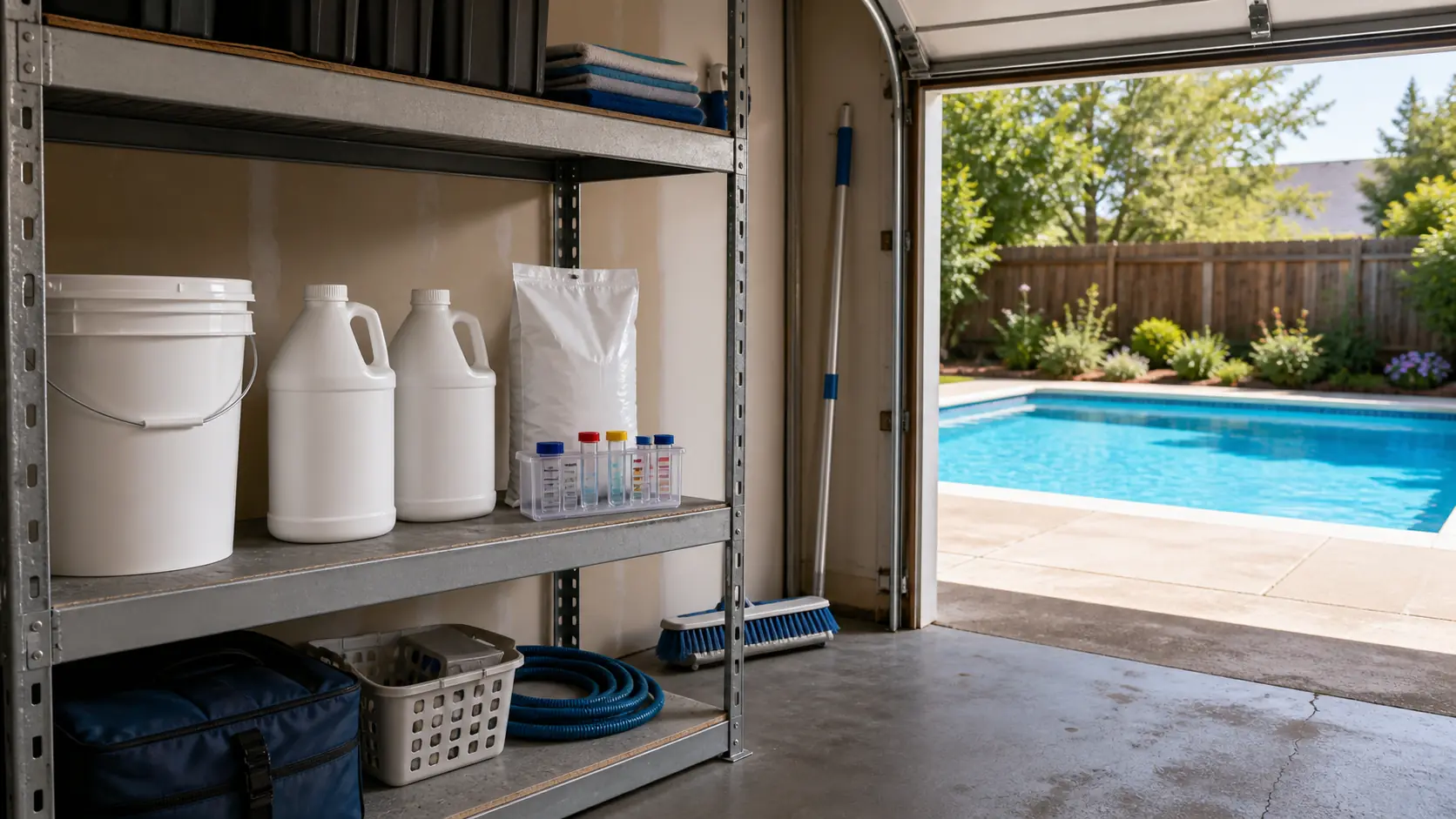
- Somewhere safe to store chemicals: ventilated, out of sun, off the floor, out of reach, with chlorine physically separated from acid. Not optional, and covered in chemical safety and storage.
Chemicals at retail
This is where the saving is smaller than people expect. Published figures put residential pool chemicals somewhere around $50 to $125 a month, and a homeowner buying at a pool store or a big box pays retail on every jug. A service company buys in volume. So the honest chemical saving from DIY is not the full chemical line, it is the difference between what you pay and what a company pays, and that gap is real but not enormous.
Add seasonal variation. A Collin County pool in July and August consumes roughly twice what it used in a mild June week, so the summer chemical bill is the one that matters.
Time, which is the actual price
| Season | Weekly time | What it consists of |
|---|---|---|
| Summer (May to Sep) | 2 to 4 hours | Skim, baskets, brush, vacuum, test twice, dose, check the pad |
| Spring and autumn | 1 to 2 hours | Same tasks, less urgency, plus pollen or leaf load |
| Winter (Dec to Feb) | 20 to 40 minutes | Baskets, water level, occasional test, freeze checks |
| Every 3 to 6 months | 2 to 3 hours | Full filter tear-down and clean |
| Annually | A day | Deeper maintenance, and whatever the year decided to break |
Look at the summer row honestly against your own calendar, because that is the row the decision actually turns on. It is not the difficulty. It is that the pool needs it in the week you have houseguests, in the week you are travelling for work, and in the week it is 104 degrees at six in the evening.
The learning curve, priced
Everybody makes these. They are not signs of incompetence, they are the tuition.
- Over-dosing acid, driving alkalinity down along with pH, and ending up with water that swings wildly between doses.
- Running tablets all season, which raises cyanuric acid permanently, since trichlor is around half stabilizer by weight. The pool then goes green while the test strip looks fine. The CYA guide covers why, and liquid versus tabs covers the product choice that avoids it.
- Shocking in the afternoon, so sunlight destroys much of the dose before it works.
- Adding flocculant to a cartridge filter, which clogs it immediately, since floc requires vacuuming to waste and a cartridge system has no waste line.
- Never cleaning the filter, which costs electricity every day and leaves the water cloudy no matter how good the chemistry is.
The three expensive ones, specific to here
Draining the pool to start fresh. Our expansive clay holds groundwater that pushes upward on an empty shell, which can lift or crack it. That is a structural repair rather than a resurface, and it is the single most costly DIY mistake available in this county.
Switching the pump off during a cold snap to save electricity. Moving water is the entire freeze defense on a North Texas pool.
Letting the water level fall below the skimmer throat. The pump pulls air, loses prime, and can run dry, which destroys a shaft seal in minutes.
The service column: what you are actually buying
Published DFW rates run about $120 to $220 a month, and most of that spread is an inclusion difference rather than a quality difference, which what your bill covers works through. Ours is published: weekly maintenance starts at $120 a month for a small pool, $150 for a medium one, and $225 and up for a large one, chemicals included.
What that buys, beyond the tasks:
- Consistency in the weeks you would have skipped. This is most of the value and it is the hardest thing to sell, because it is the absence of an event.
- Somebody looking at the equipment weekly. A filter gauge drifting up, a seal starting to weep, a cell losing output. All cheap early and expensive late.
- Chemicals at trade cost, and stored somewhere other than your garage.
- Pattern recognition. The difference between reading a number and knowing what it means on a pool with that history in that neighborhood.
What it does not buy, at almost any company here: filter deep cleans, repairs and parts, salt cell replacement, or the first visit on a neglected pool, which is recovery work rather than weekly work.
The comparison that actually matters
| DIY | Weekly service | |
|---|---|---|
| Cash cost | Chemicals at retail, plus equipment | A published monthly rate |
| Your time, summer | 2 to 4 hours a week | Zero |
| Consistency when life gets busy | Depends entirely on you | Unchanged |
| Equipment problems caught early | Only if you look | Weekly, by somebody who knows what a rising gauge means |
| Cost of a bad month | A recovery, at several times a monthly rate | Not your problem |
| Vacation coverage | You arrange something | Included |
| Learning and satisfaction | Real, and genuinely enjoyable for some people | None |
Row five is where the arithmetic usually turns. A green pool recovery costs several times a monthly rate, and in a North Texas summer the road from clear to green is roughly two to three days once free chlorine reaches zero. What a green recovery costs in DFW has the ranges. One recovery a year erases most of the DIY saving, and one recovery every summer erases all of it.
Who should genuinely do it themselves
- You are home most weeks and your schedule is predictable.
- You find the routine satisfying rather than resented. This matters more than any other line.
- The pool is simple: no spa, no water features, moderate trees, working equipment.
- You are willing to test properly rather than by eye, twice a week from May to September.
- You have somewhere safe to store chemicals and are comfortable handling them.
Who should not
- You travel, or your summer weeks are unpredictable.
- The pool is complicated: spa, features, heater, automation, or a salt system you have not learned yet.
- The pool is currently green or has been neglected, in which case the first job is a recovery either way.
- It is a rental or a second property, where nobody is walking past it daily.
- You would be doing it to save money you are not confident you would keep saving in August.
The split nobody advertises
You do not have to pick a column. Three arrangements that work well in practice: handle the skimming, brushing, and baskets yourself and buy chemistry and equipment monitoring; run the pool yourself through the mild months and take service from May through September; or keep the weekly routine and buy the filter cleans and the spring startup as one-off jobs. Ask for the arrangement you actually want rather than the package on the page.
If you want to try DIY properly
Do it in this order and you will avoid nearly all the expensive mistakes.
- Learn the four numbers and the order to correct them in, from the chemistry guide.
- Calculate your pool volume and set the pump by turnover, from the run time guide.
- Learn the pad, from equipment 101, and record the clean filter pressure.
- Sanitize with liquid chlorine as the routine and keep tablets for vacations, so cyanuric acid stays where you put it.
- Know the North Texas calendar, especially March and the freeze months, from the pool year.
Start in late winter rather than in June. Learning on a cold pool that forgives mistakes is a very different experience from learning on an August pool that does not.
And if you would rather not
That is a reasonable answer, and it is the one most people arrive at after a summer of trying. Weekly service is published with its pricing and carries no contract, so trying it for a season costs you a season. If the pool has already got away from you, a recovery comes first and then it goes onto the normal rate like any other pool.
The full cost of ownership breakdown puts both columns beside the three lines you pay regardless of who does the work.
If you want the honest summary from a company that would rather you hired us: do it yourself if you will enjoy it, not if you are trying to save money. The people who succeed at DIY are the ones who like standing by the pool with a test kit on a Saturday. The people who quit are the ones who worked out the saving first and discovered the August part later.
Frequently Asked Questions
Is it cheaper to maintain a pool yourself?
In cash, yes, but by less than the difference between a monthly rate and zero. You buy chemicals at retail rather than at trade prices, so the saving is the gap between what you pay and what a company pays rather than the whole chemical line. The larger cost is time: roughly two to four hours a week in a Collin County summer, every week.
How long does it take to maintain a pool yourself?
Two to four hours a week from May through September, one to two hours in spring and autumn, and twenty to forty minutes in deep winter. Add two to three hours every three to six months for a full filter tear-down. The summer number is the one the decision turns on, and it is worth reading against your own calendar rather than your intentions.
What are the most expensive DIY pool mistakes in Collin County?
Three. Draining the pool to start fresh, because our expansive clay holds groundwater that can lift or crack an empty shell, which is a structural repair. Switching the pump off during a cold snap to save electricity, because moving water is the entire freeze defense here. And letting the water level fall below the skimmer throat, which lets the pump pull air, lose prime, and run dry.
What is the most common chemistry mistake DIY pool owners make?
Running trichlor tablets all season. They are around half stabilizer by weight, so cyanuric acid climbs permanently while the chlorine reading looks fine, and eventually the pool goes green with an acceptable-looking test strip. The fix is to set stabilizer deliberately once and sanitize routinely with liquid chlorine, keeping tablets for vacations.
Do I have to choose between full DIY and full service?
No, and plenty of owners do not. Common arrangements: handle skimming, brushing, and baskets yourself and buy chemistry and equipment monitoring; run the pool yourself through the mild months and take service from May through September; or keep the weekly routine and buy filter cleans and spring startup as one-off jobs. Ask for the arrangement you want rather than the package on the page.
When is DIY pool maintenance a bad idea?
When you travel or your summer weeks are unpredictable, when the pool is complicated with a spa, features, heater, or automation you have not learned, when the pool is already green so the first job is a recovery either way, when it is a rental or second property nobody walks past daily, and when the motivation is a saving you are not confident you would keep achieving in August.
Ready to stop thinking about your pool?
True Texan Pools keeps your water swim-ready year-round across Plano and all of DFW. Clear pricing, no contracts, and a photo report after every visit. Austin handles every job personally.
Keep reading
Calcium Scale on Pool Tile: Why It Keeps Coming Back
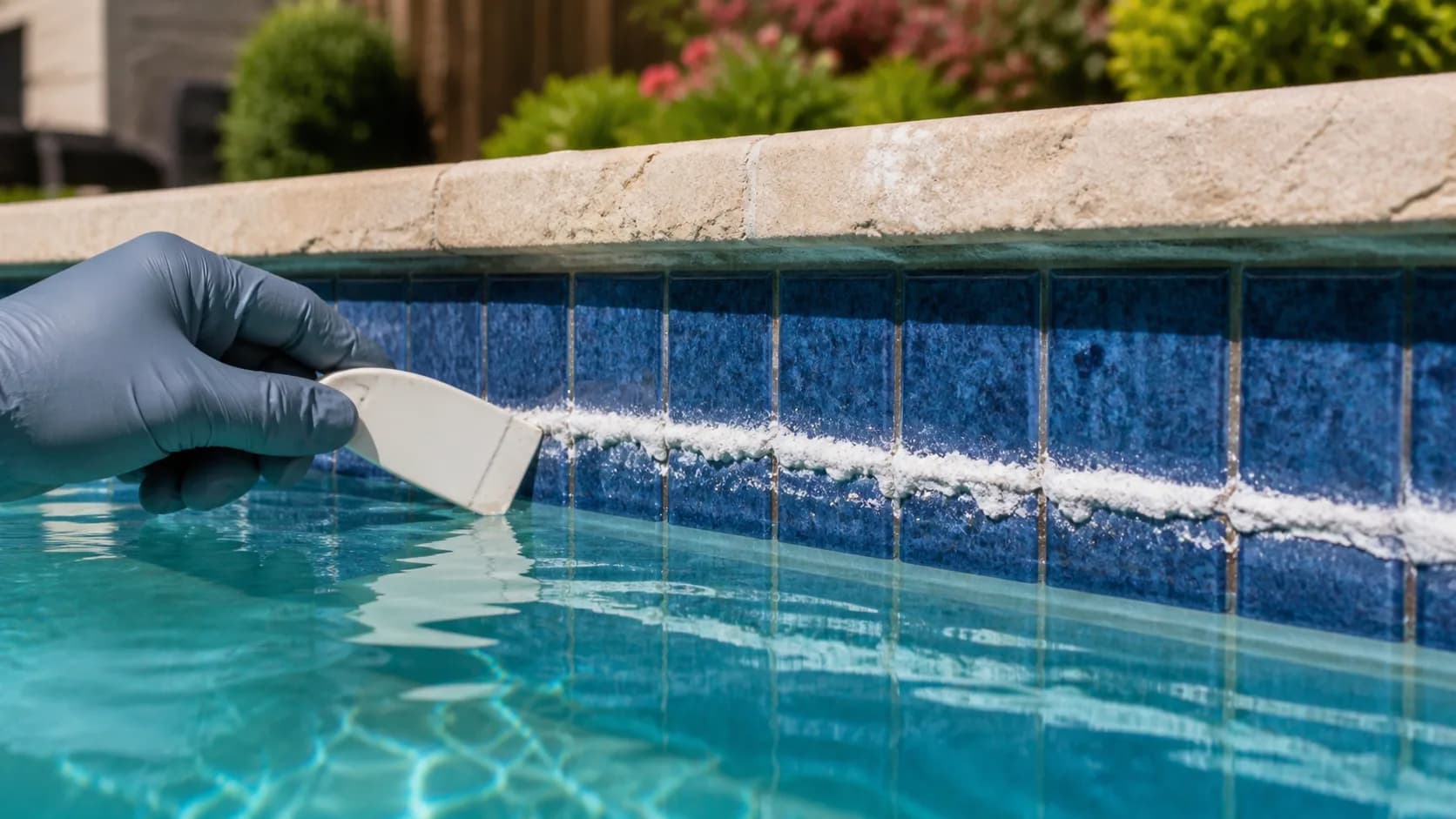
You can scrub the tile, and you should, but unless you deal with what put the scale there it comes back before the season is out. In DFW, that means understanding why your calcium hardness only ever goes up.
Salt Water Pool Maintenance in North Texas: What Nobody Tells You
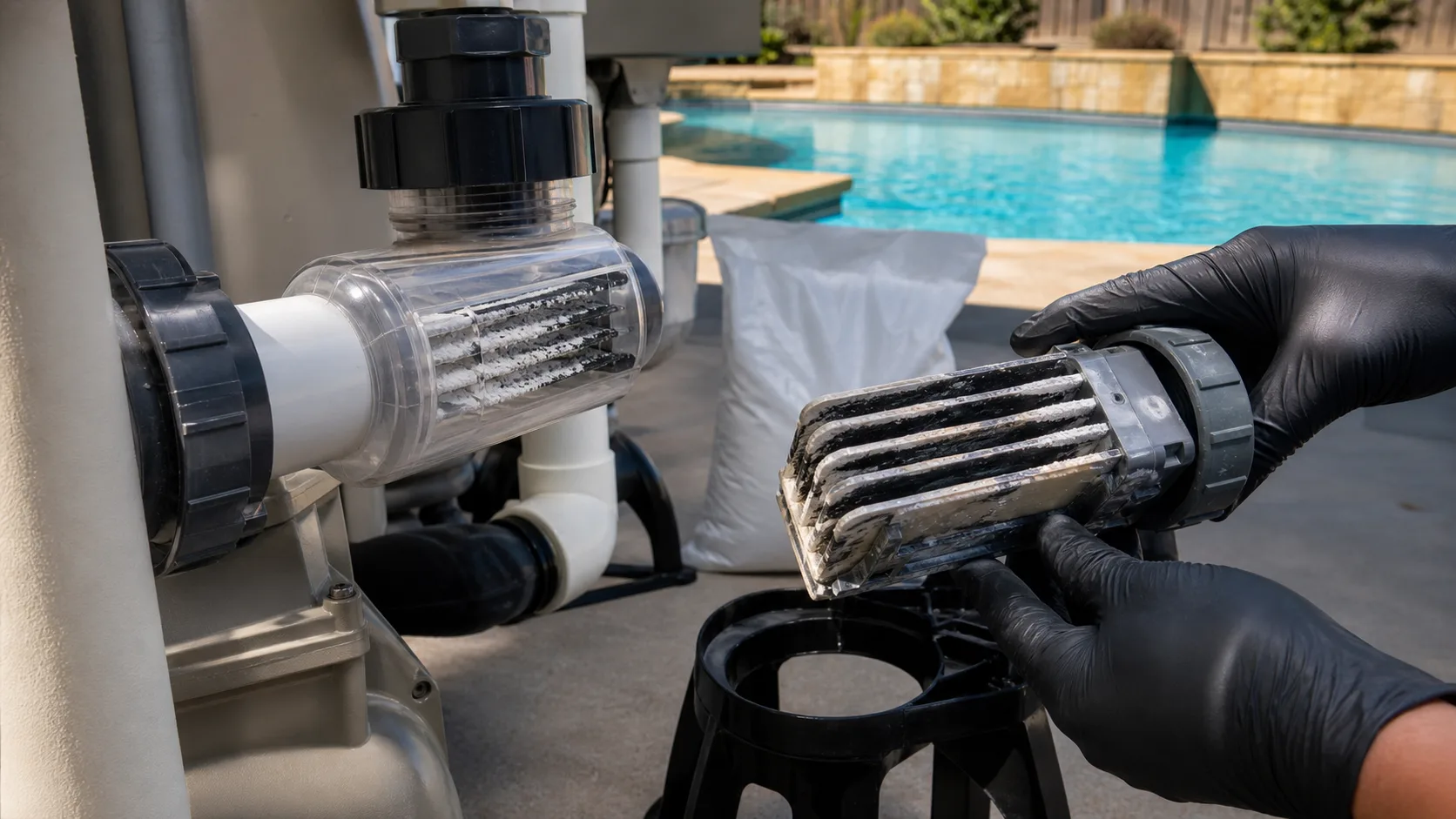
Salt pools are not chlorine-free and not lower maintenance. They trade weekly chemical handling for a standing requirement to control pH and keep the cell clean, which is harder here than most places.