Black, Mustard, and Green Algae, Told Apart

Austin Andrews
Founder, True Texan Pools
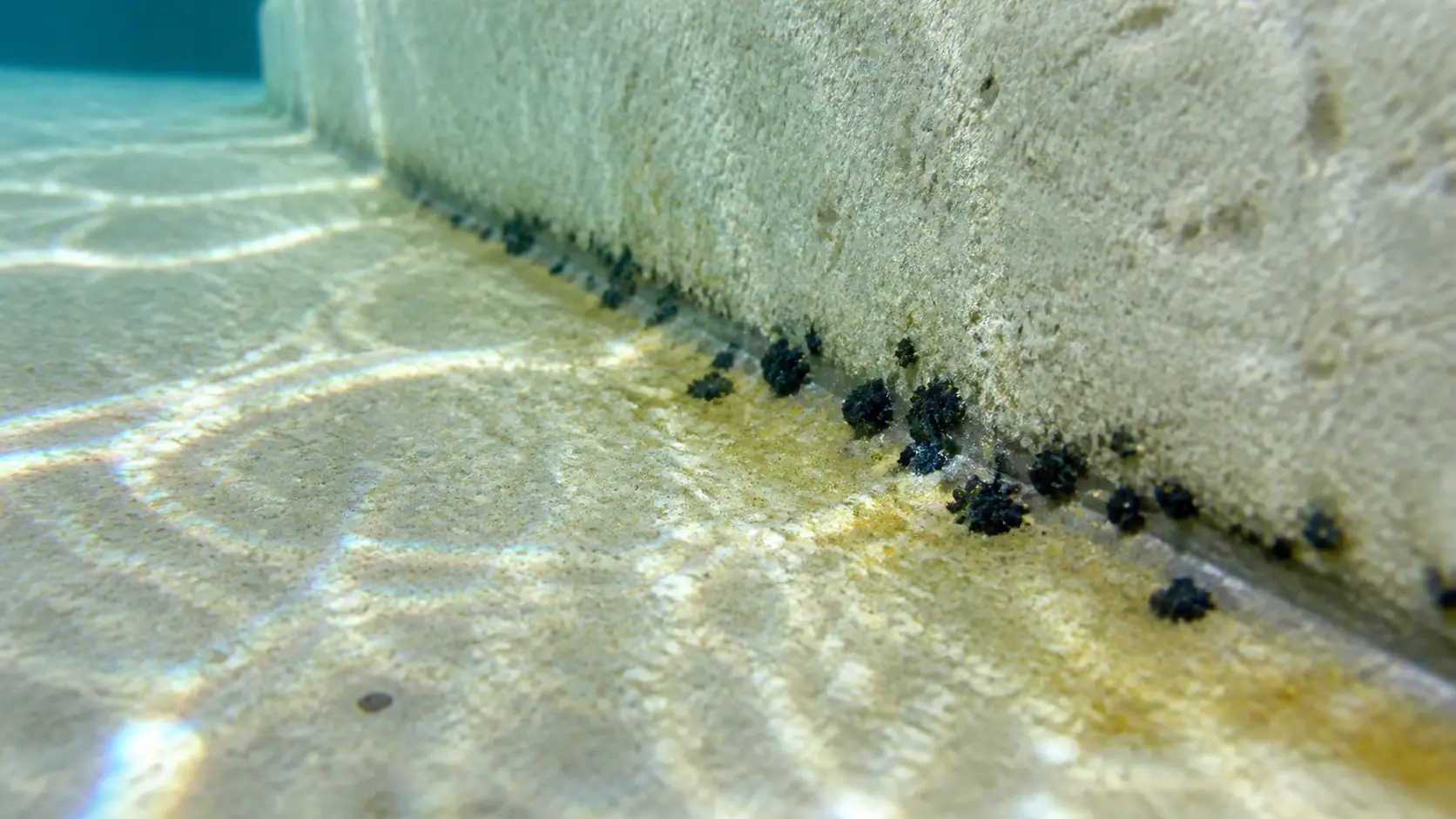
Three kinds of algae show up in North Texas pools and they need three different responses. Treating black algae like green algae wastes a month and a lot of chlorine. Treating mustard algae like green algae clears it for four days and then it comes back on the same shaded wall. Here is how to tell them apart from the deck, what each one actually requires, and which one is worth handing over.
Strictly, black algae is a cyanobacterium and mustard algae is often a form of green algae in a different habit, but the pool industry names are the ones you will see on every product label, so they are the ones used here. What matters is the behavior, and the behavior is genuinely different.
Identify it in ten seconds
| Green | Mustard | Black | |
|---|---|---|---|
| Where it is | Everywhere, suspended in the water | Shaded walls, steps, behind ladders | Plaster, grout lines, corners, rough spots |
| Color | Green tint through the whole pool | Yellow, tan, or brownish | Blue-black or very dark green spots |
| Looks like | Cloudy or opaque green water | Dirt or sand that will not vacuum away | Discrete spots, pencil eraser sized or smaller |
| Brush test | Water is already green, nothing to brush | Lifts easily in a cloud, then resettles | Does not lift. You can feel it raised |
| Water clarity | Poor to none | Usually clear | Usually clear |
| How fast it spreads | Days | Days on the same surfaces | Weeks, slowly, but it deepens |
| Chlorine resistance | Low | Moderate | High, it has a protective outer layer |
The brush test is the whole diagnosis. Take a pole brush, work a small area hard, and watch. Material that lifts into a cloud and then settles back over the next hour is mustard. A spot that stays exactly where it was, with a slightly raised, crusty feel, is black. If the water itself is green, you have green algae and the identification question is already answered.
Two things that are not algae
Pollen. In March and April, a yellow film on the surface and along the waterline is almost always oak or elm pollen rather than mustard algae. It floats rather than clinging, it arrives all at once, and it skims off.
Metal staining. Brown, grey, or greenish staining that is smooth, flat, and under the surface rather than on it, and that does not brush at all, is usually iron or copper rather than algae. If a vitamin C tablet held against it lightens the spot, it is a metal stain and chlorine will make it worse rather than better.
Green algae
The common one, the fast one, and the one with the simplest fix. Free chlorine reached zero, and in a North Texas summer the pool followed within two to three days. Our green pool guide covers the recovery sequence in full, and what a recovery costs in DFW covers the pricing if you hand it over.
The short version: balance pH first so chlorine can work, then shock to a level set against your cyanuric acid rather than to a fixed number, brush everything, and run the filter continuously. Expect the water to go cloudy grey before it goes clear, which is progress rather than a setback.
Mustard algae, which is our local recurrer
This is the one that deserves more attention than it usually gets in North Texas, because it behaves in a way that reliably fools people.
Mustard algae tolerates chlorine levels that would kill green algae. It settles on the shaded side of the pool, typically the north or east wall, behind ladders, under steps, and in the dead spot the return jets never reach. It looks exactly like a patch of dirt or fine sand, which is why owners vacuum it, watch it disappear, and find it back in the same place two days later.
Why it recurs
- It survives on surfaces outside the pool: on a pole brush, a leaf rake, a vacuum head, a float, or a swimsuit. Treating the water without treating the equipment reseeds the pool.
- It hides in the filter, particularly in a cartridge that has not been cleaned during treatment.
- It lives where circulation is poor, so it survives the same chlorine level that clears the rest of the pool.
Treating it so it stays gone
- Balance pH to the lower end of range so chlorine is at its most effective.
- Brush the affected surfaces hard, every day, including behind and underneath everything.
- Shock to a level appropriate to your cyanuric acid and hold it for several days rather than dosing once. Holding it is the part people skip.
- Clean the filter during treatment, not after. A cartridge that is holding mustard is a reservoir.
- Put every piece of pool equipment in the shallow end during the shock: brushes, poles, vacuum heads, floats, toys. Anything porous that cannot go in should be replaced.
- Improve circulation where it settled. Aiming a return jet at the dead corner does more long-term good than another dose of anything.
Products sold specifically for mustard algae generally work, and they work considerably better alongside the six steps above than instead of them.
Black algae
The genuinely difficult one, and the only one on this page where the honest advice is that it will take weeks rather than days.
Black algae grows roots into plaster and gunite, and it forms a waxy protective outer layer that chlorine struggles to penetrate. That combination is why it survives a shock that clears everything else, and why it comes back from what looks like a cleared spot: the visible part was killed and the roots were not.
It appears preferentially in rough spots, grout lines, corners, and cracks, which is why it is much more common on older, worn plaster than on a recently resurfaced pool. In practice that means an aging pool with black algae has two problems, and one of them is the surface.
What actually works
- Mechanical destruction of the protective layer. A stainless steel brush on plaster or gunite only, never on vinyl or fiberglass, worked hard over every spot. This is the step that makes everything else possible and there is no chemical substitute for it.
- Direct application to the spots. A trichlor tablet rubbed on individual spots after brushing puts concentrated chlorine exactly where the roots are.
- Sustained elevated chlorine across the whole pool for days, not a single dose.
- Repetition. Brush and treat every few days for weeks. Each cycle takes out another layer.
- Patience about the marks. Dead black algae frequently leaves a stain behind in the plaster. A grey or brown mark that no longer feels raised and no longer spreads is dead, and it may only truly go at the next resurface.
If black algae keeps returning after proper treatment
The surface is usually the reason. Plaster runs 7 to 12 years, and worn, porous, or crazed plaster gives roots somewhere to hide that no brush can reach. At that point you are managing a symptom of an aging finish, and the honest conversation is about resurfacing rather than about another chemical. DFW replastering commonly runs $6,000 to $15,000, and equipment lifespan in Texas heat covers where a surface sits in the wider replacement picture.
Why any of them appeared
All three trace to the same root cause: free chlorine that was too low, for too long. The interesting question is why, and in this market there are four usual answers.
- Cyanuric acid drifted high and the chlorine target was never raised to match. The most common cause we see, and the most invisible, because the chlorine test looks fine. The CYA guide explains the ratio, and liquid versus tabs covers the product choice that causes it.
- Circulation failed. A pump that lost prime, a clogged basket, or a loaded filter. Chemistry cannot fix a pool that is not moving.
- A gap in attention during summer. A vacation, or an interval that was fine in April and not in August. Weekly service in Texas covers why the interval matters more here.
- A storm. Heavy rain dilutes chlorine and stabilizer, drops pH, and washes organics in, all at once.
Fix the cause or you will be reading this page again next season.
Prevention, which is cheaper than any of the above
- Hold free chlorine against your cyanuric acid level, roughly 7.5 percent of it, rather than against a fixed number.
- Brush every single visit, including the shaded wall and behind the ladder, because brushing is what stops algae establishing rather than what removes it once it has.
- Keep the filter clean and the pump schedule long enough for a full daily turnover.
- Test twice a week from May through September rather than once.
- Deal with storms the same evening, not the following weekend.
What we would take on
Green and mustard are both routine work. A recovery handles the first, and mustard is usually resolved within an ordinary service relationship because the treatment is as much about circulation, brushing discipline, and equipment sanitation as it is about chemicals.
Black algae on an aging surface is the one where we would rather set expectations honestly before starting: weeks of repeated work, a likely permanent stain, and a real possibility that the surface is the actual problem. That is not a pleasant quote to give, and it is better than selling four rounds of a product that was never going to reach the roots.
If you take one thing from this page, make it the brush test, because it costs ten seconds and it decides everything that follows. Lifts in a cloud and resettles is mustard, and your real problem is the equipment and the dead corner rather than the water. Stays put and feels raised is black, and your real problem may be the plaster. Water already green is green, and the real problem is the chlorine number you were reading against the wrong stabilizer level.
Frequently Asked Questions
How do I tell what kind of algae is in my pool?
Use the brush test. Work a small area hard with a pole brush and watch. Material that lifts into a cloud and resettles over the next hour is mustard algae. A spot that stays exactly where it was, with a slightly raised crusty feel, is black algae. If the water itself is green and cloudy, you have green algae and the question is already answered.
What is mustard algae and why does it keep coming back?
A chlorine-tolerant algae that settles on shaded surfaces, typically the north or east wall, behind ladders, and in dead spots the return jets never reach. It recurs because it survives outside the water on brushes, poles, vacuum heads, floats, and swimsuits, and because it hides in an uncleaned filter. Treating the water without sanitizing the equipment reseeds the pool within days.
How do you get rid of black algae in a pool?
Mechanically first, then chemically, repeated over weeks. Black algae roots into plaster and forms a waxy protective layer that chlorine struggles to penetrate, so a stainless brush on plaster or gunite is what makes treatment possible at all. Then rub a trichlor tablet directly on the spots, hold elevated chlorine across the pool for days, and repeat every few days. Expect a residual stain even after it is dead.
Why does black algae keep returning after treatment?
Usually the surface. Worn, porous, or crazed plaster gives roots somewhere to hide that no brush reaches, and plaster runs 7 to 12 years. At that point you are managing a symptom of an aging finish rather than an algae problem, and the honest conversation is about resurfacing. DFW replastering commonly runs $6,000 to $15,000.
Is the yellow film in my pool algae or pollen?
In March and April in North Texas, usually pollen. Oak and elm pollen forms a yellow film on the surface and along the waterline, arrives all at once, floats rather than clinging to surfaces, and skims off. Mustard algae sits on shaded walls and steps rather than on the surface, and it lifts in a cloud when brushed rather than being scooped.
What causes algae in a pool in the first place?
Free chlorine that was too low for too long. In this market the four usual reasons are cyanuric acid drifting high on tablets so the chlorine target was never raised to match, a circulation failure such as a lost prime or a loaded filter, a gap in attention during summer, and a storm that diluted chlorine and washed organics in. Fix the cause or the algae returns next season.
Ready to stop thinking about your pool?
True Texan Pools keeps your water swim-ready year-round across Plano and all of DFW. Clear pricing, no contracts, and a photo report after every visit. Austin handles every job personally.
Keep reading
Chlorine Reads Fine and the Pool Still Went Green
Three parts per million of free chlorine, and the walls still feel slick. The problem is not the chlorine number, it is the number you are reading it against.
Is My Pool Leaking or Just Evaporating? The Bucket Test
There is a definitive test for this, it costs nothing, and it takes 24 hours. Here is how to run it, and how the pattern of the loss tells you which part of the system to suspect.