Spring Pool Startup After a North Texas Winter

Austin Andrews
Founder, True Texan Pools
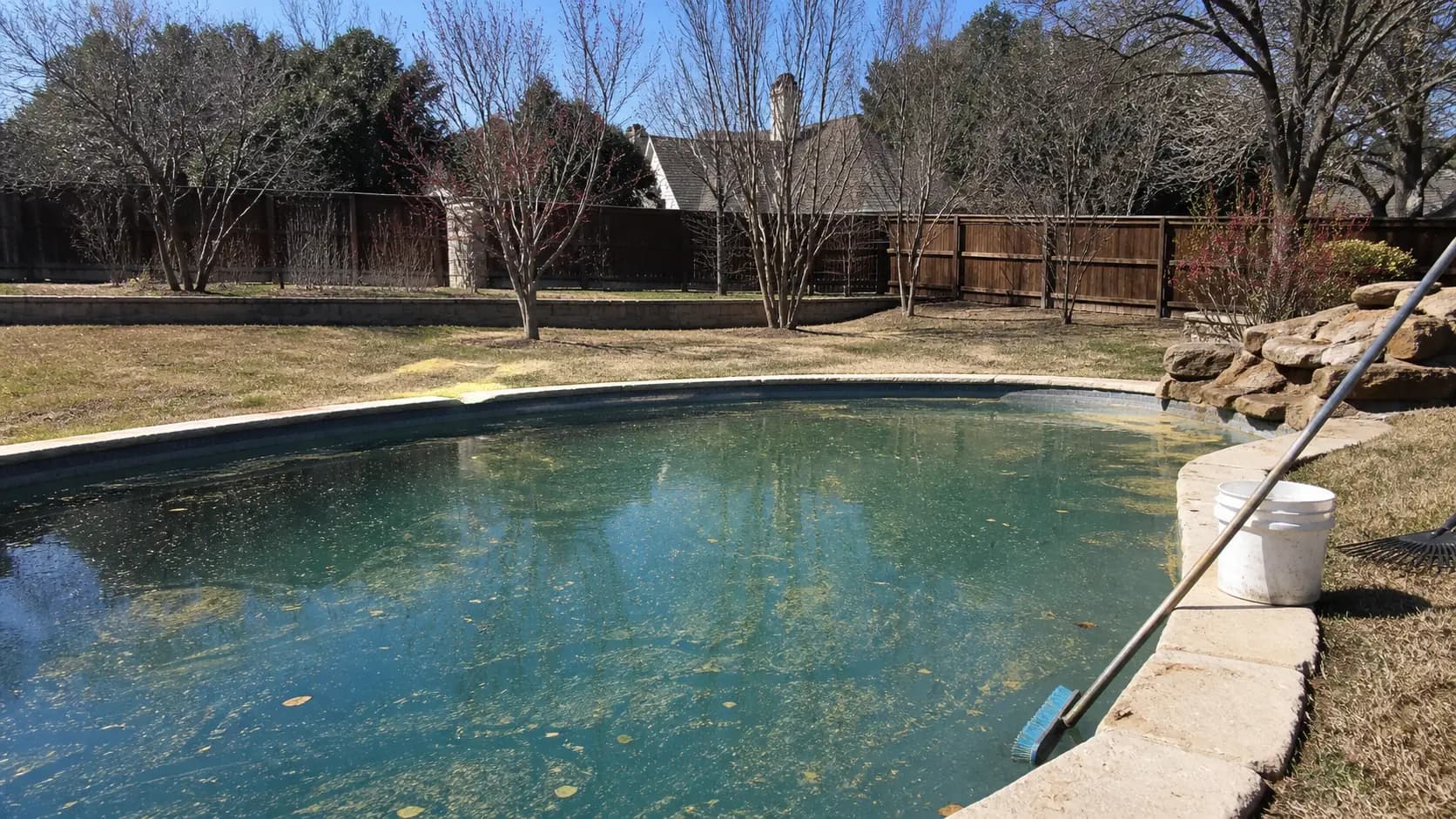
Spring startup here is not the job it is up north, because our pools were never closed. It is a transition rather than an opening, and the trick is doing it in late February while the water is still cold, rather than in April when it has already started working against you. Here is the sequence, in the order that saves you the most money, and the one number that decides how urgent all of it is.
If you have moved here from a state with a real winter, the mental model to discard is opening. There are no plugs to pull, no cover to haul off, and no lines to fill. Our pools ran all winter, because that is how a pool survives a North Texas freeze. What changes in spring is the workload, and it changes fast.
Why late February, and not April
Water temperature governs everything biological in a pool. Below roughly 60 degrees, algae is effectively dormant, chlorine is consumed slowly, and the water is chemically patient. Cross that line and algae begins reproducing, pollen arrives to feed it, and every week of approximate chemistry starts compounding into the next.
In North Texas the crossing usually happens somewhere in March. Which means the work below is a calm afternoon in late February and a race in April, for identical tasks. Almost every green pool we recover in spring was fine in March and was still being maintained on a January schedule.
The scheduling advantage nobody uses
Every pool company in the Metroplex fills its route between mid-April and Memorial Day. If you want an equipment inspection, a filter service, or a new customer slot without waiting, February is the month it is trivially available and July is the month it is not. This is the single most actionable sentence in this article.
Step one: the equipment, before anything else
Chemistry corrections depend on circulation and filtration working, so fixing water before fixing equipment is doing the same job twice.
The post-freeze inspection
Even a mild winter here usually contains at least one hard night. Freeze damage is characteristically silent: a split opens, nothing leaks while the system sits at low pressure, and then spring arrives, the schedule goes up, and the leak appears. Walk the pad in daylight and look for wet concrete on a dry day, a hairline along a pipe, a cracked pump lid, or a weeping filter clamp band. Our post-freeze inspection guide covers what each symptom points to.
The filter
Tear it down and clean it properly now. A filter that starts March clean is a filter that can cope with pollen, and a filter that starts March loaded will spend the entire spring behind. Write down the pressure gauge reading with everything clean, because that number is your baseline for the rest of the year: roughly 8 to 10 psi above it means do it again.
This is also the moment to judge whether the media is finished rather than dirty. Sand runs 5 to 7 years, cartridges 3 to 5, DE grids 5 to 10. Filter cleaning cost and frequency covers the difference between a clean and a replacement.
The pump and the schedule
Listen to it. A whine, a hot motor, or air swirling in the basket are all worth resolving before the season. Then raise the schedule from the winter four to six hours toward a full daily turnover, which on a variable speed pump means more hours at a low speed rather than fewer at a high one. The run time guide has the calculation.
Everything else
- Check the automatic cleaner actually covers the floor rather than one favorite corner, and replace worn wear parts now.
- If you have a heater, fire it once before you need it. Discovering a dead heater in October is a two-week wait.
- Check the salt cell for scale and inspect the plates. Cold water suppresses output, so a cell that appeared to underperform all winter may be fine.
- Check valves and actuators move fully, since a winter of disuse is when actuators reveal they have stopped halfway.
Step two: the physical clean
Do this before testing, because debris and dust in the water will skew what you are about to measure and consume the chemicals you are about to add.
- Skim the surface, including the winter pollen film that forms as trees bud.
- Empty both baskets, which after a winter are usually full.
- Brush everything: walls, steps, behind the ladder, and the waterline tile in particular, since a winter of drifting pH is exactly how a calcium band gets established. See calcium scale on tile.
- Vacuum the floor properly, including the corners the cleaner never reaches.
- Clear leaves out of the skimmer weir and the pump pot.
Step three: the chemistry, in the right order
Get a full panel rather than a strip: free chlorine, pH, total alkalinity, calcium hardness, and cyanuric acid. Then correct in this order, because each step moves the ones after it.
| Step | Target | Why it comes here |
|---|---|---|
| 1. Total alkalinity | 80 to 120 ppm | It buffers pH, so correcting pH first means correcting it again |
| 2. pH | 7.4 to 7.6 | Chlorine effectiveness and scaling both depend on it |
| 3. Calcium hardness | 200 to 400 ppm | Only ever climbs here, and dilution is the only lever |
| 4. Cyanuric acid | 30 to 50, or 60 to 80 on salt | Sets the chlorine target you will use all season |
| 5. Free chlorine | Roughly 7.5% of your CYA | Meaningless as a number until step 4 is known |
Step five is the one people get wrong every spring. Chlorine is judged against your stabilizer level rather than against an absolute, so a pool holding 3 ppm can be well sanitized or entirely unprotected depending on a number most owners never test. Why chlorine reads fine and the pool goes green covers the ratio, and the chemistry guide covers all five targets.
Late winter is the water exchange window
Calcium hardness and cyanuric acid both only ever rise, and both can only be lowered by replacing water. February and early March is the right time: nobody is swimming, evaporation is slow so the pool refills predictably, and the water is cold enough that chemistry is forgiving while you rebalance. Do it in staged partial exchanges rather than a full drain, because our clay soil can lift an empty shell.
Step four: the things that are only true in spring
Pollen
Oak pollen falls in sheets here and it is organic load. It consumes chlorine, it sinks and feeds algae, and it clogs a filter faster than anything else in the year except leaf drop. Skim daily during the drop if you can, and expect to clean the filter again shortly after it ends, regardless of what you did in February.
One spring confusion worth heading off: the yellow film that shows up in March and April is almost always pollen rather than mustard algae. Pollen floats and skims off, mustard clings to shaded walls and lifts in a cloud when you brush it. Telling the three algae types apart covers the test.
Storms
Spring is our most active storm season. Heavy rain dilutes chlorine and stabilizer, drops pH and alkalinity, and washes dust and organics into the water, so the pool comes out of a storm with less sanitizer and more to sanitize. Empty the baskets, brush, test, correct pH, then shock at dusk the same evening. Left three days, that becomes a green pool rather than a twenty minute job.
The barrier
Ground movement over a wet winter regularly puts a gate out of alignment. Before the first swim, confirm every gate self-closes and self-latches from any position, that the latch is out of a small child’s reach, and that nothing climbable has been left beside the fence. What actually applies to your backyardcovers the requirements, which for a private pool come from your city’s code rather than the state statute most articles cite.
The first swim
Water in the 60s is cold, and clear water is not automatically safe water. Confirm chlorine against stabilizer and confirm the bottom drain covers are visible before anybody gets in. Is the water safe to swim in covers what to check.
If the pool is already green
Then this is a recovery rather than a startup, and it is a different job with a different sequence. Do not start dosing chemicals into a green pool on the plan above. Our green pool guide covers the recovery order, and what a green recovery costs in DFW covers what you are looking at if you hand it over. The most common cause of an April green pool in this market is a pool that was dropped from service in December to save four months of fees.
The startup in one list
- Equipment: post-freeze walk-around, filter tear-down and clean, record clean pressure, listen to the pump, raise the schedule, check cleaner, heater, cell, and valves.
- Physical: skim, empty baskets, brush everything including the tile, vacuum, clear the weir.
- Chemistry: full panel, then alkalinity, pH, calcium, stabilizer, chlorine, in that order.
- Seasonal: plan for pollen, respond to storms the same evening, check the barrier, verify before the first swim.
If you would rather hand it over
Spring startup is the most common single job we get asked for that is not weekly service, and it is a good use of one visit. That visit is a one-time clean, a full chemistry correction, and an equipment inspection that catches freeze damage while it is still a scheduled repair. Booked in February, all three are easy to arrange. Booked in May, everybody is full.
The month-by-month pool year puts this job in the context of the other eleven. If you read only one line of it, read the March one. Every expensive spring problem we get called about was cheap and preventable four weeks earlier, and almost nobody is looking at their pool in February.
Frequently Asked Questions
When should I do spring pool startup in North Texas?
Late February. Water temperature governs everything biological, and below roughly 60 degrees algae is effectively dormant while chlorine is consumed slowly. The crossing usually happens in March here, which means identical tasks are a calm afternoon in February and a race in April. Every pool company in the Metroplex also fills its route between mid-April and Memorial Day.
Do North Texas pools need to be opened in spring?
Not in the northern sense. Our pools are not closed, plugged, or covered for winter, because a North Texas winter is mild days punctuated by a handful of hard nights, and moving water is the freeze defense. So spring is a transition rather than an opening: the workload changes, the equipment gets audited after the freezes, and the chemistry goes from maintenance to active.
What order should I balance pool chemistry in?
Total alkalinity, then pH, then calcium hardness, then cyanuric acid, then free chlorine. Each step moves the ones after it, so doing it out of order means doing it twice. The one people get wrong is the last: chlorine is judged against your stabilizer level rather than against an absolute, so a pool holding 3 ppm can be well sanitized or entirely unprotected.
Should I do a partial water exchange in spring?
Late winter is the right window if calcium hardness or cyanuric acid have drifted well above range, because both only climb and both can only be reduced by replacing water. Nobody wants to swim, evaporation is slow so the pool refills predictably, and cold water is forgiving while you rebalance. Do it as staged partial exchanges, never as a full drain, because our clay can lift an empty shell.
What should I do about pollen in my pool in spring?
Skim daily during the drop if you can, because pollen that sinks is organic load your chlorine has to deal with. Expect to clean the filter again shortly after the drop ends regardless of what you did in February, since oak pollen loads a filter faster than anything else in the year except leaf drop.
Why check the pool gate in spring specifically?
Because Collin County expansive clay moves through a wet winter, and a gate that self-closed and self-latched perfectly last September may not now. Before the first swim, confirm every gate closes and latches on its own from any opening angle, that the latch is out of a small child's reach, and that nothing climbable has been left beside the fence.
Ready to stop thinking about your pool?
True Texan Pools keeps your water swim-ready year-round across Plano and all of DFW. Clear pricing, no contracts, and a photo report after every visit. Austin handles every job personally.
Keep reading
What Changes in Your Pool Above 100 Degrees
A pool that has been effortless since April starts misbehaving in the second week of August, and the owner has changed nothing. That is exactly the point.
Opening and Closing a Pool in North Texas (Most Never Close)
The close-in-September habit does not survive North Texas. Our winters are mild but punctuated by hard freezes, and the pool you walk away from in November is the one you pay to recover in April.