Robotic, Suction, or Pressure: Which Pool Cleaner Suits Your Pool

Austin Andrews
Founder, True Texan Pools
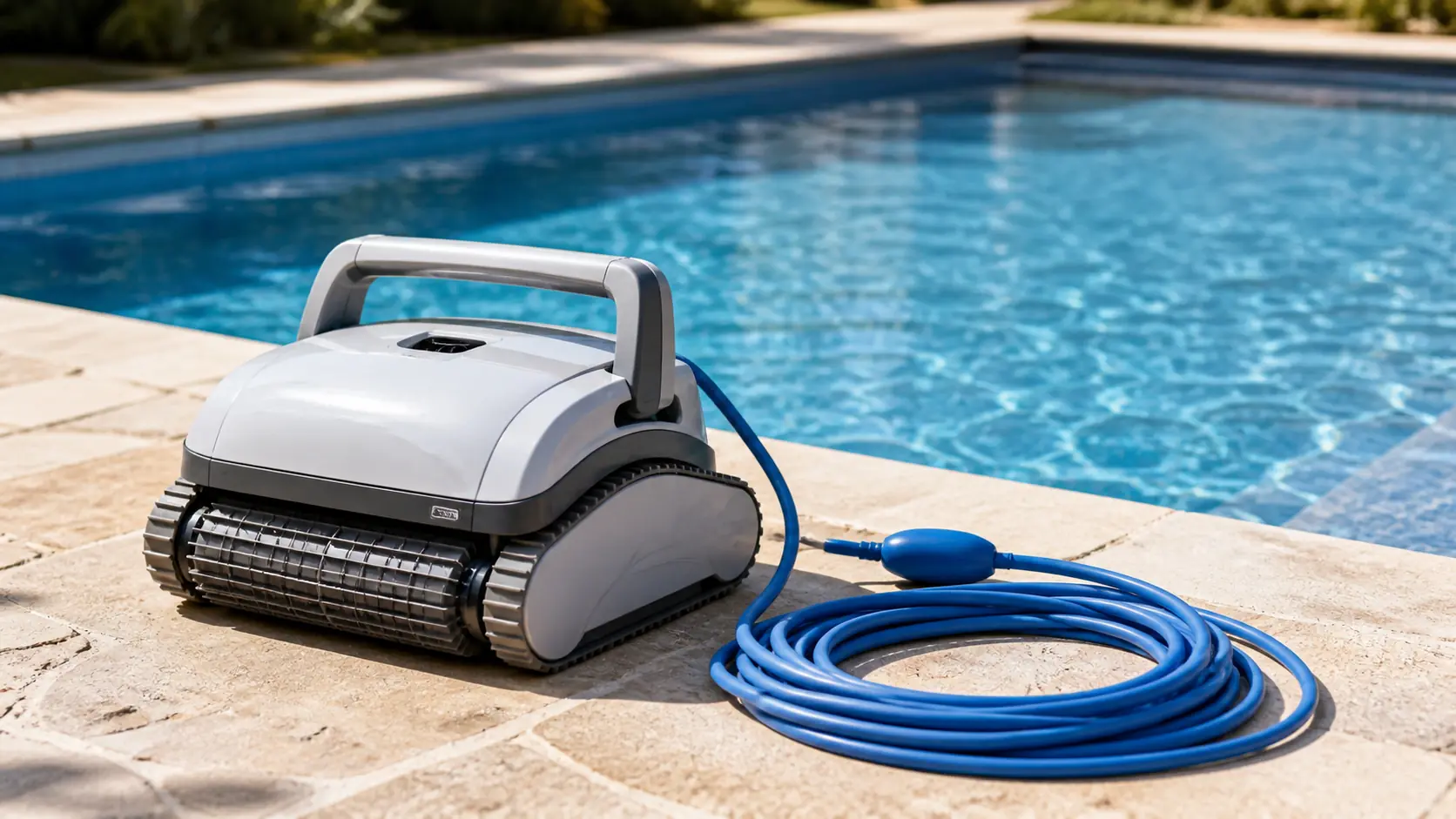
Three kinds of automatic cleaner exist, they work in genuinely different ways, and the one that suits your pool depends more on your plumbing and your debris than on the review you read. There is also a question underneath the comparison that nobody selling cleaners wants asked, which is what a cleaner actually replaces. Here is how each type works, what each costs to own in North Texas, and the honest answer about whether buying one lets you cancel your pool service.
Nearly every pool in Plano and Frisco came with a cleaner or acquired one, and a surprising number of them sit in the shed because they never worked properly on that pool. Matching type to pool is most of the battle, and the mismatch is usually predictable in advance.
How the three types actually work
Suction cleaners
A suction cleaner is a body with a hose that connects to your skimmer or to a dedicated suction port. Your existing pump provides all the force. The cleaner crawls, water and debris are pulled up the hose, through the pump basket, and into your filter.
Nothing about it is complicated, which is its main virtue. There are few or no moving parts on the cheap ones, they cost the least to buy, and they are easy to replace. The cost is that everything they pick up ends up in your filter, so your filter cleaning interval shortens, and they lean on your pump. Running a variable speed pump at the higher speed a suction cleaner needs undoes part of the savings the pump was bought for, which is worth knowing if you followed the advice in the variable speed pump guide.
Pressure cleaners
A pressure cleaner is driven by water pushed at it rather than pulled through it. On most installations that requires a separate booster pump, which is the extra piece of equipment on the pad running only while the cleaner runs. The cleaner sweeps debris into its own mesh bag, which you empty.
The advantage is that the debris never reaches your filter, and the bag holds a lot. For a pool under oaks or a big elm, that matters in November. The disadvantage is the booster pump: a dedicated motor, running additional hours, needing its own repairs, on a pad that already has enough on it. When people talk about a cleaner that costs a fortune to run, this is usually the one they mean.
The federal government agrees it is a pump worth regulating. Pressure cleaner booster pumps are one of the four categories covered by the Department of Energy’s 2023 final rule on dedicated-purpose pool pump motors, alongside self-priming and non-self-priming filter pumps and waterfall pumps. Most booster pumps sit below the 1.15 total horsepower threshold, so they are not required to go variable-speed until September 2027, which means a single-speed replacement is still available today and may not be in a few years. If you are choosing a cleaner type now and expect to keep it a decade, that is worth knowing. The same rule is what changed the arithmetic on your main pump, which we cover in repair or replace your pool pump.
Robotic cleaners
A robot is a self-contained appliance. It plugs into a GFCI outlet, drops in the water, and runs its own low-voltage motors and its own internal filter cartridge or bag. Your pool pump can be off entirely while it works.
Because it filters the water itself, it takes load off your sand or cartridge filter rather than adding to it, and because it does not use your pump, it costs very little to run. Better ones scrub the walls and the waterline, which the other two types largely do not. The costs are the purchase price, a power cord to manage, a unit that has to come out of the water and be stored out of the sun, and eventual repairs to something with electronics in it.
The comparison, on the things that matter
| Suction | Pressure | Robotic | |
|---|---|---|---|
| Typical purchase price | $150 to $700 | $500 to $1,200 plus booster pump | $700 to $1,800 |
| Needs your pool pump running | Yes, often at higher speed | Yes, plus a booster pump | No |
| Where debris goes | Your filter | Its own bag | Its own cartridge |
| Effect on filter cleaning interval | Shortens it | Neutral | Lengthens it |
| Fine silt and sand | Poor to fair | Fair | Good |
| Heavy leaves | Fair, clogs | Best | Good, fills up |
| Climbs walls | Some models | Some models | Most models |
| Cleans the waterline | No | Rarely | Better models yes |
| Running cost | Moderate, via your pump | Highest | Lowest |
| Typical service life here | 3 to 6 years | 5 to 8 years, plus booster | 4 to 8 years |
| Repairability | Cheap parts, easy | Parts available, moderate | Varies widely by brand |
Where the running cost actually is
None of these three uses much electricity by itself. What costs money is what they require from the rest of the pad. A suction cleaner that forces a variable speed pump to run at 2,600 rpm for three hours a day instead of 1,400 rpm is the expensive option even though the cleaner has no motor at all, because pump power rises steeply with speed. A booster pump is a second motor running those hours. A robot with a 150 watt motor running two hours costs pennies and lets the main pump stay slow. The arithmetic on pump speed is worked through in how long to run your pool pump.
Which one fits your pool
The choice is usually made for you by three things: what falls in the pool, what plumbing you already have, and the surface.
| If your pool is | Best fit | Why |
|---|---|---|
| Under mature oaks or elms, heavy seasonal leaf drop | Pressure, or a robot with a large canister | Bag capacity is the constraint, and your filter should not be the leaf trap |
| Open yard, mostly dust and fine grit | Robotic | Fine silt is what suction cleaners miss and robots catch |
| Already has a dedicated pressure line and booster pump | Pressure | The expensive infrastructure is installed, use it |
| Plaster or pebble with a lot of steps and benches | Robotic | Better wall and step coverage, no hose to snag |
| Vinyl liner | Suction or robotic | Check the manufacturer approves it for liners before buying |
| On a variable speed pump you want to run slow | Robotic | It is the only type that does not fight the pump savings |
| Small, simple, and you want the cheapest thing that works | Suction | Genuinely fine on a clean pool in a low-debris yard |
The Collin County debris problem
Local pools get two distinct debris seasons and they are not the ones people expect. Spring is heavier than fall: oak catkins, elm samaras, and cottonwood come down in volume across a few weeks, and they are fine and fibrous rather than large. That material packs the pleats of a cartridge and binds the top of a sand bed, which is exactly why the same weeks produce a run of filter complaints. The types are broken down in the filter comparison.
The second, and the one that separates cleaners, is fine mineral silt. Dust blows in constantly here, storms wash soil off the yard, and it settles as a grey film that a cheap suction cleaner drives straight through. If your complaint about your current cleaner is that the pool still looks dusty on the bottom after it ran, that is not a broken cleaner. That is a cleaner without the filtration fineness to hold what it picked up, and no adjustment fixes it.
Sand and silt go somewhere
A suction cleaner sends everything it collects through your pump basket and into your filter. On a pool with a real silt load, that is a large amount of abrasive material moving through a pump impeller several hours a day. It is not the main reason pumps fail here, but it is a genuine contributor, and it is one more line in the argument for a cleaner that keeps its own debris. Pump lifespans locally are in equipment lifespan in Texas.
What a cleaner does not do
This is the part worth being straight about, because a cleaner is frequently sold as a substitute for service and it is not one. An automatic cleaner vacuums. Here is everything on a normal weekly visit that it does not touch:
- Testing the water and correcting chlorine, pH, alkalinity, stabilizer, and calcium.
- Emptying the skimmer basket and the pump basket, which no cleaner does and which a full basket makes the cleaner worse at.
- Brushing the waterline, the steps, and behind the ladder, where scale and algae actually start.
- Watching filter pressure and cleaning the filter when it climbs.
- Noticing the pump seal that has started weeping, the salt cell that has stopped producing, or the gate latch that no longer catches.
- Anything at all in a freeze event.
A robot on a pool with no chlorine in it produces a clean-bottomed green pool. That is not a rhetorical flourish, it is a thing we have been called out to. The full list of what a visit actually includes is in what weekly service includes, and the honest cost comparison against doing it yourself is in DIY versus a service.
Where a cleaner genuinely earns its money is alongside service rather than instead of it. A pool that is vacuumed daily by a robot is cleaner on day six than a pool vacuumed once on day one, and a technician who arrives to a floor that is already clean spends that time on chemistry, brushing, and equipment instead. Several of our customers run a robot for exactly that reason.
Buying advice, briefly
- Buy for your debris, not for the feature list. App control and scheduling are pleasant. Canister capacity and filtration fineness determine whether the pool looks clean.
- Check the pool size rating honestly. A unit rated to 30 feet on a 40 foot pool leaves a third of the floor untouched every cycle.
- Ask what parts cost before you buy. Brushes, tracks, and impellers wear on all three types. The question that separates brands is whether you can get a drive motor in three years or whether the whole unit is disposable.
- Get it out of the sun. A robot left floating in a Texas July, or stored on the hot deck, ages years in a season. Every one of these that we see fail early lived outdoors.
- Do not buy one to fix a circulation problem. If one end of the pool is always dirty, the cause is usually return aiming or run time, and a cleaner treats the symptom at some expense. Start with how the equipment fits together.
Austin’s Tip
Before you spend anything, run your pump for a normal cycle with the returns aimed to push surface water toward the skimmer and the floor debris toward the main drain, then look at where dirt still collects. Most pools have one dead zone, and it is almost always the same corner. Knowing where it is tells you whether you need a cleaner that climbs, one that carries a big bag, or one that filters fine, which is a more useful specification than any star rating.
What we would put on a Plano pool
Suction if the yard is clean and the budget is tight. Pressure if the booster line is already in the ground and the trees are the real problem. Robotic for most other pools here, because it handles our fine silt, spares the filter, and is the only one of the three that does not quietly undo a variable speed pump.
We are relaxed about which one you choose, and we say so because we have no cleaner to sell you. What we would push back on is the reasoning that sometimes comes attached to the purchase. A cleaner is a vacuum. It is a good vacuum, and on a pool that gets one visit a week it genuinely keeps the floor better than we can between stops. It does not test water, empty a basket, brush a waterline, watch a pressure gauge, or notice the gate latch. Buy one to make your pool cleaner and it will. Buy one to replace the rest of the job and you will own a clean-bottomed green pool by August.
Frequently Asked Questions
Is a robotic pool cleaner better than a suction cleaner?
For most North Texas pools, yes. A robot filters the water itself rather than sending debris into your filter, runs on its own low-wattage motor so your pump can stay slow, and handles the fine silt that suction cleaners drive straight through. Suction cleaners remain a reasonable choice on a low-debris yard where the budget matters, since they cost a fraction as much and have almost nothing to break.
Does a pool cleaner mean I can cancel my pool service?
No, because a cleaner vacuums and does nothing else. It does not test or correct water chemistry, empty the skimmer and pump baskets, brush the waterline, watch filter pressure, or notice a weeping pump seal or a gate latch that no longer catches. A robot running in a pool with no chlorine in it produces a clean-bottomed green pool, which is a thing we have been called out to.
Do pressure side pool cleaners need a booster pump?
Most do. That is a second motor on the pad running whenever the cleaner runs, which is why pressure cleaners have a reputation for being expensive to operate. The upside is that debris goes into the cleaner’s own bag rather than your filter, and the bag capacity is the largest of the three types, which matters on a pool under mature oaks.
Will a suction cleaner ruin my variable speed pump savings?
It can eat a good part of them. Suction cleaners need real flow, so the pump has to run at a higher speed while the cleaner works, and pump power rises steeply with speed. A pool running at 2,600 rpm for three hours a day to drive a cleaner costs considerably more than the same pool at 1,400 rpm. A robot avoids this entirely because it does not use your pump at all.
Why does my pool cleaner leave dust on the bottom?
Because it lacks the filtration fineness to hold what it picks up. Fine mineral silt is the characteristic North Texas debris, blown in constantly and washed off the yard by storms, and a cheap suction cleaner stirs it and passes it through. No adjustment fixes that. It is an argument for a cleaner with a fine internal cartridge rather than for running the existing one longer.
How long do pool cleaners last in Texas?
Roughly three to six years for a suction cleaner, five to eight for a pressure cleaner plus whatever the booster pump gives you, and four to eight for a robot depending heavily on the brand and on whether it is stored properly. Sun is what kills them early. Every robot we see fail young lived outdoors, either left floating in the pool or parked on a hot deck.
Ready to stop thinking about your pool?
True Texan Pools keeps your water swim-ready all year, across Plano and the rest of DFW. Clear pricing, a photo report after every visit, and Austin doing every job himself.
Keep reading

Pool Light Replacement Cost, and When It Is Worth Converting to LED
A light that has been out for two summers is the most deferred repair in the backyard, usually because nobody knows what it costs. Here is the real range and what moves it.
What It Costs to Convert a Pool to Salt Water in Texas
The hardware goes on in an afternoon. What changes permanently is what your water does to your equipment and your plaster, and that is the part that decides whether it was a good idea.