What It Really Costs to Own a Pool in Collin County

Austin Andrews
Founder, True Texan Pools
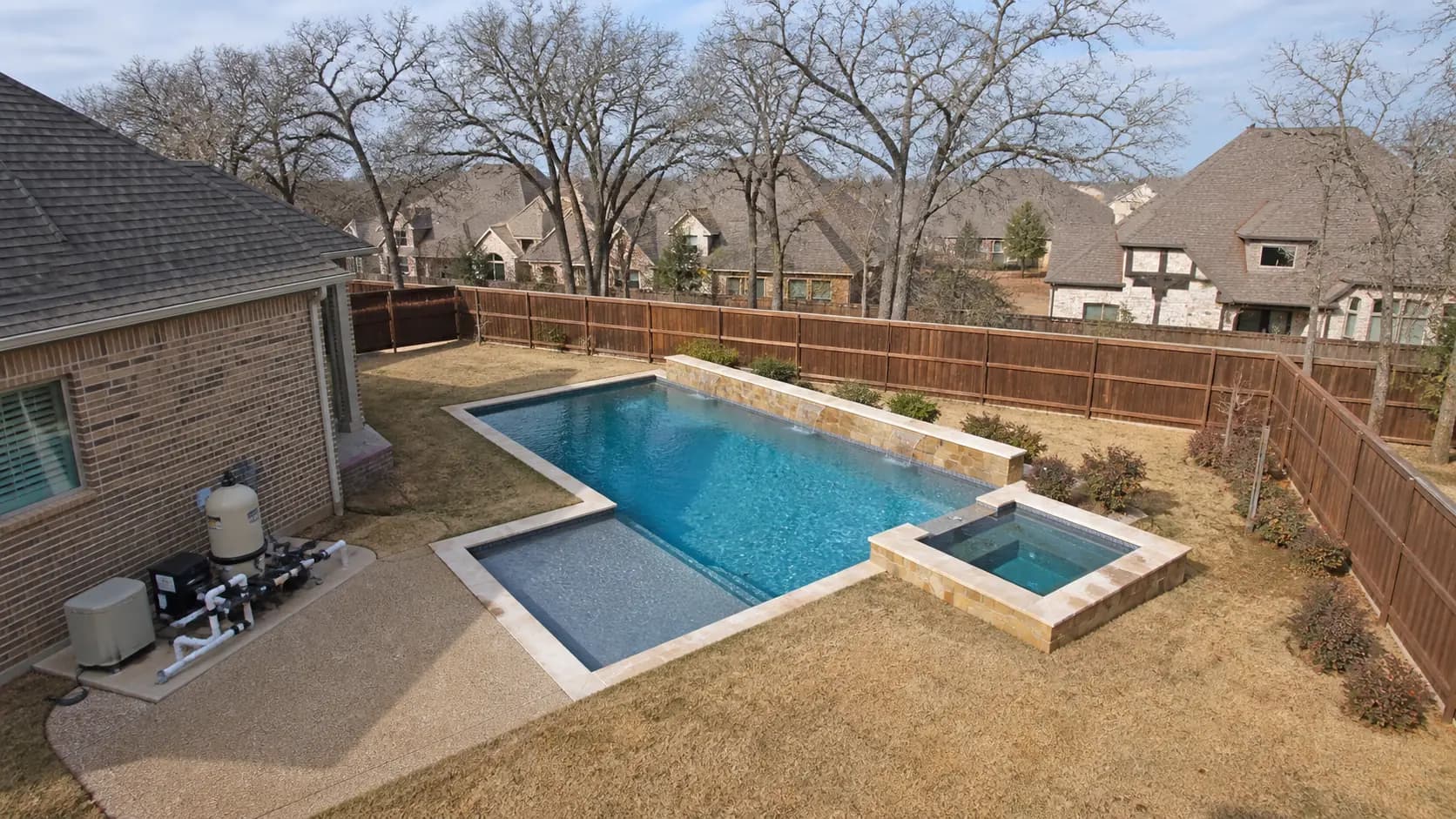
Most articles about the cost of owning a pool in Texas give you a monthly service figure and stop, which is roughly like pricing a car by its insurance. The real number has five parts: service, chemicals, electricity, water, and the annualized cost of things that will eventually need replacing. Here is each one worked out for a normal Collin County pool, with the reasoning shown so you can substitute your own pool for ours.
The pool this article prices is the one we service most often: a plaster pool of roughly 15,000 to 20,000 gallons, no spa or a small attached one, moderate tree cover, a variable-speed pump, a cartridge filter, and either a salt system or tablets. If yours is bigger, shaded, heated, or twenty years old, the shape of the arithmetic holds and the numbers move.
Line one: service
Published monthly rates around DFW currently run from about $120 to $220 a month. That is a wide band for what looks like the same product, and the reason is not quality. It is what is inside the number: whether chemicals are included, whether filter cleans are bundled, whether vacuuming happens every visit, and what size band your pool falls in.
The honest way to compare two quotes is annually rather than monthly, which is the whole argument of what your monthly bill actually covers. If you are doing the work yourself this line is zero and the chemical line below roughly doubles, because you will not be buying at trade prices. Our DIY versus hiring comparison works through that trade in detail.
Line two: chemicals
Commonly published figures put residential pool chemicals somewhere around $50 to $125 a month nationally. Two local conditions push a Collin County pool toward the upper half of that for four months of the year and toward the bottom for four others.
- UV load. Sunlight destroys free chlorine, and our summer sun angle and day length mean a July pool can consume roughly twice what the same pool used in a mild June week.
- Water temperature. Algae reproduction accelerates steeply as water warms. A pool sitting in the low 90s is a materially different chemical problem from the same pool at 78.
- Fill water hardness. NTMWD treated water is moderately hard, and a pool concentrates it further every summer. That does not cost you chlorine, but it does drive acid demand and the occasional water exchange. See what hard water does to a whole pool.
Winter is genuinely cheap. Below 60 degrees a pool consumes very little chlorine and a two-week testing interval is adequate. If your service is on a pass-through chemical model, this is exactly why your August bill and your February bill do not resemble each other.
Line three: electricity
Published ranges for pool electricity run roughly $30 to $150 a month, and that spread is almost entirely the pump. Nothing else on a normal pad runs long enough to matter, unless you have a heat pump, in which case it dwarfs everything.
Why the pump you own matters more than the hours you run
Flow falls roughly in proportion to pump speed, but power draw falls with roughly the cube of it. Halving the speed moves about half the water for something near an eighth of the power, so running twice as long at half speed delivers the same daily turnover for around a quarter of the energy. That is why a single-speed pump can sit at the top of the published range while a properly programmed variable-speed pump sits near the bottom.
There is no Oncor rebate to wait for
Owners regularly ask whether to delay a pump upgrade until a utility rebate appears. Oncor publishes no residential variable-speed pool pump rebate. Entergy Texas does run a distributor program worth up to $350 per qualified pump, but that is a different service territory and most of Collin County is not in it. The honest answer is that the upgrade has to justify itself on the energy math alone, and for most pools it does. Our variable speed guide shows the working.
Line four: water
Published estimates put pool water at roughly $20 to $70 a month. Here is the local reasoning behind why our figure sits at the top of that band in summer.
A commonly quoted rule of thumb is a quarter inch of evaporation a day, but that comes from milder conditions than ours. In a North Texas summer, with afternoons near or past 100 degrees, low humidity, and wind, half an inch a day is ordinary. On a 15 by 30 foot pool that is roughly 140 gallons a day, or close to a thousand gallons a week, and nothing is wrong. Add splash-out, water features, and backwashing a sand filter and it climbs.
Two practical notes. First, an autofill valve makes this invisible, which is convenient right up until it hides a leak, so a summer water bill that jumps sharply is worth the bucket testrather than a shrug. Second, city rules matter: Plano permits pool top-offs to replace evaporative loss on any day, while a new pool fill requires a permit and is treated differently from irrigation. Confirm your own city’s current ordinance before assuming, because these change.
Line five: the one nobody puts on a quote
Everything on a pool pad is a wear item with a finite life. Ignoring that does not make it free, it just means the bill arrives all at once and feels like bad luck. The fix is arithmetic: take a realistic replacement cost, divide by a realistic service life, and carry the result as a monthly reserve.
| Item | Typical life here | How to think about the reserve |
|---|---|---|
| Variable-speed pump | 8 to 12 years | Replacement divided by ten years |
| Salt cell | 3 to 6 years | Take the installed price and spread it over four or five years |
| Filter cartridges | 3 to 5 years | A set every few years, the cheapest line here |
| Sand media | 5 to 7 years | Infrequent, modest |
| DE grids | 5 to 10 years | Infrequent, modest |
| Gas heater | 5 to 10 years | Only if you have one, and it is a large number |
| Plaster resurface | 7 to 12 years | $6,000 to $15,000 in DFW, roughly $6.50 to $8.00 per square foot |
| Filter deep cleans | Every 3 to 6 months | $125 to $150 each, so a real recurring line |
Run that division for your own pool and the number is uncomfortable, which is the point. Resurfacing alone, taken at the middle of the DFW range and divided across ten years, is a larger monthly figure than most owners expect, and marcite plaster is described as the most replaced surface in this market. Our equipment lifespan guide covers why our climate pushes each of these toward the short end.
The Collin County wrinkle: do not plan on draining
Some maintenance advice assumes an occasional full drain and refill as a reset. Our expansive clay holds groundwater that exerts real upward pressure on an empty shell, which can lift or crack it, and that is a structural repair rather than a resurface. Staged partial exchanges are the local answer, and they cost water rather than risk. What clay soil does to a pool covers the wider effect on decks and plumbing.
Putting the five lines together
Add the five and the honest conclusion is that the monthly service rate is somewhere between a third and a half of the true cost of owning a pool in Collin County. Service, chemicals if they are not included, electricity, water, and reserve. Every one of those is real, four of them arrive monthly, and the fifth arrives all at once in a year you did not choose.
The statewide Texas average that gets quoted around the internet, roughly $198 a month, is a service-and-chemicals figure. It is not wrong, it is just measuring one and a half of the five lines above.
The four ways to actually reduce it
- Upgrade the pump if it is single speed. The largest controllable line, and the only one where a purchase reliably reduces a recurring cost.
- Keep chemistry stable rather than dramatic. Balanced water is cheaper than corrected water, and a single green recovery costs several months of service. Our green pool recovery cost guide shows the gap.
- Clean the filter on schedule.A loaded filter costs electricity every day it stays loaded, and shortens the pump’s life while doing it.
- Fix small leaks early. Water, chemicals, and heat all escape through the same hole, and the pool that is topped up daily by an autofill is paying for all three quietly.
Two things do not reduce it, despite being the most common attempts. Dropping to biweekly service in summer shifts cost from the service line to the recovery line. Switching the pump off in winter shifts it to the plumbing repair line. Neither saves money; both move it somewhere less predictable. Weekly versus biweekly and whether to run through winter cover both.
What we charge, and what we do not
Our weekly maintenance is published rather than quoted on a callback: it starts at $120 a month for a small pool, $150 for a medium pool, and $225 and up for a large one, chemicals included, on the weekly pool service page. That covers lines one and two. Lines three, four, and five are yours regardless of who services the pool, which is exactly why we would rather publish this arithmetic than pretend the monthly rate is the whole number.
For your own city’s figures, we publish Plano, Frisco, McKinney, and Allen separately, because build era, tree load, and local rules genuinely differ across the county.
Frequently Asked Questions
What does it really cost to own a pool in Collin County?
Five lines: service, chemicals, electricity, water, and a replacement reserve. Published DFW service rates run $120 to $220 a month, chemicals commonly $50 to $125, electricity $30 to $150 depending almost entirely on the pump, and water $20 to $70 with our summers at the top of that band. The fifth line is the one no quote contains, and it is large enough to change the total substantially.
What is a pool replacement reserve and how do I calculate it?
It is the monthly amount that covers the things that wear out. Take a realistic replacement cost and divide by a realistic service life: a pump over ten years, a salt cell at $600 to $1,000 over four or five, cartridges over four, and a plaster resurface at $6,000 to $15,000 over ten. Ignoring it does not make it free, it just means the bill arrives all at once and feels like bad luck.
How much does pool electricity cost in North Texas?
Published ranges run roughly $30 to $150 a month, and that spread is almost entirely the pump. Power draw falls with roughly the cube of pump speed, so a properly programmed variable speed pump sits near the bottom of the range while a single-speed pump sits near the top. Nothing else on a normal pad runs long enough to matter, unless you have a heat pump, which dwarfs everything.
Why is water a bigger cost for pools here than elsewhere?
Evaporation. The commonly quoted quarter inch a day comes from milder conditions than ours, and in a North Texas summer half an inch is ordinary. On a 15 by 30 pool that is roughly 140 gallons a day, or close to a thousand gallons a week, with nothing wrong. Add splash-out, water features, and backwashing and it climbs further, and an autofill makes the whole thing invisible.
Is there a rebate for pool equipment in the DFW area?
Not for pool pumps from Oncor, which publishes no residential variable-speed pool pump rebate. Entergy Texas runs a distributor program worth up to $350 per qualified pump, but that is a different service territory and most of Collin County is not in it. The honest answer is that a pump upgrade has to pay for itself on the energy math alone, and for most year-round pools it does.
What actually reduces the cost of owning a pool?
Four things. Upgrading a single-speed pump, which is the only purchase that reliably reduces a recurring cost. Keeping chemistry stable rather than dramatic, since one green recovery costs several months of service. Cleaning the filter on schedule, because a loaded filter costs electricity daily. And fixing small leaks early, because water, chemicals, and heat all escape through the same hole.
Ready to stop thinking about your pool?
True Texan Pools keeps your water swim-ready year-round across Plano and all of DFW. Clear pricing, no contracts, and a photo report after every visit. Austin handles every job personally.
Keep reading
What Your Monthly Pool Bill Actually Covers, and What It Does Not
Three quotes at $135, $165, and $210 look like a clear decision until you find out they are written in three different billing models. Here is how to compare them properly.
How Much Does Pool Cleaning Cost in Plano, TX? (2026 Pricing Guide)
Most Plano pool companies hide their prices behind a phone call. Here is exactly what weekly service, one-time cleans, and green pool recovery actually cost in 2026, and what drives the number up or down.