North Texas does not get a long, gentle autumn. It gets a warm October, then a cold front, and then most of the leaves in the neighborhood come down inside about four weeks. For a pool that is the hardest month of the year on the equipment, and it lands while the water is still warm enough to grow algae, which is the part that catches people out.
Every pool article about fall was written for somewhere with a real autumn. Here the useful version is shorter and more specific: the drop is late, it is fast, and the water is still working. What follows is the routine that gets a pool through it without a filter rebuild or a green pool in Thanksgiving week.
When the leaves actually come down here
Our growing season is long. The National Weather Service Fort Worth office describes the local climate with an average freeze-free period running from March to November, which is most of the year. Trees here hold their leaves later than the calendar suggests, and what usually triggers the drop is the first serious cold front rather than a date.
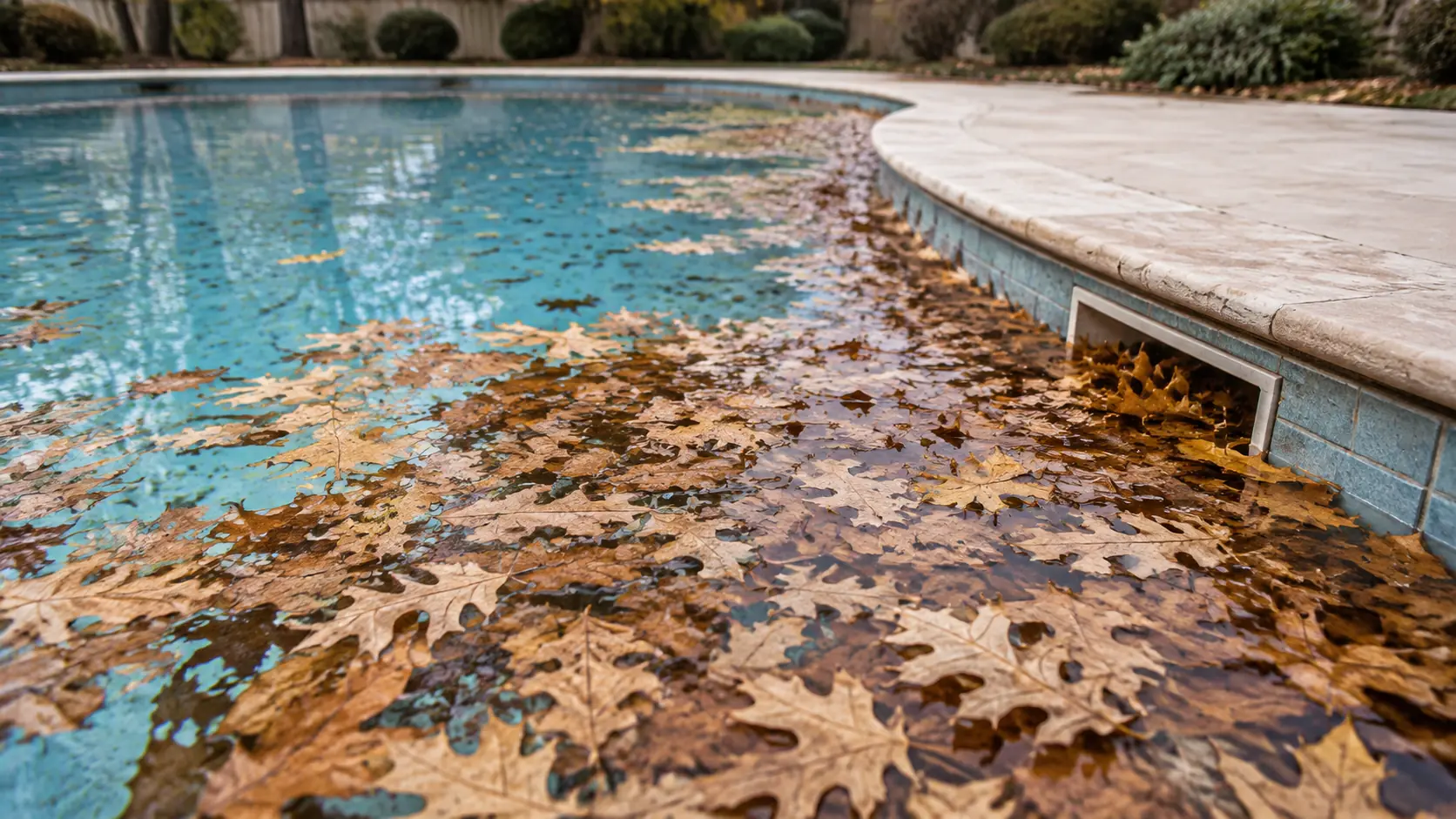
The practical effect is a compressed season. Instead of six or eight weeks of gradual shedding, a front comes through in October or early November, the wind gets up, and a large share of the year’s leaf load arrives in the pool over a handful of days. A skimmer basket that took a week to fill in September fills in an afternoon.
Why a late drop is harder on a pool than an early one
A pool in Ohio is cold by the time the leaves fall. Cold water is close to inert: nothing grows, chlorine demand is minimal, and a few leaves on the bottom are a cosmetic problem until spring.
A pool in Plano in early November is often still in the 60s or low 70s. That is warm enough for algae to establish and warm enough for organic material to decompose quickly, and decomposition is a chlorine expense. Every leaf on the floor is a small, continuous demand on your sanitizer, which is why the classic North Texas November failure is not a frozen pipe. It is a pool that went green while the owner was raking the yard.
| Day | What is happening | What you would notice |
|---|---|---|
| 1 to 2 | Skimmer and pump baskets fill | Weaker surface skimming, then reduced flow at the returns |
| 2 to 4 | Flow drops, filter pressure changes, chlorine demand climbs | Free chlorine falling faster than usual between tests |
| 3 to 7 | Leaves settle and begin to break down against the plaster | Tannin staining under the leaf pile, cloudy water |
| Week 2 | Sanitizer is consumed faster than it is added, algae establishes | Green or dull water despite adding chlorine |
| Any time | A packed basket starves the pump | A gravel-like noise at the pad, which is cavitation rather than a fault |
That last row is worth naming, because it gets misread as a broken pump every year. The difference between a pump starved of water and a pump with a failing bearing is set out in what a loud pool pump is telling you, and in leaf season the answer is almost always the basket.
The four-week routine
None of it is difficult. It is the same work as the rest of the year done more often, and the frequency is the whole point.
- Empty both baskets every day or two. Skimmer and pump. During the heaviest week, daily. This one habit prevents most of the rest of the list.
- Net the surface before you net the floor. A leaf floating is easy. A leaf on the bottom is waterlogged, stains, and has to be vacuumed. Ten minutes with a net on the day of a big drop saves an hour later.
- Keep the water level up. Leaf season overlaps with the point in the year when people stop topping off, and a low level plus a full basket is how a pump starts pulling air.
- Do not shorten the pump schedule yet. Cutting run time for the season is a November or December decision, and doing it in the middle of leaf drop removes filtration exactly when the pool needs the most. The run-time reasoning is in how long to run the pump.
- Test twice a week rather than once. Chlorine demand is unusually high and unusually variable during the drop, and a reading from last Sunday tells you very little.
- Brush the waterline and the steps. Tannin lifts easily while it is fresh and reluctantly after a week.
- Watch the filter pressure. A rise of 8 to 10 psi over the clean baseline means it is time, and in leaf season that can arrive weeks earlier than usual. Cleaning cost and intervals are in filter cleaning cost.
Skimmer socks help until they do not
A mesh sock over the skimmer basket catches fine debris and is genuinely useful in spring pollen season. During a heavy leaf drop it blinds over in hours, and a blinded sock is a closed valve. If you use one now, check it as often as you check the basket, and take it out entirely on the days the leaves are actually falling.
Tannin stains, and telling them apart
Leaves left against plaster leave a brown shadow behind. Oak and pecan are the usual culprits here, and the stain can appear in under 48 hours on a warm pool. It is an organic stain, which means chlorine lifts it: brush the area, hold sanitizer at the top of its normal range for a day or two, and most of it goes.
The reason to be sure it is organic is that the treatments diverge completely. A metal stain gets worse when you shock it. The one-minute test that separates them, a vitamin C tablet against the stain, is in rust and blue-green stains, and it is worth running before anybody adds anything.
What is worth buying, and what is not
| Item | Verdict |
|---|---|
| A wide leaf rake, not a flat skimmer net | Worth it. A deep bag holds a drop’s worth instead of two passes’ worth. |
| A leaf canister in the vacuum line | Worth it if you vacuum manually. It stops the pump basket packing every three minutes. |
| A mesh leaf cover | Worth it on a pool under heavy canopy that will not be swum until spring. Awkward on a pool still in use. |
| A second skimmer basket | Cheap, and it means you empty rather than clean, which is the difference between doing it daily and not. |
| A robotic cleaner as the leaf answer | Not on its own. Bag capacity is the limit during a real drop, though it earns its place the rest of the year. |
On that last row, which cleaner suits a pool under trees is a longer question with a clear local answer, and it has its own post at robotic against suction against pressure cleaners.
The second leaf season nobody plans for
Live oaks are everywhere in Plano, Frisco, and Allen landscaping, and they do not drop in the fall. The US Forest Service describes the southern live oak as a nearly evergreen tree that drops its leaves and grows new ones within several weeks in the spring, which is the whole problem in one sentence: the drop is not just late, it is compressed into a few weeks, and around here that lands in late February and March along with the catkins that follow. A pool ringed with live oaks gets a second load at the point in the year when the water is warming, the pump schedule is still on winter hours, and nobody has thought about the pool since November.
That is a large part of why so many pools here look fine in January and turn in March. The month-by-month view of the whole cycle is in the North Texas pool year, and the recovery from it, if it gets away, is spring startup.
Austin’s Tip
Write your filter’s clean pressure on the tank with a marker the day it is serviced. Filter pressure is the only instrument on the pad that tells you what leaf season is doing inside your filter, and it is useless without the baseline. Two numbers on a label beat a gauge you are guessing at.
Closing out the season
When the drop finishes, do three things before you settle the pool into winter. Clean the filter properly rather than backwashing it, since a season of organic loading is exactly what a deep clean is for. Vacuum the floor completely, because anything left down there decomposes all winter. Then, and only then, set the run time for the cold months.
That last decision is not the same here as it is further north. Our winters are mild with sharp cold snaps inside them, which changes both the run time answer and the freeze plan. Both are covered in should the pool run all winter and freeze protection, and this is the month to read them rather than the night the front arrives.
Where the help is worth paying for
Leaf season is the clearest month of the year for the value of a scheduled visit, and not because the work is skilled. It is because the work is frequent, tedious, and entirely dependent on somebody actually doing it on the day the wind blew. A pool that gets its baskets emptied and its chlorine checked twice in the worst week comes through it unremarkably. A pool that waits for the weekend does not.
If your pool sits under a heavy canopy, this is also the month to have the filter looked at rather than assumed, since the pressure that has been climbing since October will not come down on its own. That check is part of weekly service from now through the drop, and it is a great deal cheaper than the recovery that follows a November nobody watched.