Pool Cleaning Cost in Frisco, Texas

Austin Andrews
Founder, True Texan Pools
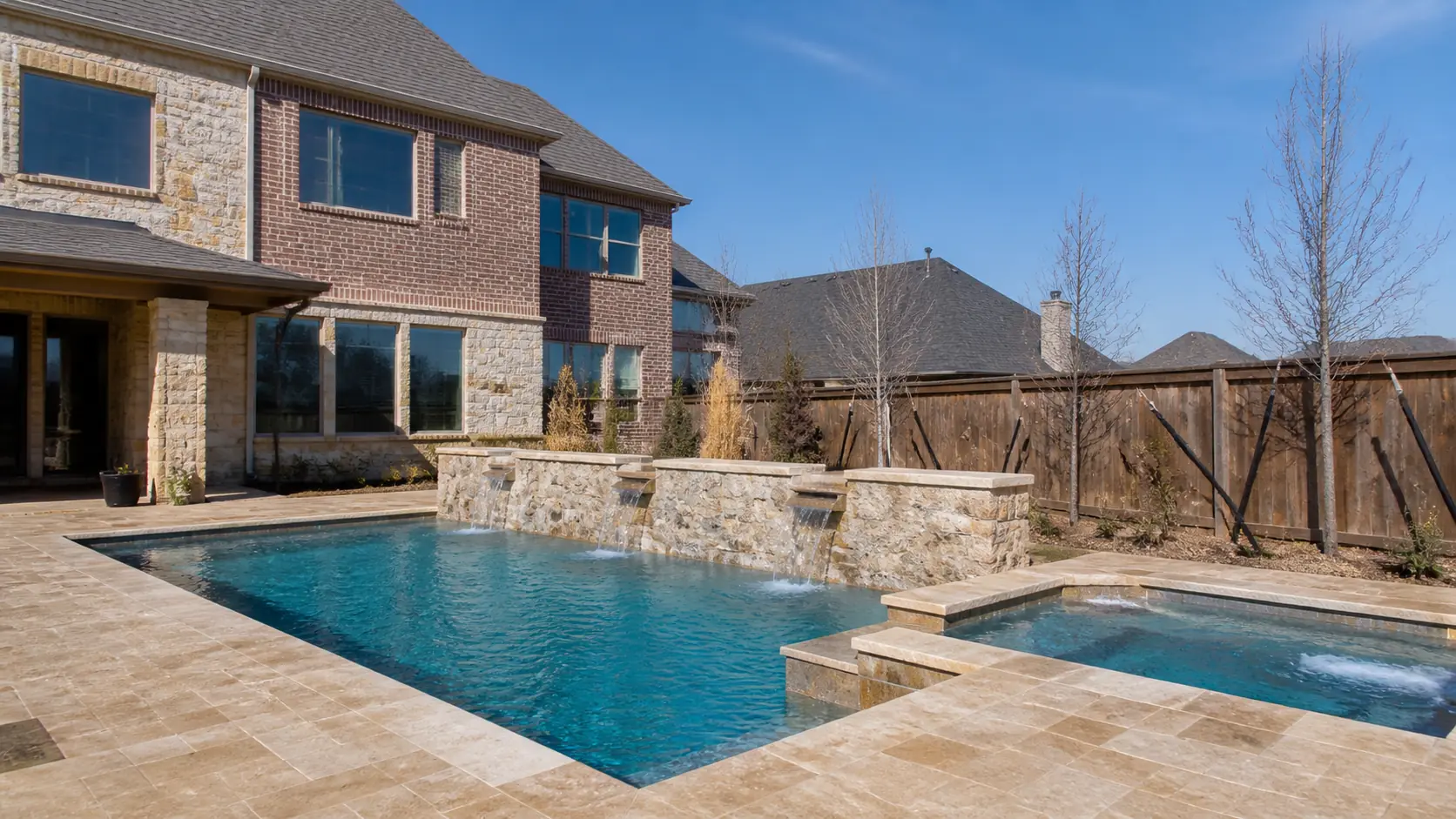
Published monthly rates for pool service in Frisco currently run from about $139 to $195 and up, with directory sites estimating roughly $123 to $139 a month or about $27 a visit. The spread is not a quality signal. Frisco has a particular kind of pool, built in a particular two decades, and that build era is what actually determines what yours costs to run. Here is the local reasoning behind the number.
Before the numbers, the caveat that makes them useful. Any quote given without seeing the pool is a band rather than a price, and the four things that move it are size, tree load, whether there is a spa or water features, and what condition the pool is in when service starts. What follows is why those four land where they do in Frisco specifically.
What is actually published for Frisco
| Source | Published figure | What it appears to include |
|---|---|---|
| A local operator's Frisco city page | From $139 a month | Entry rate, small pool |
| A Frisco maintenance company | $195 a month plus tax | Stated rate, tax added separately |
| Directory aggregators | Roughly $123 to $139 a month | Generic estimate, undated, not pool-specific |
| Directory per-visit estimate | About $27 a visit | Works out near $117 a month at weekly frequency |
| True Texan Pools | $120 small, $150 medium, $225 and up large | Chemicals included, published on our service page |
Two things to note about the directory figures. They are estimates rather than quotes, and they are undated, which matters because chemical costs have moved. Treat them as a floor for the market rather than as what anybody will actually charge you for a large pool with a spa.
The Frisco build era, and why it sets your price
Frisco grew later and faster than the rest of Collin County. The overwhelming majority of its housing stock, and therefore its pools, went in from the late 1990s onward, with the biggest wave through the 2000s and 2010s. That single fact drives most of what is different about servicing a pool here.
- The equipment is newer. A pool built in 2012 is on its first or second pump. Variable speed pumps, cartridge filters, and salt systems are the norm rather than the exception. Fewer surprise repairs, lower electricity, and a cell replacement every three to six years instead of a chlorinator.
- The surfaces are newer, but not new. Plaster runs 7 to 12 years. A pool built in 2010 is now on borrowed time for its original finish, and DFW replastering runs roughly $6,000 to $15,000. A meaningful share of Frisco pools are entering their first resurface window right now, which is a budget item rather than a service item.
- The pools are bigger and more complicated.Newer builds are far more likely to include an attached spa, a raised water feature, or a tanning ledge. Every one of those is more surface to brush, more plumbing to check, and in the spa’s case a second body of water with its own chemistry.
A spa is not a rounding error
It is the most common reason a Frisco quote comes in above a Plano quote for the same size pool. A spa has its own chemistry, its own surfaces, and its own equipment path, and because it is heated it scales far faster than the pool does on our water. If your quote did not ask whether you have one, it is not a quote for your pool.
Tree load: Frisco’s genuine cost advantage, and its hidden cost
Established neighborhoods in Plano and Richardson sit under mature oak and pecan canopy that puts a serious volume of debris in the water. Much of Frisco was farmland twenty five years ago, and its landscaping is correspondingly young. The difference at the pool is real: a five minute skim rather than a fifteen minute one, lighter baskets, and dramatically less October leaf load.
That should make Frisco pools cheaper to service, and on the labor side it does. But the same absence of canopy means most Frisco pools sit in full sun all day, and sunlight destroys free chlorine. A pool with no afternoon shade consumes materially more sanitizer through a Texas summer than an identical pool under a canopy.
So the honest local summary is that Frisco pools are cheap to clean and expensive to sanitize, which is exactly why the billing model you are quoted on matters more here than the headline rate. A labor-only quote looks excellent in a full-sun yard right up until August. What your bill actually covers works through the four models.
Frisco water: hard from the hose
Frisco is supplied by the North Texas Municipal Water District, whose treated water is moderately hard, with its own reports putting total hardness in the 105 to 202 ppm range. That is not alarming on its own. What matters is that it is a one-way input.
Nothing in normal maintenance removes calcium, so every top-off adds a little and evaporation keeps the rest. In summer a 15 by 30 pool takes close to a thousand gallons a week of top-off just to replace what evaporates, and the mineral content of every one of those gallons stays behind. A newer Frisco pool starts comfortably inside the recommended range and climbs out of the top of it over the years.
Practically, that means three things cost Frisco owners money over time: the white band on the waterline tile, scale inside a gas heater’s exchanger, and scale on a salt cell, which is common here because so many Frisco pools are salt. What hard water does to a whole pool covers the system, and calcium scale on tile covers getting it off.
Local rules worth checking before you fill
Frisco sets its own water conservation rules and enforces them independently of neighboring cities, and both the schedule and the drought stage in effect change. Rather than repeat a figure that may be out of date by the time you read it, the reliable move is to check the City of Frisco’s current water conservation and drought stage information directly before filling a new pool or doing a large partial exchange.
Two things that are generally true across NTMWD member cities and worth knowing anyway. Topping off to replace evaporation is treated differently from irrigation. And a new pool fill is treated differently again, usually requiring a permit. If you are planning a partial water exchange to bring calcium or cyanuric acid down, do it outside a drought stage restriction and do it in late winter when nobody wants to swim.
What actually changes your Frisco quote
| Factor | Typical Frisco situation | Effect on price |
|---|---|---|
| Pool size | Newer builds trend larger | The single biggest driver |
| Spa attached | Common on post-2005 builds | Meaningful increase, second body of water |
| Water features | Common: raised walls, sheer descents, deck jets | More plumbing, more splash-out |
| Tree load | Light in newer neighborhoods | Reduces labor per visit |
| Sun exposure | Usually full sun | Raises chemical consumption |
| Salt versus chlorine | Salt is very common here | Lower recurring chemical cost, cell replacement every 3 to 6 years |
| Starting condition | Affects the first visit only | A neglected pool starts with a recovery, not a monthly rate |
What is not in a monthly rate, here or anywhere
- Filter deep cleans, typically $125 to $150 in this area, every three to six months.
- Equipment repairs and parts, quoted per job. Our repair cost guide covers the common ones.
- Salt cell replacement, roughly $600 to $1,000 installed every three to six years.
- The first visit on a neglected pool, which is a recovery priced by condition.
- Resurfacing, which is a capital item rather than a service item, and which a good few Frisco pools are approaching.
What it really costs to own a pool in Collin County annualizes all of these alongside electricity and water, which is the number that actually answers what a pool costs.
The one question that makes Frisco quotes comparable
Ask for the twelve month total for your pool, including chemicals, filter cleans, and the first visit. A $139 rate without chemicals and a $195 rate with them can land within a few dollars of each other by December, and only one of the two told you so in February.
Our Frisco pricing, published
Three bands, chemicals in, no contract: $120 a month small, $150 medium, $225 and up large. Those figures sit on the weekly pool service page rather than behind a callback, and they do not change because the address is in Frisco. What does change a Frisco quote is the two things this article has been about: whether there is a spa in the plan, and which size band a newer, larger build actually falls into.
Outside that: filter deep cleans at $125 to $150, repairs quoted per job after an equipment inspection, and a recovery priced by condition if the pool has been sitting. We publish the boundary because in this market the boundary, not the rate, is where the surprises live.
For the wider area we also publish costs for Plano, McKinney, and Allen, and our Frisco service page has the coverage detail. If you are weighing doing it yourself instead, the DIY comparison has both columns honestly.
Frequently Asked Questions
How much does pool cleaning cost in Frisco, Texas?
Published Frisco figures include one local operator advertising from $139 a month and another listing $195 a month plus tax, with directory aggregators estimating roughly $123 to $139 a month or about $27 a visit. Ours are $120 for a small pool, $150 for a medium one, and $225 and up for a large one, chemicals included. Directory numbers are undated estimates rather than quotes.
Why are Frisco pool quotes often higher than Plano quotes?
Because Frisco pools tend to be newer, larger, and more complicated. Post-2005 builds are far more likely to include an attached spa, a raised water feature, or a tanning ledge, and a spa in particular is a second body of water with its own chemistry and its own surfaces. If a quote did not ask whether you have one, it is not a quote for your pool.
Does Frisco's lack of mature trees make pool service cheaper?
On labor, yes. Young landscaping means a five minute skim rather than a fifteen minute one, lighter baskets, and far less October leaf load. But the same absence of canopy means most Frisco pools sit in full sun, and sunlight destroys free chlorine, so they consume materially more sanitizer through a Texas summer. Cheap to clean, expensive to sanitize.
Is Frisco water hard enough to damage a pool?
It is hard enough to matter over time. Frisco is supplied by the North Texas Municipal Water District, whose treated water is moderately hard, with its own reports putting total hardness in the 105 to 202 ppm range. A newer Frisco pool starts comfortably inside the recommended 200 to 400 ppm band and climbs out of the top of it over the years, because evaporation concentrates calcium and nothing removes it. Tile scale, heater scale, and salt cell scale all follow.
Are Frisco pools due for resurfacing yet?
A meaningful share are entering the window now. Plaster runs 7 to 12 years, so a pool built in 2010 is on borrowed time for its original finish. DFW replastering runs roughly $6,000 to $15,000, or about $6.50 to $8.00 per square foot. That is a capital item rather than a service item, and it belongs in a replacement reserve rather than in a monthly comparison.
How do I compare two Frisco pool service quotes fairly?
Ask each for the twelve month total for your pool including chemicals, filter cleans, and the first visit. A $139 rate without chemicals and a $195 rate with them can land within a few dollars of each other by December, and only one of them told you so in February. Chemicals alone account for $30 to $60 a month of the difference between quotes in this market.
Ready to stop thinking about your pool?
True Texan Pools keeps your water swim-ready year-round across Plano and all of DFW. Clear pricing, no contracts, and a photo report after every visit. Austin handles every job personally.
Keep reading
What Your Monthly Pool Bill Actually Covers, and What It Does Not
Three quotes at $135, $165, and $210 look like a clear decision until you find out they are written in three different billing models. Here is how to compare them properly.
How Much Does Pool Cleaning Cost in Plano, TX? (2026 Pricing Guide)
Most Plano pool companies hide their prices behind a phone call. Here is exactly what weekly service, one-time cleans, and green pool recovery actually cost in 2026, and what drives the number up or down.