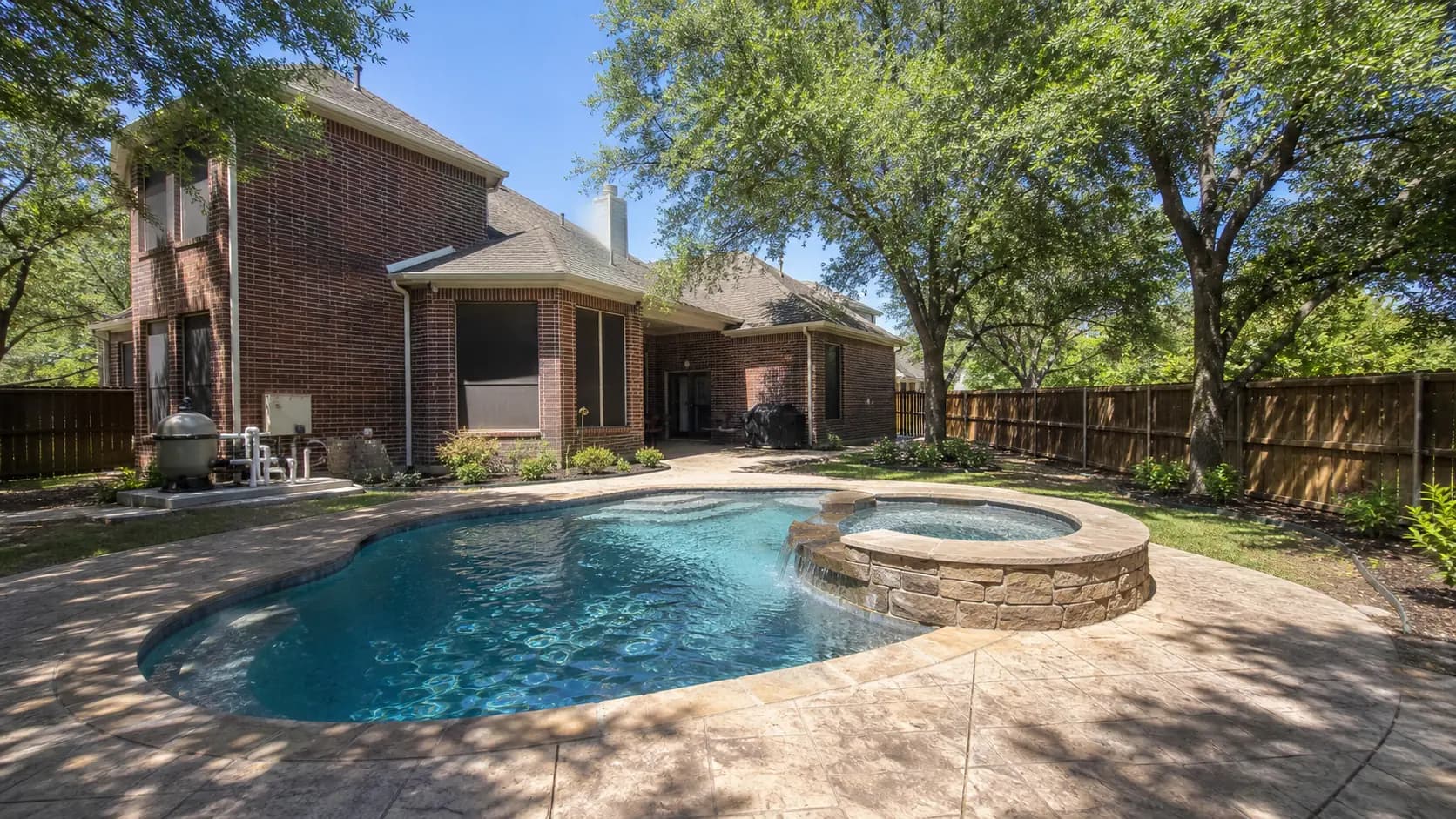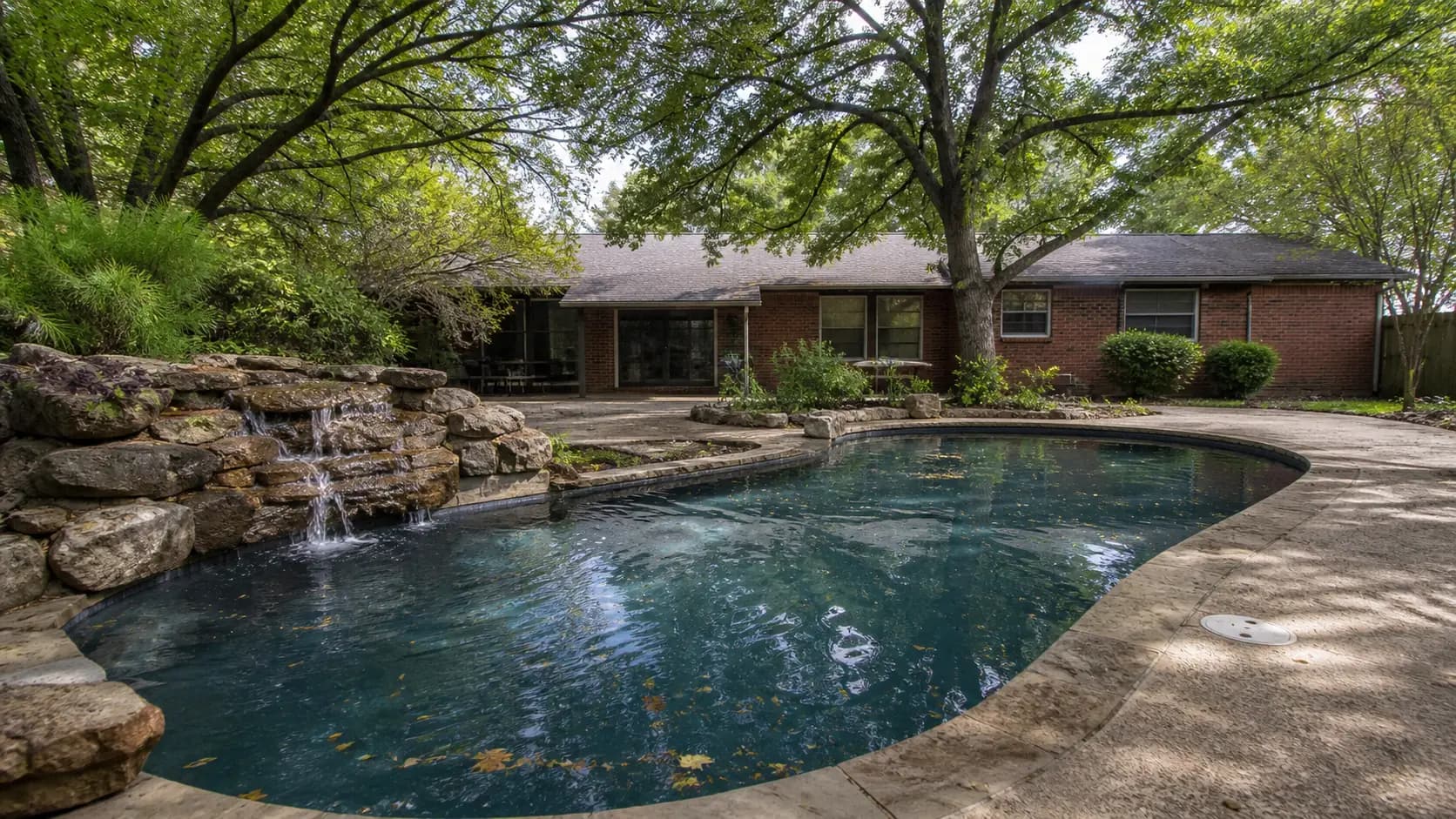
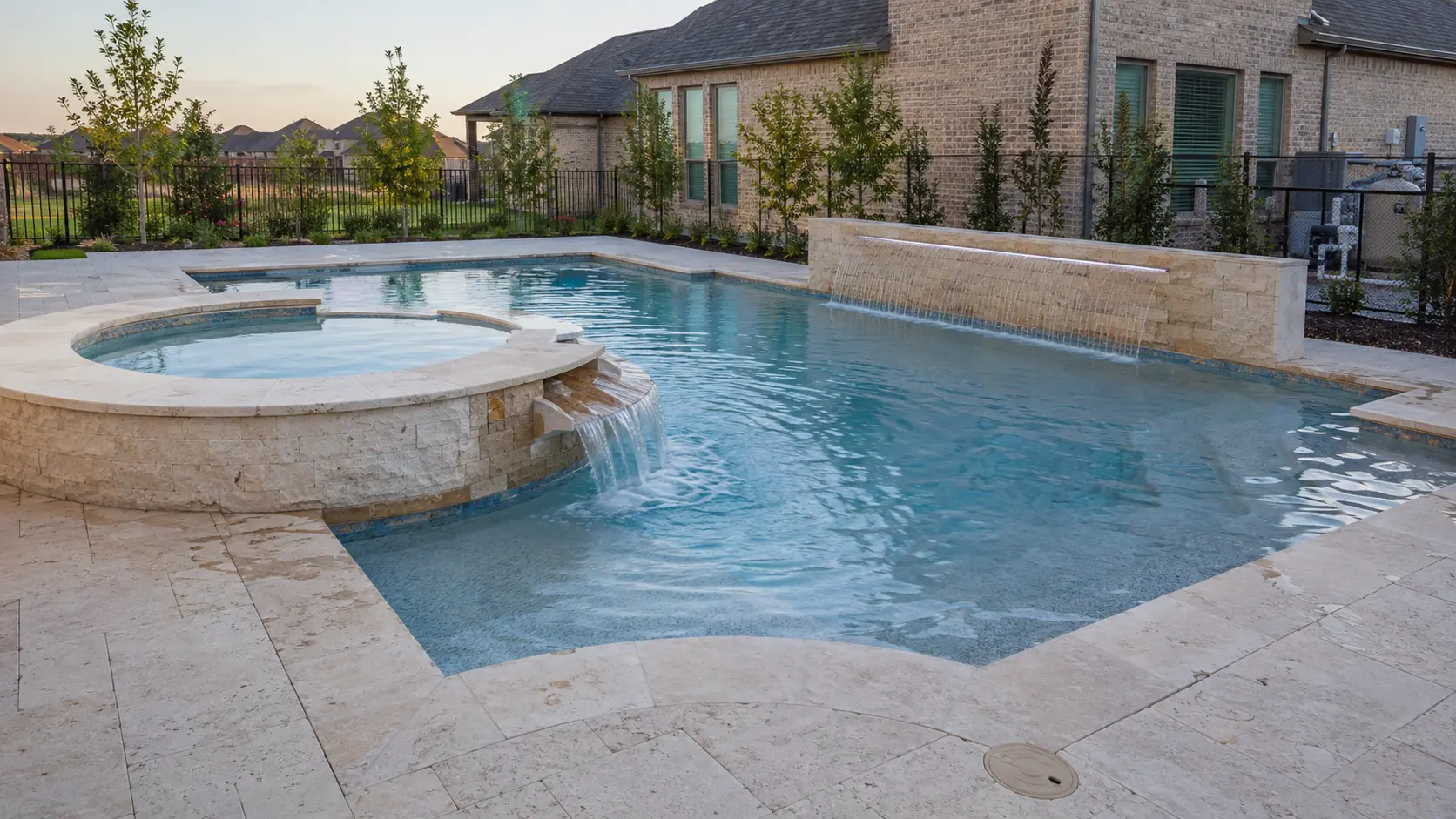
Pool cleaning in Prosper costs more than it does in Frisco or McKinney, and the reason is not that somebody looked up the median household income. It is that the pool is bigger. Prosper built late and built large, and a town full of 25,000 gallon pools with attached spas, sheer descents and full automation is a town where the honest monthly cost sits at the top of the published range. Here is what actually drives the number, and what should be in the quote.
What is published, and where Prosper sits in it
Directory sites estimate DFW pool service at roughly $123 to $139 a month, or about $27 a visit, and local operators publish rates from about $120 up to $220 and beyond. Prosper pools sit at the top of that spread and frequently past it, which reads as a premium and is actually arithmetic. The published low end describes a small pool in an established neighborhood. Very few of those were built here.
Treat any Prosper quote that lands at the bottom of the market range as a question rather than a bargain. Either the company has not seen the pool, or it has not counted the spa.
Prosper pools are bigger, and size is a price
The size bands every company in this market uses are drawn on gallons and footprint. A small pool is up to about 10,000 gallons and 12 by 24 feet. A medium one runs 10,000 to 20,000 gallons, somewhere between 14 by 28 and 16 by 32. Large starts at 20,000 gallons and 18 by 36 feet, and that is where most of Windsong Ranch, Star Trail and Whitley Place lands.
What that extra volume and surface actually costs, every week:
- More water to sanitize, so more chlorine or a bigger cell working harder for the same residual.
- More wall and floor to brush, which is the part of a visit that cannot be done faster without being done worse.
- More surface to skim, and more of it out of reach of the skimmer on a wide pool.
- A larger filter that still needs cleaning every three to six months, at the large-pool rate rather than the small one.
- A pump moving a bigger turnover, which is a running cost you pay whether anyone swims or not.
None of that is negotiable and none of it is a markup. It is the same job on a bigger pool. How long to run the pump covers the turnover side, which on a large Prosper pool is worth getting right for the power bill alone.
The spa, which is not a small second pool
Nearly every Prosper build has an attached spa, and the way it is usually described is wrong. It is not a separate body of water that you can ignore between uses. It shares the pool’s water, its plumbing and often its heater, so the chemistry is one system with two temperatures.
Three things follow from that, and all three are cost:
- Heat burns sanitizer. A spa run at 102 degrees consumes chlorine far faster than the pool does, and it returns that depleted water to the pool when it spills back.
- Spillover aerates. Water falling over a raised spa wall is a permanent aeration feature, and aeration drives pH up. On a spa that spills continuously, pH is a weekly adjustment rather than a monthly one.
- The spa surface scales first. Heat drives calcium out of solution, so the tile line and the spa seats are where hard water shows itself before anywhere else in the system.
A service visit on a pool with an attached spa involves testing and treating one system that behaves like two. That is real time, and a quote that does not mention the spa has not accounted for it.
Water features, the most under-quoted thing in town
Sheer descents, bubblers, scuppers and deck jets are the signature of a Prosper backyard and the single most reliable way to make chemistry work harder. Every one of them is an aerator. Aeration drives carbon dioxide out of the water, and losing carbon dioxide raises pH. A pool that runs its features on a timer every afternoon is a pool whose pH climbs all week, every week, for as long as the feature runs.
The knock-on is chlorine. Sanitizer gets weaker as pH rises, so a feature pool held at a drifting pH is a pool where the chlorine reading looks adequate and the water is not protected. That is the mechanism behind most surprise blooms on new, expensive, well-equipped pools, and it is why a Prosper visit ends in adjustment more often than it ends in a glance at the water.
Run the features when you are looking at them
Features on a timer that runs whether anyone is home costs you twice, once in acid and once in the electricity to move the water. Put them on a scene you trigger for the evening rather than on a daily schedule. The pool looks the same when it matters and the pH holds far better between visits.
Automation, which helps and hides
Most Prosper pads run full automation, and it is genuinely better. It also changes what can go wrong. A valve actuator that has quietly stopped rotating, a schedule that reverted after a power cut, a heater locked out on a sensor fault, a spa mode that never returns the water: none of those announce themselves the way a noisy pump does. They present as a pool that is slightly off for a few weeks.
This is the part of a Prosper visit that has nothing to do with brushing. Somebody has to confirm that the schedule that is meant to be running is the schedule that is running. What each piece of equipment does is worth reading once if the pad was handed over to you at closing with no explanation, which is how most of these systems arrive.
Prosper water, and what it does to a new finish
Prosper buys all of its treated water from the North Texas Municipal Water District, whose supply comes from Lavon Lake, Lake Texoma and Jim Chapman Lake. The town’s own water quality page describes that supply as moderately hard, and attributes the minerals to Lavon Lake. That is fine to drink and consequential for a pool, because every top-off through a hot Prosper summer adds hardness that never leaves on its own.
On a fifteen-year-old plaster pool, hardness is a scale problem. On a three-year-old pebble or quartz finish, it is the finish’s whole future. Water that is out of balance in one direction deposits scale on the tile and the spa. Out of balance in the other, it etches, and etching does not come back. Neither is dramatic in any single week, which is precisely the problem. Hard water in North Texas pools covers the management, and the white line on the tile covers what it looks like once it has started.
The first decade is the whole game
Prosper is new enough that most of its pools are still on their original surface, original pump and original cell. That means almost nothing on a Prosper pad is due for replacement yet, which makes this the cheapest decade the pool will ever have and the one most worth protecting.
A pebble or quartz finish looked after through its first ten years is a finish you keep for twenty. Carry the same finish through a few seasons of low calcium or drifting pH and you replace it early. Resurfacing a large pool with a spa is a five-figure job in this market. What resurfacing costs in DFW is the number this decade is being spent to postpone, and how long equipment lasts here turns the rest of the pad into a monthly reserve figure rather than a series of surprises.
What changes a Prosper quote
| Factor | Which way it moves | Why |
|---|---|---|
| Over 20,000 gallons | Up | More sanitizer, more surface to brush, a larger filter |
| Attached spa | Up | One system, two temperatures, and a permanent aerator if it spills |
| Sheer descents or bubblers | Up | Aeration drives pH, so more acid and more adjustment |
| Salt system | Roughly neutral | Lower chemical cost, offset by cell care and a replacement every few years |
| Full automation | Neutral to down | Better control, provided somebody verifies the schedules |
| Young landscaping | Down | Very little debris load compared with an established canopy |
| Original surface under warranty | Neutral | Nothing to repair yet, and everything to protect |
Read the last two rows together. Prosper pools are cheap on debris and expensive on chemistry, which is the exact opposite of an established McKinney pool under pecans. The McKinney breakdown is the useful contrast if you moved from one to the other and the quotes surprised you.
What a monthly rate does not cover, here or anywhere
- Filter deep cleans. Every three to six months on most pools, and excluded from nearly every plan in this market. What a filter clean costs covers when it is genuinely due.
- Cell replacement. A consumable on a salt pool, due every few years. Salt cell lifespan and replacement has the interval and what shortens it.
- Repairs and equipment work. Quoted per job. What pool repairs cost in DFW sets out what drives each one.
- Recovery from a bloom. Priced by condition rather than by the hour, since the work is genuinely different at each stage.
Our Prosper pricing, published
Ours are $120 a month for a small pool, $150 for a medium one, and $225 and up for a large one. Most Prosper pools are large, and several are large with a spa and features, which is the case where the figure is a starting point rather than the answer. We would rather look at the pool and tell you the number than publish one that quietly assumes your backyard is smaller than it is.
What the weekly visit includes and what it does not is set out in what weekly service covers, and our Prosper page has the service details for the town itself. Every visit ends with the readings and a photo report. On a pool with a spa, features and automation, that is the difference between knowing the system ran and assuming it did.