Pool cleaning in Allen costs about $120 to $220 a month at published rates, and the age of Allen’s pools decides where yours lands. The city built out largely through the 1990s and 2000s. Its pools are old enough that the original equipment has been replaced once and the plaster is due, and young enough that the landscaping has grown into real shade. Those two facts move the price in opposite directions.
The age matters more than the monthly rate. Servicing an Allen pool is usually straightforward and budgeting for one isn’t, because the capital items were all installed at once and are all arriving at once. Size, tree load, a spa and starting condition move the weekly quote here as anywhere; age and shade decide how each of them lands.
The Allen build era, and its water
Allen grew after the oldest parts of Plano and McKinney and ahead of Frisco, so a typical Allen backyard pool is 15 to 30 years old. Equipment lifespan in Texas heat turns the table below into a monthly reserve rather than a series of surprises.
| Component | Where an Allen pool usually sits | What it means |
|---|---|---|
| Plaster | On its original or first replacement finish | At or past the 7- to 12-year window. The largest budget item |
| Pump | Second or third pump | Often already variable speed, sometimes still single speed |
| Filter | Second housing or second media generation | Cartridge or DE, occasionally an original sand tank |
| Sanitizer | Frequently converted to salt at some point | A cell every 3 to 6 years at $600 to $1,000 installed |
| Heater | If original, it’s well past its life | Gas heaters run 5 to 10 years here |
| Plumbing | Two to three decades of clay soil movement | Leaks become more common with age here, and not because of build quality |
The heater row is where Allen’s water shows first. The North Texas Municipal Water District supplies the city and describes its treated water as moderately hard. Its water quality page mentions “water heaters which can build up with hard water mineral deposits over time.” A pool heater sees the same water, hotter and more concentrated. If your Allen pool still has a heater from the original build, scale in the exchanger is the most likely reason it heats poorly, and that’s a chemistry problem rather than a burner problem.
Calcium keeps climbing on an Allen pool because evaporation removes the water and keeps the mineral, so twenty-five years of top-offs is twenty-five years of one-way accumulation. A pool that old with no partial water exchange usually has calcium hardness well above range by now, and the white band on the waterline tile is the other visible result. Hard water and your whole pool covers it.
Tree load: Allen’s middle ground
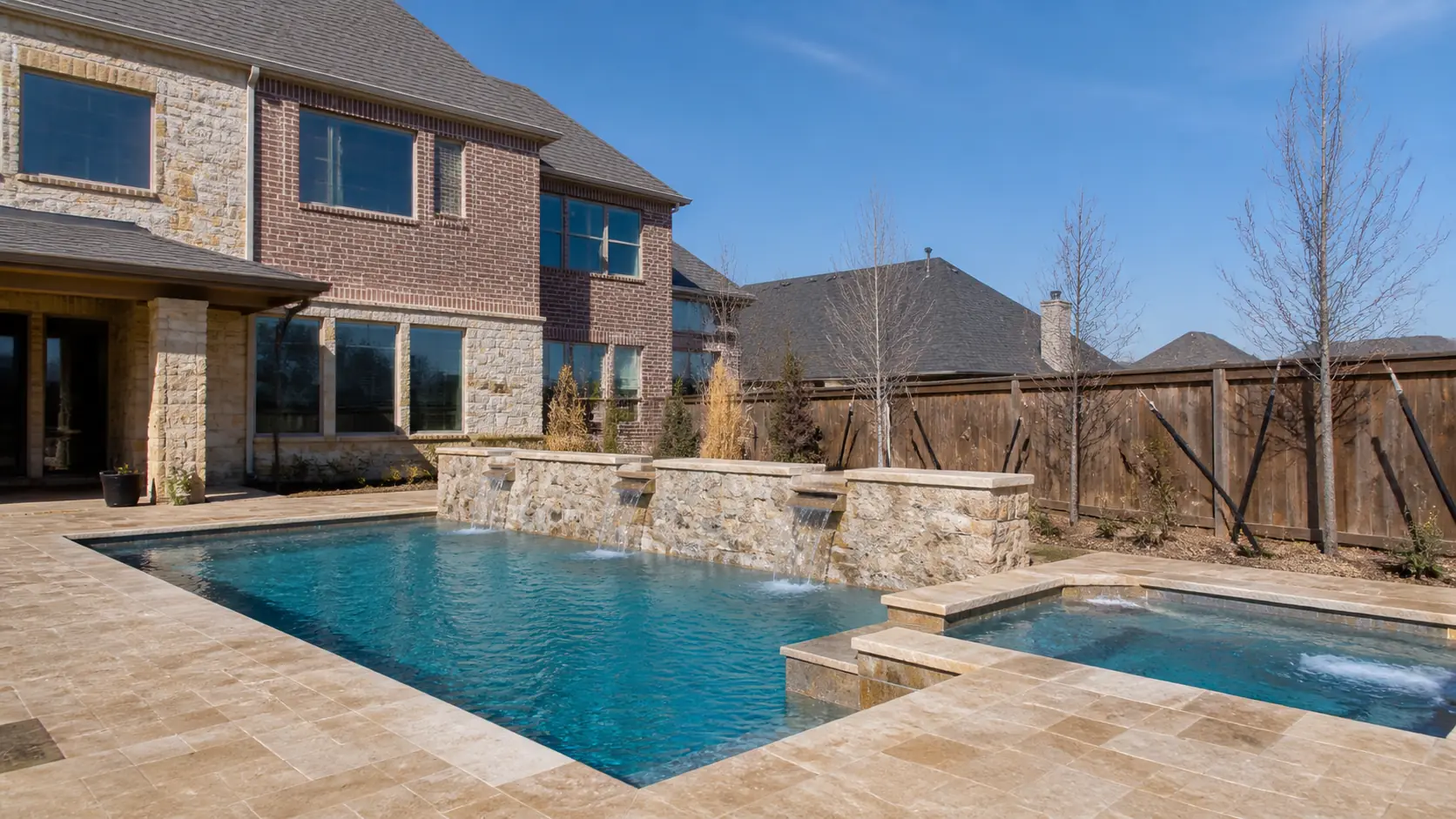
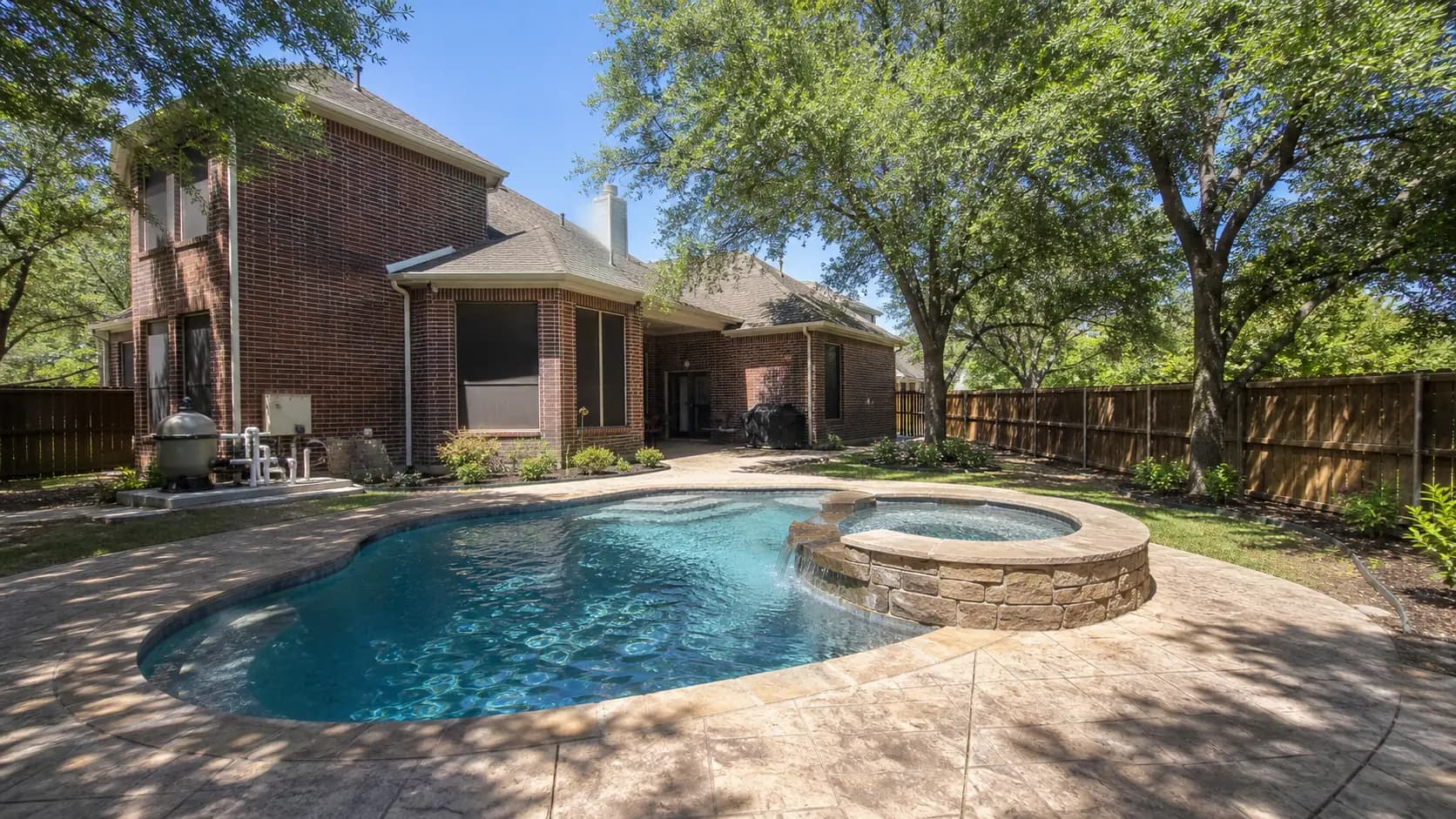
Landscaping planted in 1998 is now roughly thirty years old. In North Texas that means live oaks and red oaks: real afternoon shade, without the sheer volume of drop that comes off a mature pecan in an older McKinney or east Plano yard.
Semi-mature shade is a favorable combination for an Allen pool:
- Moderate debris. More skimming than a new-build Frisco pool, less than under a heavy pecan canopy. October is a busy month here without being a crisis.
- Lower chemical demand. Afternoon shade means less ultraviolet light destroying free chlorine, and chlorine demand is the largest chemical line in a Texas summer.
- Cooler water. Shade keeps late-summer water temperature down, and algae reproduction rises steeply with temperature. A pool that peaks at 86 rather than 92 is a materially easier pool.
The trade-off with shade trees near an Allen pool is soil movement. Mature trees near a deck withdraw moisture from the soil in summer, which contributes to differential settlement in our expansive clay. Clay soil and your pool covers that, and it is the reason older Allen decks so often show a stepped joint somewhere.
If your Allen pool is shaded, revisit the pump schedule
A shaded pool needs less chlorine but the same turnover, and many shaded pools here still run a schedule set for full sun. On a variable speed pump the right move is usually longer hours at a lower speed, which delivers the turnover for a fraction of the electricity because power draw falls with roughly the cube of speed. The run time guide has the arithmetic.
What Allen’s water rules say about pools
Allen’s 2024 Water Conservation and Water Resource Management Plan addresses swimming pools directly, which is unusual and useful, so read it from the city rather than from a search result. Checked against Plano, the directory sites that rank for these queries had both the watering days and the pool-filling rule wrong. Three provisions matter to a pool owner, and they apply at different levels of drought.
- Under normal conditions, pools are explicitly carved out. Allen prohibits using potable water to fill or refill ponds of 500 square feet or more, and then states in the same provision that this doesn’t include recreational swimming pools. So the pond rule isn’t a pool rule, which is exactly the confusion that sends people looking for a permit that doesn’t exist.
- In an early drought stage, the language is encouragement. The plan asks users to reduce the frequency of draining and refilling pools. That’s a request, not a prohibition, and topping off isn’t what it is aimed at.
- In a severe stage, it becomes a prohibition with one important exception. Filling, draining, or refilling existing pools is prohibited except to maintain structural integrity or address a public safety risk, and permitting of new pools stops. But the plan says that existing pools may still add water to replace losses from normal use and evaporation. Topping off survives even the severe stage.
The top-off exception is the one to remember, because it answers the question most Allen owners have. What it doesn’t protect is a partial water exchange. Draining and refilling a share of the pool to bring calcium hardness or cyanuric acid (sold as stabilizer) down is precisely the activity a severe stage restricts. Plan those exchanges for a period with no stage in effect, and check the current stage before you start.
What is published, and what it means
| Source | Published figure | What it is |
|---|---|---|
| Directory aggregators, DFW | Roughly $123 to $139 a month | Generic, undated estimate |
| Directory per-visit estimate | About $27 a visit | Near $117 a month at weekly frequency |
| Published local operator rates | About $120 to $220 a month | Real rates, in different billing models |
| True Texan Pools | $140 small, $170 medium, $255 and up large | Chemicals included, published, cancel anytime |
The $100 spread across the Allen market is mostly an inclusion difference rather than a quality difference. Chemicals alone account for $30 to $60 of it, and bundled filter cleans another $20 to $25 amortized. A $130 labor-only quote and a $195 all-inclusive quote can land within a few dollars of each other by December, and only one of them told you so in advance. What your bill covers works through the four billing models in this market.
What an Allen plan doesn’t cover
- Filter deep cleans, typically $125 to $150, every three to six months. See cost and frequency.
- Repairs and parts, quoted per job. Repair costs in DFW covers the common ones.
- Salt cell replacement, roughly $600 to $1,000 installed every three to six years.
- The first visit on a neglected pool, which is a recovery rather than weekly work.
- Resurfacing, which on a pool of Allen’s typical vintage is the item most worth budgeting for now.
What it costs to own a pool in Collin County annualizes each of these alongside electricity and water.
Buying an older Allen pool?
The two findings that change what the house is worth are a plumbing or shell leak and a plaster surface at the end of its life. Neither is covered by a standard Texas home inspection unless you specifically request a pool inspection. What to check before you close covers the option period while you still have leverage, and your first thirty days covers what happens after the keys change hands.
The resurface, since it’s the number that matters here
If your Allen pool is on its original 1990s plaster, the resurface isn’t a decision you can defer indefinitely. It’s the largest single check the pool will ask for, and the finish you pick determines how it behaves for the next decade on our water.
- Standard white plaster, or marcite. Cheapest per square foot and the most commonly replaced surface in DFW. It’s also the softest of the three and the most readily etched by aggressive water or scaled by hard water, which matters on an NTMWD supply where calcium keeps climbing.
- Quartz. A denser aggregate finish, more resistant to staining and scale, and longer lived. It costs more up front, and it’s generally the option we would point an Allen owner toward, because the extra life lands in the years when the rest of the equipment is also being replaced.
- Pebble. The most durable and the most expensive, with the longest service life of the three. The trade is texture: it’s rougher underfoot than plaster, which some families like and some don’t. Stand on a sample before you commit.
The first month after a resurface is the part few owners are warned about. A new interior finish is curing, and it’s chemically active while it does. It pulls the water toward high pH, and it will scale permanently if the chemistry is left alone.
A curing finish needs daily brushing for the first stretch, close pH control, and no salt until it has cured for as long as the applicator specifies. Homeowners who spend $9,000 on a surface and then treat week one like any other week are the ones with a mottled finish by year two. If you’re resurfacing, have somebody watching the water closely that month, which is a strong argument for having service in place before the work starts.
Our Allen pricing
Our Allen rates are published on the weekly pool service page rather than quoted on a callback: $140 a month small, $170 medium, $255 and up large, chemicals included. A spa or a spillover feature moves a pool up a band. What won’t appear on that page, and is the larger number for many Allen owners, is the resurface waiting at the end of a 1990s plaster job.
We also publish costs for Plano, Frisco, McKinney, and Prosper, and if you’re weighing doing it yourself, the DIY comparison has both columns, including the time it takes in August. Our Allen service page has the coverage detail. Ask us about the resurface while it’s still a plan rather than a surprise.