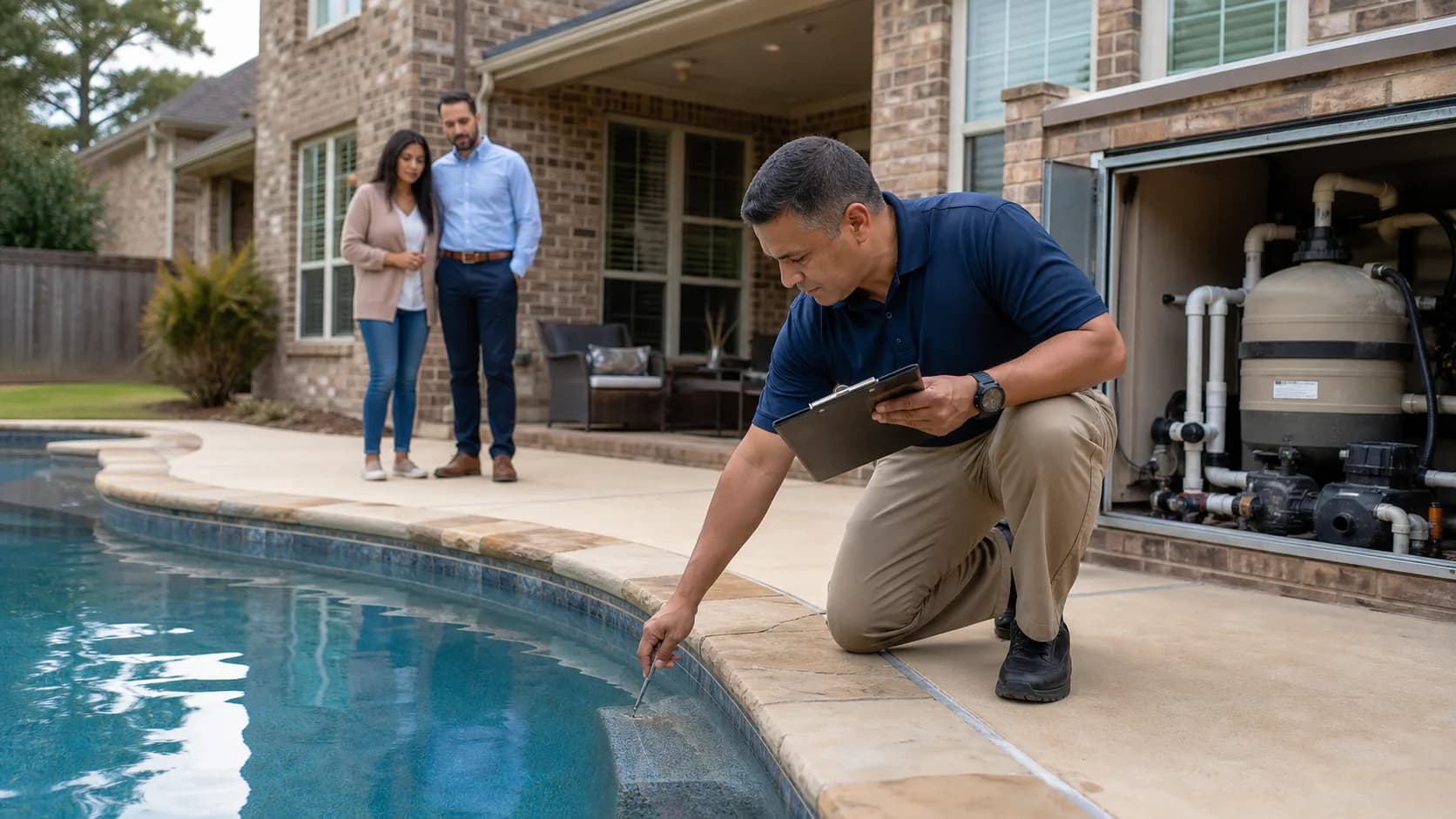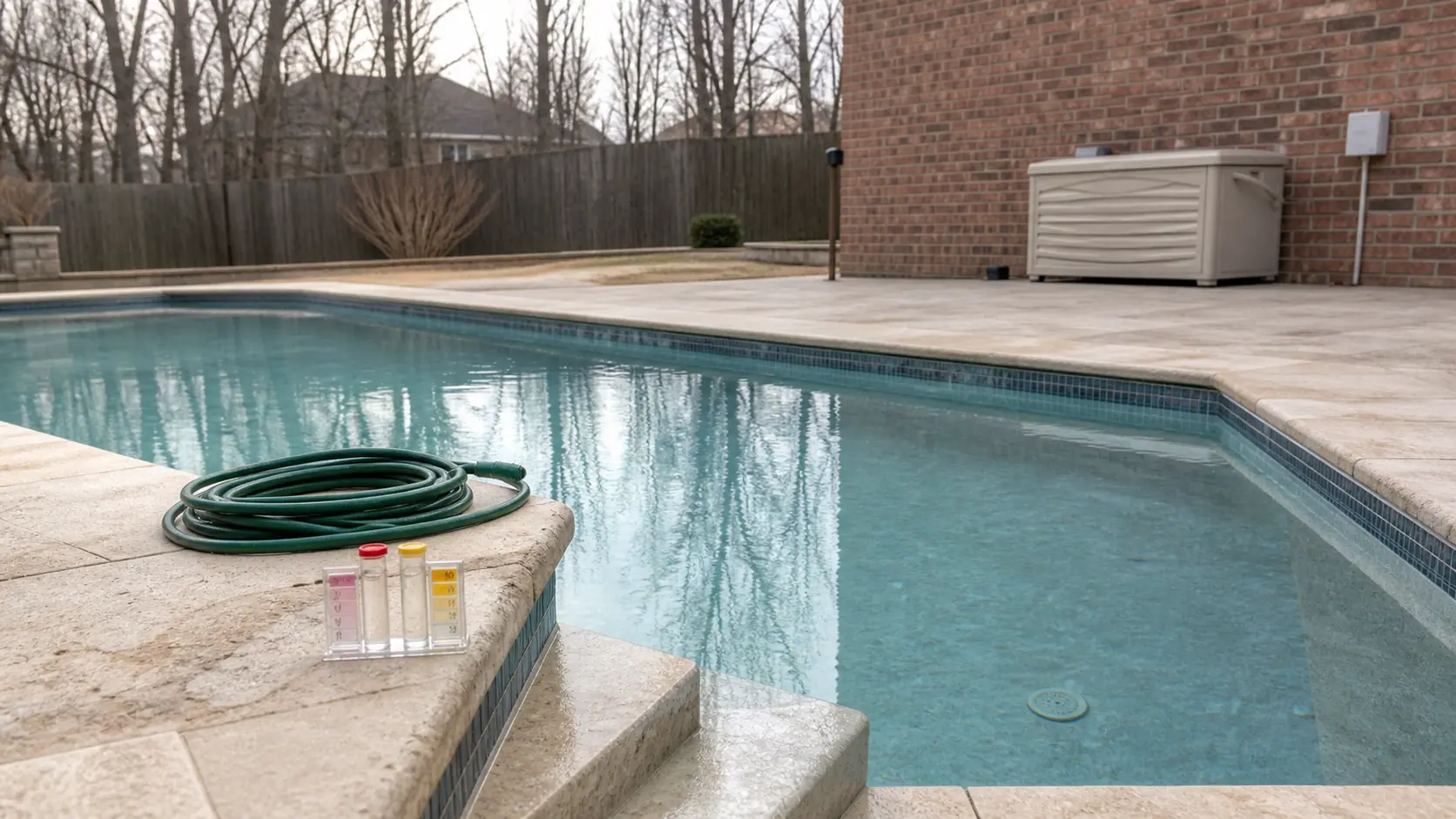

A pool does not have to be perfect to sell a house in Collin County. It has to photograph clear, survive an inspection without producing a list, and come with enough paperwork that a nervous buyer stops asking questions. Those are three cheap things. The expensive things, replastering and new equipment, almost never return what they cost at closing.
This is the seller’s side. If you are on the other end of the transaction, the reciprocal article is the pre-purchase pool inspection, which covers what to look for before you sign. Reading both is not a bad idea, because knowing what the buyer’s inspector is looking for is most of the work here.
What the buyer is really asking
Almost no buyer in this market is afraid of a pool. What they are afraid of is inheriting an unknown, expensive, ongoing obligation from somebody who stopped maintaining it two years ago and did not mention it. Everything in this article is a way of answering that specific fear, and the ones that work best are documents rather than repairs.
The single question underneath all of it is how old the equipment is, and most sellers cannot answer it. Pumps, filters, heaters, and salt cells all carry a date code or a serial number on the label, and writing those four numbers on a sheet of paper is twenty minutes of work that removes an entire category of anxiety. If a pump is nine years old, say so. A buyer who knows a replacement is somewhere in the next few years can price that. A buyer who suspects it and cannot confirm it assumes the worst, and the worst is always more expensive than the truth. Typical service lives for each part are in how long pool equipment lasts in Texas heat, which runs shorter here than the manufacturer literature suggests.
Heaters deserve their own sentence, because they are the item most often quietly broken. A heater that has not been fired since two winters ago is a heater nobody can vouch for, and the buyer’s inspector will try to run it. Fire it yourself in the weeks before listing. If it works, you have a fact. If it does not, you have a choice, made early, with time to get a price rather than a concession demand.
The timeline that works
| When | What to do | Why then |
|---|---|---|
| Six weeks out | Get an equipment check and a full water panel. Fix the cheap things and price the expensive ones. | You want to know what an inspector will find before an inspector finds it, while you still have options. |
| Four weeks out | Service the filter, replace failed light bulbs, sort the gate latch and self-closing hinge. | These are the items that turn into repair requests, and all three are cheap now and awkward later. |
| Two weeks out | Bring chemistry fully to target and start weekly service if it is not already running. | Water that has been balanced for two weeks photographs differently from water balanced on Tuesday. |
| Photography day | Vacuum, brush, empty the baskets, clean the tile line, run the pump before the photographer arrives. | The listing photo is the single highest-leverage image of the pool anyone will ever see. |
| Option period | Have the service records and receipts ready to hand over as one file. | Documents answer questions faster than negotiation does. |
What a Texas seller has to disclose
Texas law requires a seller of residential property to give the buyer a written notice of the property’s condition, and the wording of that notice is set out in the statute itself at Texas Property Code section 5.008. It asks what the property has, and whether you are aware of defects or malfunctions in any of it.
The pool is not an afterthought in that notice. The statute defines a main drain and a blockable main drain in its own text, and carries the warning that a single blockable main drain may cause a suction entrapment hazard. A law that stops to define a pool drain is a law that expects sellers to answer about pools specifically, which is worth knowing before you decide what counts as a detail.
The practical reading is simple and it is worth stating plainly. Disclosing a known problem is cheap. Failing to disclose one you knew about is a different category of problem entirely, and a pool leak or a cracked shell is not the kind of thing that stays hidden after somebody moves in and gets their first water bill. If you have been topping off a pool weekly for a year, that is a known condition.
Disclosure is not the same as repair
A worn plaster surface, a heater that no longer fires, and an eleven-year-old pump are all sellable conditions when they are on the disclosure and priced into the listing. The buyer gets to decide what to do about them, which is exactly the deal they are signing up for. What sinks a contract is finding one of them in week two of the option period when the seller said the pool was fine.
The four things inspectors flag here
The barrier and the gate
Gates are the most commonly written item on a pool inspection and the cheapest to fix. A self-closing hinge that has lost its tension, a latch mounted at the wrong height, a gate that swings toward the pool, or a gap under a fence panel will all appear on a report. The requirements and the measurements are in pool safety barriers in Texas, and it is worth reading before you buy hardware, because the height of the latch is not a matter of preference.
GFCI protection and bonding
Anything electrical around a pool is a headline item on an inspection report, and it is one of the few areas where the fix genuinely needs a licensed trade. If the pad has no GFCI protection, or a light has been replaced by somebody who should not have been in the niche, that will be written up. What kind of license the work needs, and how to check that somebody holds it, is in what licensed and insured means in Texas.
Drain covers
Compliant anti-entrapment drain covers carry a service life stamped on the cover, commonly five to seven years, and ultraviolet light and pool chemistry make them brittle as that runs out. A cracked, loose, or out-of-date cover is both an easy write-up and a genuine safety matter rather than a paperwork one, and it is one of the cheapest items on any inspection report to put right. Go and read the date on yours, and check it against what to look for on a drain cover.
Deck and coping movement
This one is regional. On the expansive clay under most of Plano, Frisco, McKinney, and Allen, decks move, coping lifts, and mortar joints open. An inspector who works this market knows the difference between ordinary seasonal movement and a deck that has been soaking beside a leak, and so does an experienced buyer’s agent. If you have movement, what clay does to a pool here explains what is normal and what is not, and whether the leak is at the pad or the shell is the test to run before you assume the worst.
What not to spend money on
The temptation is to fix the biggest visible thing. It is usually the wrong move.
- Do not replaster to sell. Resurfacing is a five-figure job in this market and buyers do not pay a premium for new plaster; they simply stop asking for a concession. Disclose the surface, price the house accordingly, and let the buyer choose their own finish. The bands and the timing are in what resurfacing costs in DFW.
- Do not replace working equipment. An eight-year-old pump that runs is an eight-year-old pump that runs. Replacing it buys you nothing at closing and removes the negotiating room you might have wanted.
- Do not do a partial repair on something structural. A patched crack reads worse on an inspection than an unpatched one, because now there is evidence somebody knew.
- Do not drain the pool to clean it. Ever, here, without advice. An empty shell in clay soil is a hydrostatic risk, and the reasoning is in draining a pool in clay soil.
The one thing worth more than any repair
A file. Dated service records showing the water was tested and balanced, receipts for the filter clean and the pump repair, the age of the equipment written down, and a photograph of the pool clear in each season. It costs nothing to assemble if the service already exists and it is close to impossible to fake in the option period.
The reason it works is that it converts your pool from an unknown into a documented asset. A buyer looking at a year of readings can see that chlorine held, that the filter was serviced, and that nothing dramatic happened. That is a far stronger answer than a fresh coat of anything, and it is the argument for the record-keeping described in what a weekly visit includes.
Austin’s Tip
If you are listing in the spring market, start the pool six weeks earlier than feels necessary. Water in Collin County sits in the 50s through February, which means algae is dormant and problems are invisible, and it warms fast enough in March that a pool neglected all winter can go from apparently fine to green during the week your photos are being taken. The month-by-month version of this is the North Texas pool year.
When to get somebody out before listing
Book an inspection of your own, before the buyer’s, in any of these cases: you have been adding water and do not know why, the heater has not been fired in two seasons, the equipment predates your ownership and you cannot date it, or there is visible movement in the deck or coping. In each of those the risk is not the repair, it is finding out during the option period when your leverage is gone and the clock is somebody else’s.
The rest of it is ordinary. Clear water, a working gate, a set of records, and honest answers on the disclosure will carry almost any pool through a sale in this market. If you want the condition of the equipment written down before an inspector writes it down for you, that is what an equipment inspection is for, and knowing the answer six weeks early is the entire advantage.